[Maximum number: 1]
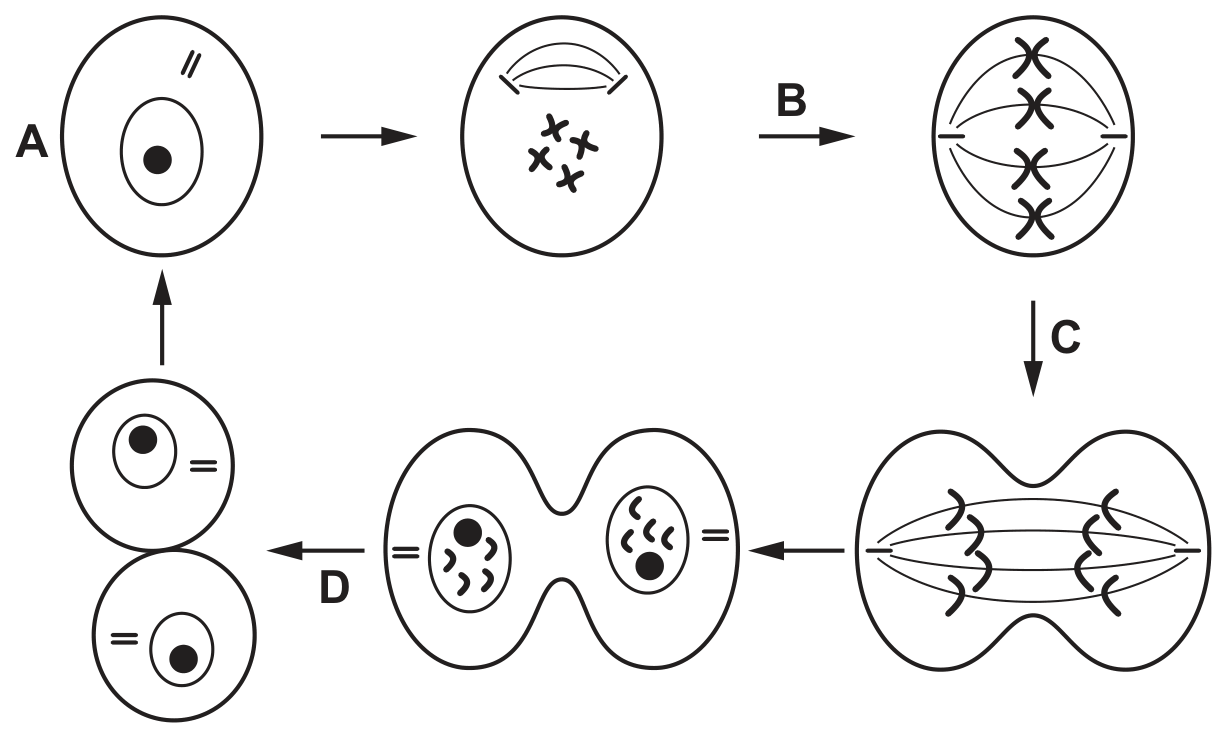
The diagram shows a cell before and during mitosis.
At which stage are the chromosomes copied?
 EduNinja
The diagram shows a cell before and during mitosis.
At which stage are the chromosomes copied?
All cells develop from stem cells.
Describe what is meant by the term stem cell.
Cells in the lining of the stomach secrete gastric juice, which contains hydrochloric acid and pepsin.
There are stem cells in the epithelial tissue that forms the lining of the stomach.
Explain why these stem cells are necessary.
Fig. 3.2 shows the life cycle of a fern. The life cycle of a fern has some similarities and some differences compared with the life cycles of other plants.
The letters represent processes that occur during the life cycle.
The haploid stages of the life cycle are represented by (n).
The diploid stages of the life cycle are represented by (2 n).
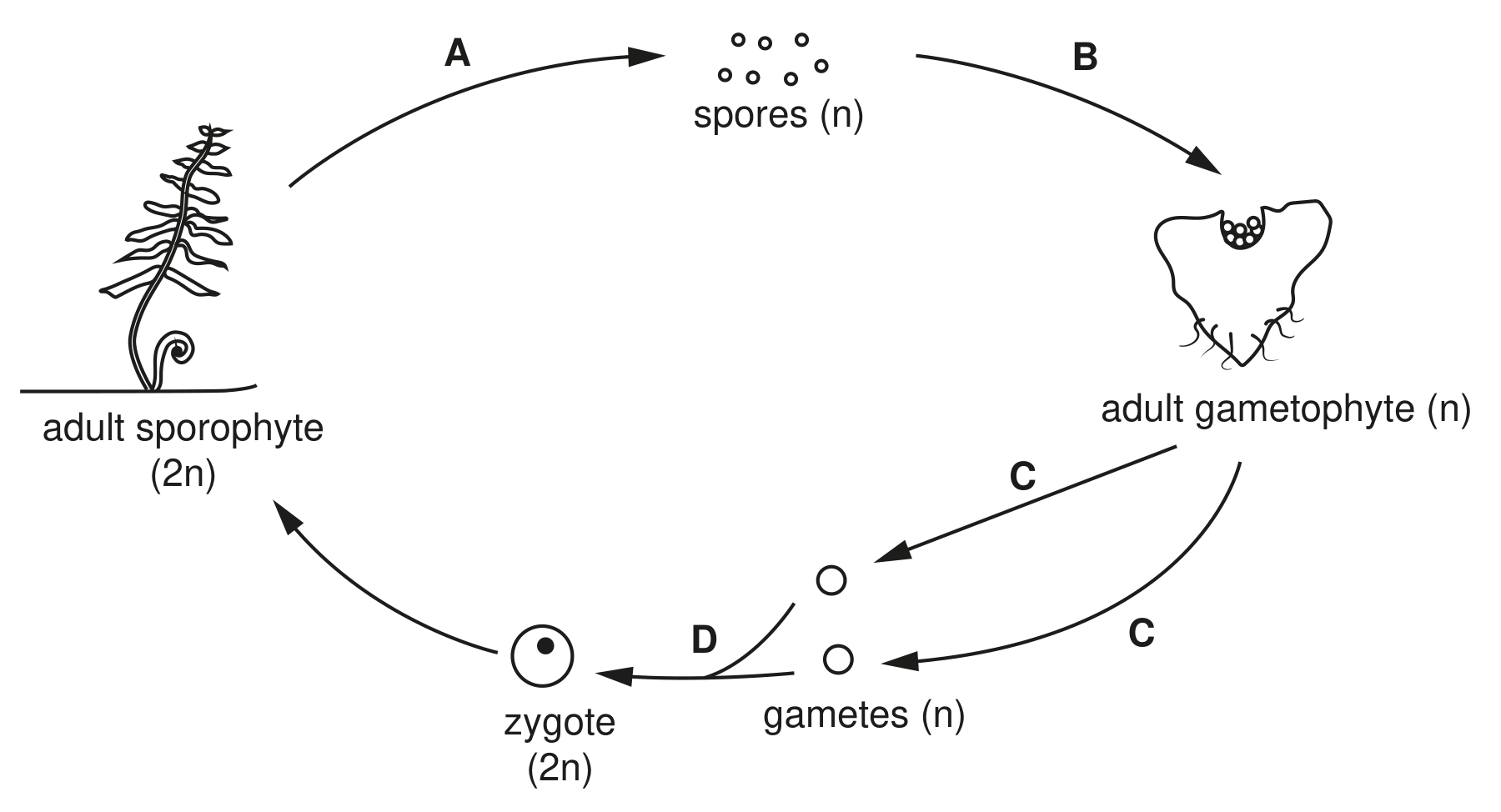
Fig. 3.2
State the name of process D in Fig. 3.2.
Red blood cells in humans are produced from stem cells.
Fig. 3.1 shows how a red blood cell is produced and becomes specialised.
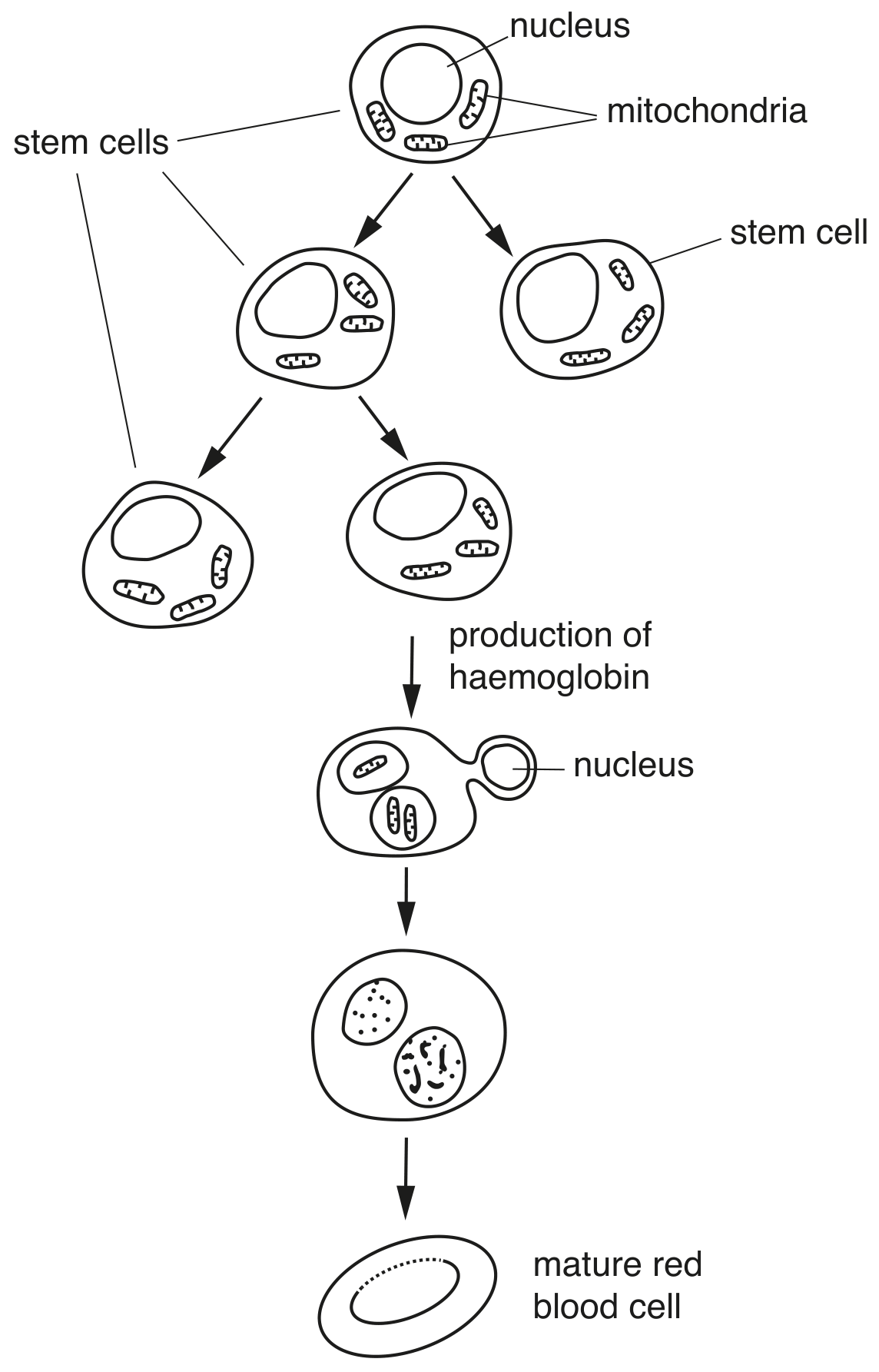
Fig. 3.1
Use the information in Fig. 3.1 to describe how red blood cells are produced and explain how they are adapted to their function.
Stem cells are also found under the outer layer of the skin.
Explain why stem cells are found in the skin.
Draw an X on Fig. 4.1 on the structure where meiosis occurs.
Cell division has the following functions.
1 asexual reproduction
2 growth
3 production of gametes
4 repair of damaged tissue
5 replacement of cells
Which functions are specific to mitosis?
1, 2, 3 and 4
1, 2, 4 and 5
2, 3 and 4 only
3,4 and 5 only
Mitosis and meiosis are both important processes for life.
Complete the sentences about mitosis and meiosis.
Mitosis is a type of nuclear division which produces genetically identical cells. It is important for growth, of tissues and reproduction.
Just before mitosis the chromosomes are replicated and then the chromosomes so that the chromosome number is maintained in each daughter cell.
Meiosis is another type of nuclear division that is involved in the production of gametes. The chromosome number is halved from to haploid resulting in genetically different cells. The fusion of the nuclei of two gametes formed by meiosis forms a This process is known as .
A cell with 16 chromosomes divides twice by mitosis.
How many chromosomes does each of the resulting cells contain?
4
8
16
32
Which row correctly describes mitosis?
new cells are
genetically identical
to the parent cell
duplication of
chromosomes
occurs
number of
chromosomes in a
daughter cell compared
to the parent cell
no
before mitosis
same
no
during mitosis
halved
yes
before mitosis
same
yes
during mitosis
halved