EduNinja
[Maximum number: 5]

Fig. 1.1 is a diagram of an animal cell.
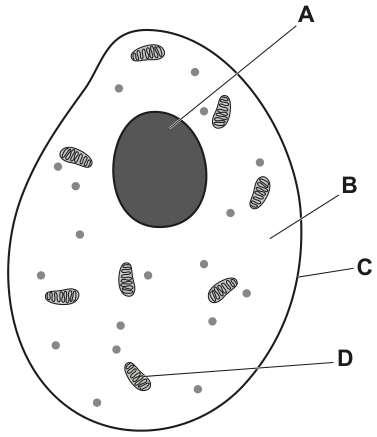
Fig. 1.1

Fig. 1.1

(a)
(i)

Explain how water moves into and out of animal cells.

[ 3 ]
(ii)

A sample of red blood cells was taken from a person. The red blood cells were put into three test-tubes. Each test-tube contained a different liquid:
- blood plasma
- pure water
- a very concentrated salt solution.

Fig. 1.2 shows the appearance of the red blood cells when examined using a microscope. Identify the liquids the red blood cells were immersed in.

Write your answers in the spaces provided in Fig. 1.2.
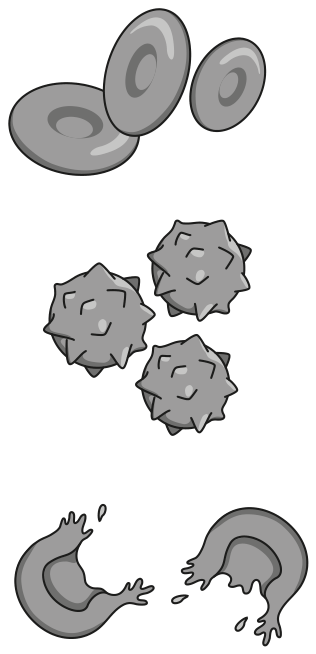
Fig. 1.2

Fig. 1.2

[ 2 ]
(a)
(i)

Explain how oxygen in the capillaries reaches the cells in the eye.

[ 2 ]
[Maximum number: 1]

Water is a very important molecule for all living organisms.

(a)
(i)

State one property of water that makes it useful to animals and plants.

[ 1 ]
[Maximum number: 1]

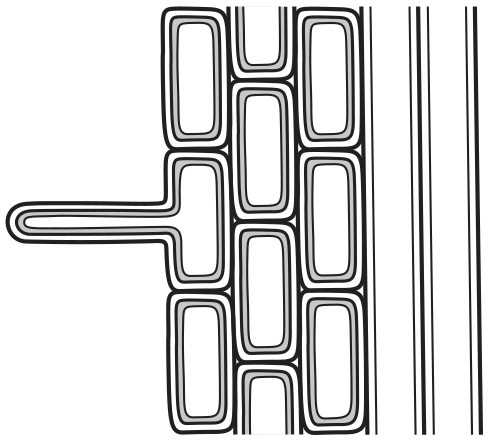
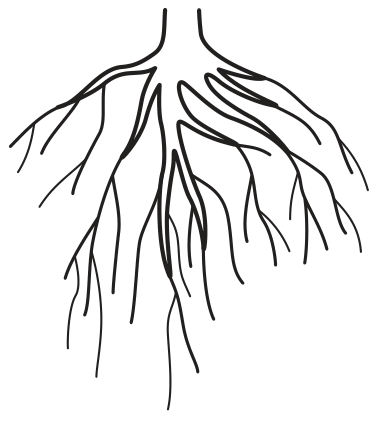
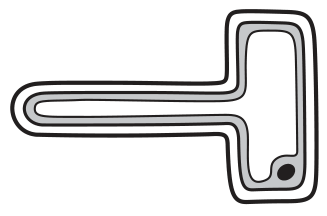
The diagrams show different levels of organisation in a plant. (Not drawn to scale.)

1

1

2

2

3

3

4

4

Which sequence shows the levels of organisation in order from smallest to largest?

A

42314 \rightarrow 2 \rightarrow 3 \rightarrow 1

B

43124 \rightarrow 3 \rightarrow 1 \rightarrow 2

C

34213 \rightarrow 4 \rightarrow 2 \rightarrow 1

D

32143 \rightarrow 2 \rightarrow 1 \rightarrow 4

[Maximum number: 1]

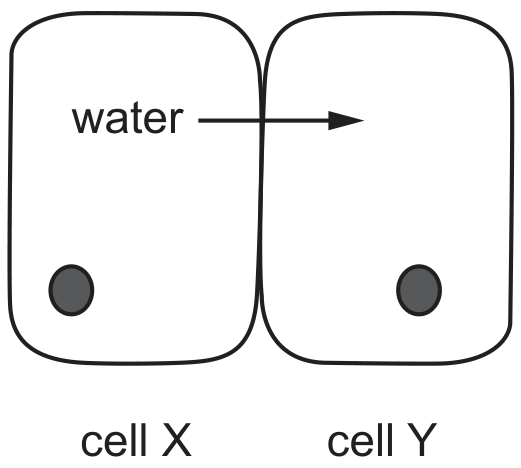
The diagram shows two cells. The net movement of water is from cell X to cell Y.

Question image

What causes water to pass from cell X to cell Y ?

A

water potential is higher in cell X and active transport occurs

B

water potential is higher in cell X and osmosis occurs

C

water potential is lower in cell X and active transport occurs

D

water potential is lower in cell X and osmosis occurs

[Maximum number: 1]

Samples of plant cells from the same species are immersed in three different liquids. The low concentration sucrose solution has a higher water potential than the plant cell cytoplasm. The high concentration sucrose solution has a lower water potential than the plant cell cytoplasm.

What is the state of the cells in the different liquids?

distilled waterlow concentration sucrose solutionhigh concentration sucrose solution
Aturgidplasmolysedflaccid
Bflaccidturgidplasmolysed
Cflaccidplasmolysedflaccid
Dturgidturgidplasmolysed
[Maximum number: 1]

Some plant cells are placed in distilled water for 1 hour.
Which description of the condition of the plant cells after 1 hour is correct?

A

burst

B

flaccid

C

plasmolysed

D

turgid

[Maximum number: 1]

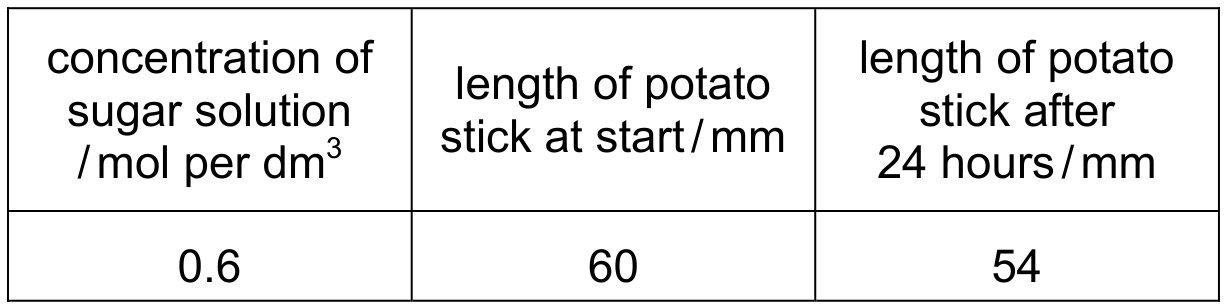
The data show the results of an investigation on osmosis using sticks of potato.

Table

Which statements explain this change in length?

movement of water

cause of the movement

into the potato cells

The sugar solution has a higher water
potential than the potato cells.

into the potato cells

The sugar solution has a lower water
potential than the potato cells.

out of the potato cells

The sugar solution has a higher water
potential than the potato cells.

out of the potato cells

The sugar solution has a lower water
potential than the potato cells.

[Maximum number: 1]

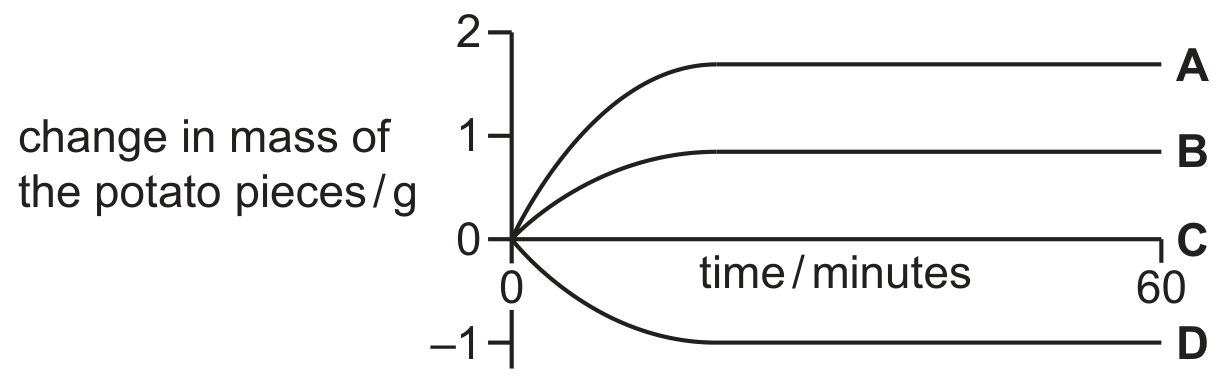
Three equally sized pieces of potato were put into different concentrations of sucrose solution. One piece of potato was put into distilled water.

The concentrations of sucrose solution were 0.2gdm3,0.4gdm30.2 \mathrm{gdm}^{-3}, 0.4 \mathrm{gdm}^{-3} and 0.6gdm30.6 \mathrm{gdm}^{-3}.
The graph shows the change in mass of the potato pieces over a period of 60 minutes.
Which piece of potato was put into distilled water?

Question image
[Maximum number: 1]

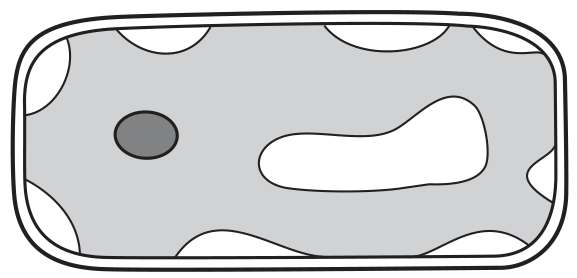
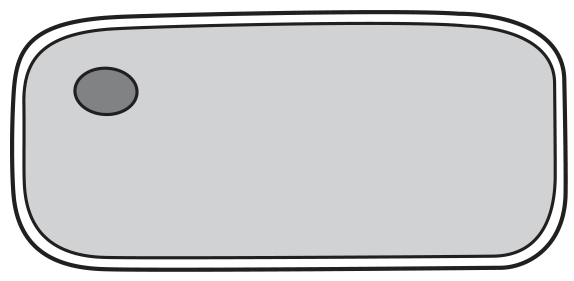
Which diagram shows the appearance of a plant cell several minutes after it has been placed in a concentrated solution of sugar?

A
Question image
B
Question image
C
Question image
D
Question image
0