EduNinja
(a)

Fig. 1.1 is a micrograph of part of some fish gills.
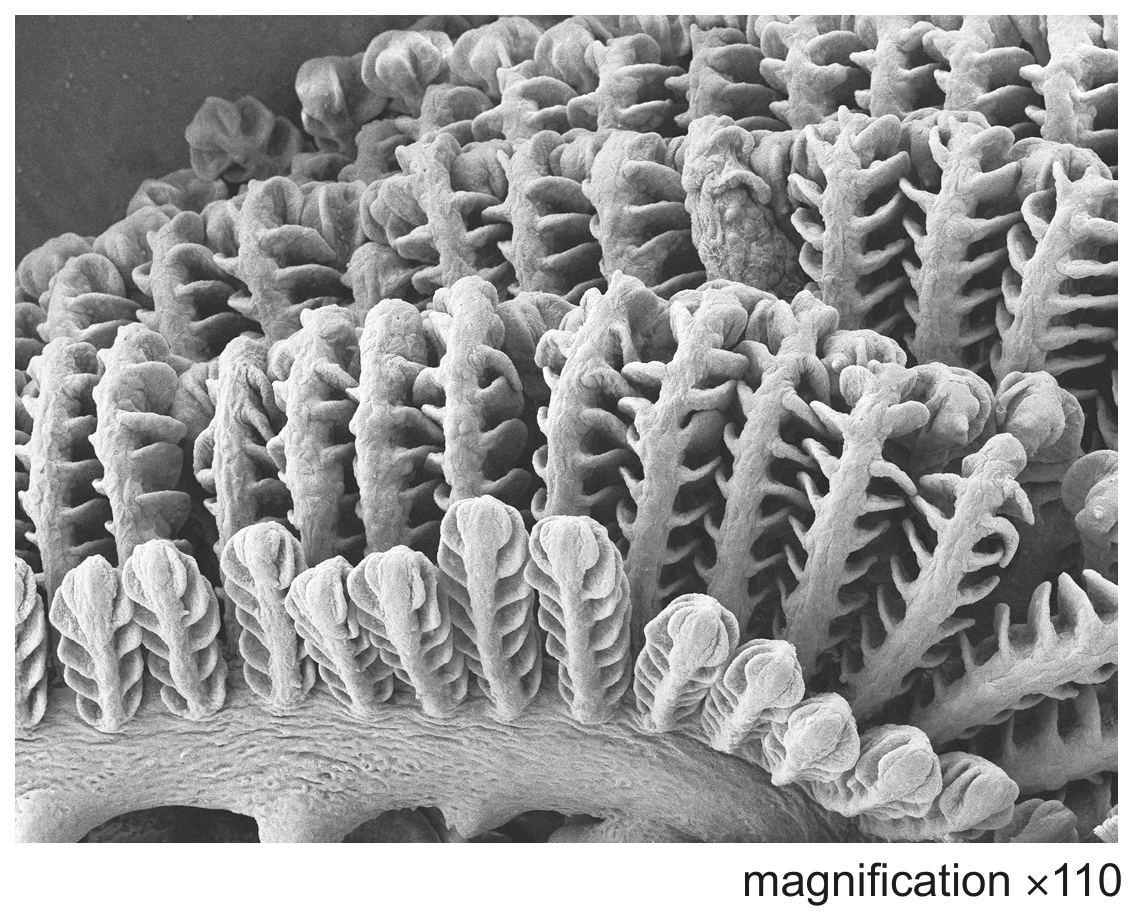
Fig. 1.1

Fig. 1.1

Fish gills are adapted for gas exchange by diffusion.

[ 2 ]
(i)

Define the term diffusion.

[ 2 ]
(b)

Some pollutants decrease the concentration of dissolved oxygen in rivers. This can result in the death of fish.

[ 3 ]
(i)

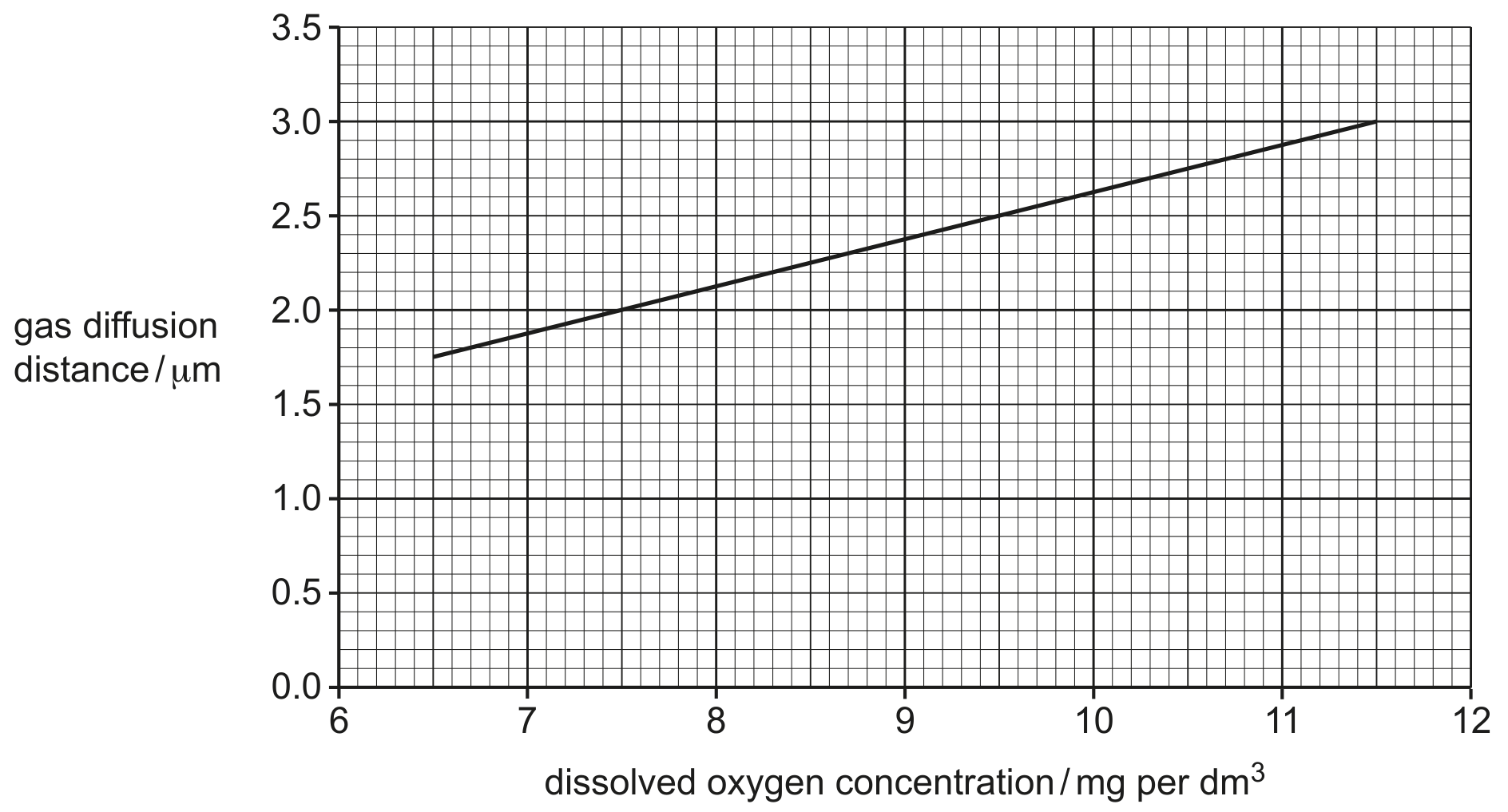
Researchers investigated the effect of the concentration of dissolved oxygen in water on gas diffusion distance in tissues. The thickness of fish gills was used to determine the gas diffusion distance.

The researchers changed the concentration of dissolved oxygen by bubbling different concentrations of oxygen into water. The temperature of the water was kept constant at 15C15^{\circ} \mathrm{C}.

Their results are shown in Fig. 1.2.

Fig. 1.2

Fig. 1.2

Fig. 1.3 shows the relationship between the concentration of dissolved oxygen and water temperature.
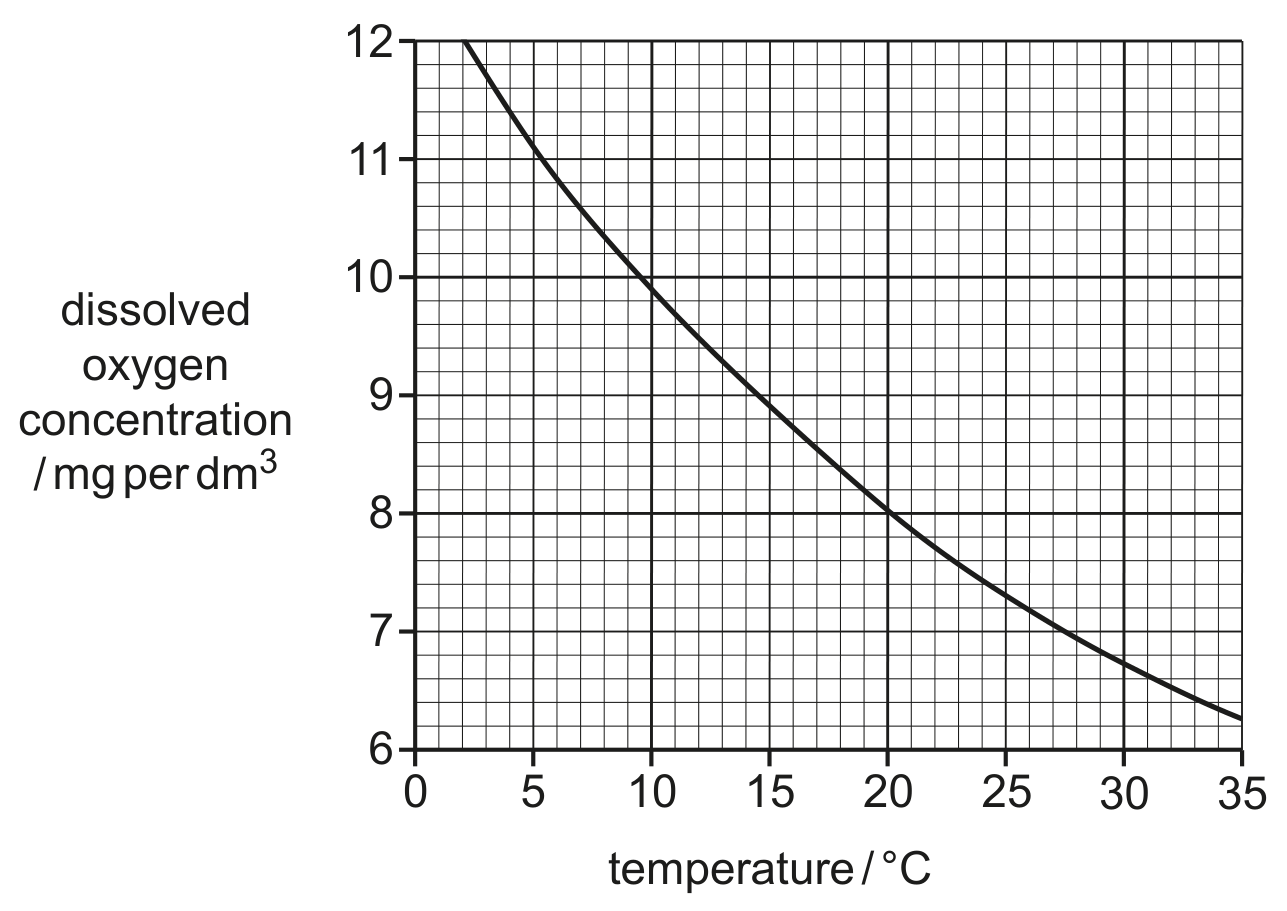
Fig. 1.3

Fig. 1.3

Complete steps 1 to 3 to determine the effect on gas diffusion distance of increasing the temperature of the water from 15C15^{\circ} \mathrm{C} to 25C25^{\circ} \mathrm{C}.

Step 1
Find the concentration of dissolved oxygen from Fig. 1.3 at:
15C15^{\circ} \mathrm{C} : mg per dm3\mathrm{dm}^{3}25C25^{\circ} \mathrm{C} : mg per dm3\mathrm{dm}^{3}

Step 2
Use the values from step 1 to find the gas diffusion distances from Fig. 1.2: μm\mu \mathrm{m}μm\mu \mathrm{m}
Step 3
Calculate the difference in the values from step 2. μm\mu \mathrm{m}
[ 3 ]
(a)

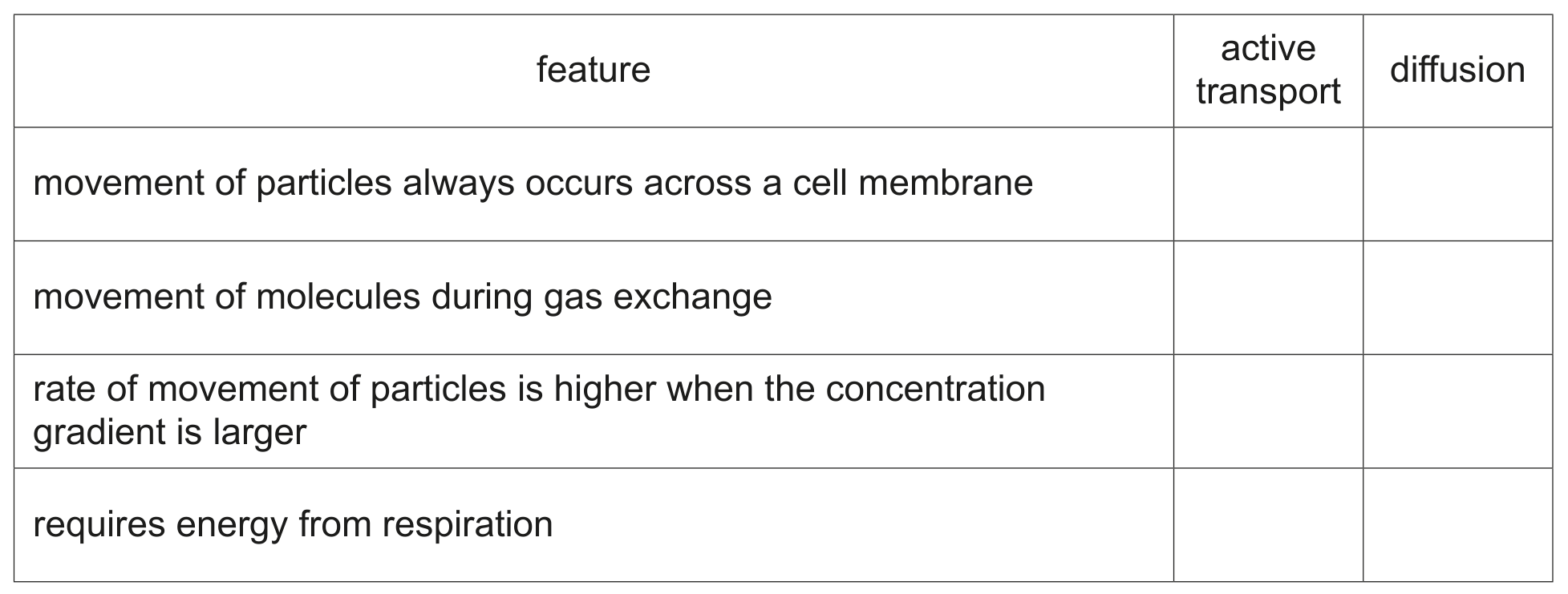
The movement of molecules within an organism can occur by diffusion and active transport.
Complete Table 1.1 by placing ticks ()(\checkmark) to show the correct features of each process.

Table 1.1

Table 1.1

[ 4 ]
[Maximum number: 1]

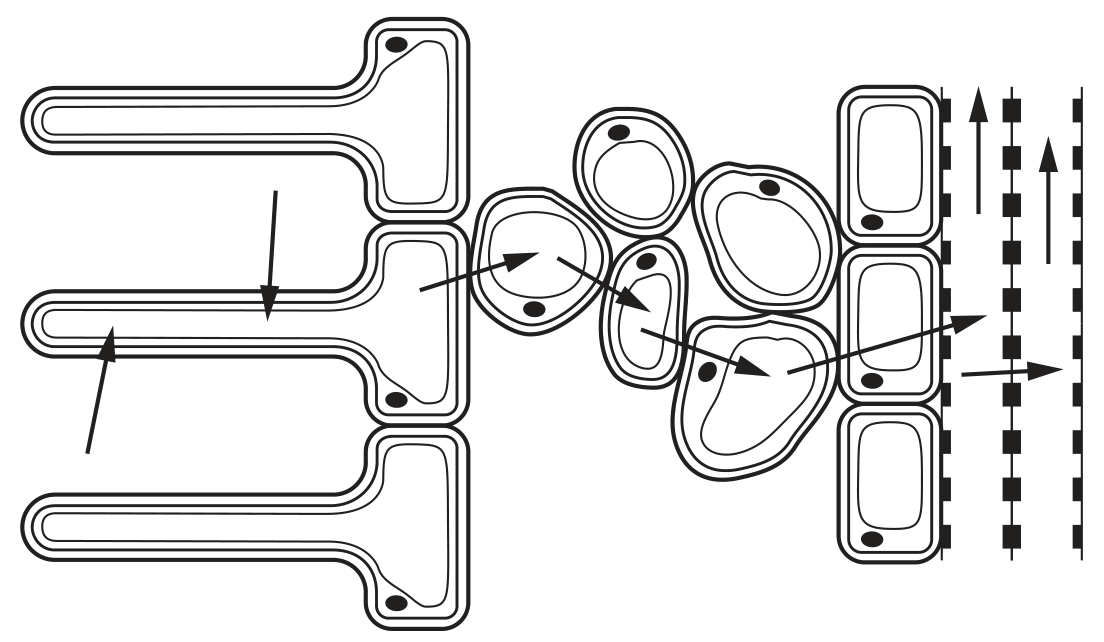
The diagram shows some tissues in part of a plant root. The arrows represent the movement of water into and across the plant root tissues.

Question image

How many different tissues are shown?

A

2

B

4

C

5

D

7

[Maximum number: 1]

How do carbon dioxide and oxygen move into and out of a mesophyll cell?

A

active transport

B

diffusion

C

respiration

D

transpiration

[Maximum number: 1]

Different factors affect the rate of diffusion of molecules across a membrane.
Which row represents changes to factors that will increase the rate of diffusion?

concentration
gradient across
a membrane

thickness
of membrane

surface area
of membrane

temperature

decrease

decrease

increase

increase

decrease

increase

increase

decrease

increase

decrease

increase

increase

increase

increase

decrease

decrease

[Maximum number: 1]

What would increase the rate of diffusion of oxygen into an animal cell?

A

decreasing the concentration gradient between the inside of the cell and the outside

B

decreasing the temperature of the cell and its surroundings

C

increasing the distance that the oxygen molecules have to travel

D

increasing the surface area of the cell membrane

[Maximum number: 1]

Which characteristics are correct for both osmosis and diffusion?

require a partially
permeable membrane

require a
concentration gradient

are energy
consuming processes

×

×

χ\boldsymbol{\chi}

×\boldsymbol{\times}

χ\boldsymbol{\chi}

χ\boldsymbol{\chi}

[Maximum number: 1]

How do carbon dioxide and oxygen move into and out of a mesophyll cell?

A

active transport

B

diffusion

C

respiration

D

transpiration

[Maximum number: 1]

What will increase the rate of diffusion across a gas exchange surface?

A

a decrease in the concentration gradient

B

a decrease in the diffusion distance

C

a decrease in the kinetic energy of molecules

D

a decrease in the surface area of the gas exchange surface

[Maximum number: 1]

How do carbon dioxide and oxygen move into and out of a mesophyll cell?

A

active transport

B

diffusion

C

respiration

D

transpiration

0