EduNinja
[Maximum number: 8]

Fig. 8.1 shows part of the emission spectrum of visible radiation emitted by hydrogen gas in a star in a distant galaxy.
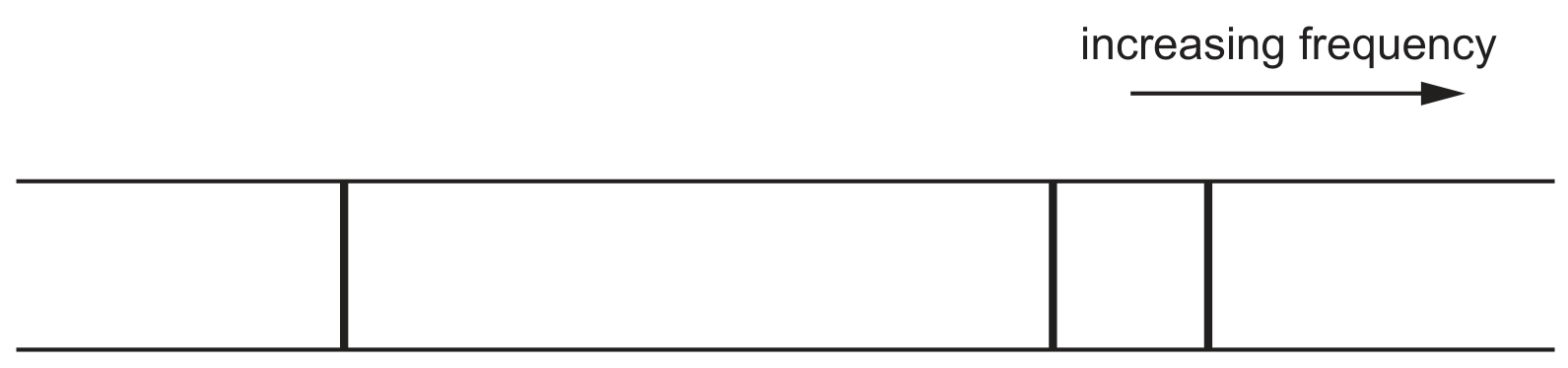
Fig. 8.1

Fig. 8.1

The galaxy is moving away from the Earth at a speed of 6.2×10⁶ ms16.2 \times 10^{6} \mathrm{~ms}^{-1}

(a)
(i)

(a)(i)Explain how the positions of the lines in the emission spectrum seen by an observer on the Earth differ from the positions shown in Fig.8.1.

[ 2 ]
(ii)

(ii)On Fig.8.1,draw the three lines in possible positions in the spectrum seen by the observer.
(b)The lines in Fig. 8.1 correspond to electron transitions down to the energy level -3.40 eV . One of the lines represents emitted radiation of wavelength 488 nm .

[ 2 ]
(b)
(i)

Determine the wavelength, in nm , of this radiation as detected by the observer on the Earth.
wavelength =
nm

[ 2 ]
(c)

A value for the Hubble constant is 2.3×10¹⁸ s12.3 \times 10^{-18} \mathrm{~s}^{-1}.

Determine the distance of the galaxy from the Earth.
distance =
m
[ 2 ]
(a)

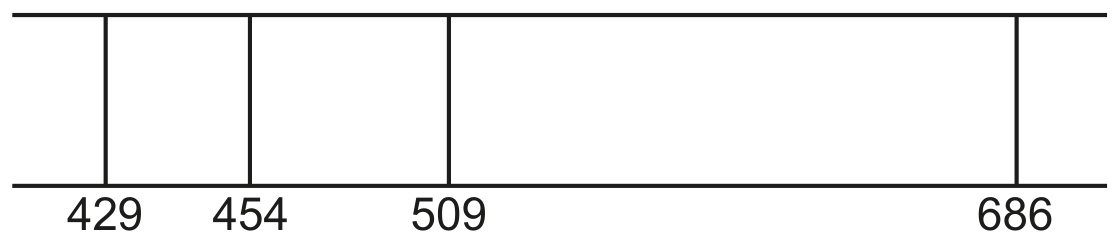
The same part of the emission spectrum from hydrogen as in (a), observed in light from stars in a distant galaxy, is shown in Fig. 9.3. The numbers indicate the wavelengths in nm .

Fig. 9.3

Fig. 9.3

The spectrum shows the same pattern as Fig. 9.1 but with different wavelengths.

[ 5 ]
(i)

State the name of the phenomenon that gives rise to the change in the wavelengths.

[ 1 ]
(ii)

State what this phenomenon shows about the motion of the galaxy.

[ 1 ]
(iii)

Use one of the lines in Fig. 9.1, and the corresponding line in Fig. 9.3, to determine the speed of the distant galaxy relative to the observer.
speed = ms1\mathrm{m} \mathrm{s}^{-1}

[ 3 ]
(b)

The galaxy in (b) is known to be a distance of 5.7×1024 m5.7 \times 10^{24} \mathrm{~m} from the Earth.

Use your answer in (b)(iii) to determine a value for the Hubble constant H0H_{0}.

H0=...s1H_{0}=\ldots \ldots \ldots \ldots \ldots \ldots \ldots \ldots \ldots \ldots \ldots \ldots \ldots \ldots \ldots . . . s^{-1}
[ 2 ]
(a)
(i)

State Hubble's law.

[ 2 ]
(ii)

Explain how cosmologists use observations of emission spectra from stars in distant galaxies to determine that the Universe is expanding.

[ 2 ]
(b)

Explain how Hubble's law and the idea of the expanding Universe lead to the Big Bang theory of the origin of the Universe.

[ 3 ]
(a)

A spectral line from a star within a galaxy is observed to have a wavelength of 660.9 nm . The same spectral line measured in the laboratory is observed to have a wavelength of 656.3 nm .

[ 6 ]
(i)

Show that the speed of the star relative to the Earth is 2.1×10⁶ ms12.1 \times 10^{6} \mathrm{~ms}^{-1}.

[ 1 ]
(ii)

Calculate the distance to the star.

The Hubble constant is 2.3×10¹⁸ s12.3 \times 10^{-18} \mathrm{~s}^{-1}.
distance = m

[ 2 ]
(iii)

State and explain what can be concluded about the Universe based on this change in observed wavelength.

[ 3 ]
(a)

A galaxy in the constellation Corona Borealis is moving away from the Earth.

[ 4 ]
(i)

The visible emission spectrum for the Sun is shown in Fig. 10.2.

Fig. 10.2

Fig. 10.2

The lines are at wavelengths of 397 nm,410 nm,434 nm,486 nm397 \mathrm{~nm}, 410 \mathrm{~nm}, 434 \mathrm{~nm}, 486 \mathrm{~nm} and 656 nm . The compositions of the Sun and a star in the Corona Borealis galaxy are similar.

On Fig. 10.3, sketch the emission spectrum for the star in the Corona Borealis galaxy as observed from the Earth. No calculations are required.

Fig. 10.3

Fig. 10.3

[ 1 ]
(ii)

The galaxy in Corona Borealis is moving away from the Earth at a speed of 21400 km s121400 \mathrm{~km} \mathrm{~s}^{-1}.

Use information from (b)(i) to calculate, in nm , the observed wavelength of the lowest visible energy emission for the star in the Corona Borealis galaxy.
wavelength = nm

[ 2 ]
(iii)

The wavelength in (b)(ii) is used to calculate a value for the surface temperature of the star in the Corona Borealis galaxy. The calculation does not give an accurate value.

State and explain whether this value of temperature is too high or too low.

[ 1 ]
(a)

The lines in Fig. 10.1 have been corrected for redshift.

[ 4 ]
(i)

State what is meant by redshift.

[ 2 ]
(ii)

Explain how cosmologists are able to determine that light from a distant star has undergone redshift.

[ 2 ]
(a)

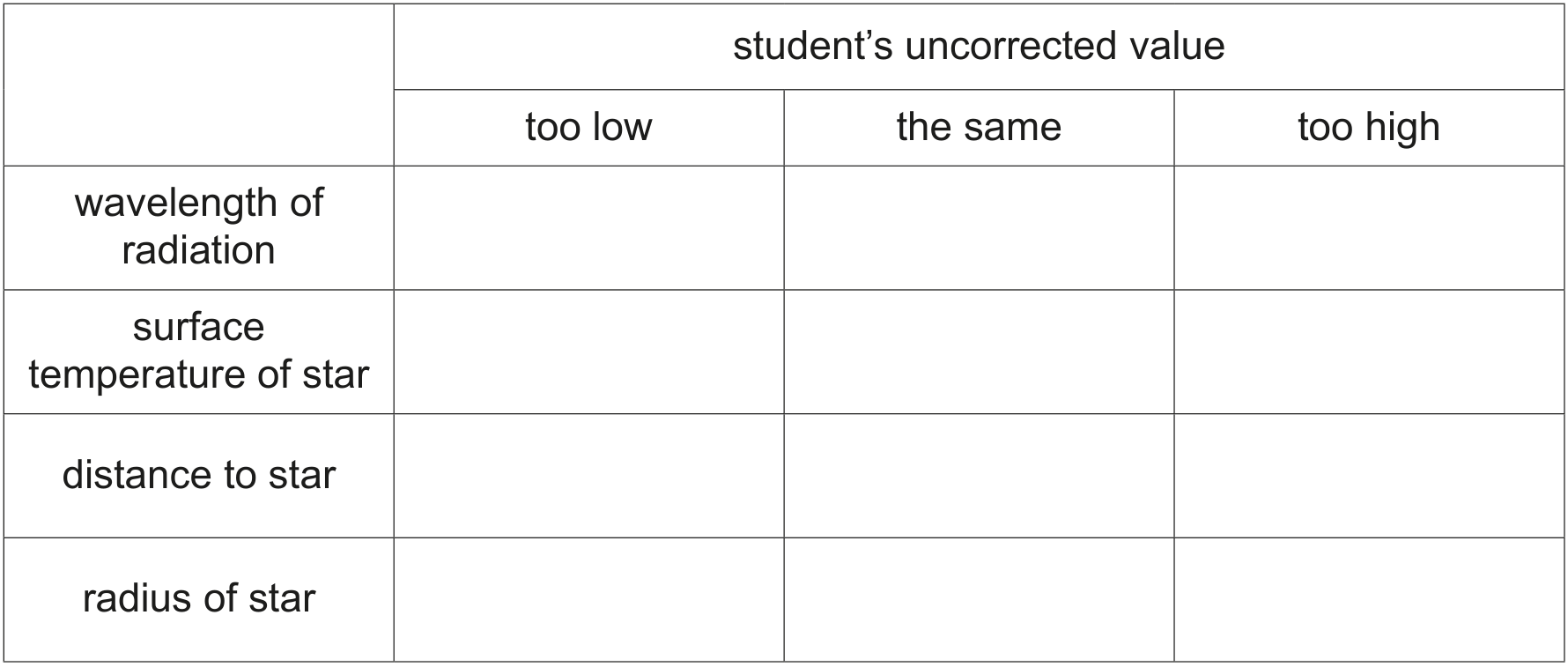
A cosmology student observes the electromagnetic radiation received from a star in a galaxy. The student uses Wien's law to estimate the surface temperature of the star, a standard candle to estimate the distance to the galaxy, and the Stefan-Boltzmann law to estimate the radius of the star.

The student observes that the radiation from the star is redshifted.

[ 5 ]
(i)

State the reason why the radiation from the star is redshifted.

[ 1 ]
(ii)

The true values of the quantities observed or estimated are those that are corrected to allow for redshift. However, the student does not correct for redshift.

By placing one tick ()(\checkmark) in each row, complete Table 10.1 to indicate how the observations and estimates made by the student compare with the true values.

Table 10.1

Table 10.1

[ 4 ]
(a)

State Hubble's law. Identify any symbols that you use.

[ 2 ]
(b)

The star in (b) is in a distant galaxy. A spectral line in the light from this galaxy is known to have a wavelength of 486 nm . This spectral line in the light from the galaxy observed on the Earth has a wavelength of 492 nm .

[ 5 ]
(i)

Explain why the wavelength observed on the Earth is different from the wavelength that the galaxy is known to have emitted.

[ 2 ]
(ii)

Determine a value for the Hubble constant H0H_{0}.

H0=...s1H_{0}=\ldots \ldots \ldots \ldots \ldots \ldots \ldots \ldots \ldots \ldots \ldots \ldots \ldots \ldots \ldots \ldots \ldots . . . s^{-1}
[ 3 ]
(a)

State Hubble's law. Identify any symbols that you use.

[ 2 ]
(b)

The star in (b) is in a distant galaxy. A spectral line in the light from this galaxy is known to have a wavelength of 486 nm . This spectral line in the light from the galaxy observed on the Earth has a wavelength of 492 nm .

[ 5 ]
(i)

Explain why the wavelength observed on the Earth is different from the wavelength that the galaxy is known to have emitted.

[ 2 ]
(ii)

Determine a value for the Hubble constant H0H_{0}.

H0=H_{0}=

s1\mathrm{s}^{-1}

[ 3 ]
0