EduNinja
(a)

A circular metal disc spins horizontally about a vertical axis, as shown in Fig. 1.1.
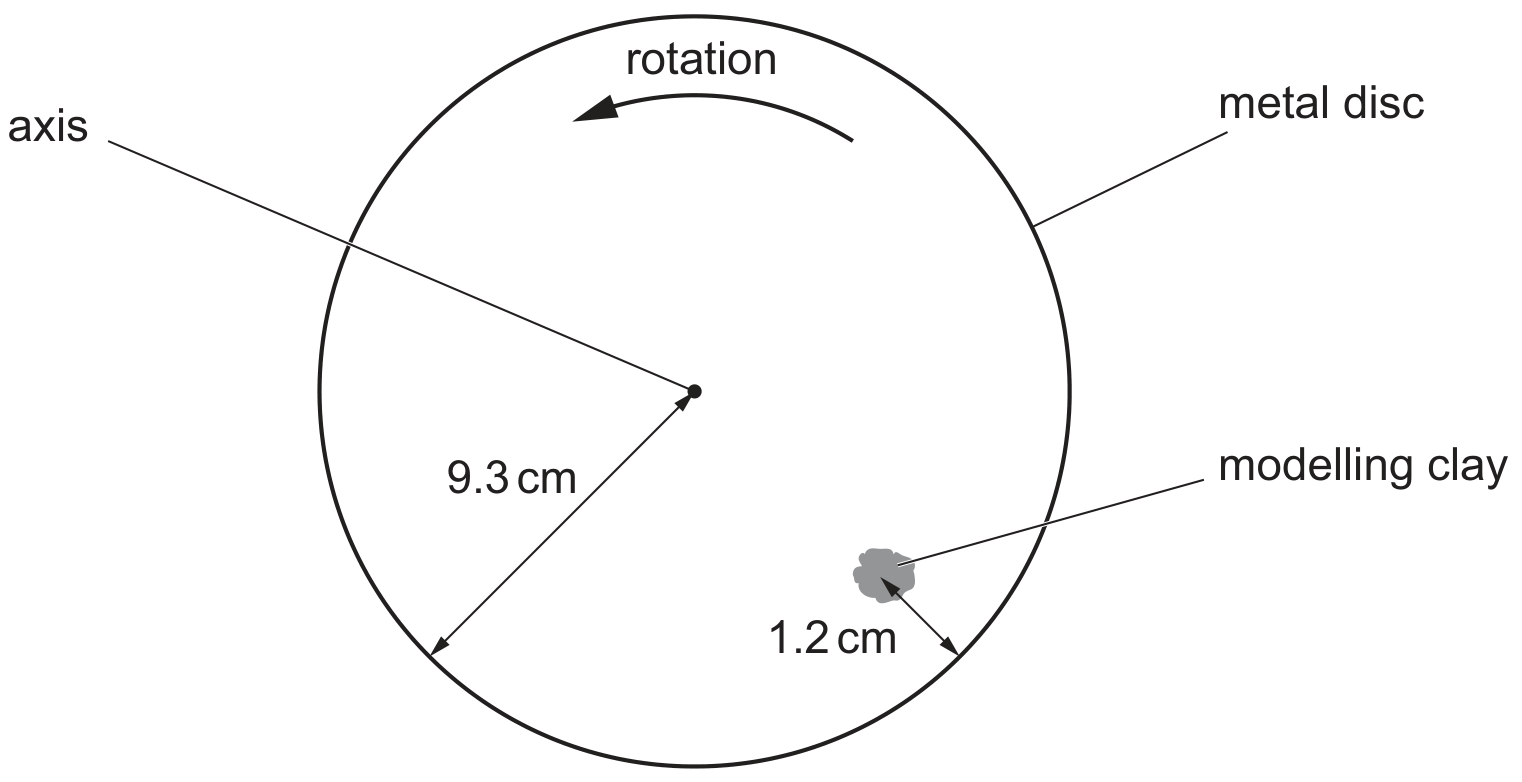
Fig. 1.1 (not to scale)

Fig. 1.1 (not to scale)

A piece of modelling clay is attached to the disc.
For the instant when the piece of modelling clay is in the position shown, draw on Fig. 1.1:

[ 1 ]
(i)

an arrow, labelled A , showing the direction of the acceleration of the modelling clay.

[ 1 ]
(b)

The metal disc in Fig. 1.1 has a radius of 9.3 cm .

The centre of gravity of the modelling clay is 1.2 cm from the rim of the disc and moves with a speed of 0.68 ms10.68 \mathrm{~ms}^{-1}.

[ 2 ]
(i)

Calculate the acceleration a of the centre of gravity of the modelling clay.
a= ms2\mathrm{ms}^{-2}

[ 2 ]
(c)

A second piece of modelling clay is attached to the disc in the position shown in Fig. 1.2.
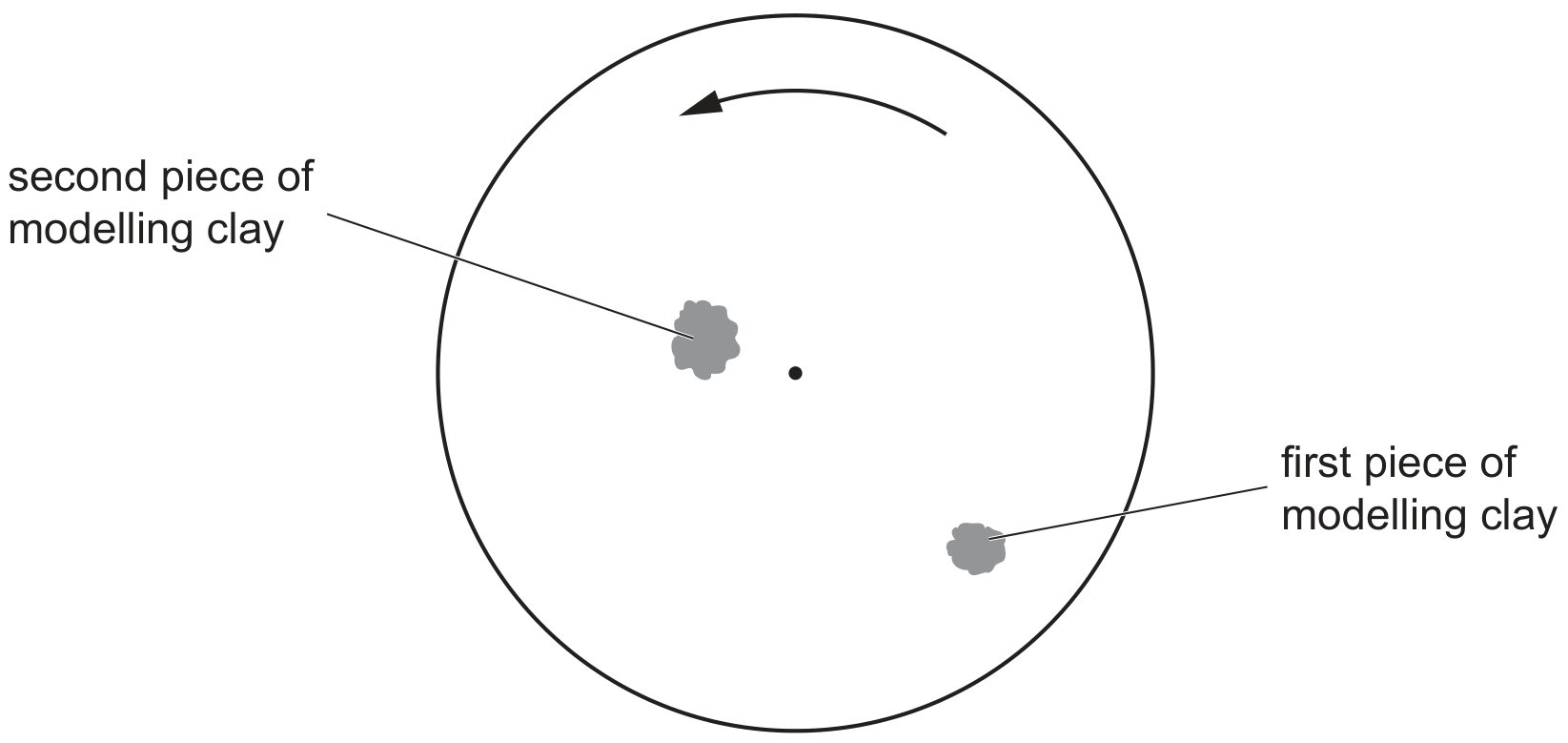
Fig. 1.2

Fig. 1.2

The second piece of modelling clay has a larger mass than the first piece.
By placing one tick ()(\checkmark) in each row, complete Table 1.1 to show how the quantities indicated compare for the two pieces of modelling clay.
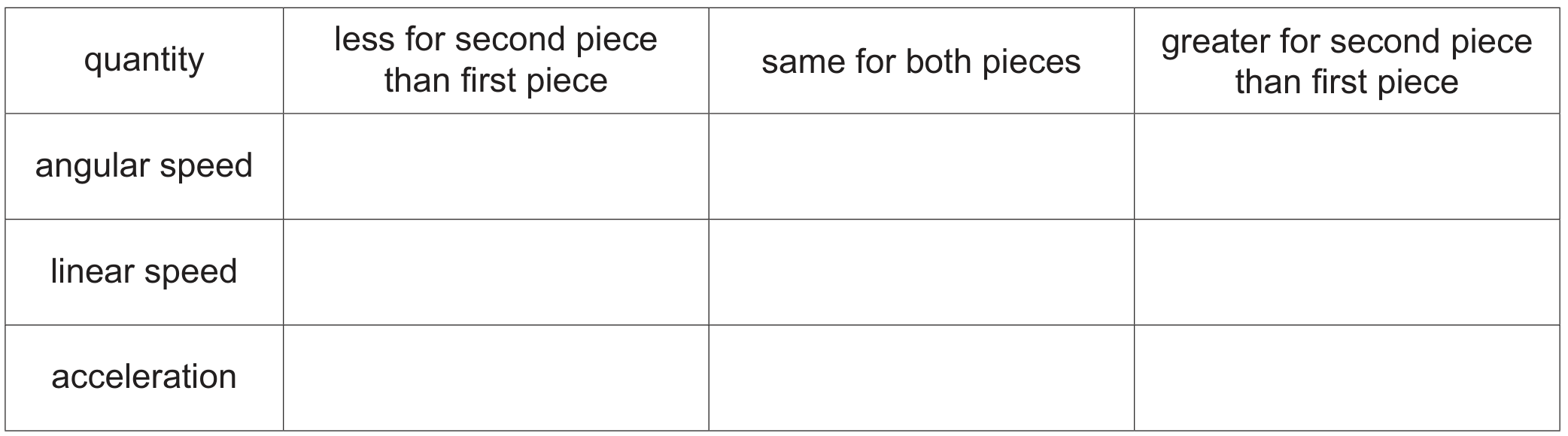
Table 1.1
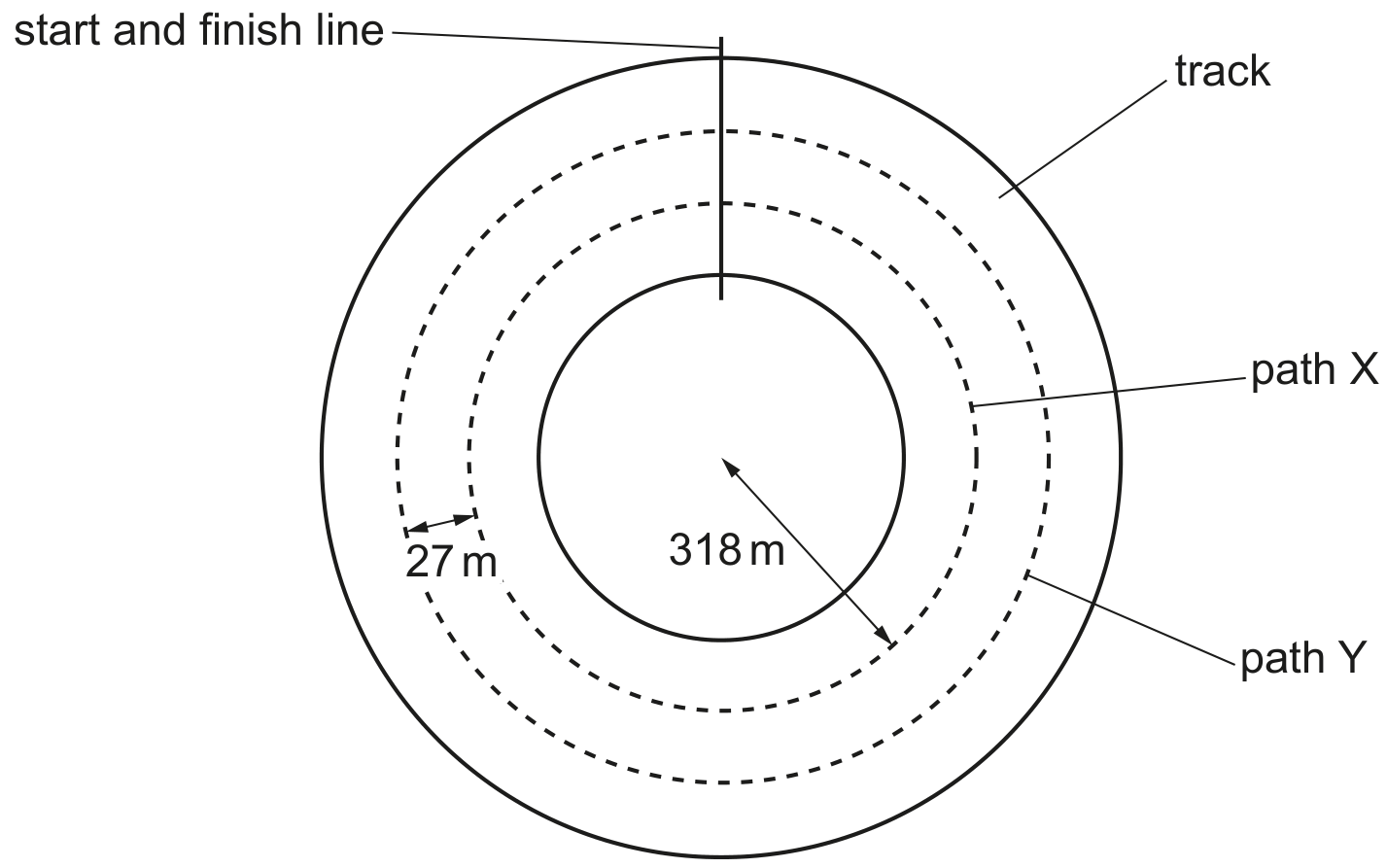
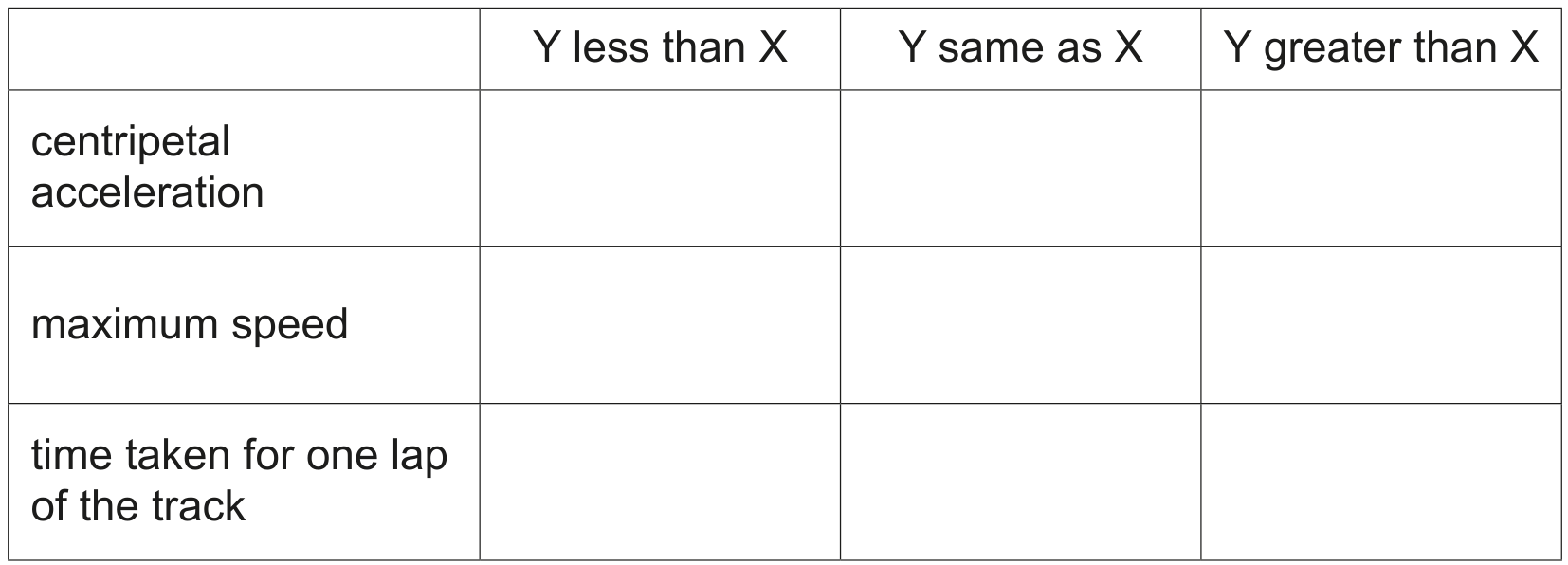
Table 1.1

[ 3 ]
(a)

During a time interval of 1400 s , the centre of gravity of the piece of modelling clay in Fig. 1.1 moves through a total distance of 0.44 m .

[ 2 ]
(i)

Calculate the magnitude of the centripetal acceleration of the piece of modelling clay.
centripetal acceleration = ms2\mathrm{ms}^{-2}

[ 2 ]
(b)

Use your answer in (c)(iii) to explain why the variation with time of the magnitude of the force exerted by the minute hand on the piece of modelling clay is negligible as the minute hand undergoes one full revolution.

[ 2 ]
(a)

An object rests on the surface of the Earth at the Equator. The radius of the Earth is 6.4×10⁶ m6.4 \times 10^{6} \mathrm{~m}.

[ 5 ]
(i)

Determine the centripetal acceleration of the object.

\text { centripetal acceleration = \mathrm{m} \mathrm{~s}^{-2} \text { [3] }
[ 3 ]
(ii)

Describe how the two forces acting on the object give rise to this centripetal acceleration. You may draw a diagram if you wish.

[ 2 ]
(a)

Explain how the force(s) on a satellite can result in the satellite being in a circular orbit around a planet.

[ 2 ]
(a)

Two cars are moving around a horizontal circular track. One car follows path X and the other follows path Y , as shown in Fig. 1.1.

Fig. 1.1 (not to scale)

Fig. 1.1 (not to scale)

The radius of path X is 318 m . Path Y is parallel to, and 27 m outside, path X . Both cars have mass 790 kg . The maximum lateral (sideways) friction force F that the cars can experience without sliding is the same for both cars.

[ 5 ]
(i)

The maximum speed at which the car on path X can move around the track without sliding is 94 m s194 \mathrm{~m} \mathrm{~s}^{-1}.

Calculate F.
F= N

[ 2 ]
(ii)

Both cars move around the track. Each car has the maximum speed at which it can move without sliding.

Complete Table 1.1, by placing one tick in each row, to indicate how the quantities indicated for the car on path Y compare with the car on path X .

Table 1.1

Table 1.1

[ 3 ]
(a)

State what is meant by centripetal acceleration.

[ 1 ]
(b)

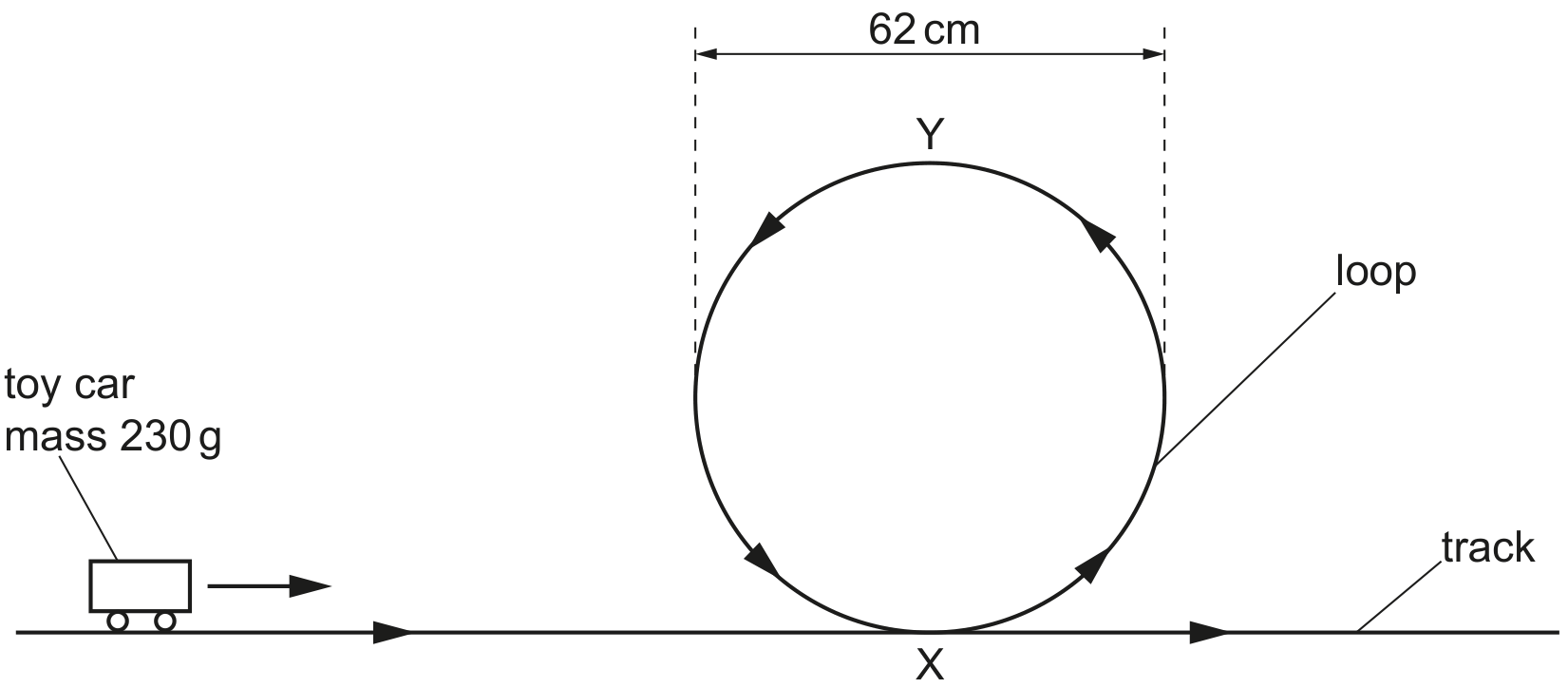
An unpowered toy car moves freely along a smooth track that is initially horizontal. The track contains a vertical circular loop around which the car travels, as shown in Fig. 1.1.

Fig. 1.1

Fig. 1.1

The mass of the car is 230 g and the diameter of the loop is 62 cm . Assume that the resistive forces acting on the car are negligible.

[ 3 ]
(i)

State what happens to the magnitude of the centripetal acceleration of the car as it moves around the loop from X to Y .

[ 1 ]
(ii)

Explain, if the car remains in contact with the track, why the centripetal acceleration of the car at point Y must be greater than 9.8 ms29.8 \mathrm{~ms}^{-2}.

[ 2 ]
(c)

The initial speed at which the car in (b) moves along the track is 3.8 ms13.8 \mathrm{~ms}^{-1}.

Determine whether the car is in contact with the track at point Y . Show your working.

[ 3 ]
(d)

Suggest, with a reason but without calculation, whether your conclusion in (c) would be different for a car of mass 460 g moving with the same initial speed.

[ 1 ]
[Maximum number: 4]

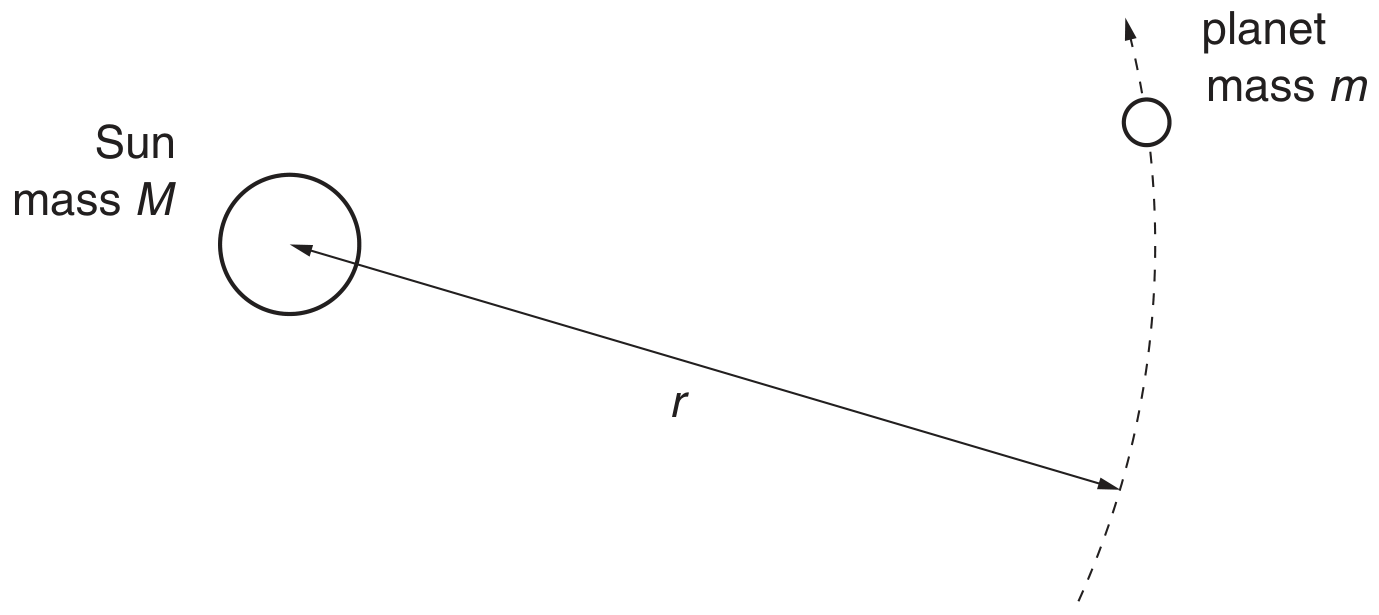
A planet of mass m is in a circular orbit of radius r about the Sun of mass M, as illustrated in Fig. 1.1.

Fig. 1.1

Fig. 1.1

The magnitude of the angular velocity and the period of revolution of the planet about the Sun are ω\omega and T respectively.

(a)

Show that, for a planet in a circular orbit of radius r, the period T of the orbit is given by the expression

T2=cr3T^{2}=c r^{3}

where c is a constant. Explain your working.

[ 4 ]
[Maximum number: 4]

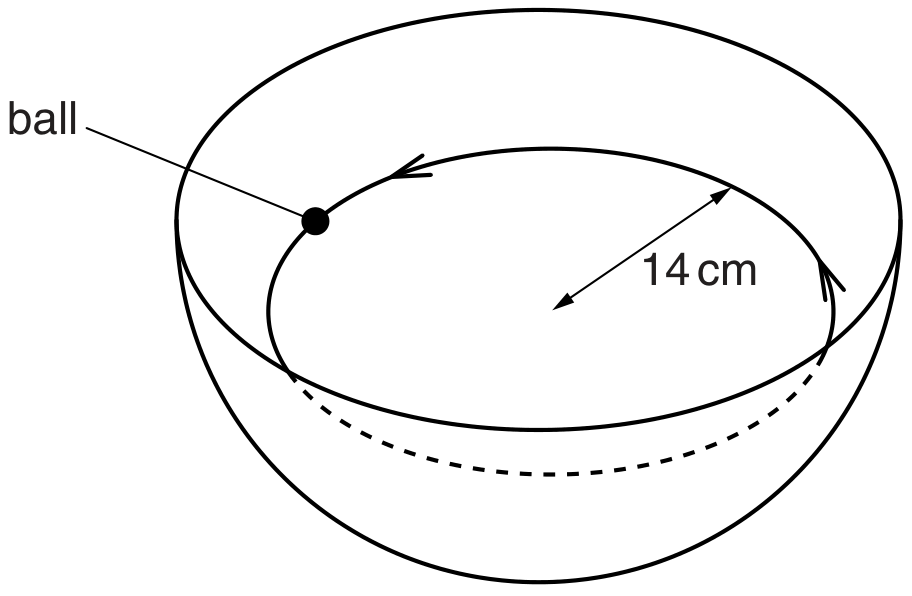
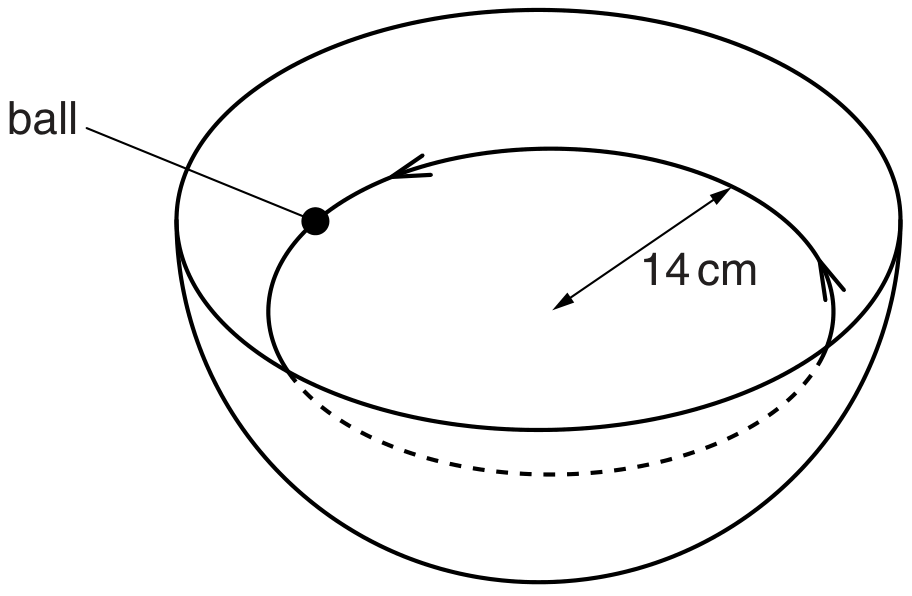
A large bowl is made from part of a hollow sphere.
A small spherical ball is placed inside the bowl and is given a horizontal speed. The ball follows a horizontal circular path of constant radius, as shown in Fig. 2.1.

Fig. 2.1

Fig. 2.1

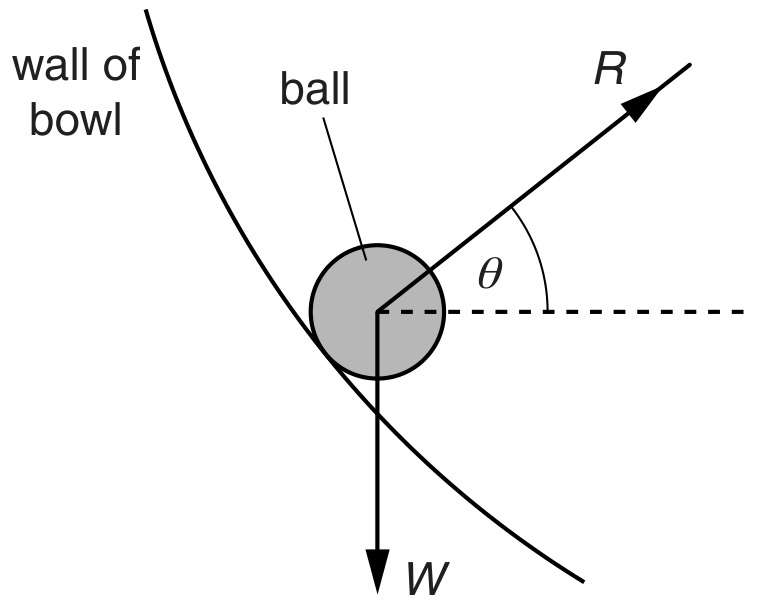
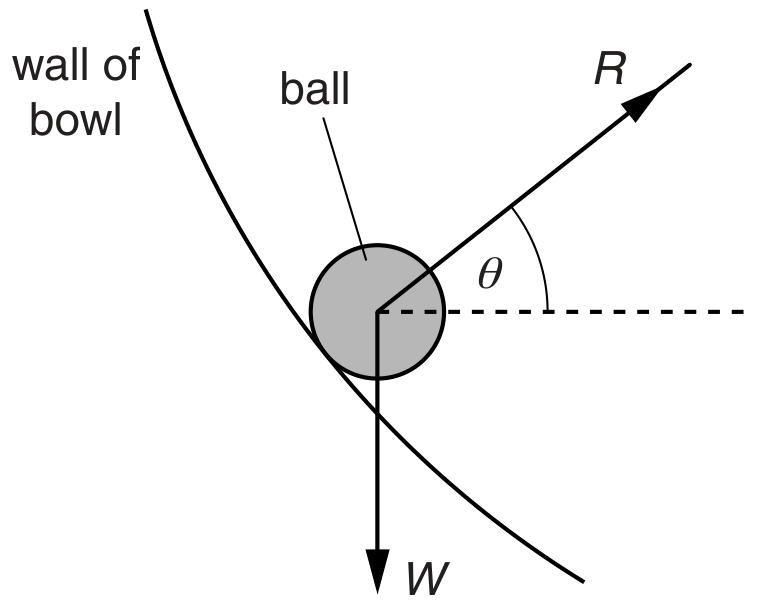
The forces acting on the ball are its weight W and the normal reaction force R of the bowl on the ball, as shown in Fig. 2.2.

Fig. 2.2

Fig. 2.2

The normal reaction force R is at an angle θ\theta to the horizontal.

(a)
(i)

State the significance of the force F for the motion of the ball in the bowl.

[ 1 ]
(b)

The ball moves in a circular path of radius 14 cm . For this radius, the angle θ\theta is 2828^{\circ}.

Calculate the speed of the ball.
speed = ms1\mathrm{ms}^{-1}

[ 3 ]
[Maximum number: 4]

A large bowl is made from part of a hollow sphere.
A small spherical ball is placed inside the bowl and is given a horizontal speed. The ball follows a horizontal circular path of constant radius, as shown in Fig. 2.1.

Fig. 2.1

Fig. 2.1

The forces acting on the ball are its weight W and the normal reaction force R of the bowl on the ball, as shown in Fig. 2.2.

Fig. 2.2

Fig. 2.2

The normal reaction force R is at an angle θ\theta to the horizontal.

(a)
(i)

State the significance of the force F for the motion of the ball in the bowl.

[ 1 ]
(b)

The ball moves in a circular path of radius 14 cm . For this radius, the angle θ\theta is 2828^{\circ}.

Calculate the speed of the ball.
speed = ms1\mathrm{ms}^{-1}

[ 3 ]
[Maximum number: 7]

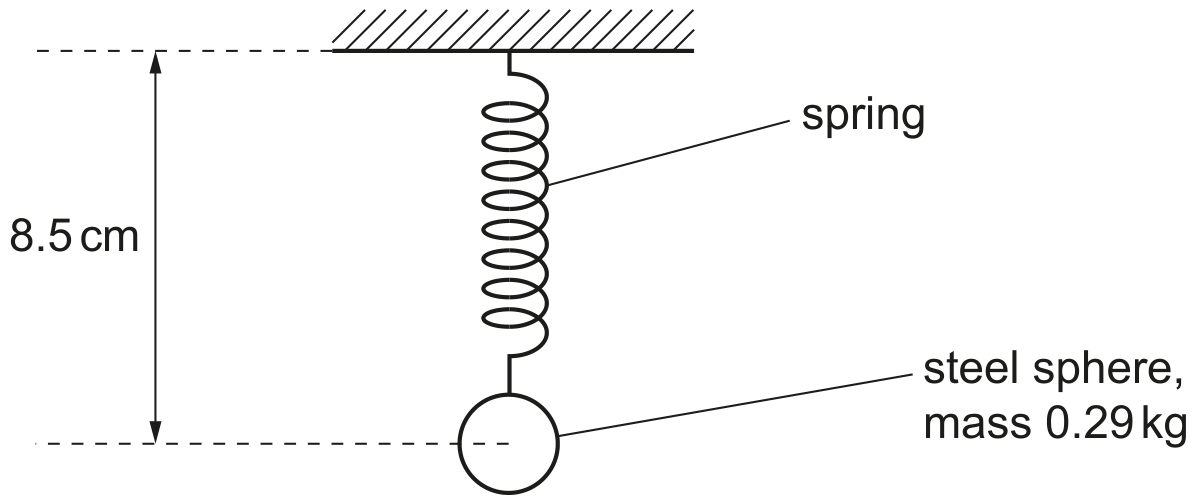
A steel sphere of mass 0.29 kg is suspended in equilibrium from a vertical spring. The centre of the sphere is 8.5 cm from the top of the spring, as shown in Fig. 2.1.

Fig. 2.1

Fig. 2.1

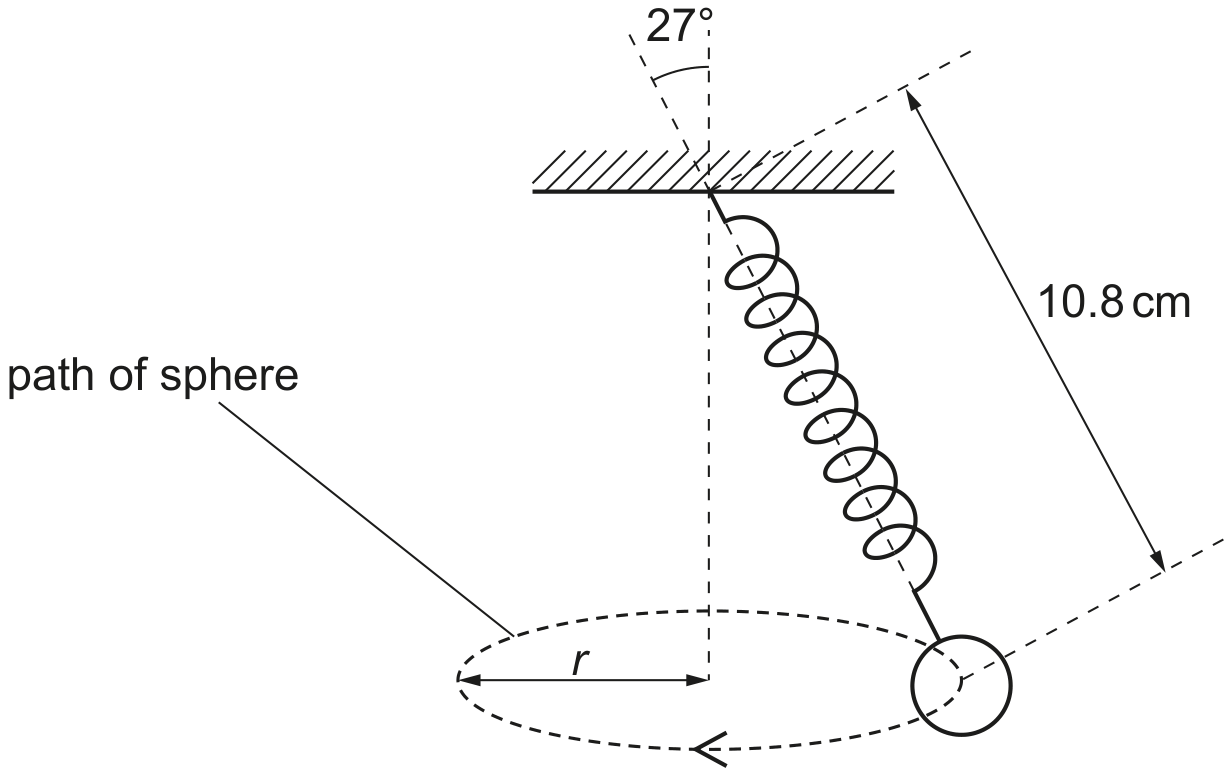
The sphere is now set in motion so that it is moving in a horizontal circle at constant speed, as shown in Fig. 2.2.

Fig. 2.2

Fig. 2.2

The distance from the centre of the sphere to the top of the spring is now 10.8 cm .

(a)

Explain, with reference to the forces acting on the sphere, why the length of the spring in Fig. 2.2 is greater than in Fig. 2.1.

[ 3 ]
(b)

The angle between the linear axis of the spring and the vertical is 2727^{\circ}.

[ 2 ]
(i)

Show that the tension in the spring is 3.2 N .

[ 2 ]
(c)
(i)

Use the information in (b) to determine the centripetal acceleration of the sphere.

\text { centripetal acceleration = \mathrm{m} \mathrm{~s}^{-2}
[ 2 ]
0