EduNinja
[Maximum number: 5]

A capacitor consists of two metal plates separated by an insulator, as shown in Fig. 3.1.
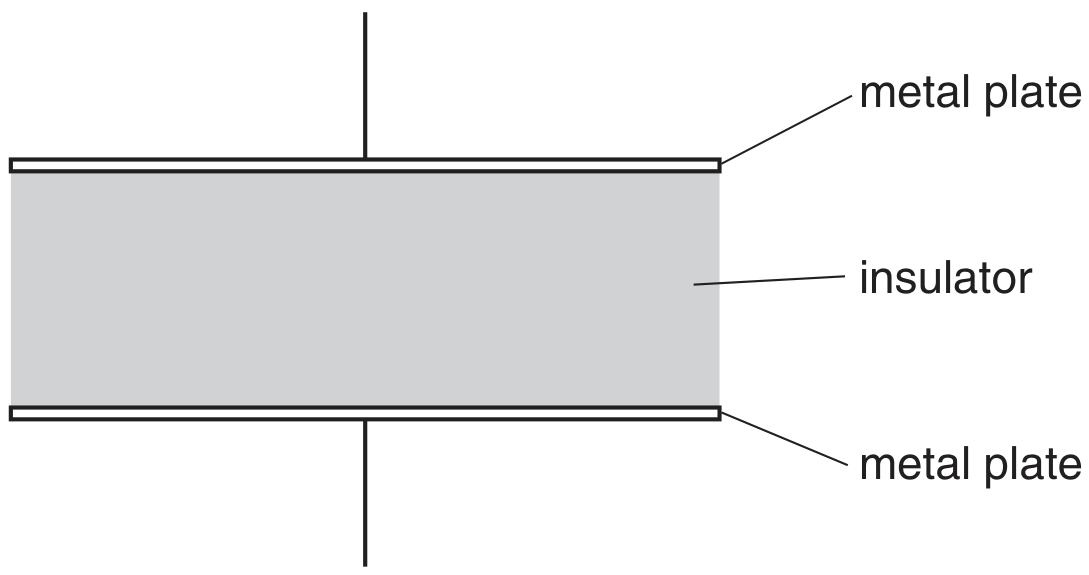
Fig. 3.1

Fig. 3.1

The potential difference between the plates is V. The variation with V of the magnitude of the charge Q on one plate is shown in Fig. 3.2.
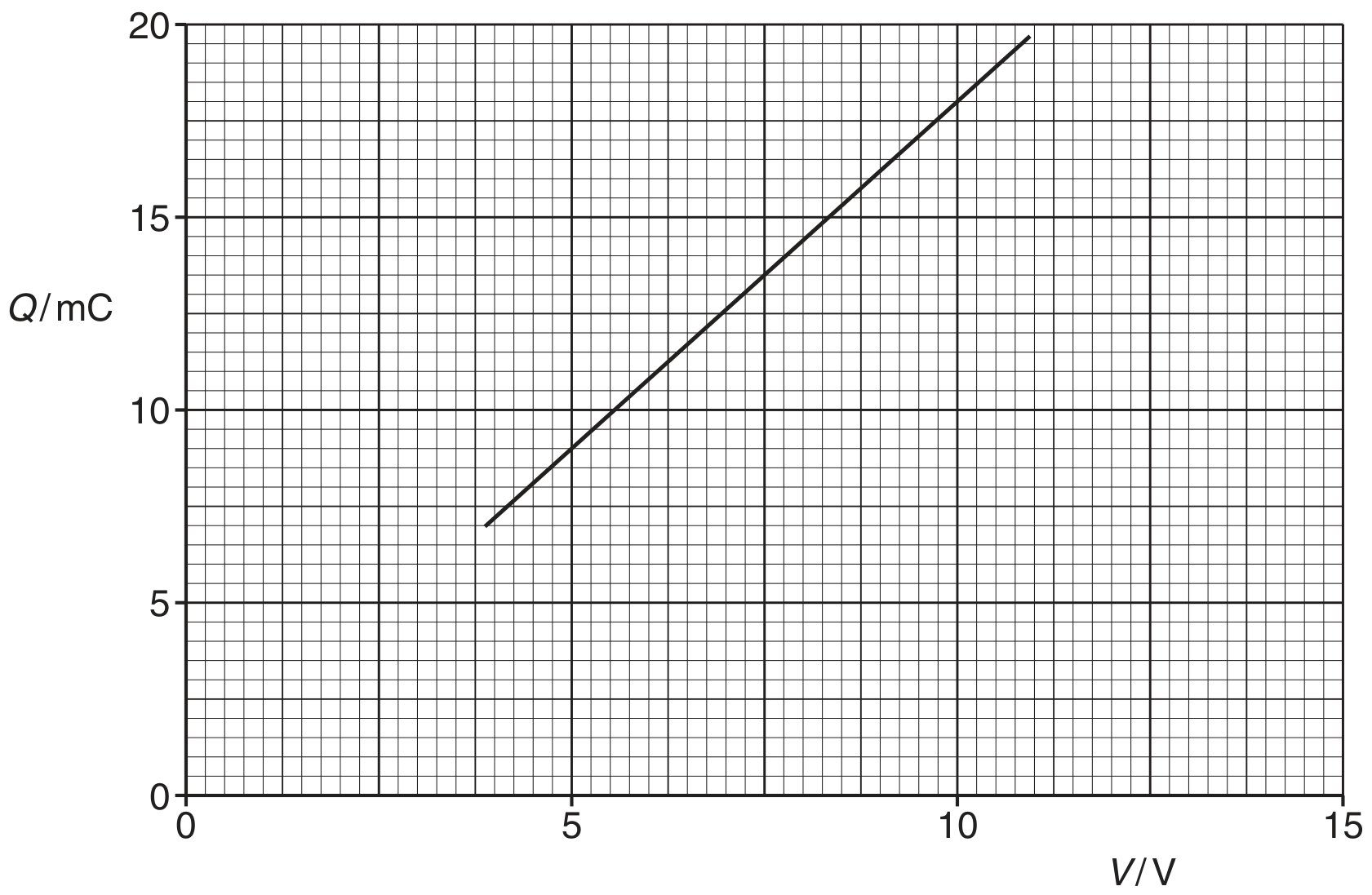
Fig. 3.2

Fig. 3.2

(a)

Use Fig. 3.2 to determine

[ 2 ]
(i)

the capacitance of the capacitor,
capacitance = μF\mu \mathrm{F}

[ 2 ]
(b)

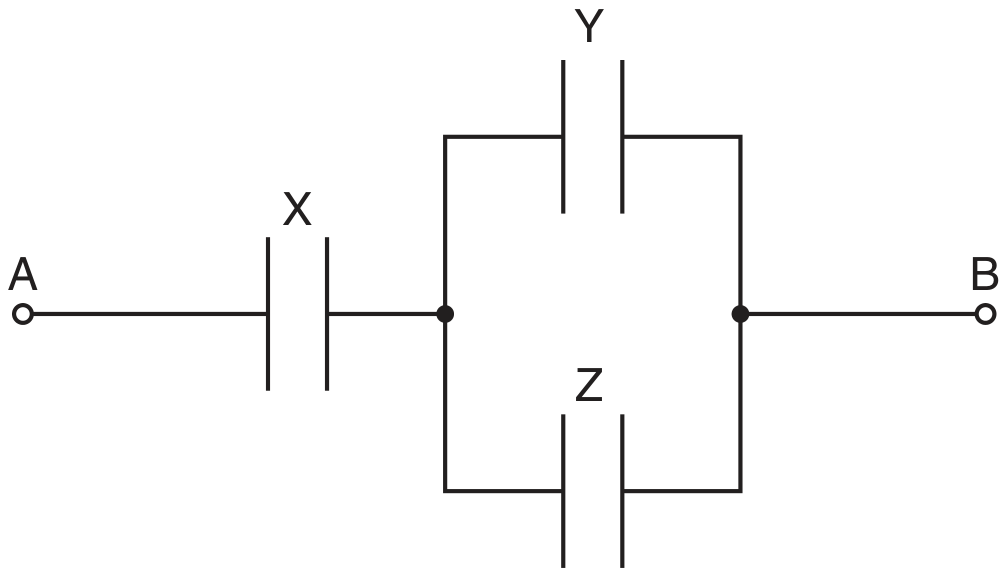
Three capacitors X, Y and Z , each of capacitance 10μ F10 \mu \mathrm{~F}, are connected as shown in Fig. 3.3.

Fig. 3.3

Fig. 3.3

Initially, the capacitors are uncharged.
A potential difference of 12 V is applied between points A and B .
Determine the magnitude of the charge on one plate of capacitor X.
charge = μC\mu \mathrm{C}

[ 3 ]
(a)

An insulated metal sphere of radius R is situated in a vacuum. The charge q on the sphere may be considered to be a point charge at the centre of the sphere.

[ 2 ]
(i)

State a formula, in terms of R and q, for the potential V on the surface of the sphere.

[ 1 ]
(ii)

Define capacitance and hence show that the capacitance C of the sphere is given by the expression

C=4πε0R.C=4 \pi \varepsilon_{0} R .
[ 1 ]
(b)

An isolated metal sphere has radius 45 cm .

(i)

Use the expression in (a)(ii) to calculate the capacitance, in picofarad, of the sphere.

capacitance =
(a)

An isolated metal sphere is to be used to store charge at high potential. The charge stored may be assumed to be a point charge at the centre of the sphere. The sphere has a radius of 25 cm . Electrical breakdown (a spark) occurs in the air surrounding the sphere when the electric field strength at the surface of the sphere exceeds 1.8×10⁴Vcm11.8 \times 10^{4} \mathrm{Vcm}^{-1}.

[ 2 ]
(i)

Calculate the potential of the sphere for this maximum charge.
potential = V

[ 2 ]
(a)

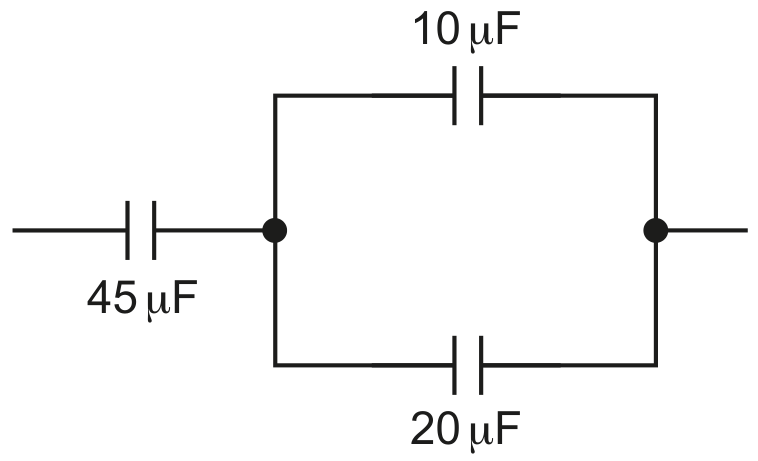
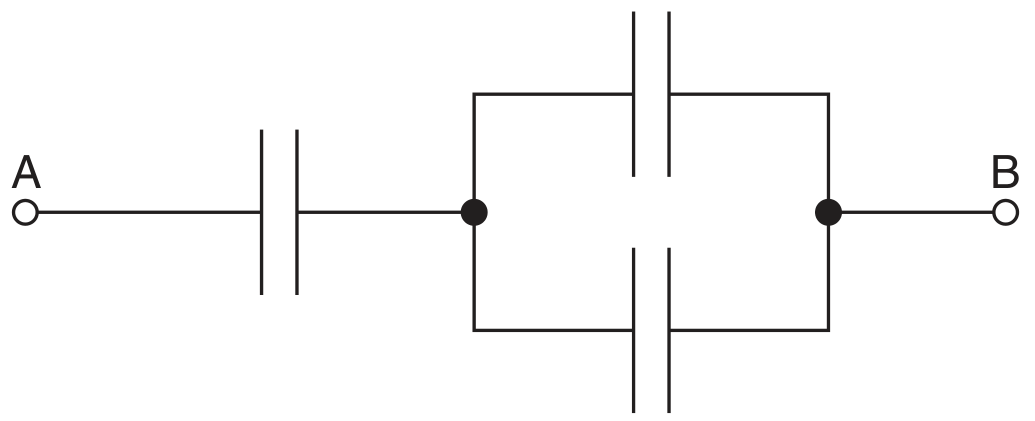
Three capacitors are connected as shown in Fig. 4.1.

Fig. 4.1

Fig. 4.1

Determine the total capacitance, in μF\mu \mathrm{F}, of the network of three capacitors.
capacitance = μF\mu \mathrm{F}

[ 2 ]
(a)

State two functions of capacitors connected in electrical circuits.
1.
2.

[ 2 ]
(b)

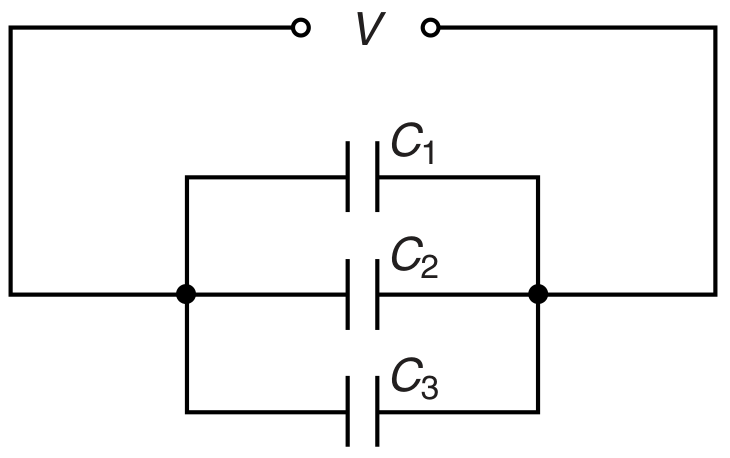
Three capacitors are connected in parallel to a power supply as shown in Fig. 4.1.

Fig. 4.1

Fig. 4.1

The capacitors have capacitances C1,C2C_{1}, C_{2} and C3C_{3}. The power supply provides a potential difference V.

[ 3 ]
(i)

Explain why the charge on the positive plate of each capacitor is different.

[ 1 ]
(ii)

Use your answer in (i) to show that the combined capacitance C of the three capacitors is given by the expression

C=C1+C2+C3.C=C_{1}+C_{2}+C_{3} .
[ 2 ]
(c)

A student has available three capacitors, each of capacitance 12μ F12 \mu \mathrm{~F}. Draw circuit diagrams, one in each case, to show how the student connects the three capacitors to provide a combined capacitance of

[ 2 ]
(i)

8μ F8 \mu \mathrm{~F},

[ 1 ]
(ii)

18μ F18 \mu \mathrm{~F}.

[ 1 ]
(a)

State two functions of capacitors in electrical circuits.
1.
2.

[ 2 ]
(b)

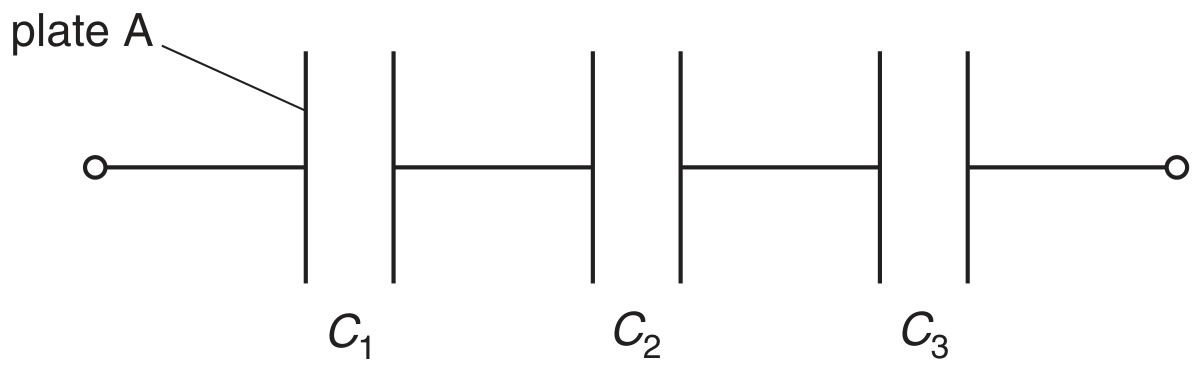
Three uncharged capacitors of capacitance C1,C2C_{1}, C_{2} and C3C_{3} are connected in series, as shown in Fig. 4.1.

Fig. 4.1

Fig. 4.1

A charge of +Q is put on plate A of the capacitor of capacitance C1C_{1}.

[ 4 ]
(i)

State and explain the charges that will be observed on the other plates of the capacitors.
You may draw on Fig. 4.1 if you wish.

[ 2 ]
(ii)

Use your answer in (i) to derive an expression for the combined capacitance of the capacitors.

[ 2 ]
[Maximum number: 2]

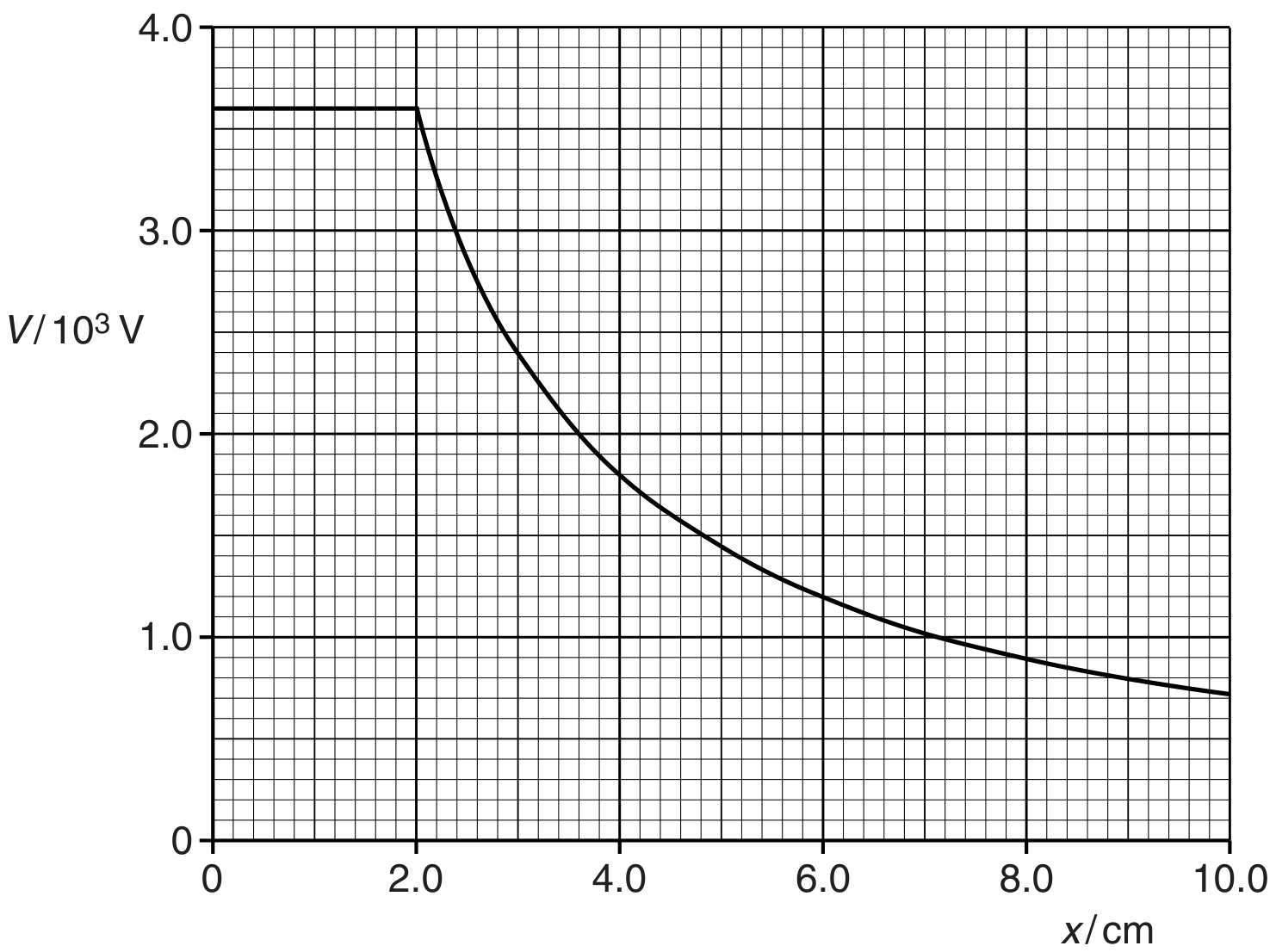
A charged metal sphere is isolated in space. Measurements of the electric potential V are made for different distances x from the centre of the sphere.

The variation with distance x of the potential V is shown in Fig. 5.1.

Fig. 5.1

Fig. 5.1

(a)

The charge on the sphere is 8.0×10⁹C8.0 \times 10^{-9} \mathrm{C}.

[ 2 ]
(i)

The sphere acts as a capacitor. Determine the capacitance of the sphere.
capacitance = F

[ 2 ]
(a)
(i)

Define capacitance.

[ 1 ]
(b)

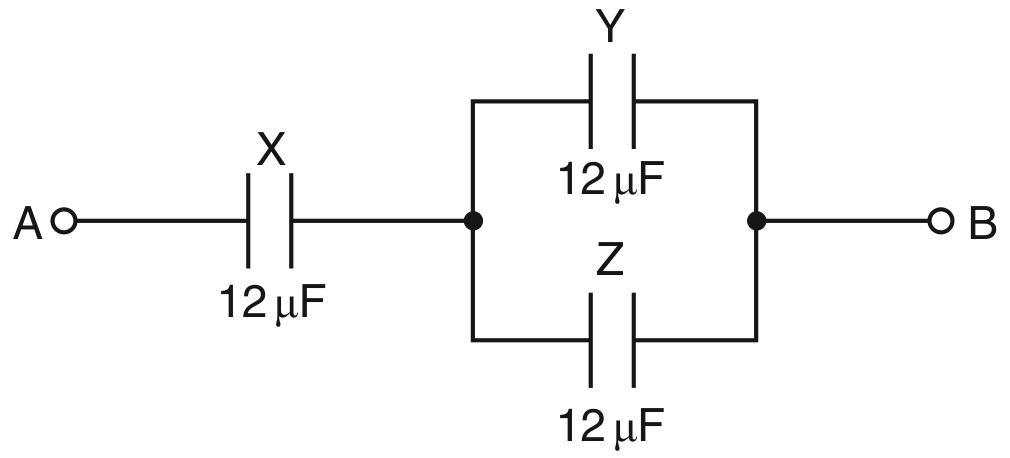
Three uncharged capacitors X, Y and Z , each of capacitance 12μ F12 \mu \mathrm{~F}, are connected as shown in Fig. 5.2.

Fig. 5.2

Fig. 5.2

A potential difference of 9.0 V is applied between points A and B .

[ 5 ]
(i)

Calculate the combined capacitance of the capacitors X, Y and Z .
capacitance = μF\mu \mathrm{F}

[ 2 ]
(ii)

Explain why, when the potential difference of 9.0 V is applied, the charge on one plate of capacitor X is 72μC72 \mu \mathrm{C}.

[ 2 ]
(iii)

Determine
1. the potential difference across capacitor X ,
potential difference = V
2. the charge on one plate of capacitor Y .
charge = μC\mu \mathrm{C}

[ 1 ]
(a)

State two functions of capacitors in electrical circuits.
1.
2.

[ 2 ]
(b)

Three capacitors, each marked ' 30μ F,6 V30 \mu \mathrm{~F}, 6 \mathrm{~V} max', are arranged as shown in Fig. 5.1.

Fig. 5.1

Fig. 5.1

Determine, for the arrangement shown in Fig. 5.1,

[ 4 ]
(i)

the total capacitance,
capacitance = μF\mu \mathrm{F}

[ 2 ]
(ii)

the maximum potential difference that can safely be applied between points A and B.
potential difference = V

[ 2 ]
(a)

Define capacitance.

(b)

An isolated metal sphere has a radius r. When charged to a potential V, the charge on the sphere is q.
The charge may be considered to act as a point charge at the centre of the sphere.

[ 1 ]
(i)

This isolated sphere has capacitance. Use your answers in (a) and (b)(i) to show that the capacitance of the sphere is proportional to its radius.

[ 1 ]
0