EduNinja
[Maximum number: 4]

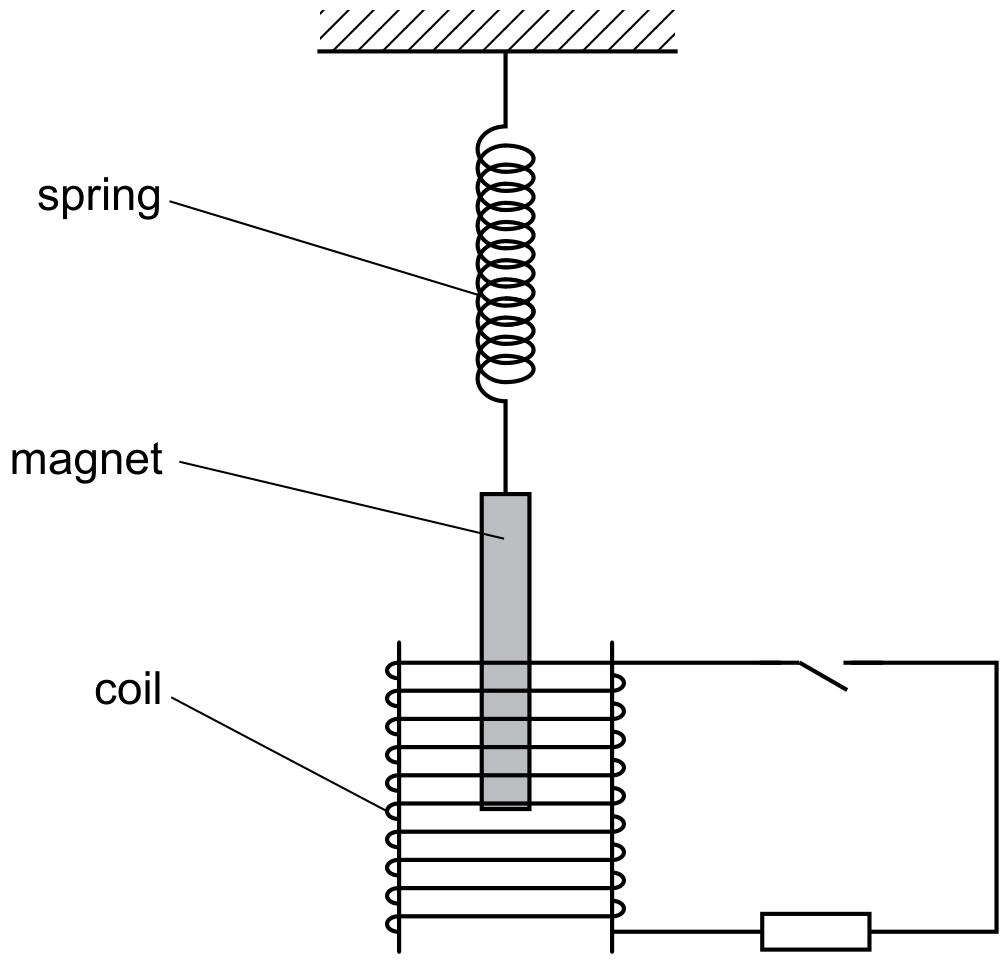
A light spring is suspended from a fixed point. A bar magnet is attached to the end of the spring, as shown in Fig. 1.1.
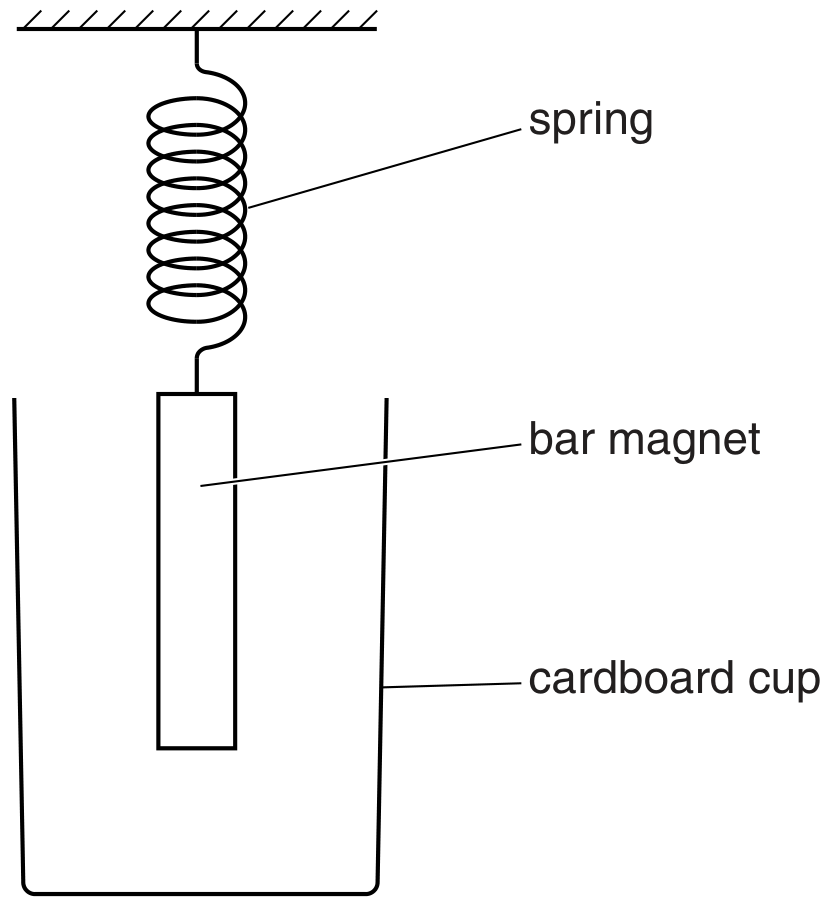
Fig. 1.1

Fig. 1.1

In order to shield the magnet from draughts, a cardboard cup is placed around the magnet but does not touch it.
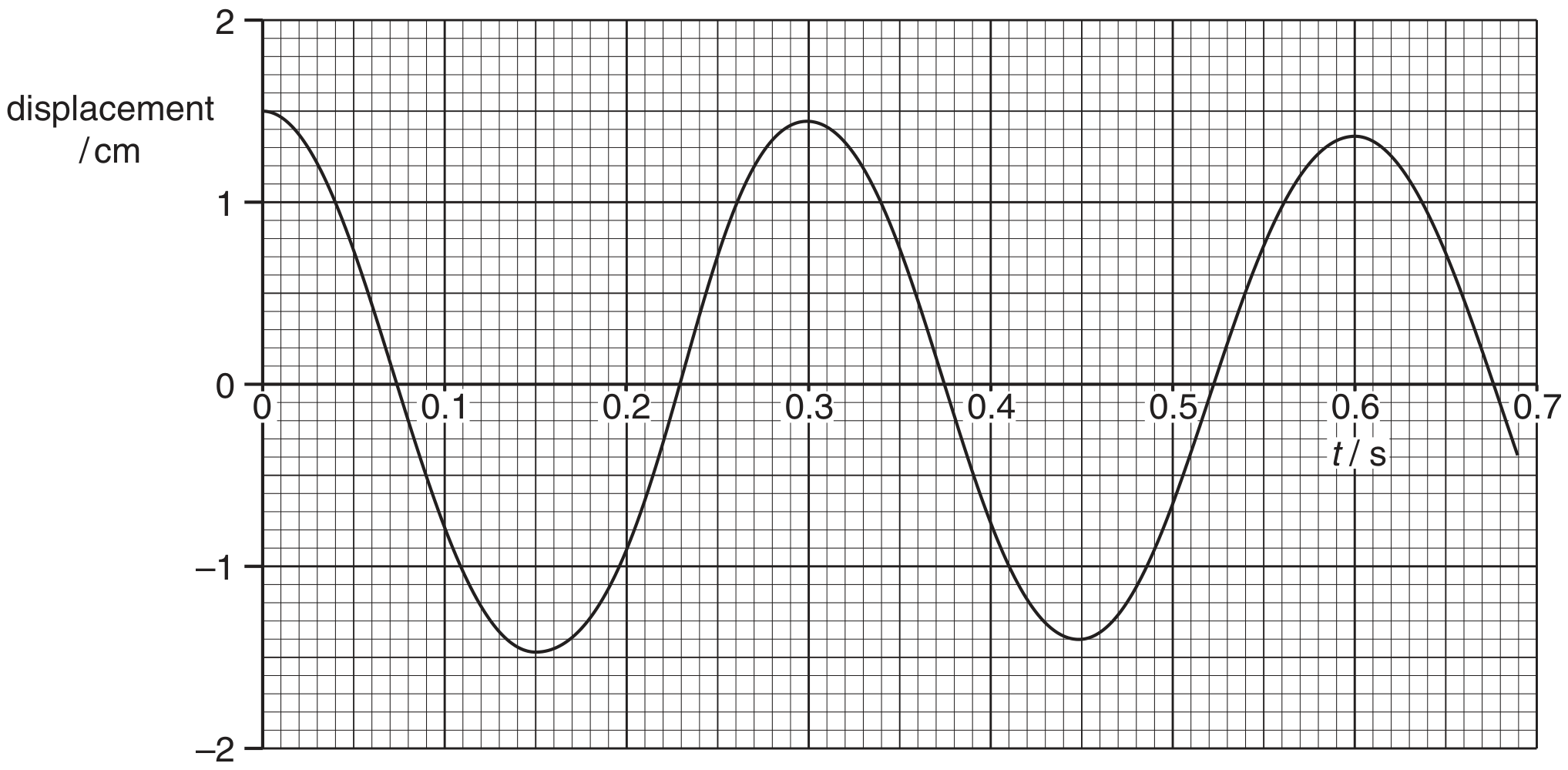
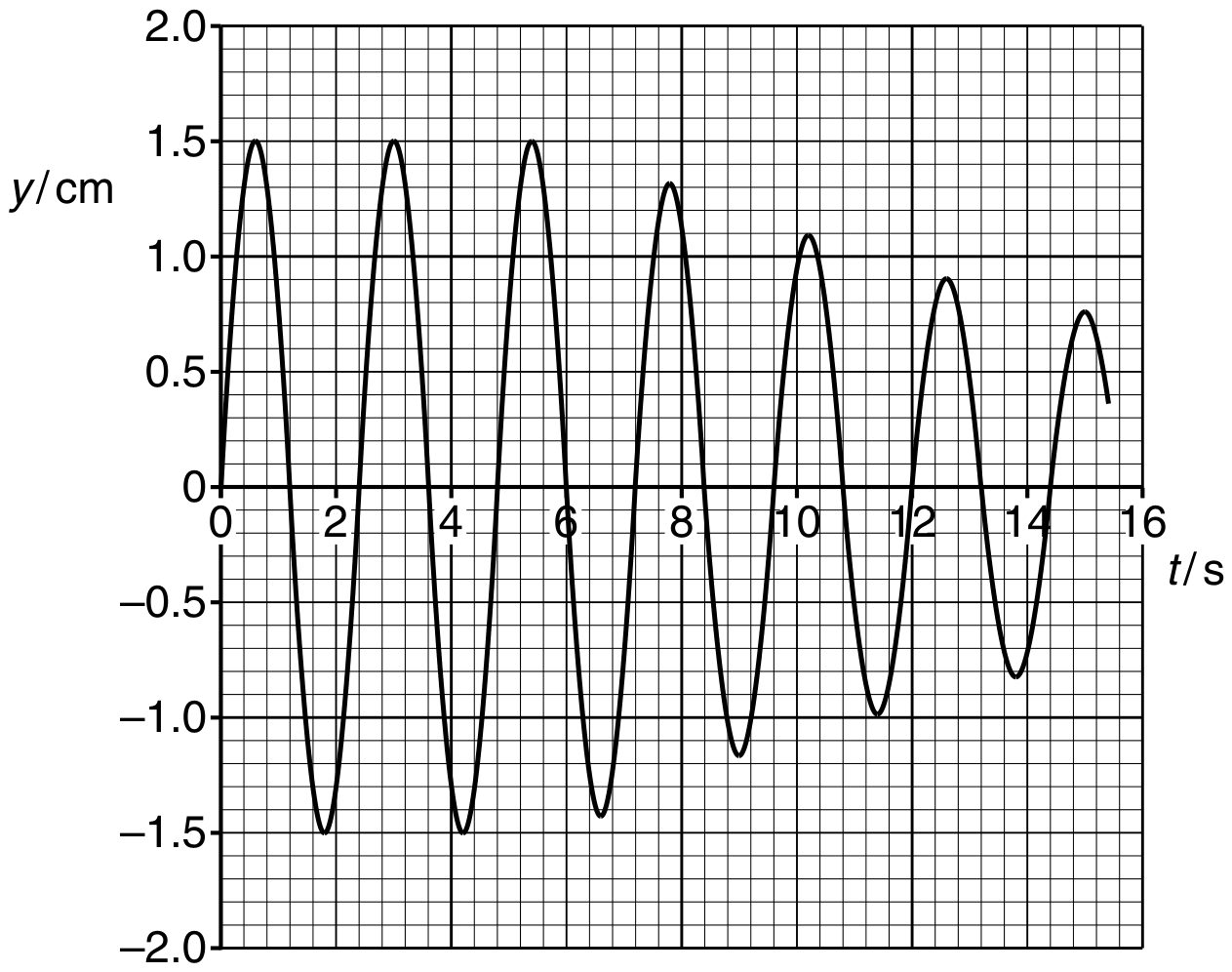
The magnet is displaced vertically and then released. The variation with time t of the vertical displacement y of the magnet is shown in Fig. 1.2.
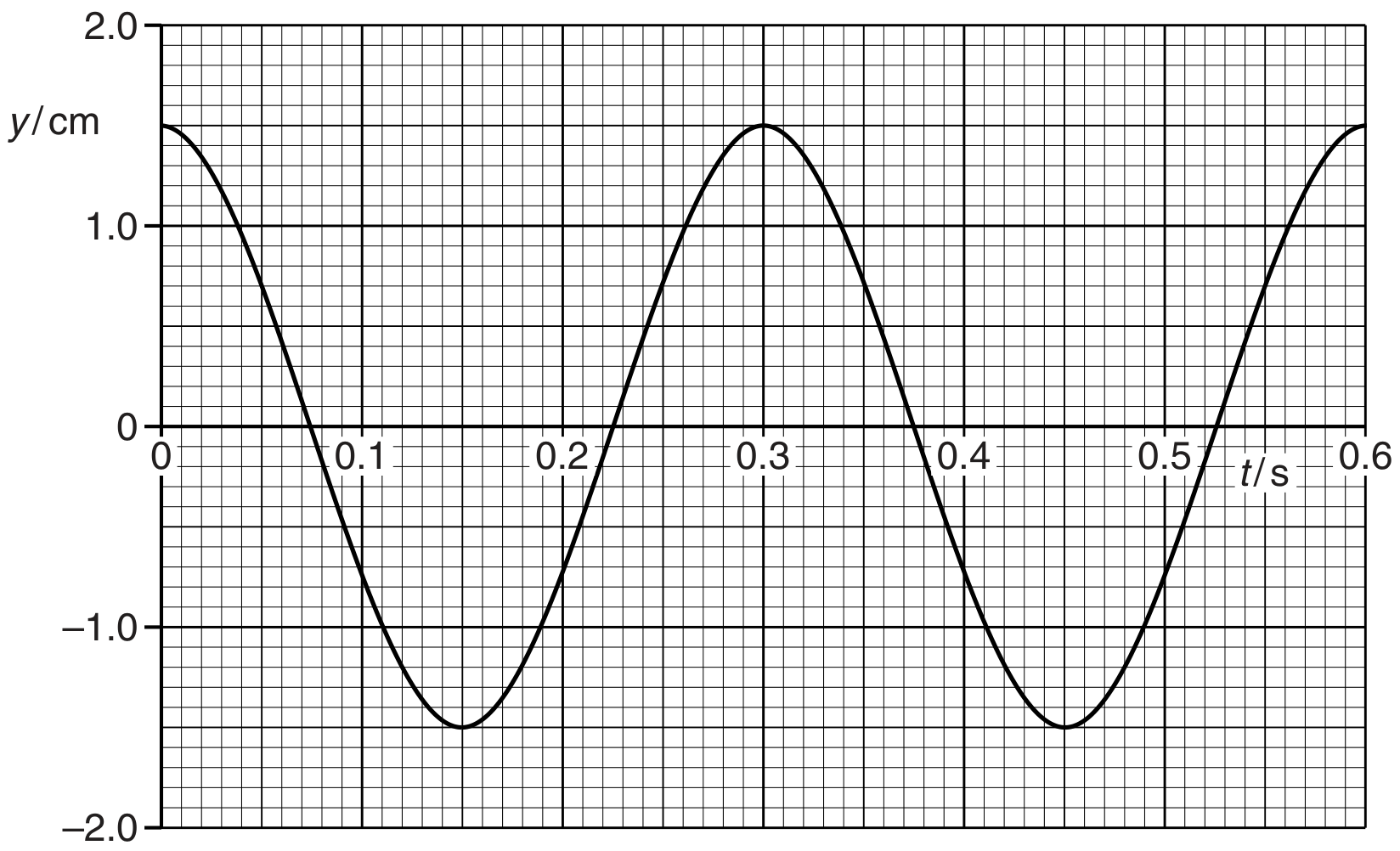
Fig. 1.2

Fig. 1.2

The mass of the magnet is 130 g .

(a)

For the oscillations of the magnet, use Fig. 1.2 to

[ 2 ]
(i)

show that the maximum kinetic energy of the oscillating magnet is 6.4 mJ .

[ 2 ]
(b)

The cardboard cup is now replaced with a cup made of aluminium foil. During 10 complete oscillations of the magnet, the amplitude of vibration is seen to decrease to 0.75 cm from that shown in Fig. 1.2. The change in angular frequency is negligible.

[ 2 ]
(i)

Show that the loss in energy of the oscillating magnet is 4.8 mJ .
[ 2 ]
[Maximum number: 2]

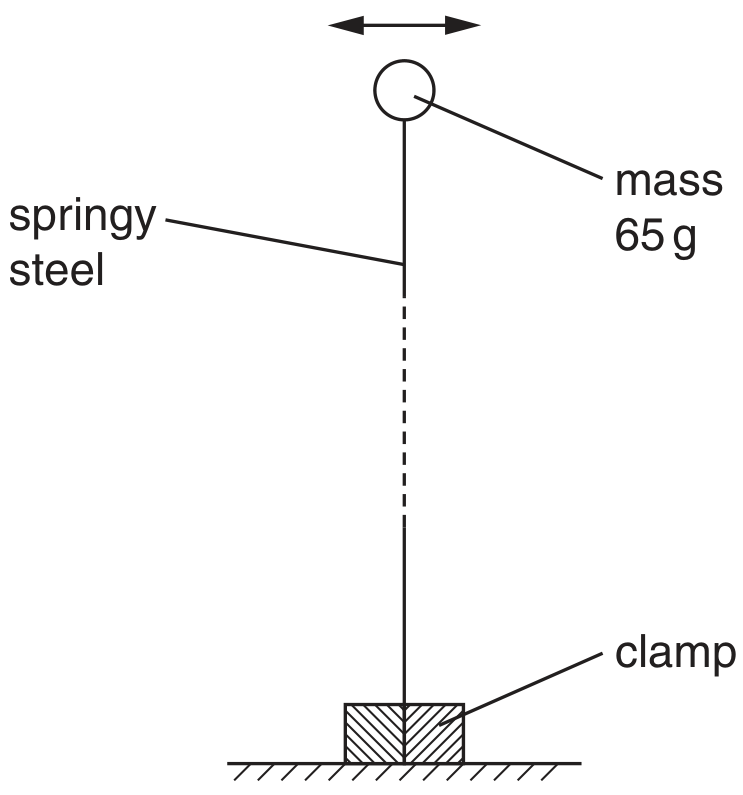
A long strip of springy steel is clamped at one end so that the strip is vertical. A mass of 65 g is attached to the free end of the strip, as shown in Fig. 2.1.

Fig. 2.1

Fig. 2.1

The mass is pulled to one side and then released. The variation with time t of the horizontal displacement of the mass is shown in Fig. 2.2.

Fig. 2.2

Fig. 2.2

The mass undergoes damped simple harmonic motion.

(a)
(i)

Hence show that the initial energy stored in the steel strip before the mass is released is approximately 3.2 mJ .

[ 2 ]
[Maximum number: 5]

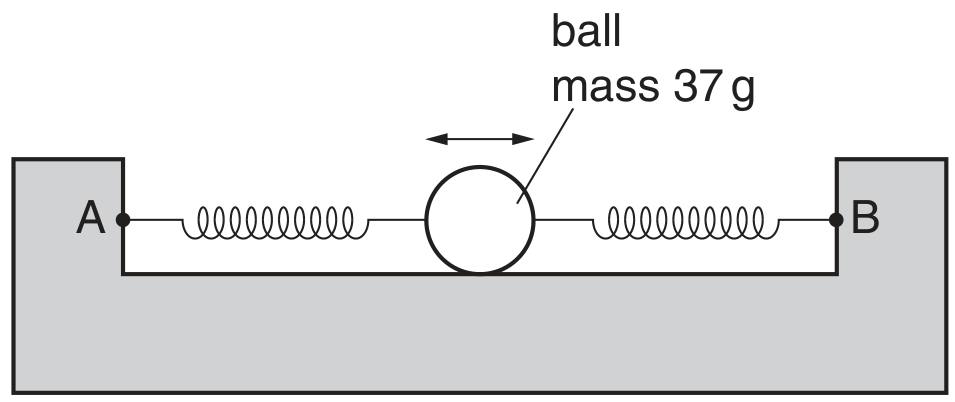
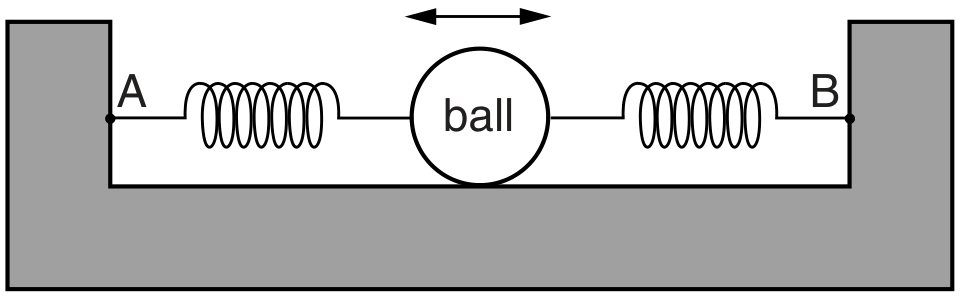
A ball of mass 37 g is held between two fixed points A and B by two stretched helical springs, as shown in Fig. 2.1.

Fig. 2.1

Fig. 2.1

The ball oscillates along the line AB with simple harmonic motion of frequency 3.5 Hz and amplitude 2.8 cm .

(a)

Show that the total energy of the oscillations is 7.0 mJ .

[ 2 ]
(b)

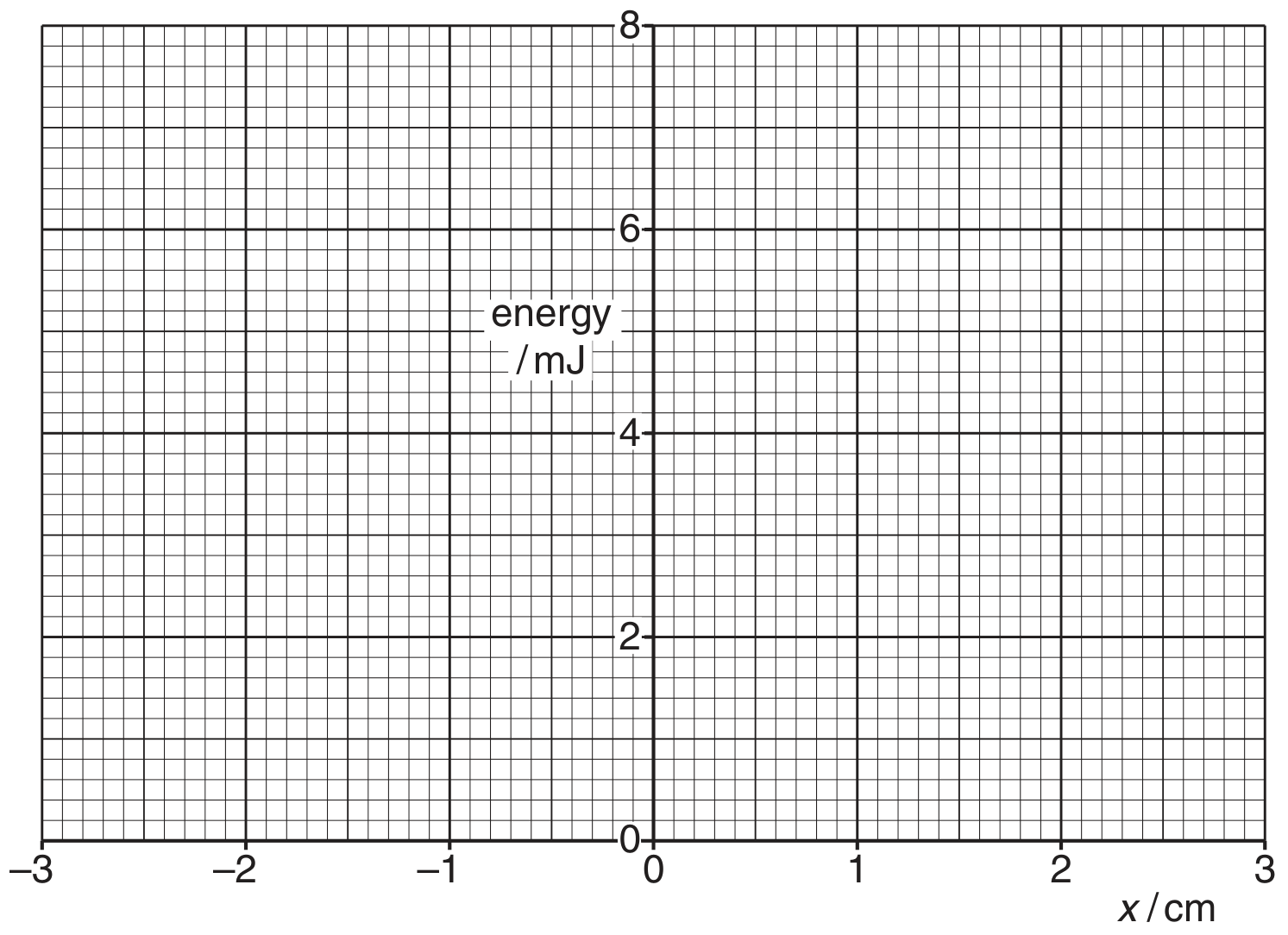
On the axes of Fig. 2.2 and using your answers in (a) and (b), sketch a graph to show the variation with displacement x of

[ 3 ]
(i)

the total energy of the system (label this line T ),

[ 1 ]
(ii)

the potential energy stored in the springs (label this line P ).

Fig. 2.2

Fig. 2.2

[ 2 ]
[Maximum number: 2]

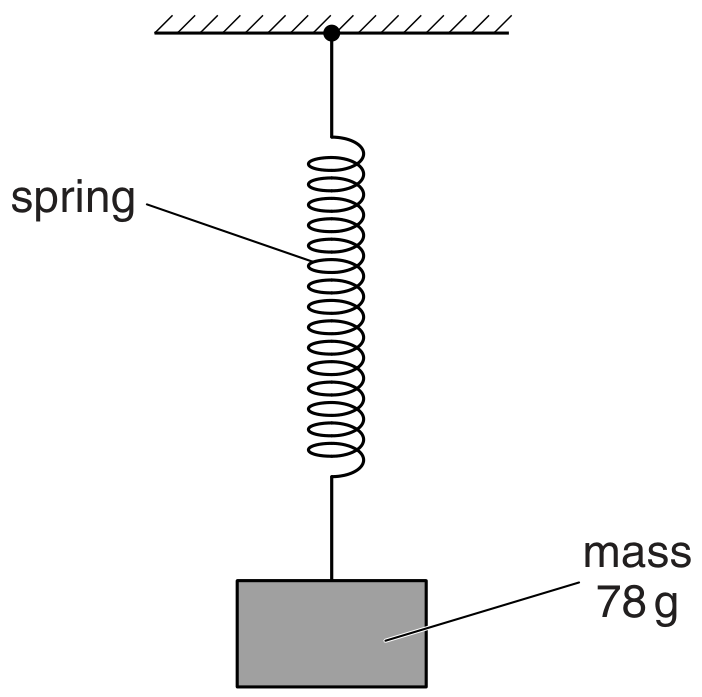
A mass of 78 g is suspended from a fixed point by means of a spring, as illustrated in Fig. 3.1.

Fig. 3.1

Fig. 3.1

The stationary mass is pulled vertically downwards through a distance of 2.1 cm and then released.
The mass is observed to perform simple harmonic motion with a period of 0.69 s .

(a)

Calculate the total energy of oscillation of the mass.
energy =
J

[ 2 ]
[Maximum number: 3]

A bar magnet of mass 250 g is suspended from the free end of a spring, as illustrated in Fig. 3.1.

Fig. 3.1

Fig. 3.1

The magnet hangs so that one pole is near the centre of a coil of wire.
The coil is connected in series with a resistor and a switch. The switch is open.
The magnet is displaced vertically and then allowed to oscillate.
At time t=0, the magnet is oscillating freely. At time t=6.0 st=6.0 \mathrm{~s}, the switch in the circuit is closed.
The variation with time t of the vertical displacement y of the magnet is shown in Fig. 3.2.

Fig. 3.2

Fig. 3.2

(a)

For the oscillating magnet, use data from Fig. 3.2 to determine, to two significant figures:

[ 3 ]
(i)

the energy of the oscillations during the time interval t=0 to t=6.0 st=6.0 \mathrm{~s}.

energy =J [3]
[ 3 ]
[Maximum number: 3]

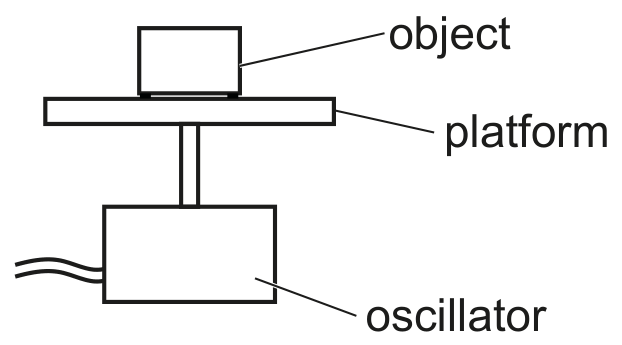
A small object of mass 24 g rests on a platform. The platform is attached to an oscillator, as shown in Fig. 3.1.

Fig. 3.1

Fig. 3.1

The oscillator moves the platform up and down.

(a)

The total energy of the oscillations of the object is 2.2×10⁴ J2.2 \times 10^{-4} \mathrm{~J}. In one oscillation the object travels a total distance of 14 mm .

Calculate the angular frequency ω\omega of the oscillations.

ω=rad s1\begin{aligned} & \omega= \\ & \mathrm{rad} \mathrm{~s}^{-1} \end{aligned}
[ 3 ]
[Maximum number: 3]

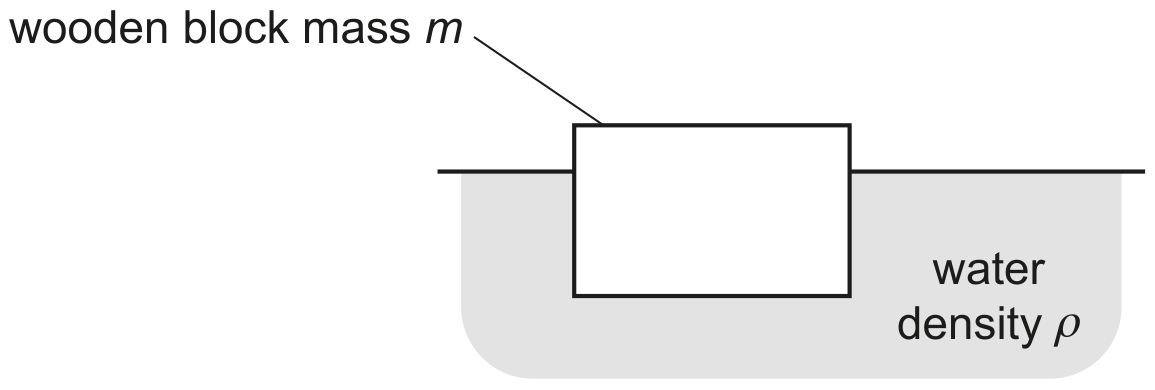
A small wooden block (cuboid) of mass m floats in water, as shown in Fig. 3.1.

Fig. 3.1

Fig. 3.1

The top face of the block is horizontal and has area A. The density of the water is ρ\rho.

(a)

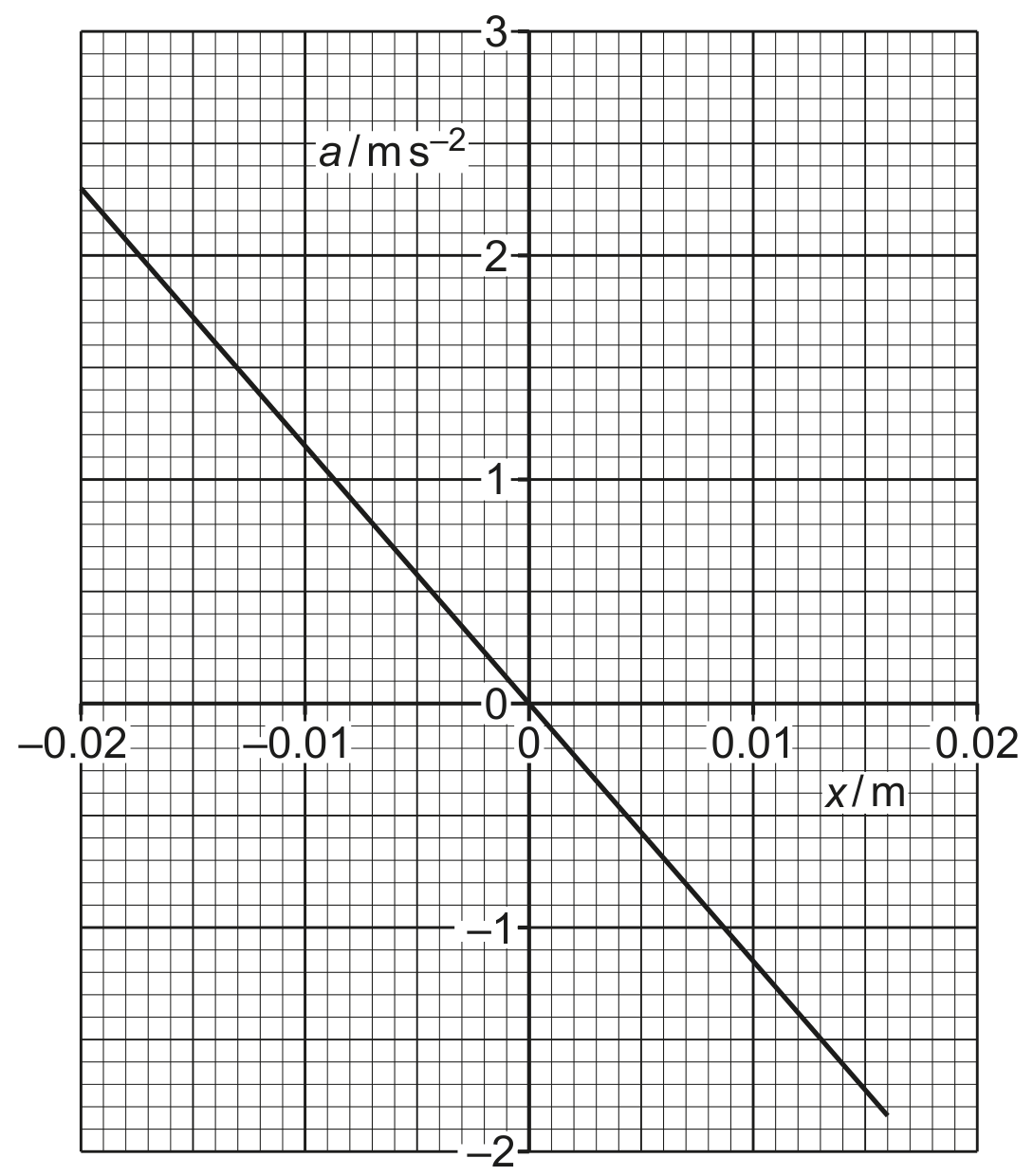
The block is now placed in a liquid with a greater density. The block is displaced and released so that it oscillates vertically. The variation with displacement x of the acceleration a of the block is measured for the first half oscillation, as shown in Fig. 3.3.

Fig. 3.3

Fig. 3.3

[ 3 ]
(i)

The mass of the block is 0.57 kg .

Use Fig. 3.3 to determine the decrease ΔE\Delta E in energy of the oscillation for the first half oscillation.
E= J

[ 3 ]
[Maximum number: 4]

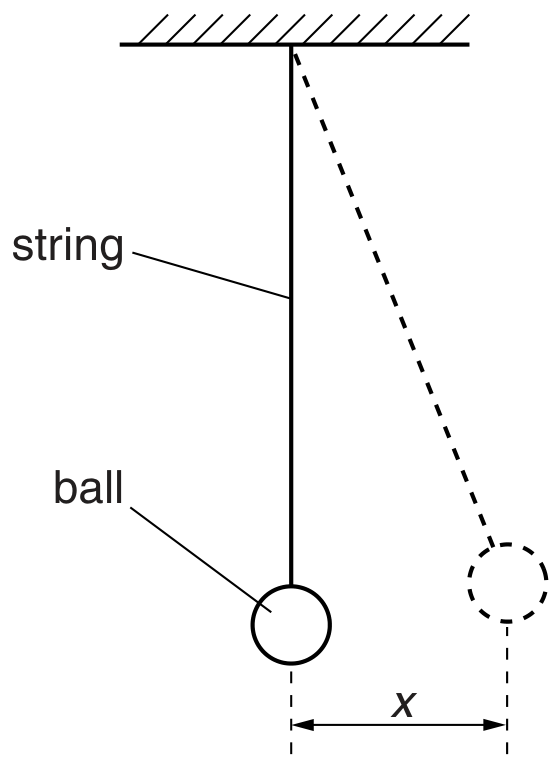
A metal ball is suspended from a fixed point by means of a string, as illustrated in Fig. 3.1.

Fig. 3.1

Fig. 3.1

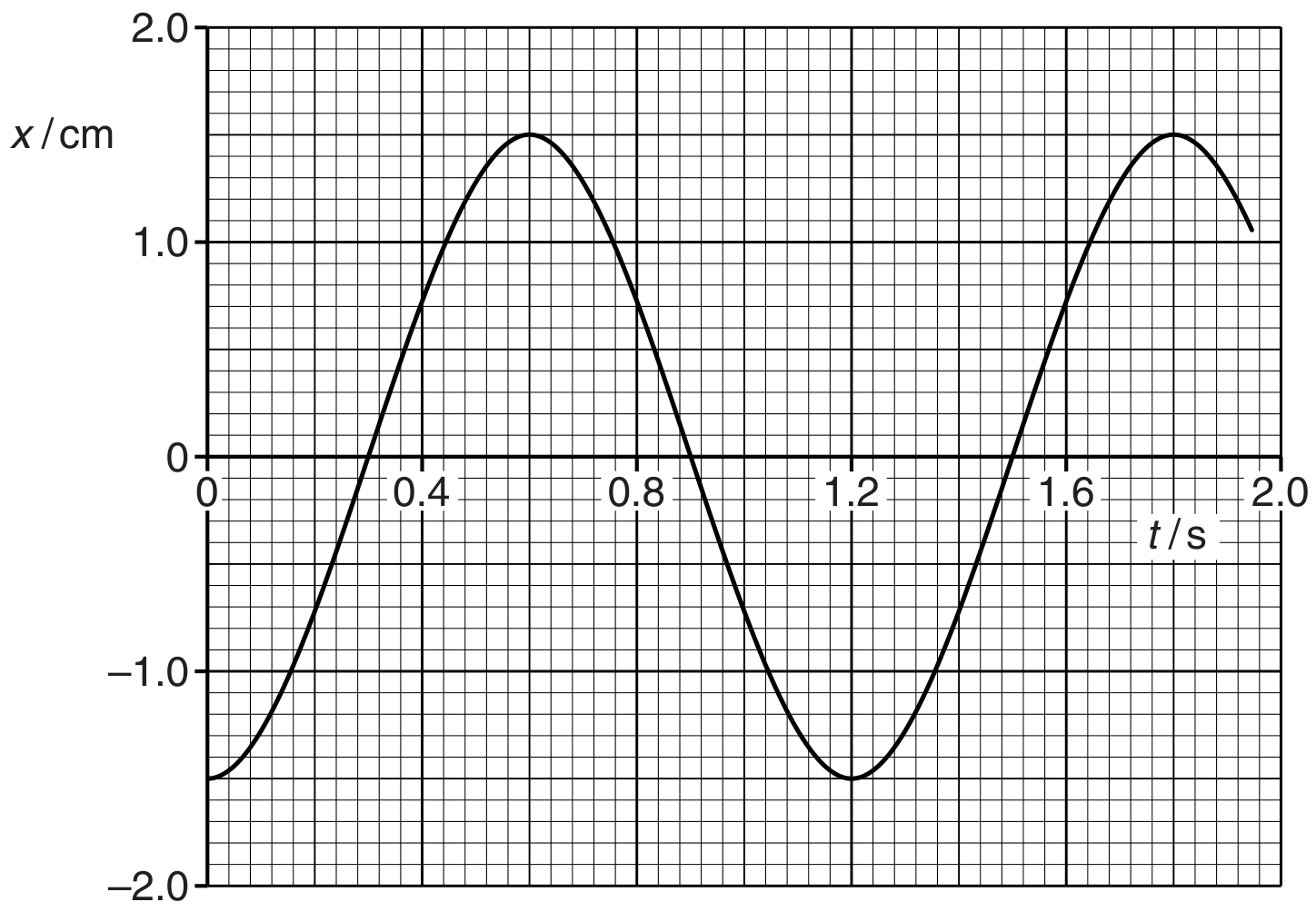
The ball is given a small displacement and then released. The variation with time t of the displacement x of the ball is shown in Fig. 3.2.

Fig. 3.2

Fig. 3.2

(a)

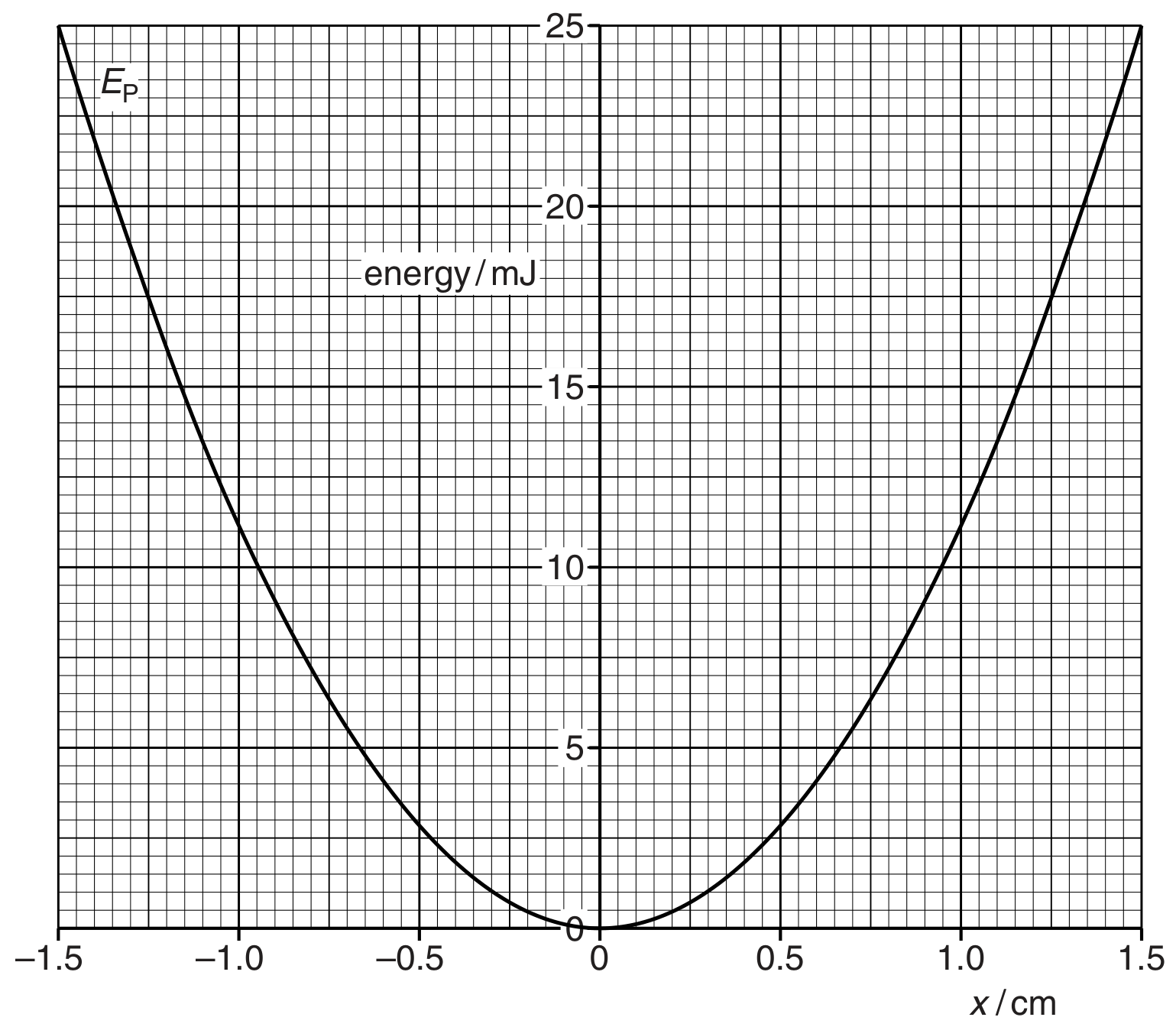
The variation with displacement x of the potential energy EPE_{\mathrm{P}} of the oscillations of the ball is shown in Fig. 3.3.

Fig. 3.3

Fig. 3.3

[ 4 ]
(i)

On the axes of Fig. 3.3, sketch a graph to show the variation with displacement x of the kinetic energy of the ball.

[ 2 ]
(ii)

The amplitude of the oscillations reduces over a long period of time. After many oscillations, the amplitude of the oscillations is 0.60 cm .

Use Fig. 3.3 to determine the total energy of the oscillations of the ball for oscillations of amplitude 0.60 cm . Explain your working.
energy =
J

[ 2 ]
[Maximum number: 3]

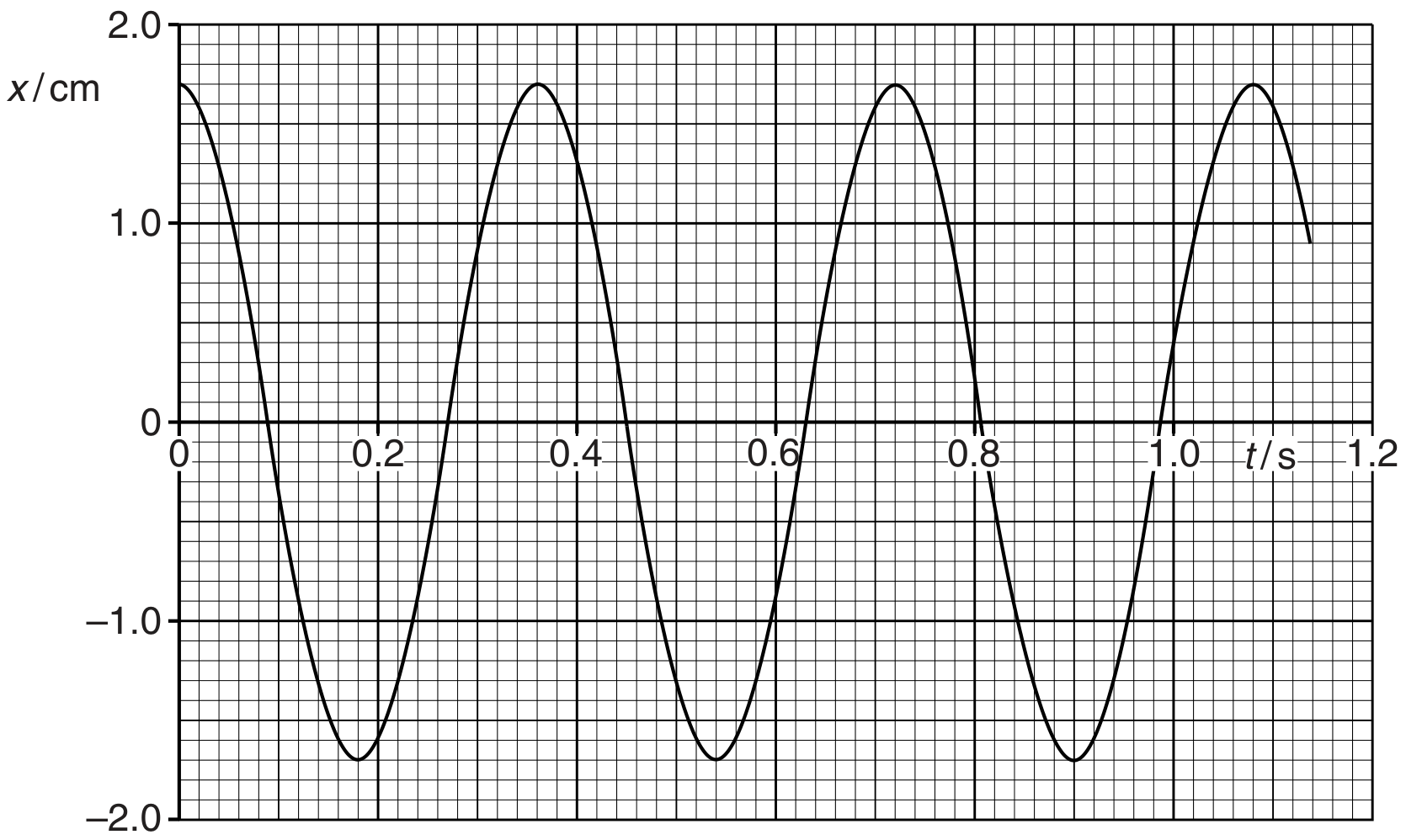
A ball is held between two fixed points A and B by means of two stretched springs, as shown in Fig. 3.1.

Fig. 3.1

Fig. 3.1

The ball is free to oscillate along the straight line AB . The springs remain stretched and the motion of the ball is simple harmonic.

The variation with time t of the displacement x of the ball from its equilibrium position is shown in Fig. 3.2.

Fig. 3.2

Fig. 3.2

(a)

Calculate the displacement of the ball at which its kinetic energy is equal to one half of the maximum kinetic energy.
cm

[ 3 ]
[Maximum number: 3]

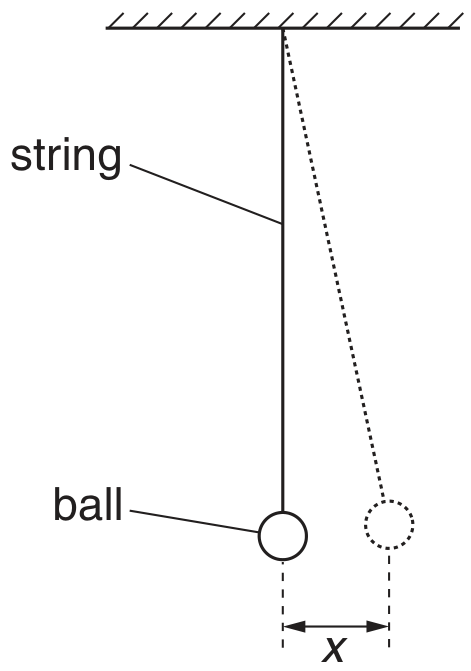
A small metal ball is suspended from a fixed point by means of a string, as shown in Fig. 4.1.

Fig. 4.1

Fig. 4.1

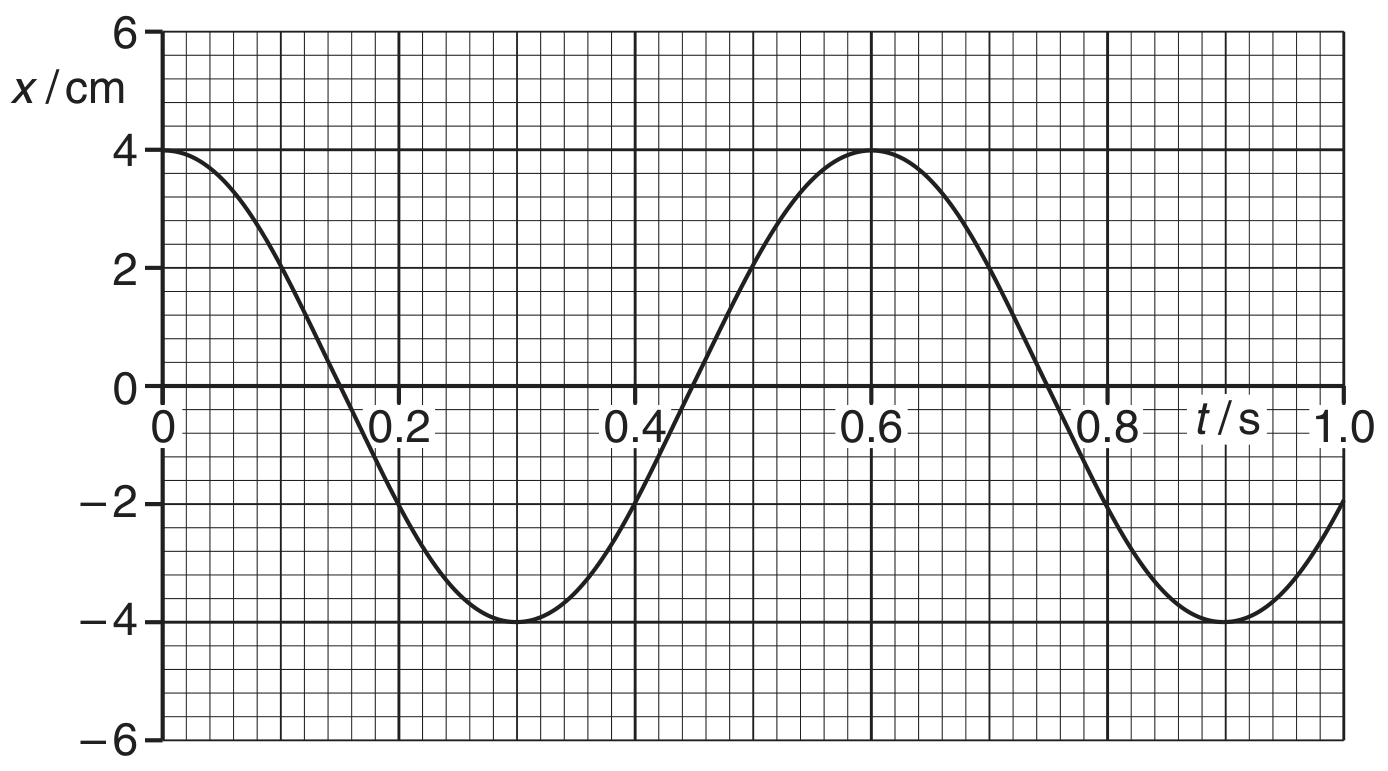
The ball is pulled a small distance to one side and then released. The variation with time t of the horizontal displacement x of the ball is shown in Fig. 4.2.

Fig. 4.2

Fig. 4.2

The motion of the ball is simple harmonic.

(a)

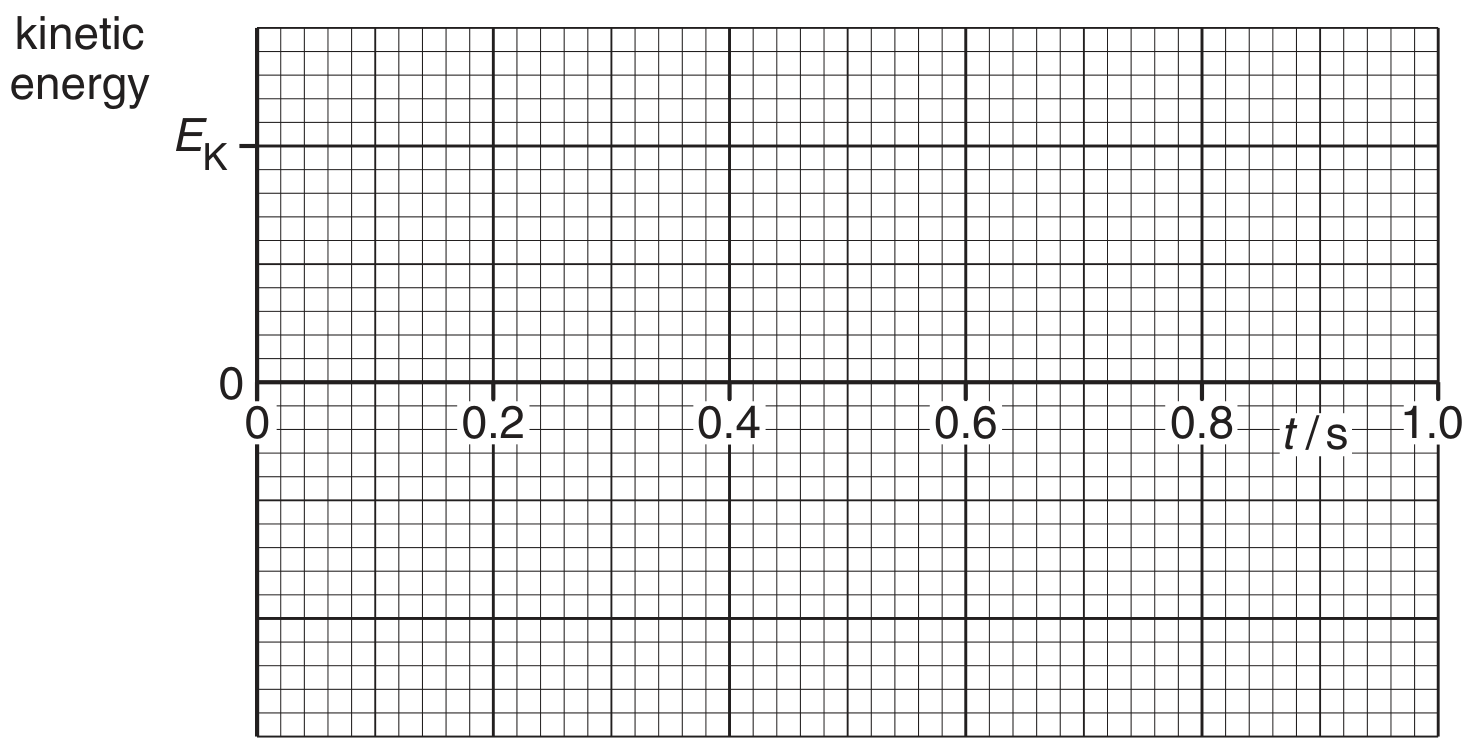
The maximum kinetic energy of the ball is EKE_{\mathrm{K}}. On the axes of Fig. 4.3, sketch a graph to show the variation with time t of the kinetic energy of the ball for the first 1.0 s of its motion.

Fig. 4.3

Fig. 4.3

[ 3 ]
0