EduNinja
[Maximum number: 3]

electric potential energy.
energy = J

(a)

Some gas, initially at a temperature of 27.2C27.2^{\circ} \mathrm{C}, is heated so that its temperature rises to 38.8C38.8^{\circ} \mathrm{C}.

Calculate, in kelvin, to an appropriate number of decimal places,

(i)

the initial temperature of the gas,

initial temperature =
(ii)

the rise in temperature.

rise in temperature =
(a)
(i)

State the magnitude and unit of absolute zero on the thermodynamic temperature scale.

[ 1 ]
(ii)

Explain why temperature measured using a laboratory liquid-in-glass thermometer does not give a measurement of thermodynamic temperature.

[ 1 ]
(b)

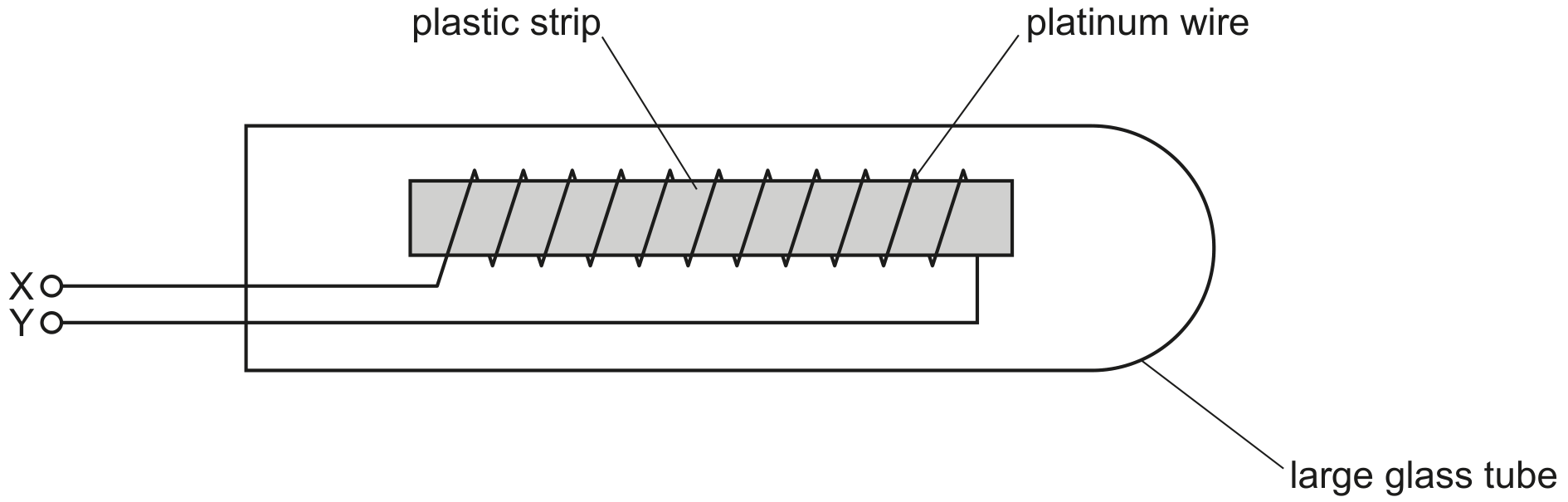
Fig. 2.1 shows a simplified diagram of a type of thermometer called a platinum resistance thermometer.

Fig. 2.1

Fig. 2.1

The glass tube is immersed in the environment for which the temperature is to be determined. The resistance between the terminals X and Y is measured.

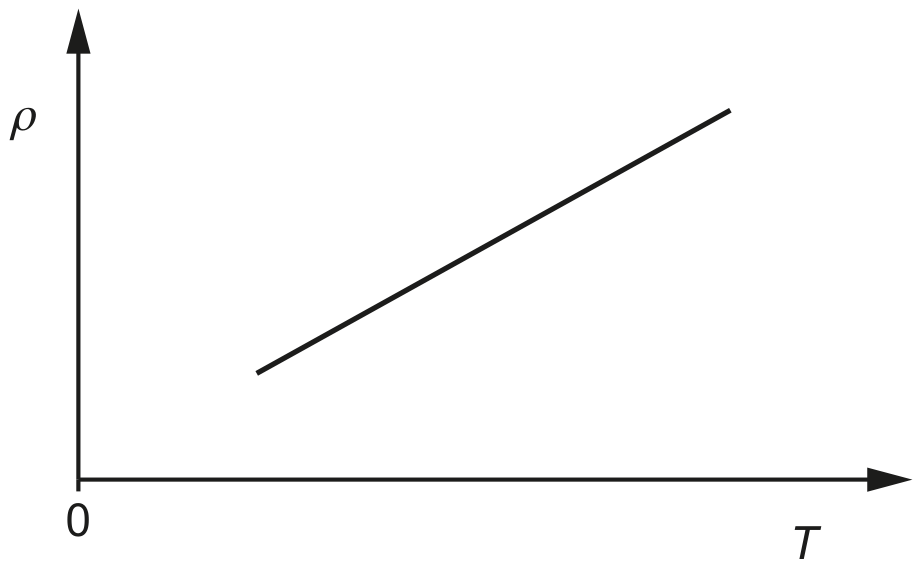
Fig. 2.2 shows the variation of the resistivity ρ\rho of platinum with thermodynamic temperature T.

Fig. 2.2

Fig. 2.2

[ 4 ]
(i)

Explain how Fig. 2.2 shows that platinum is a suitable metal for use in a resistance thermometer.

[ 2 ]
(ii)

Suggest a reason why a platinum resistance thermometer is not suitable for measuring a rapidly changing temperature.

[ 1 ]
(iii)

Suggest a type of thermometer that is suitable for measuring a rapidly changing temperature.

[ 1 ]
[Maximum number: 5]

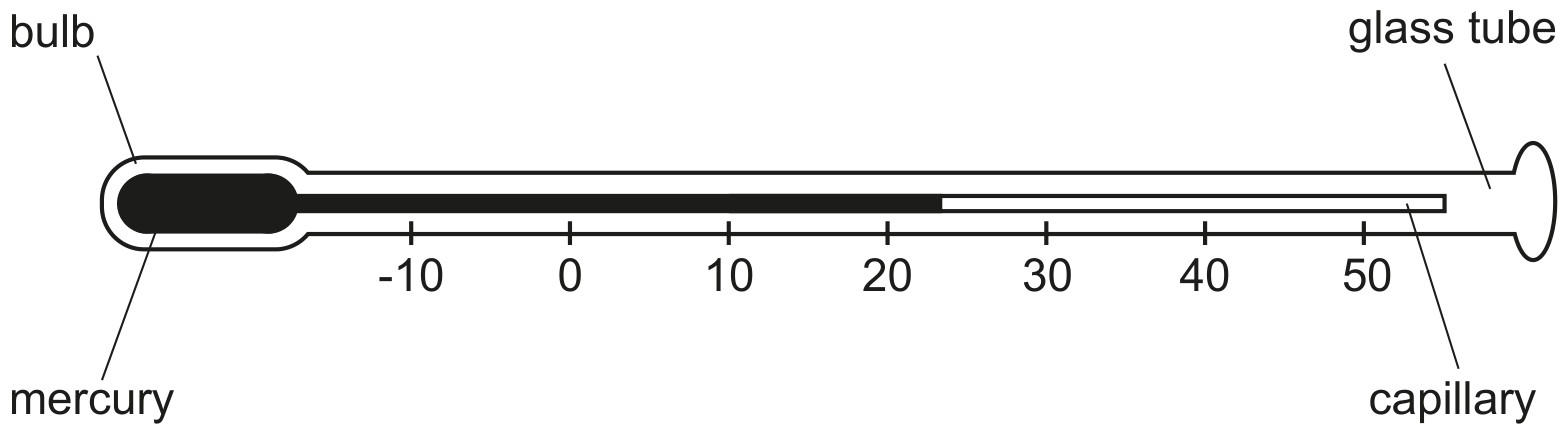
Fig. 2.1 shows a laboratory thermometer that is calibrated to measure temperature in degrees Celsius.

Fig. 2.1

Fig. 2.1

The thermometer makes use of the fact that the density of mercury varies with temperature.

(a)

State two other physical properties of materials, apart from the density of a liquid, that can be used for measuring temperature.

1

2

[ 2 ]
(b)

The thermometer is initially at 23.0C23.0^{\circ} \mathrm{C}, as shown in Fig. 2.1. It is used to measure the temperature of an insulated beaker of water that is at 37.4C37.4^{\circ} \mathrm{C}. The bulb of the thermometer is inserted into the water, and the water is stirred until the reading on the thermometer becomes steady.

The mass of water in the beaker is 18.7 g .
The mass of mercury in the thermometer is 6.94 g .
The specific heat capacity of water is 4.18 J g1 K14.18 \mathrm{~J} \mathrm{~g}^{-1} \mathrm{~K}^{-1}.
The specific heat capacity of mercury is 0.140 J g1 K10.140 \mathrm{~J} \mathrm{~g}^{-1} \mathrm{~K}^{-1}.
The glass of the thermometer and the beaker containing the water can be considered to have negligible heat capacity.

[ 1 ]
(i)

Suggest one change that could be made to the design of the thermometer that would enable it to give a more accurate measurement of temperature.

[ 1 ]
(c)
(i)

Explain why the thermometer in Fig. 2.1 does not provide a direct measurement of thermodynamic temperature.

[ 2 ]
(a)
(i)

State the temperature, in degrees Celsius, of absolute zero.

[ 1 ]
(a)

A resistance thermometer and a thermocouple thermometer are both used at the same time to measure the temperature of a water bath.

Explain why, although both thermometers have been calibrated correctly and are at equilibrium, they may record different temperatures.

[ 2 ]
(b)

State

[ 2 ]
(i)

in what way the absolute scale of temperature differs from other temperature scales,

[ 1 ]
(ii)

what is meant by the absolute zero of temperature.

[ 1 ]
(c)

The temperature of a water bath increases from 50.00C50.00^{\circ} \mathrm{C} to 80.00C80.00^{\circ} \mathrm{C}. Determine, in kelvin and to an appropriate number of significant figures,

[ 2 ]
(i)

the temperature 50.00C50.00^{\circ} \mathrm{C},
temperature = K

[ 1 ]
(ii)

the change in temperature of the water bath.
temperature change = K

[ 1 ]
(a)

The resistance of a thermistor at 0C0^{\circ} \mathrm{C} is 3840Ω3840 \Omega. At 100C100^{\circ} \mathrm{C} the resistance is 190Ω190 \Omega. When the thermistor is placed in water at a particular constant temperature, its resistance is 2300Ω2300 \Omega.

[ 5 ]
(i)

Assuming that the resistance of the thermistor varies linearly with temperature, calculate the temperature of the water.
temperature = C[2]{ }^{\circ} \mathrm{C}[2]

[ 2 ]
(ii)

The temperature of the water, as measured on the thermodynamic scale of temperature, is 286 K .

By reference to what is meant by the thermodynamic scale of temperature, comment on your answer in (i).

[ 3 ]
(a)

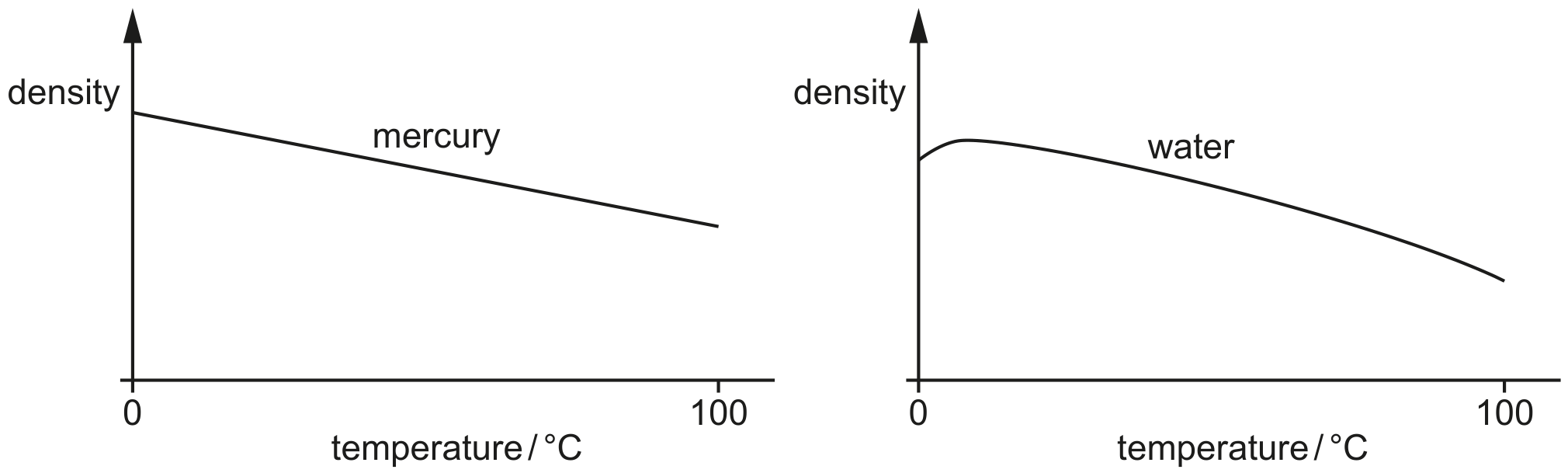
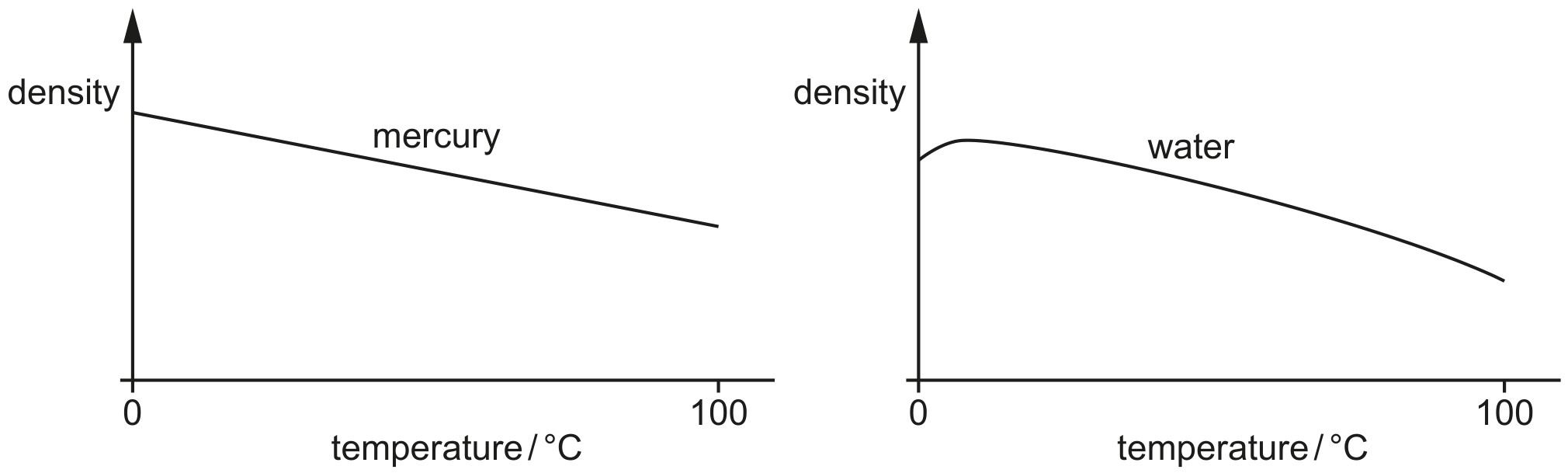
Fig. 3.1 shows the variations with temperature of the densities of mercury and of water between 0C0^{\circ} \mathrm{C} and 100C100^{\circ} \mathrm{C}.

Fig. 3.1

Fig. 3.1

Temperature may be measured using the variation with temperature of the density of a liquid.
Suggest why, for measuring temperature over this temperature range:

[ 3 ]
(i)

mercury is a suitable liquid

[ 1 ]
(ii)

water is not a suitable liquid.

[ 2 ]
(b)

A beaker contains a liquid of mass 120 g . The liquid is supplied with thermal energy at a rate of 810 W . The beaker has a mass of 42 g and a specific heat capacity of 0.84Jg1 K10.84 \mathrm{Jg}^{-1} \mathrm{~K}^{-1}. The beaker and the liquid are in thermal equilibrium with each other at all times and are insulated from the surroundings.

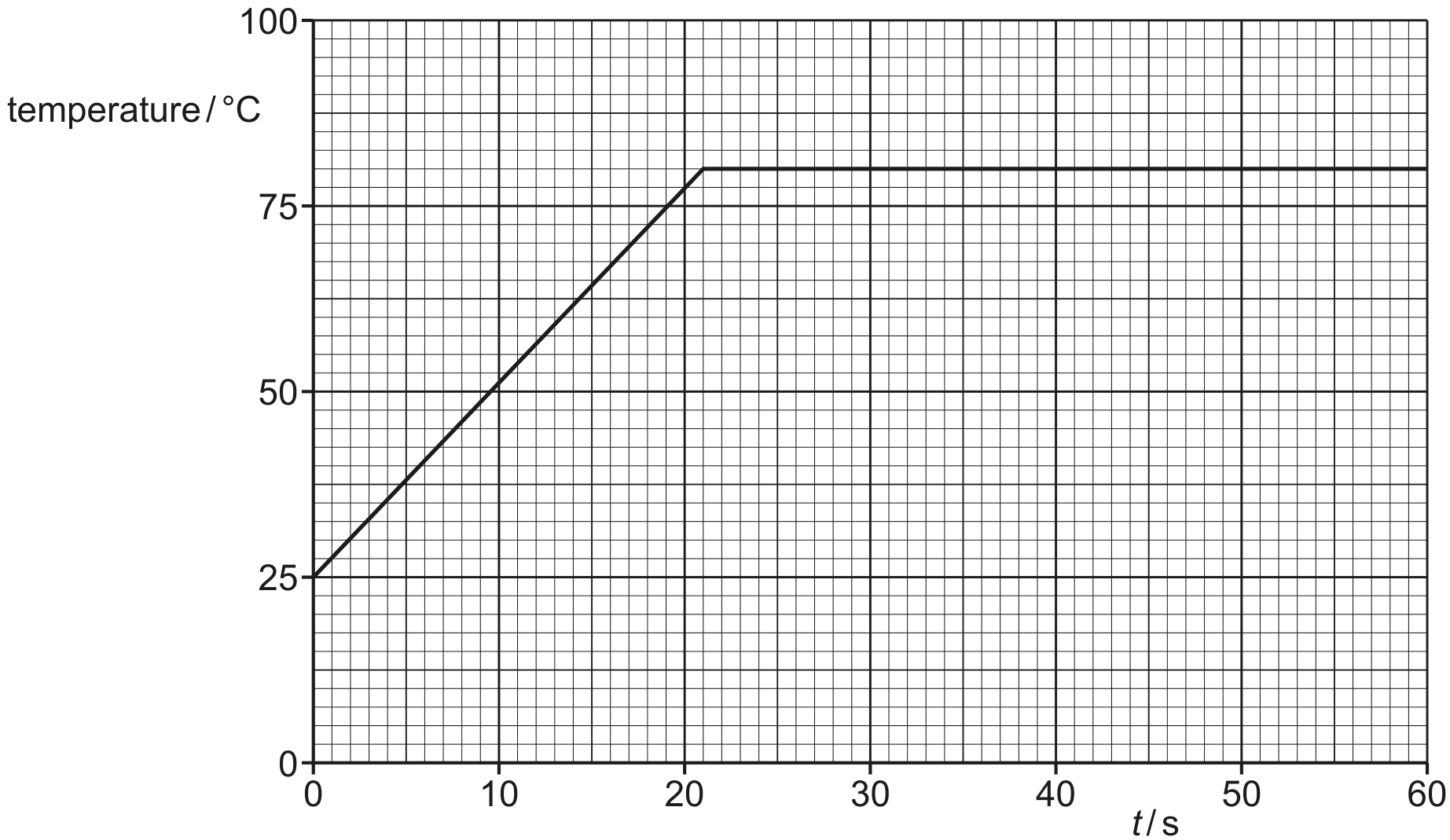
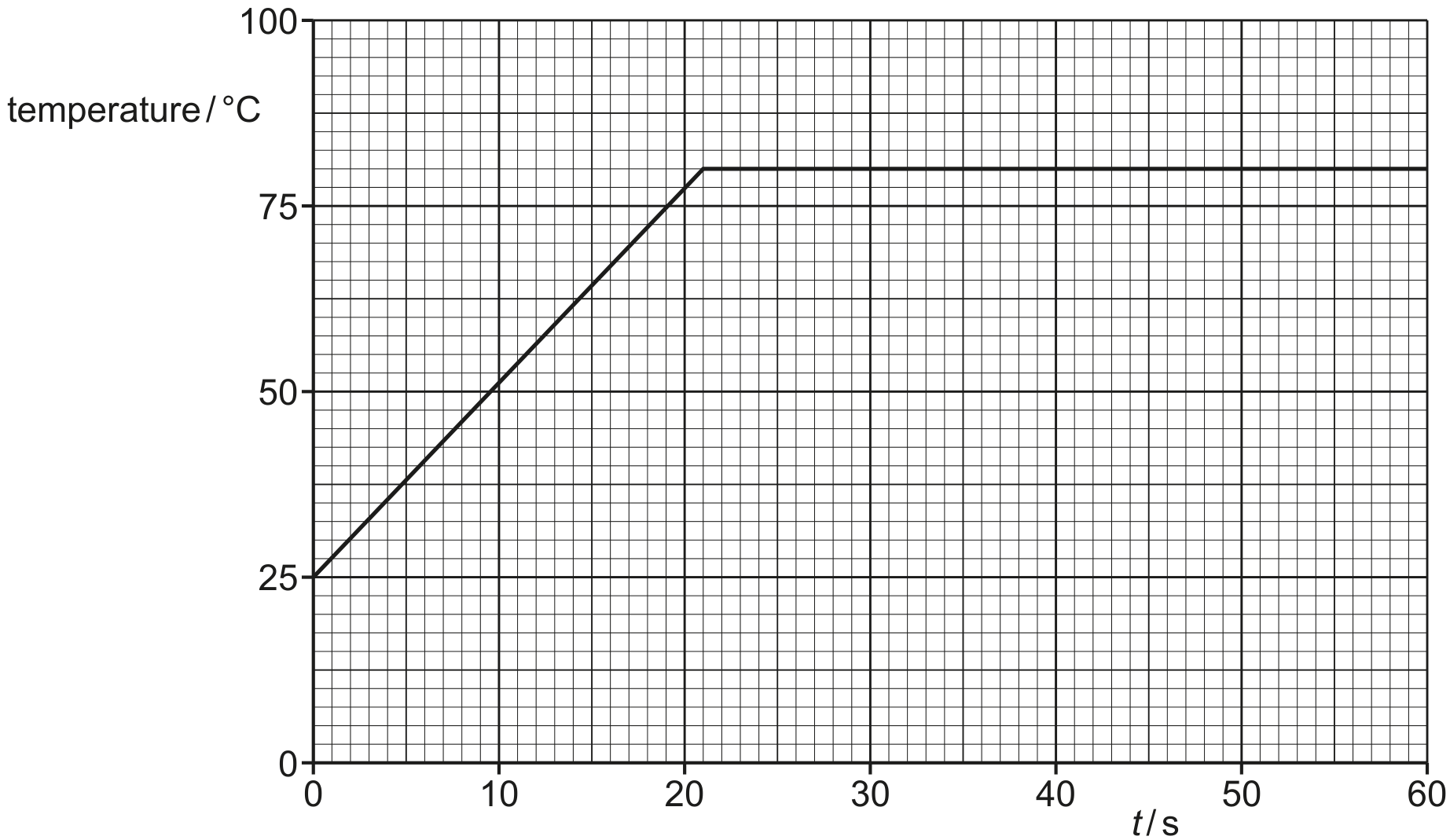
Fig. 3.2 shows the variation with time t of the temperature of the liquid.

Fig. 3.2

Fig. 3.2

[ 1 ]
(i)

State the boiling temperature, in C{ }^{\circ} \mathrm{C}, of the liquid.

[ 1 ]
(a)

Fig. 3.1 shows the variations with temperature of the densities of mercury and of water between 0C0^{\circ} \mathrm{C} and 100C100^{\circ} \mathrm{C}.

Fig. 3.1

Fig. 3.1

Temperature may be measured using the variation with temperature of the density of a liquid.
Suggest why, for measuring temperature over this temperature range:

[ 3 ]
(i)

mercury is a suitable liquid

[ 1 ]
(ii)

water is not a suitable liquid.

[ 2 ]
(b)

A beaker contains a liquid of mass 120 g . The liquid is supplied with thermal energy at a rate of 810 W . The beaker has a mass of 42 g and a specific heat capacity of 0.84Jg1 K10.84 \mathrm{Jg}^{-1} \mathrm{~K}^{-1}. The beaker and the liquid are in thermal equilibrium with each other at all times and are insulated from the surroundings.

Fig. 3.2 shows the variation with time t of the temperature of the liquid.

Fig. 3.2

Fig. 3.2

[ 1 ]
(i)

State the boiling temperature, in C{ }^{\circ} \mathrm{C}, of the liquid.

temperature = C=\ldots \ldots \ldots ~{ }^{\circ} \mathrm{C}

[ 1 ]
0