(a)
State one similarity and one difference between gravitational potential due to a point mass and electric potential due to a point charge.
similarity
difference
[ 2 ]
 EduNinja
State one similarity and one difference between gravitational potential due to a point mass and electric potential due to a point charge.
similarity
difference
Define electric potential at a point.
Two point charges A and B are separated by a distance of 20 nm in a vacuum, as illustrated in Fig. 3.1.
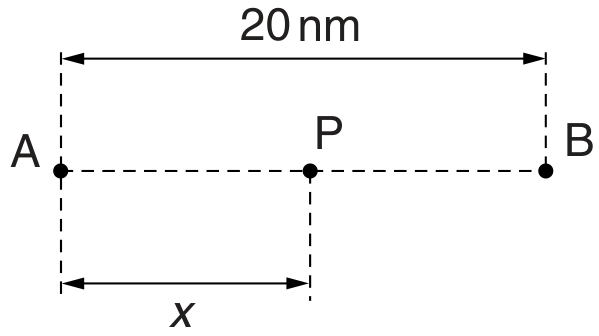
Fig. 3.1
A point P is a distance x from A along the line A B.
The variation with distance x of the electric potential due to charge A alone is shown in Fig. 3.2.
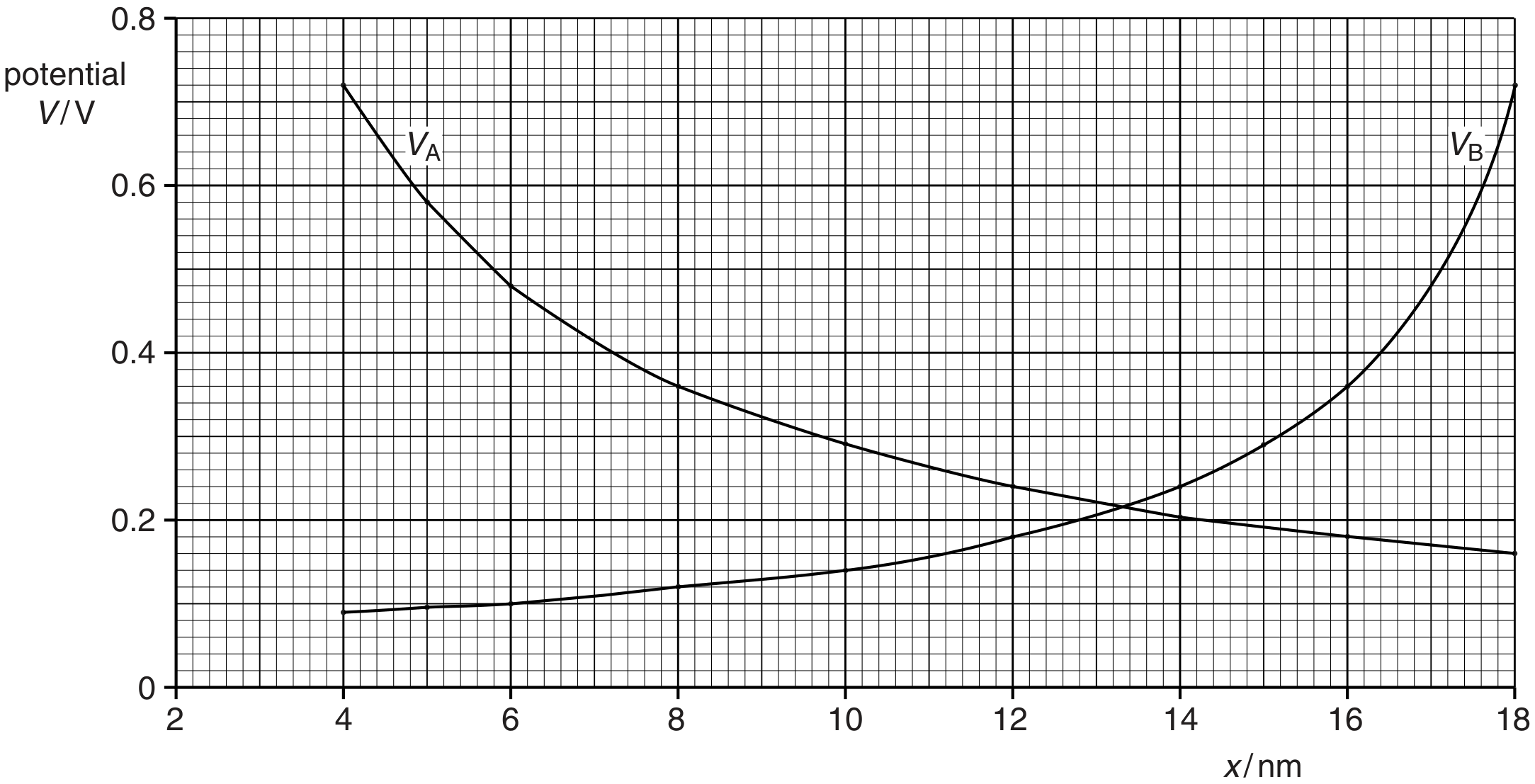
Fig. 3.2
The variation with distance x of the electric potential due to charge B alone is also shown in Fig. 3.2.
By reference to Fig. 3.2, state how the combined electric potential due to both charges may be determined.
Without any calculation, use Fig. 3.2 to estimate the distance x at which the combined electric potential of the two charges is a minimum.
The point P is a distance from A.
An -particle has kinetic energy when at infinity.
Use Fig. 3.2 to determine the minimum value of such that the -particle may travel from infinity to point P .
Define electric potential at a point.
Two small spherical charged particles P and Q may be assumed to be point charges located at their centres. The particles are in a vacuum.
Particle P is fixed in position. Particle Q is moved along the line joining the two charges, as illustrated in Fig. 4.1.
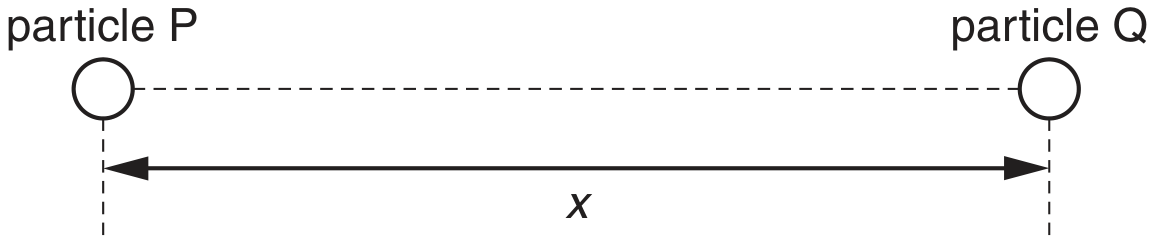
Fig. 4.1
The variation with separation x of the electric potential energy of particle Q is shown in Fig. 4.2.
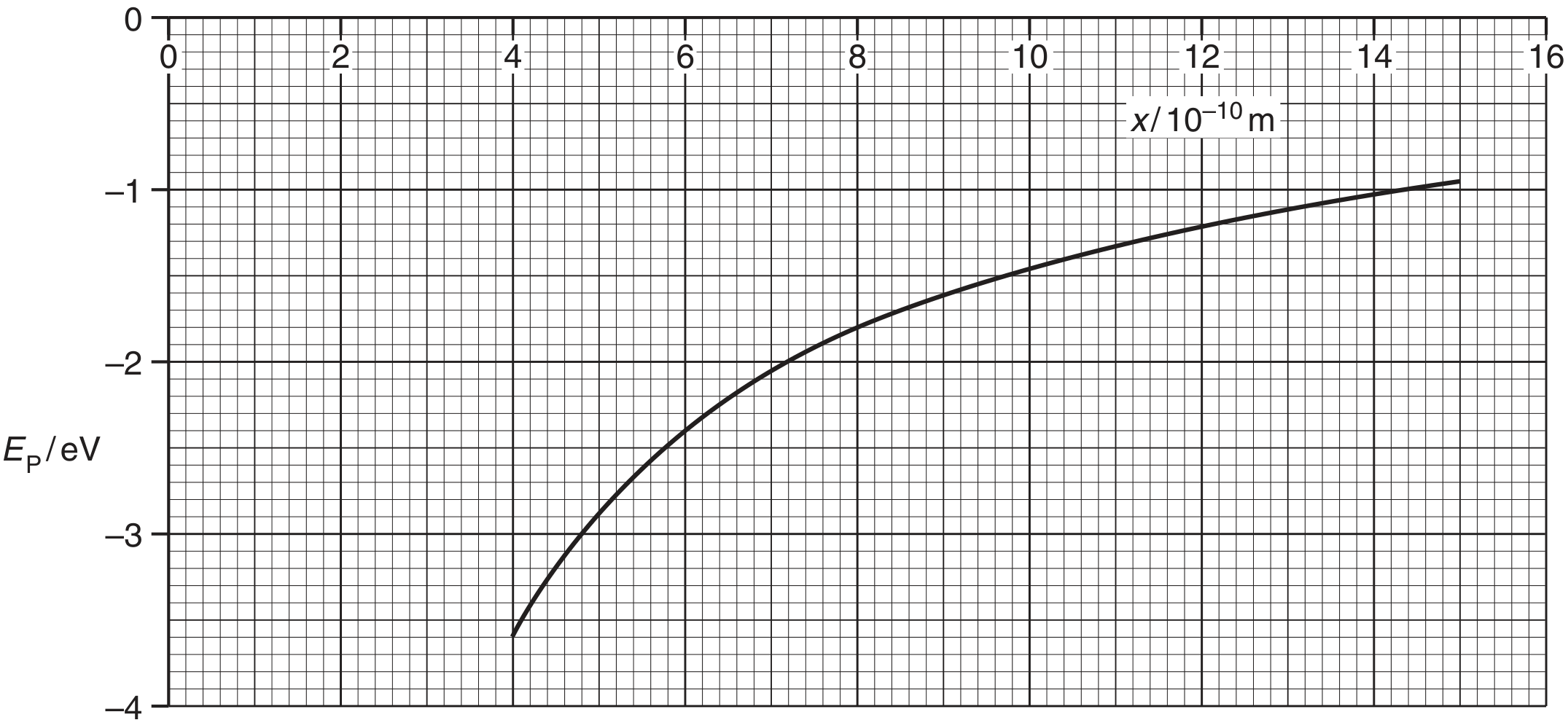
Fig. 4.2
State how the magnitude of the electric field strength is related to potential gradient.
Use your answer in (i) to show that the force on particle Q is proportional to the gradient of the curve of Fig. 4.2.
The magnitude of the charge on each of the particles P and Q is . Calculate the separation of the particles at the point where particle Q has electric potential energy equal to -5.1 eV .
separation = m
A uniform electric field is produced by applying a potential difference of 1200 V across two parallel metal plates in a vacuum, as shown in Fig. 4.1.
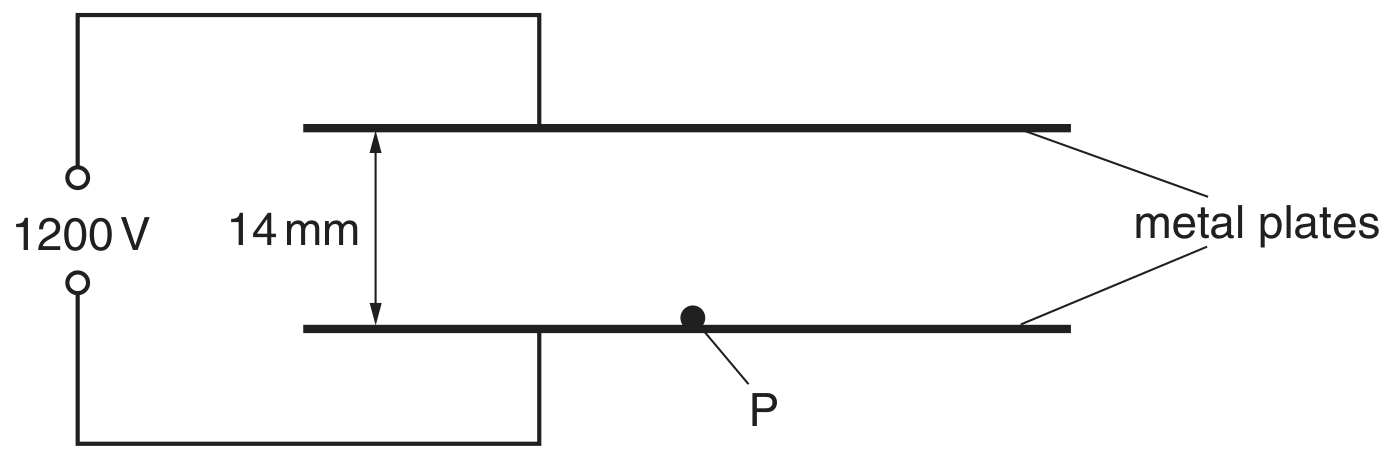
Fig. 4.1
The separation of the plates is 14 mm . A particle P with charge and mass starts from rest at the lower plate and is moved vertically to the top plate by the electric field.
Calculate
the work done on P by the electric field,
work done = J
A positive charge experiences a force F when placed at point X in a uniform electric field.
The charge is then moved from point X to point Y .
Distances r and s are shown on the diagram.
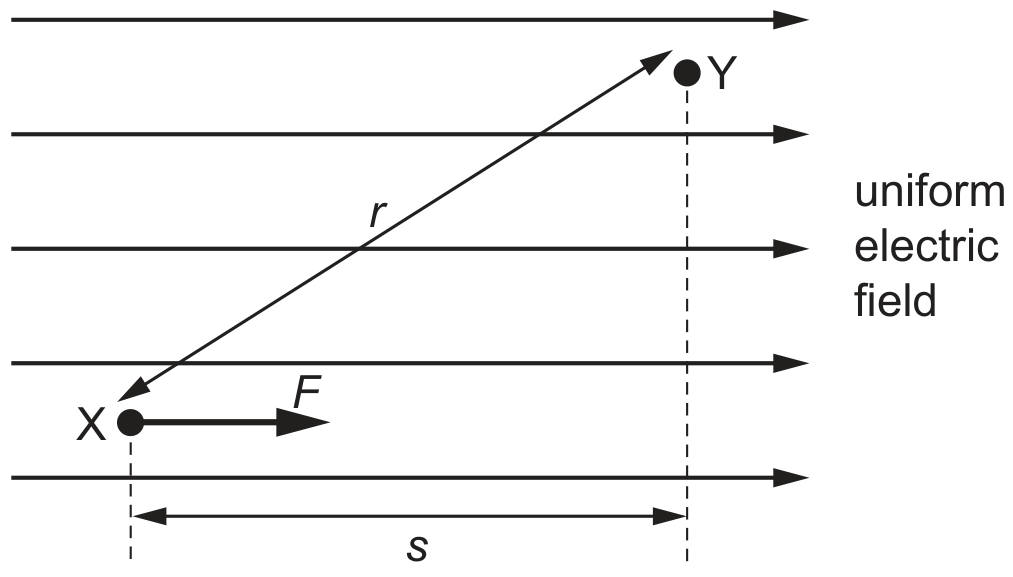
What is the change in the potential energy of the charge?
decreases by Fs
increases by Fs
decreases by Fr
increases by Fr
The electric potential gradient is related to the electric field.
Use data from Fig. 4.2 to state the value of x at which the magnitude of the electric potential gradient is maximum. Give a reason for the value you have chosen.
An isolated solid metal sphere of radius r is given a positive charge. The distance from the centre of the sphere is x.
The electric potential at the surface of the sphere is .
On the axes of Fig.5.1, sketch a graph to show the variation with distance x of the electric potential due to the charged sphere, for values of x from x=0 to x=4 r.
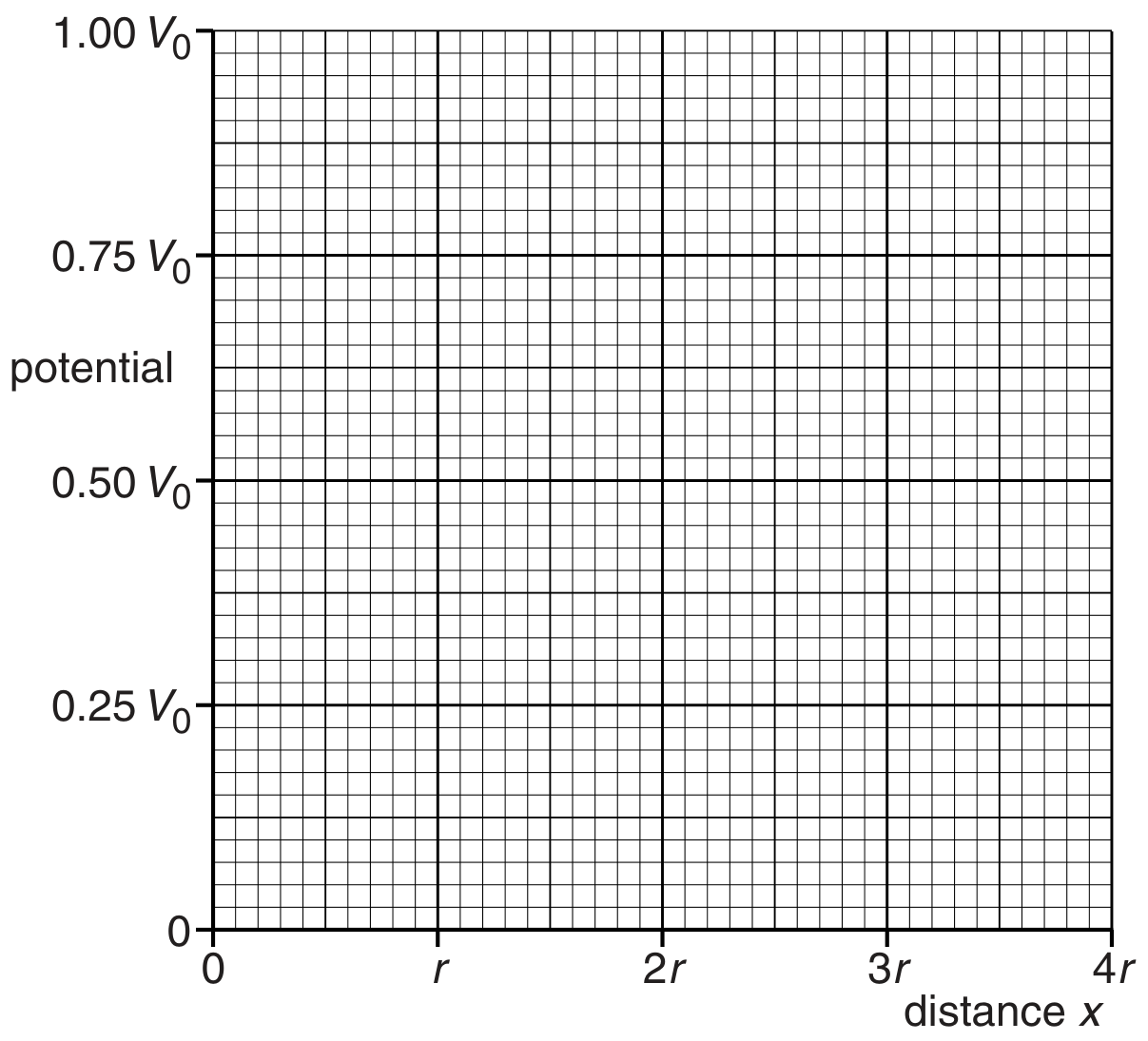
Fig. 5.1
Two point charges A and B each have a charge of . They are separated in a vacuum by a distance of , as shown in Fig. 4.1.
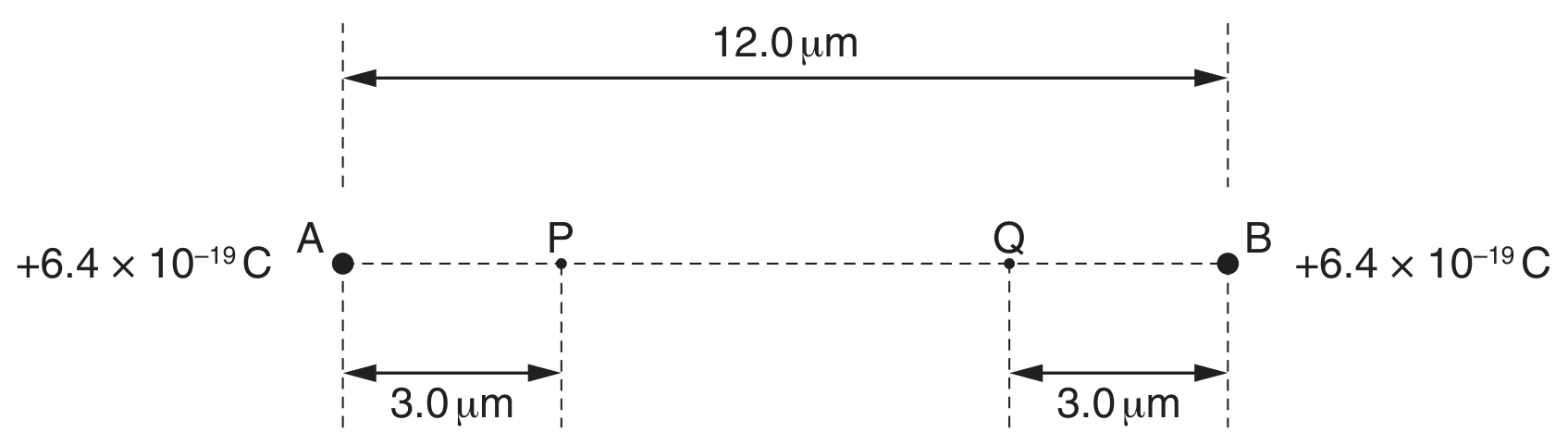
Fig. 4.1
Points P and Q are situated on the line A B. Point P is from charge A and point Q is from charge B.
Explain why, without any calculation, when a small test charge is moved from point P to point Q, the net work done is zero.
Calculate the work done by an electron in moving from the midpoint of line AB to point P.
Define electric potential at a point.
A charged particle is accelerated from rest in a vacuum through a potential difference V. Show that the final speed v of the particle is given by the expression
where is the ratio of the charge to the mass (the specific charge) of the particle.
A particle with specific charge is moving in a vacuum towards a fixed metal sphere, as illustrated in Fig. 4.1.
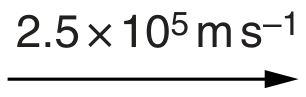
particle specific charge
metal sphere potential +470 V
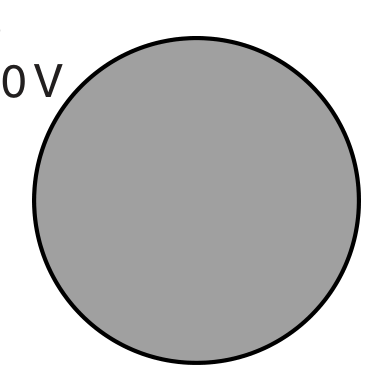
Fig. 4.1
The initial speed of the particle is when it is a long distance from the sphere.
The sphere is positively charged and has a potential of +470 V .
Use the expression in (b) to determine whether the particle will reach the surface of the sphere.
Define electric potential at a point.