EduNinja
(a)

An X-ray photon of energy 3.06×10¹⁴ J3.06 \times 10^{-14} \mathrm{~J} is incident on an isolated stationary electron, as illustrated in Fig. 6.1.
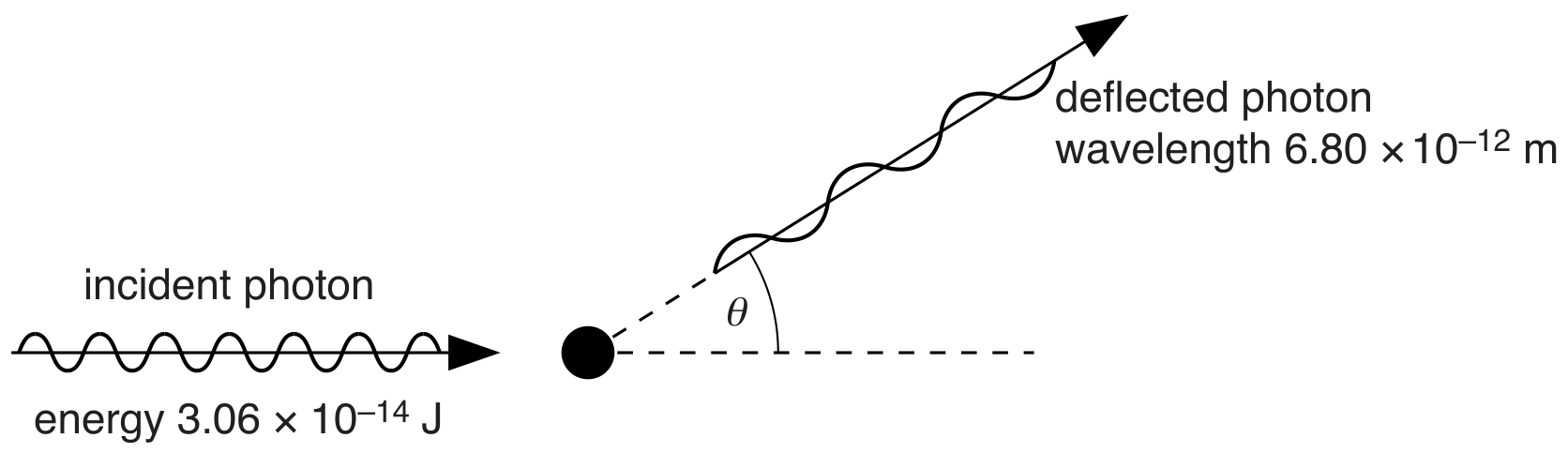
Fig. 6.1

Fig. 6.1

The photon is deflected elastically by the electron through angle θ\theta. The deflected photon has a wavelength of 6.80×10¹² m6.80 \times 10^{-12} \mathrm{~m}.

[ 1 ]
(i)

On Fig. 6.1, draw an arrow to indicate a possible initial direction of motion of the electron after the photon has been deflected.

[ 1 ]
(a)

State what is meant by the de Broglie wavelength.

[ 2 ]
(b)

An electron is accelerated in a vacuum from rest through a potential difference of 850 V .

[ 2 ]
(i)

Calculate the de Broglie wavelength of this electron.
wavelength = m

[ 2 ]
(c)

Describe an experiment to demonstrate the wave nature of electrons. You may draw a diagram if you wish.

[ 5 ]
(a)

State what is meant by the de Broglie wavelength.

(b)

An electron is accelerated from rest in a vacuum through a potential difference of 4.7 kV .

[ 7 ]
(i)

Calculate the de Broglie wavelength of the accelerated electron.
wavelength = m

[ 5 ]
(ii)

By reference to your answer in (i), suggest why such electrons may assist with an understanding of crystal structure.

[ 2 ]
[Maximum number: 9]

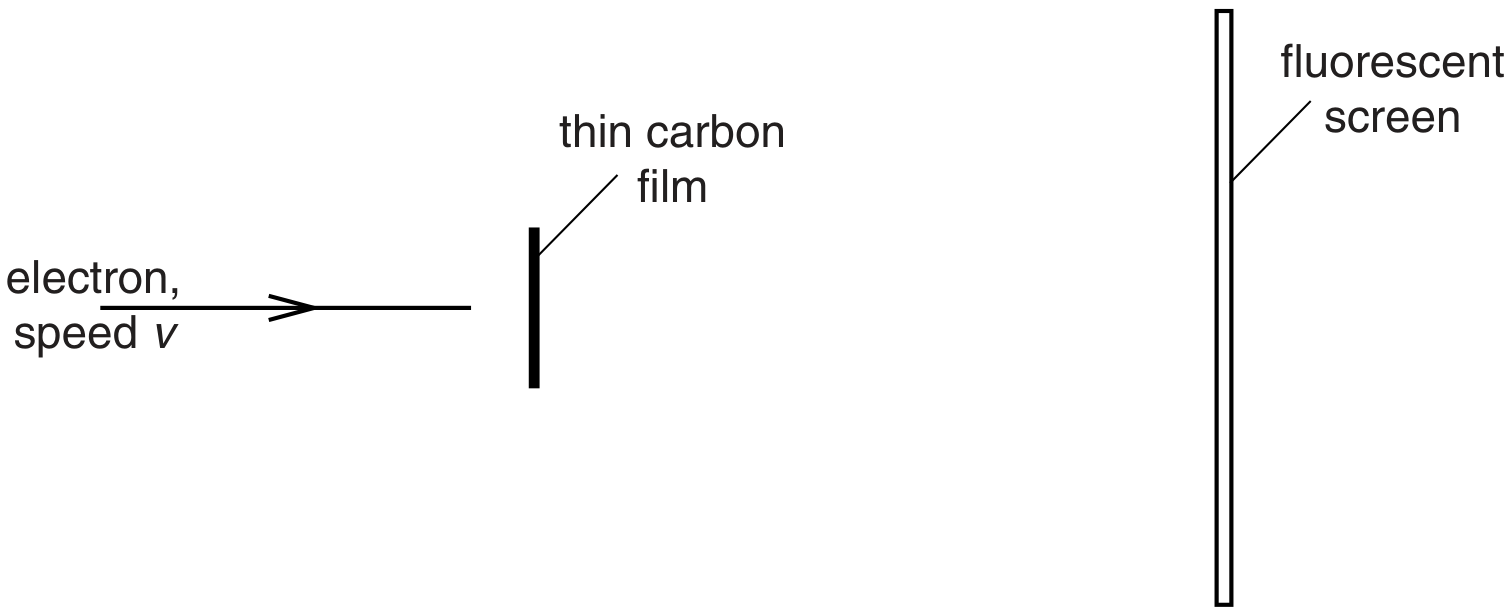
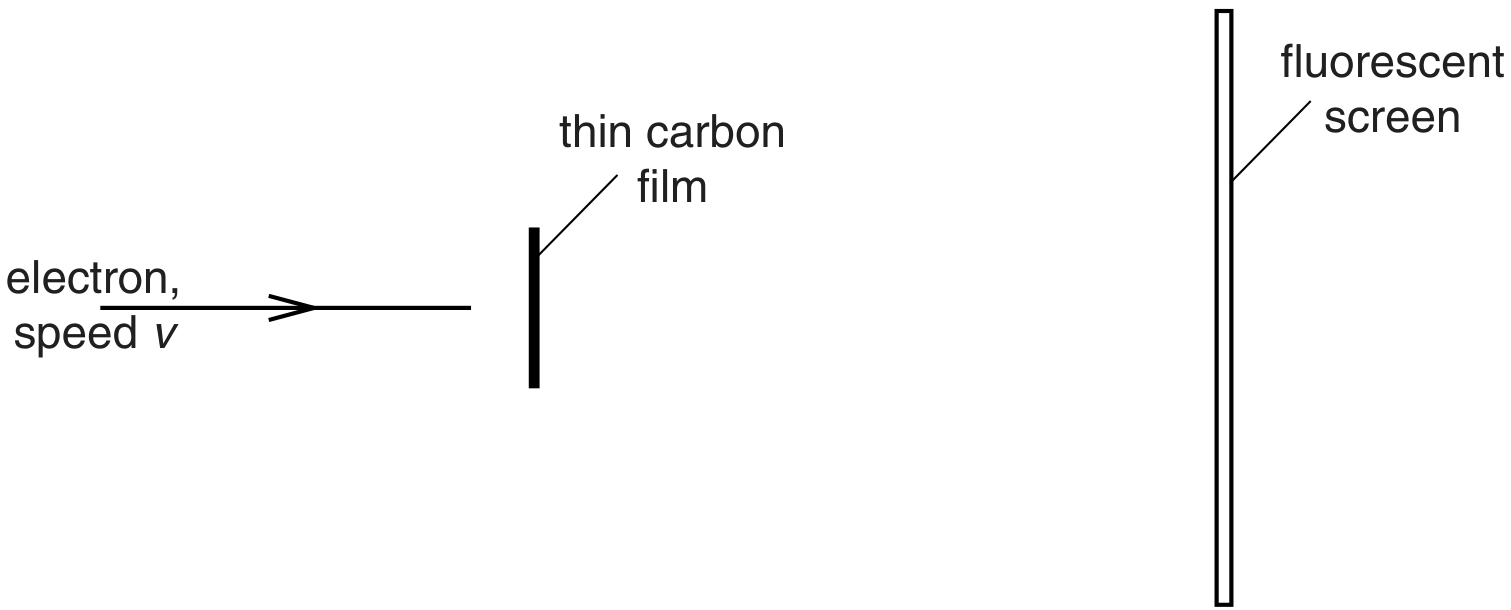
Electrons, travelling at speed v in a vacuum, are incident on a very thin carbon film, as illustrated in Fig. 7.1.

Fig. 7.1

Fig. 7.1

The emergent electrons are incident on a fluorescent screen.
A series of concentric rings is observed on the screen.

(a)

Suggest why the observed rings provide evidence for the wave nature of particles.

[ 2 ]
(b)

The initial speed of the electrons is increased. State and explain the effect, if any, on the radii of the rings observed on the screen.

[ 3 ]
(c)

A proton and an electron are each accelerated from rest through the same potential difference.

Determine the ratio
 de Broglie wavelength of the proton  de Broglie wavelength of the electron \frac{\text { de Broglie wavelength of the proton }}{\text { de Broglie wavelength of the electron }}.
ratio =

[ 4 ]
[Maximum number: 9]

Electrons, travelling at speed v in a vacuum, are incident on a very thin carbon film, as illustrated in Fig. 7.1.

Fig. 7.1

Fig. 7.1

The emergent electrons are incident on a fluorescent screen.
A series of concentric rings is observed on the screen.

(a)

Suggest why the observed rings provide evidence for the wave nature of particles.

[ 2 ]
(b)

The initial speed of the electrons is increased. State and explain the effect, if any, on the radii of the rings observed on the screen.

[ 3 ]
(c)

A proton and an electron are each accelerated from rest through the same potential difference.

Determine the ratio
 de Broglie wavelength of the proton  de Broglie wavelength of the electron \frac{\text { de Broglie wavelength of the proton }}{\text { de Broglie wavelength of the electron }}.
ratio =

[ 4 ]
[Maximum number: 2]

8 Aπ08 \mathrm{~A} \pi^{0} meson is a sub-atomic particle.

A stationary π0\pi^{0} meson, which has mass 2.4×1028 kg2.4 \times 10^{-28} \mathrm{~kg}, decays to form two γ\gamma-ray photons. The nuclear equation for this decay is

π0γ+γ.\pi^{0} \rightarrow \gamma+\gamma .
(a)

Determine, for each γ\gamma-ray photon,

[ 2 ]
(i)

the wavelength,
wavelength = m

[ 2 ]
(a)

State an effect, one in each case, that provides evidence for

[ 1 ]
(i)

the wave nature of a particle,

[ 1 ]
(a)

State the formula for the de Broglie wavelength λ\lambda of a moving particle.
State the meaning of any other symbol used.

[ 2 ]
(b)

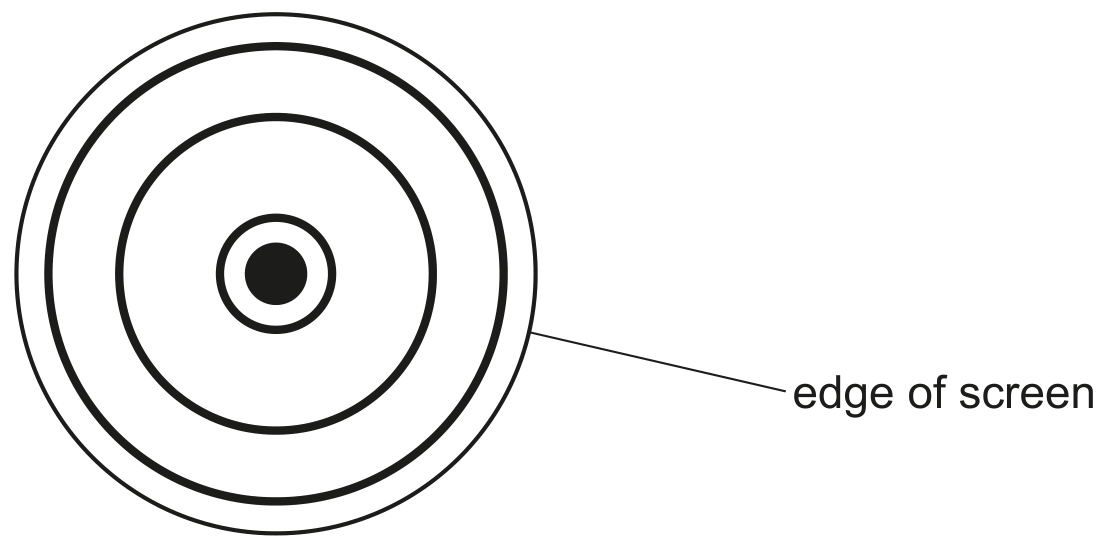
Electrons accelerate through a potential difference, pass through a thin crystal and are then incident on a fluorescent screen.

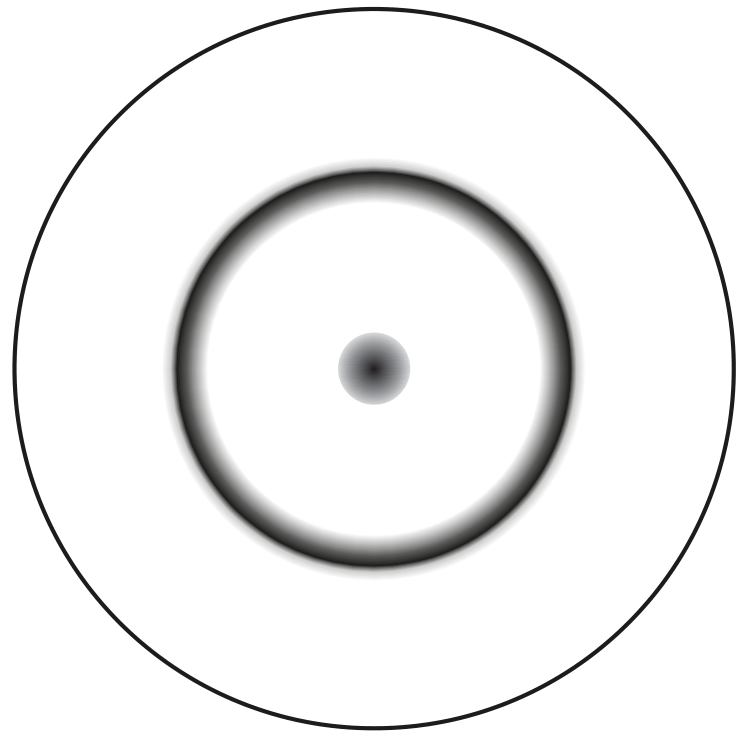
The pattern in Fig. 8.1 is observed on the fluorescent screen.

Fig. 8.1 not to scale

Fig. 8.1 not to scale

[ 5 ]
(i)

State the name of the phenomenon shown by the electrons at the crystal.

[ 1 ]
(ii)

State what this phenomenon shows about the nature of electrons.

[ 1 ]
(iii)

Suggest why the thin crystal causes the phenomenon in (b)(i).

[ 1 ]
(iv)

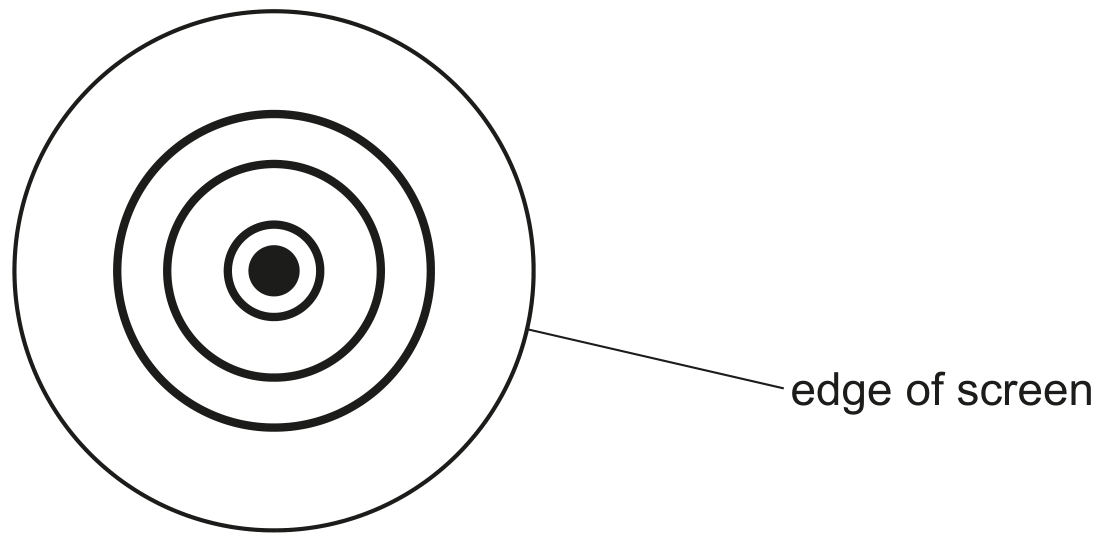
The electron is accelerated through a different potential difference. The new pattern observed on the screen is shown in Fig. 8.2.

Fig. 8.2 not to scale

Fig. 8.2 not to scale

State and explain the change that has been made to the potential difference to create the pattern shown in Fig. 8.2.

[ 2 ]
(a)

State what is meant by the de Broglie wavelength.

[ 1 ]
(b)

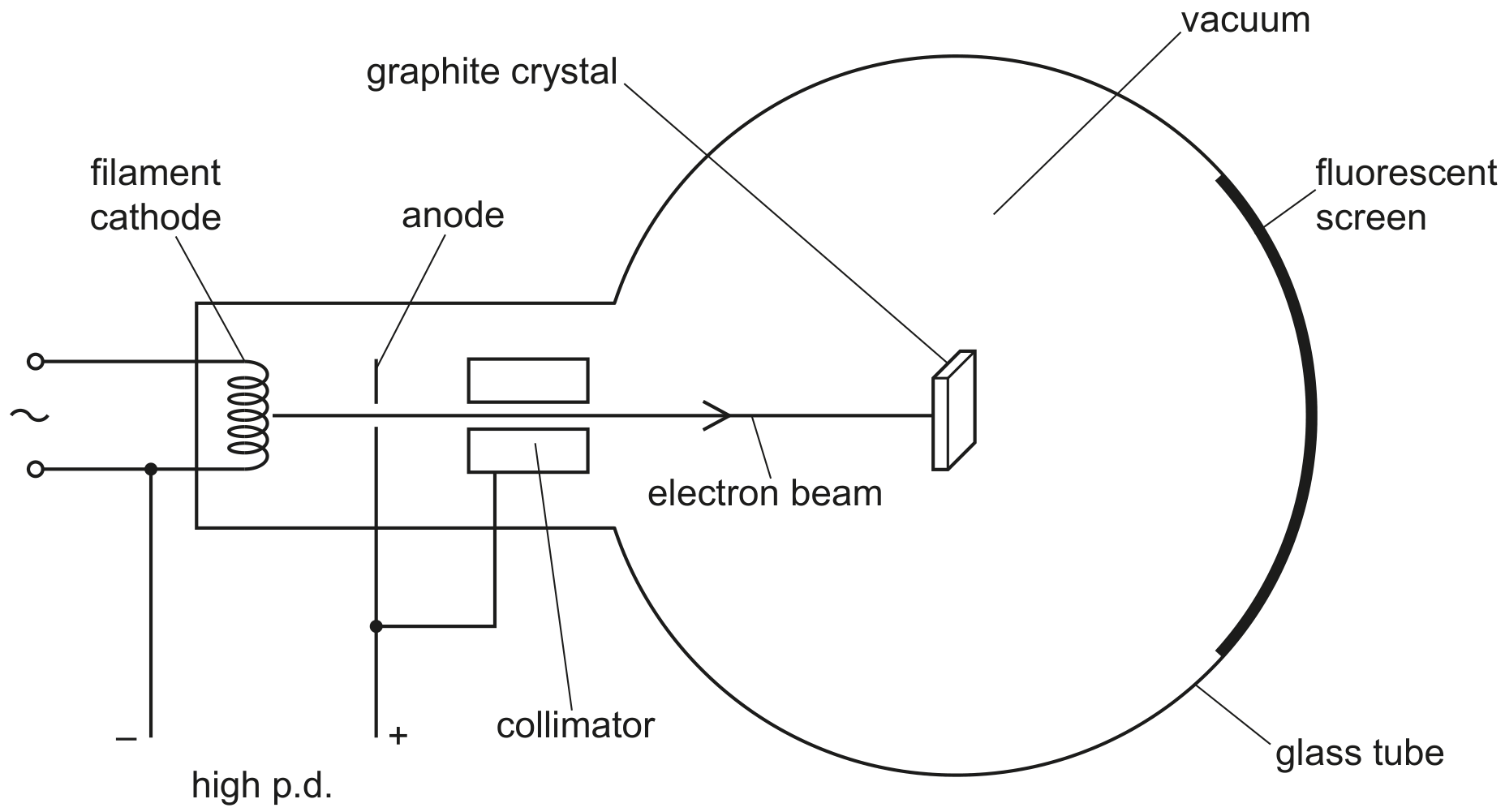
Fig. 7.1 shows a glass tube in which electrons are accelerated through a high p.d. to form a beam that is incident on a thin graphite crystal.

Fig. 7.1 (not to scale)

Fig. 7.1 (not to scale)

After passing through the graphite crystal, the electrons reach the fluorescent screen. The screen glows where the electrons strike it.

Fig. 7.2 shows the fluorescent screen viewed end-on, from the right-hand side of Fig. 7.1.

Fig. 7.2

Fig. 7.2

[ 3 ]
(i)

State the name of the phenomenon demonstrated by the pattern shown in Fig. 7.2.

[ 1 ]
(ii)

Explain what can be concluded from the pattern in Fig. 7.2 about the nature of electrons.

[ 2 ]
(c)

The electrons in (b) are now accelerated through a greater potential difference between the cathode and the anode.

[ 5 ]
(i)

On Fig. 7.3, sketch the pattern that is now seen on the fluorescent screen in Fig. 7.1.

Fig. 7.3

Fig. 7.3

[ 2 ]
(ii)

Explain, with reference to de Broglie wavelength, the change in the pattern on the fluorescent screen.

[ 3 ]
(a)

State one piece of experimental evidence for:

[ 2 ]
(i)

the particulate nature of electromagnetic radiation

[ 1 ]
(ii)

the wave nature of matter.

[ 1 ]
(b)
(i)

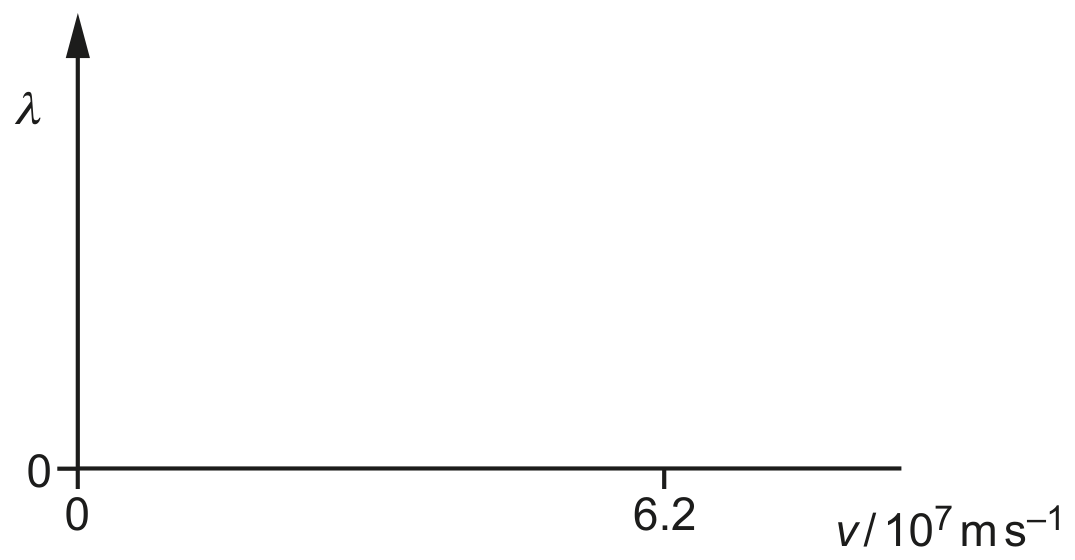
Calculate the de Broglie wavelength λ\lambda of an alpha-particle moving at a speed of 6.2×10⁷ m s16.2 \times 10^{7} \mathrm{~m} \mathrm{~s}^{-1}.

λ=\lambda=
[ 2 ]
(ii)

The speed v of the alpha-particle in (b)(i) is gradually reduced to zero.

On Fig. 8.1, sketch the variation with v of λ\lambda.

Fig. 8.1

Fig. 8.1

[ 2 ]
0