[Maximum number: 2]
+w.
(a)
Argon-40 may be assumed to be an ideal gas.
A mass of 3.2 g of argon- 40 has a volume of at a temperature of .
Determine, for this mass of argon-40 gas,
[ 2 ]
(i)
the pressure,
pressure = Pa
[ 2 ]
 EduNinja
+w.
Argon-40 may be assumed to be an ideal gas.
A mass of 3.2 g of argon- 40 has a volume of at a temperature of .
Determine, for this mass of argon-40 gas,
the pressure,
pressure = Pa
Two containers A and B are joined by a tube of negligible volume, as illustrated in Fig. 2.1.
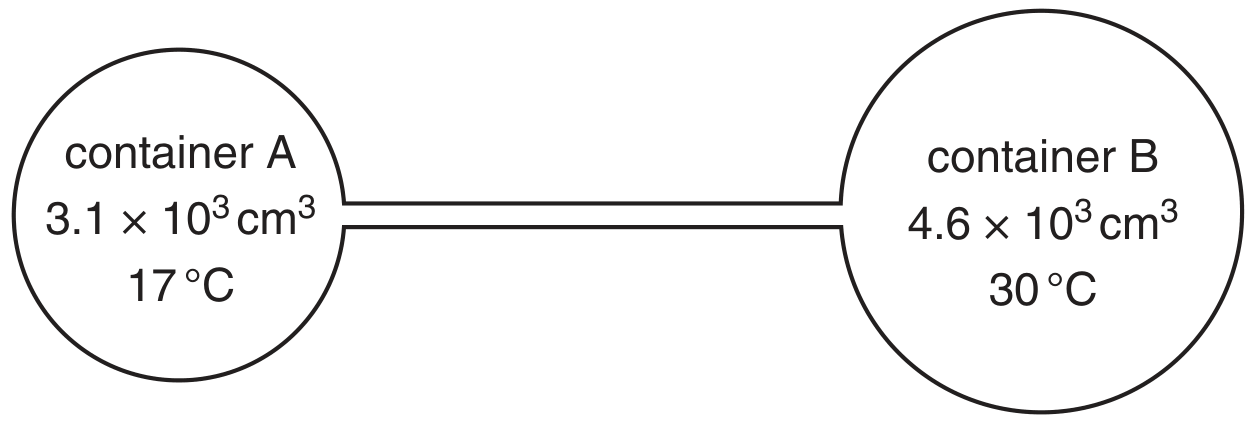
Fig. 2.1
The containers are filled with an ideal gas at a pressure of .
The gas in container A has volume and is at a temperature of .
The gas in container B has volume and is at a temperature of .
Calculate the total amount of gas, in mol, in the containers.
amount = mol
the rate h of thermal energy gained by the ice from the surroundings.
W
The variation with volume V of the pressure p of an ideal gas as it undergoes a cycle ABCA of changes is shown in Fig. 2.1.
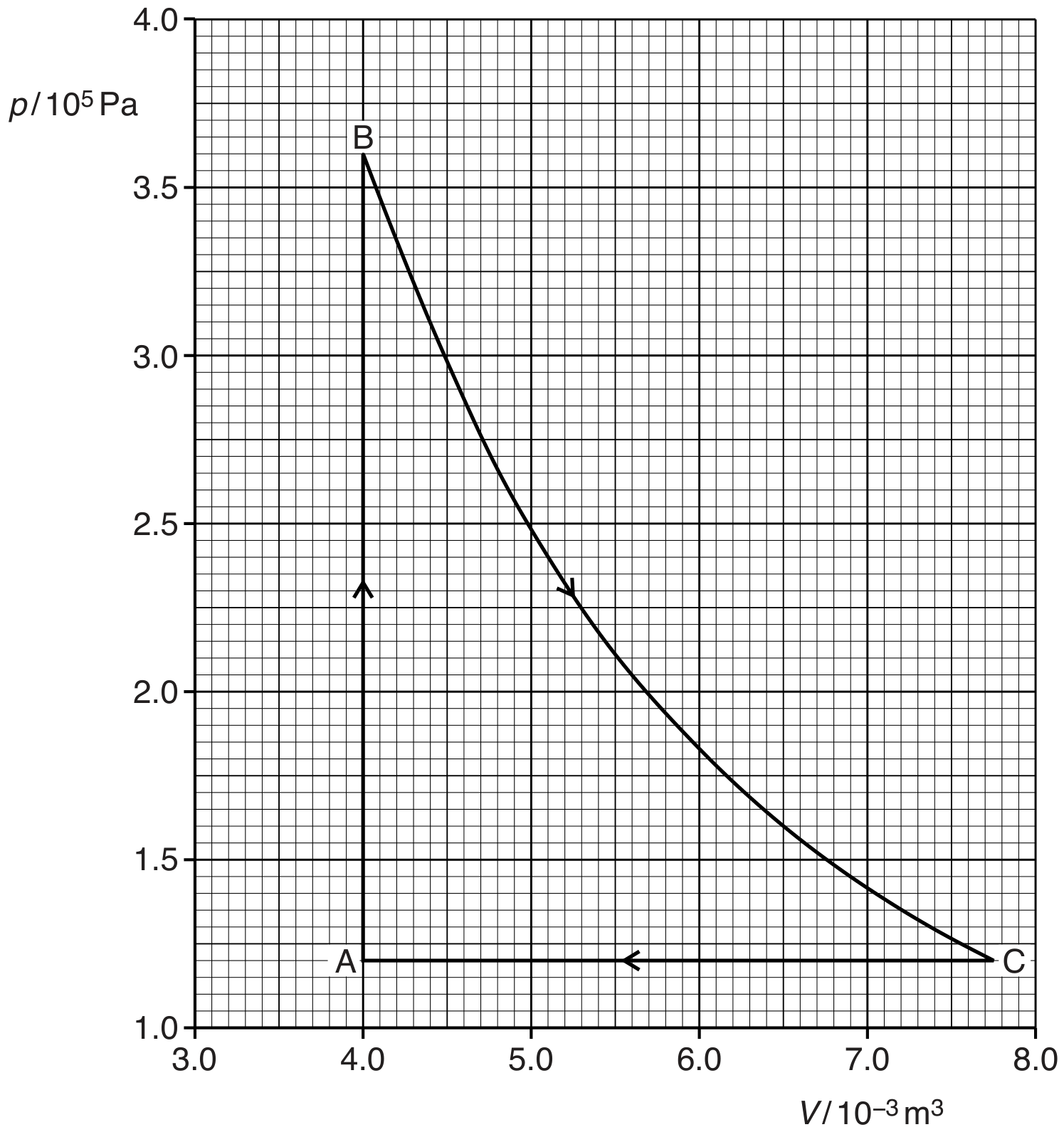
Fig. 2.1
The temperature of the gas at A is 290 K . The temperature at B is 870 K .
Determine
the temperature of the gas at C .
temperature = K
the rise in temperature of the gas.
temperature rise = K
The volume of an ideal gas in a cylinder is at a pressure of and a temperature of 297 K , as illustrated in Fig. 2.1.
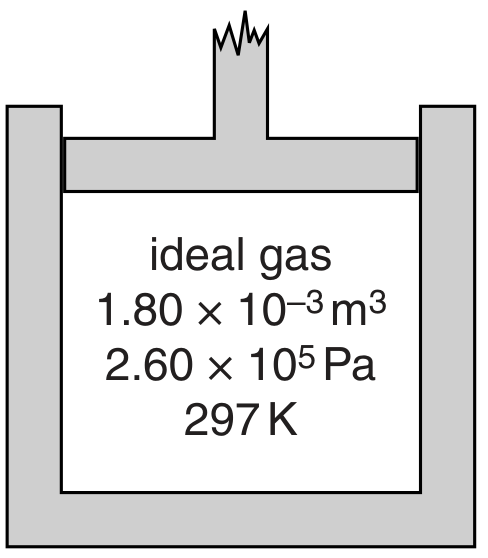
Fig. 2.1
The thermal energy required to raise the temperature by 1.00 K of 1.00 mol of the gas at constant volume is 12.5 J .
The gas is heated at constant volume such that the internal energy of the gas increases by 95.0 J .
Calculate
Use your answer in (i) part 2 to show that the final pressure of the gas in the cylinder is .
A cylinder contains 5.12 mol of an ideal gas at pressure and volume .
Calculate the thermodynamic temperature of the gas.
The average kinetic energy of a molecule of the gas is given by the expression
where k is the Boltzmann constant and T is the thermodynamic temperature.
The gas is heated at constant pressure so that its temperature rises by 125 K .
Show that the new volume of the gas is .
A constant mass of an ideal gas has a volume of at a temperature of . When the gas is heated, 565 J of thermal energy causes it to expand to a volume of at . This is illustrated in Fig.2.1.
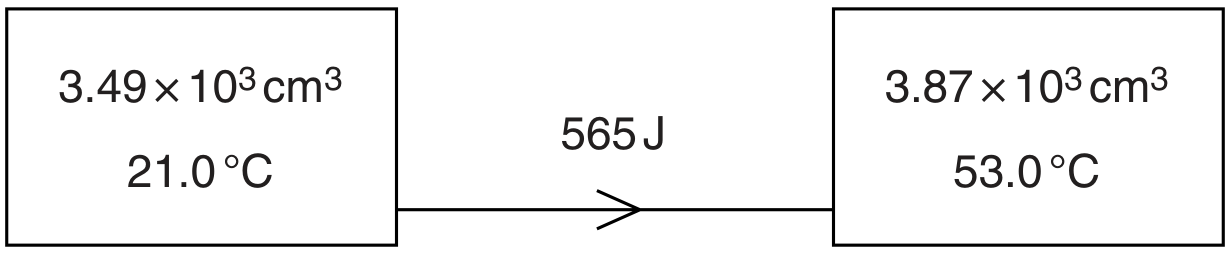
Fig. 2.1
Show that the initial and final pressures of the gas are equal.
A fixed mass of an ideal gas at a temperature of is sealed in a cylinder by a piston, as shown in Fig. 2.1.
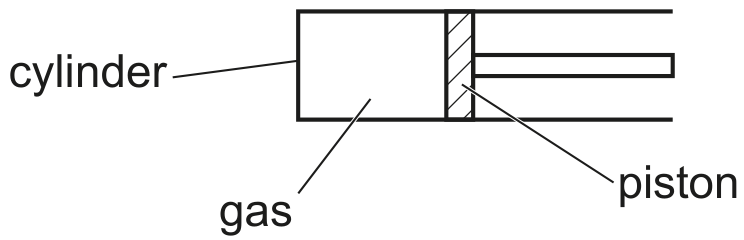
Fig. 2.1
The initial volume of the gas is .
Thermal energy is supplied to the gas and its volume increases by .
Calculate the final thermodynamic temperature T of the gas.
Fig. 2.1 shows a laboratory thermometer that is calibrated to measure temperature in degrees Celsius.
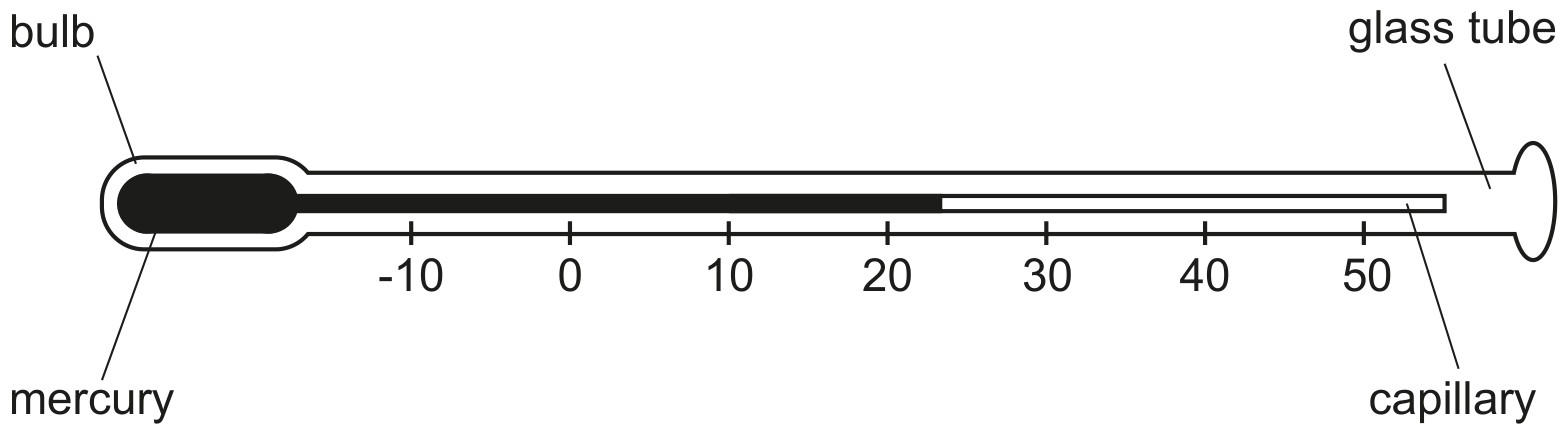
Fig. 2.1
The thermometer makes use of the fact that the density of mercury varies with temperature.
Thermodynamic temperature T may be determined by the behaviour of a type of substance for which T is proportional to the product of pressure and volume.
State the name of this type of substance.
The product of the pressure p and the volume V of an ideal gas is given by the expression
where m is the mass of one molecule of the gas.
State the meaning of the symbol
N,
A balloon is filled with helium gas at a pressure of and a temperature of .
The balloon has a volume of .
Helium may be assumed to be an ideal gas.
Determine the number of gas atoms in the balloon.
number =