EduNinja
(a)

Explain what is meant by a photon.

[ 2 ]
(b)

An X-ray photon of energy 3.06×10¹⁴ J3.06 \times 10^{-14} \mathrm{~J} is incident on an isolated stationary electron, as illustrated in Fig. 6.1.
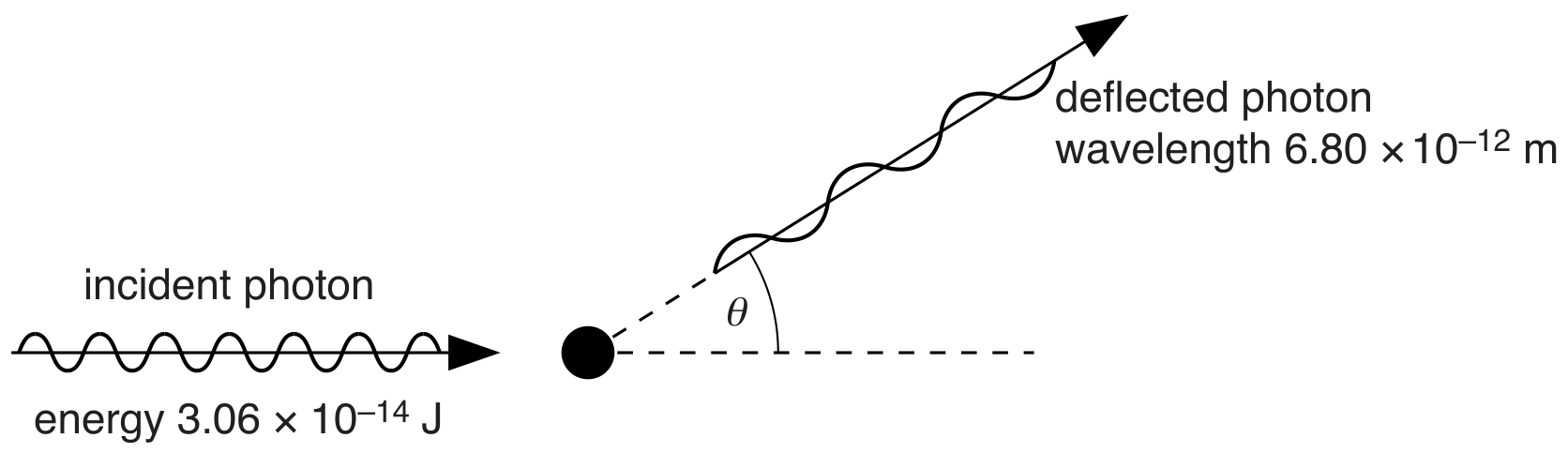
Fig. 6.1

Fig. 6.1

The photon is deflected elastically by the electron through angle θ\theta. The deflected photon has a wavelength of 6.80×10¹² m6.80 \times 10^{-12} \mathrm{~m}.

[ 3 ]
(i)

Calculate
1. the energy of the deflected photon,

photon energy =

2. the speed of the electron after the photon has been deflected. ms1[3]\mathrm{m} \mathrm{s}^{-1}[3]

[ 3 ]
(c)

Explain why the magnitude of the final momentum of the electron is not equal to the change in magnitude of the momentum of the photon.

[ 2 ]
[Maximum number: 4]

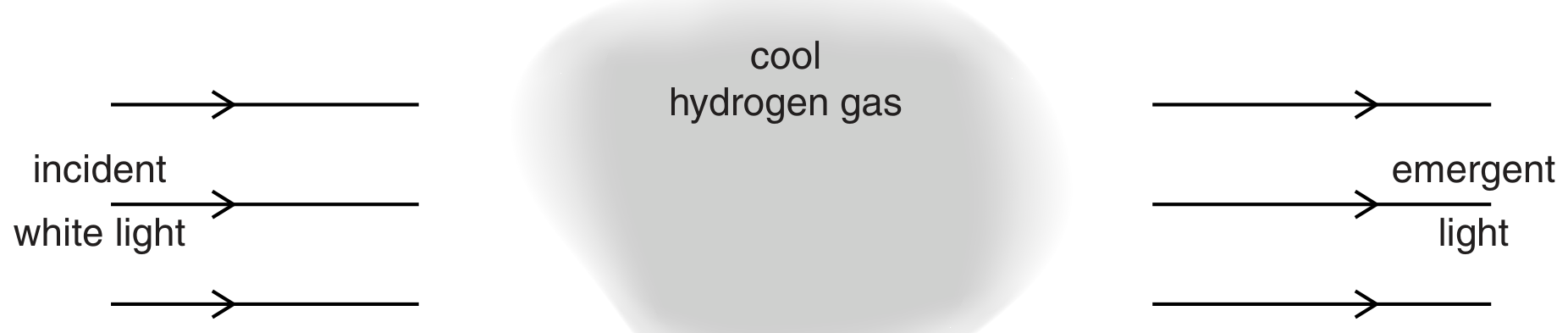
White light is incident on a cloud of cool hydrogen gas, as illustrated in Fig. 8.1.

Fig. 8.1

Fig. 8.1

The spectrum of the light emerging from the gas cloud is found to contain a number of dark lines.

(a)

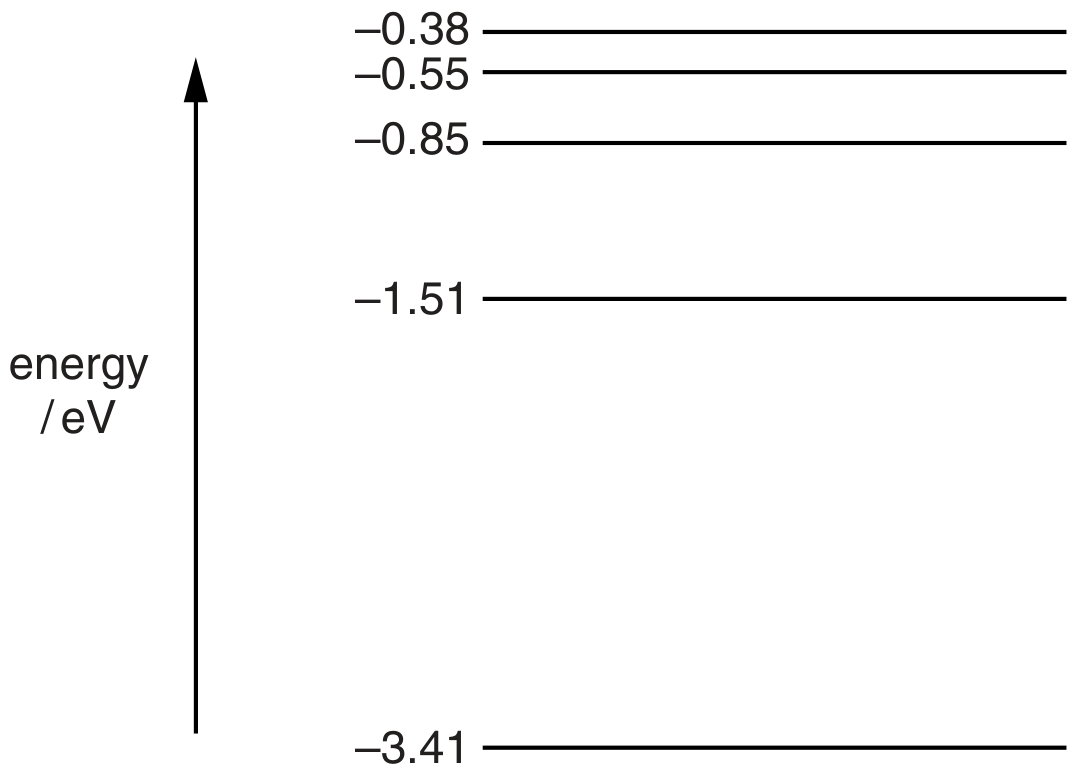
Some electron energy levels in a hydrogen atom are illustrated in Fig. 8.2.

Fig. 8.2

Fig. 8.2

One dark line is observed at a wavelength of 435 nm .

[ 4 ]
(i)

Calculate the energy, in eV , of a photon of light of wavelength 435 nm .

energy =eV [4]
[ 4 ]
[Maximum number: 4]

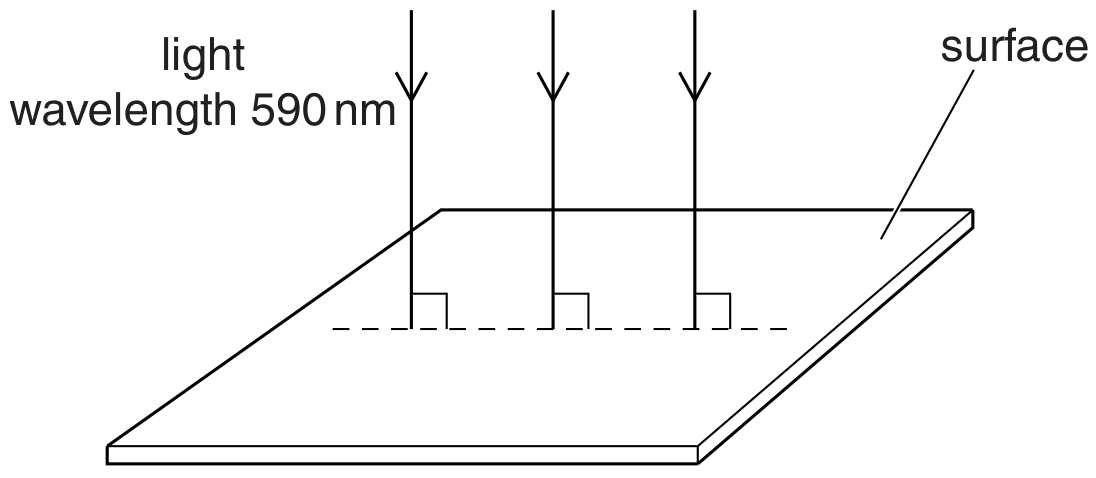
Light of wavelength 590 nm is incident normally on a surface, as illustrated in Fig. 8.1.

Fig. 8.1

Fig. 8.1

The power of the light is 3.2 mW . The light is completely absorbed by the surface.

(a)

Calculate the number of photons incident on the surface in 1.0 s .

number =
(b)

Use your answer in (a) to determine

[ 4 ]
(i)

the total momentum of the photons arriving at the surface in 1.0 s ,

momentum =

kgms1\mathrm{kgms}^{-1}

[ 3 ]
(ii)

the force exerted on the surface by the light.

[ 1 ]
(a)

The β\beta-particle is emitted with an energy of 5.7×10³eV5.7 \times 10^{3} \mathrm{eV}.

Calculate the speed of the β\beta-particle.
speed = ms1\mathrm{ms}^{-1}

[ 3 ]
(a)

State what is meant by a photon.

[ 2 ]
(b)

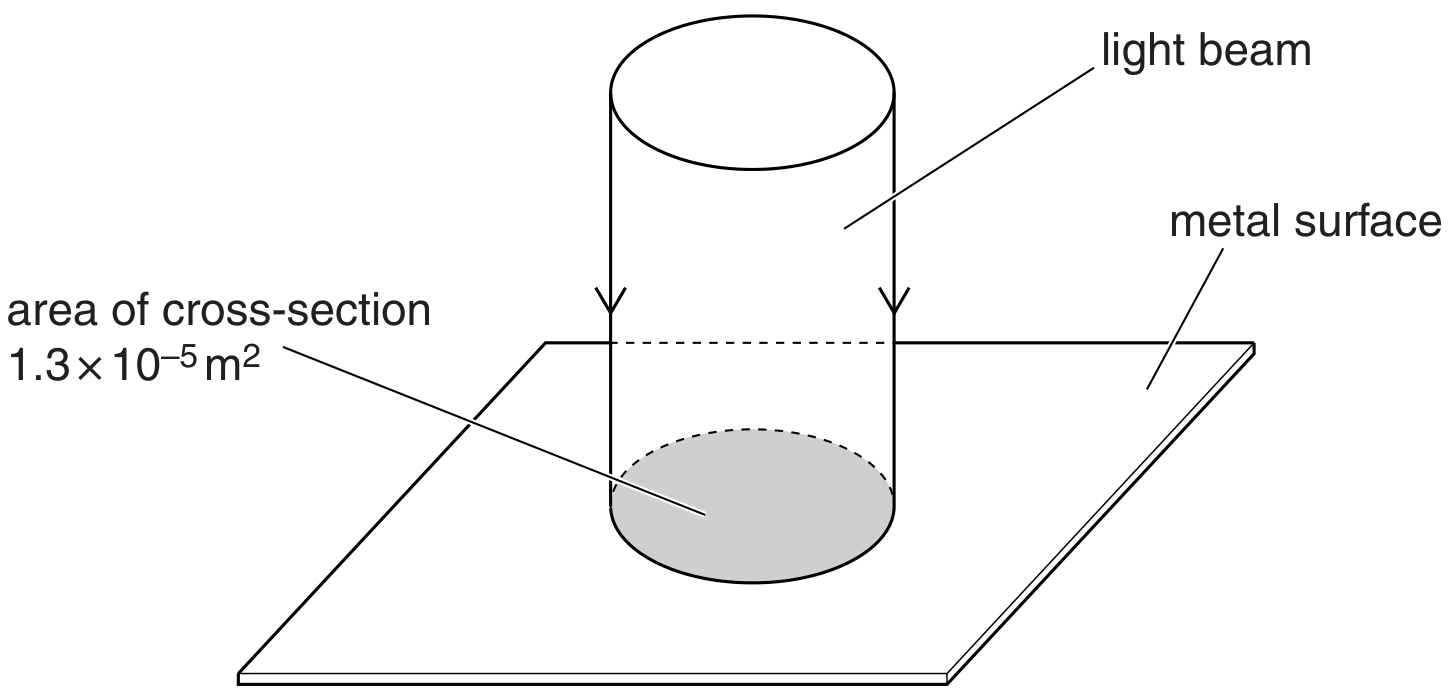
A beam of light is incident normally on a metal surface, as illustrated in Fig. 8.1.

Fig. 8.1

Fig. 8.1

The beam of light has cross-sectional area 1.3×10⁵ m21.3 \times 10^{-5} \mathrm{~m}^{2} and power 2.7×10³ W2.7 \times 10^{-3} \mathrm{~W}. The light has wavelength 570 nm .

The light energy is absorbed by the metal and no light is reflected.

[ 1 ]
(i)

Show that a photon of this light has an energy of 3.5×10¹⁹ J3.5 \times 10^{-19} \mathrm{~J}.

[ 1 ]
(ii)

Calculate, for a time of 1.0 s ,
1. the number of photons incident on the surface,
number =

2. the change in momentum of the photons.
change in momentum =
kgms1\mathrm{kg} \mathrm{ms}^{-1}

(a)

Explain what is meant by a photon.

[ 3 ]
[Maximum number: 7]

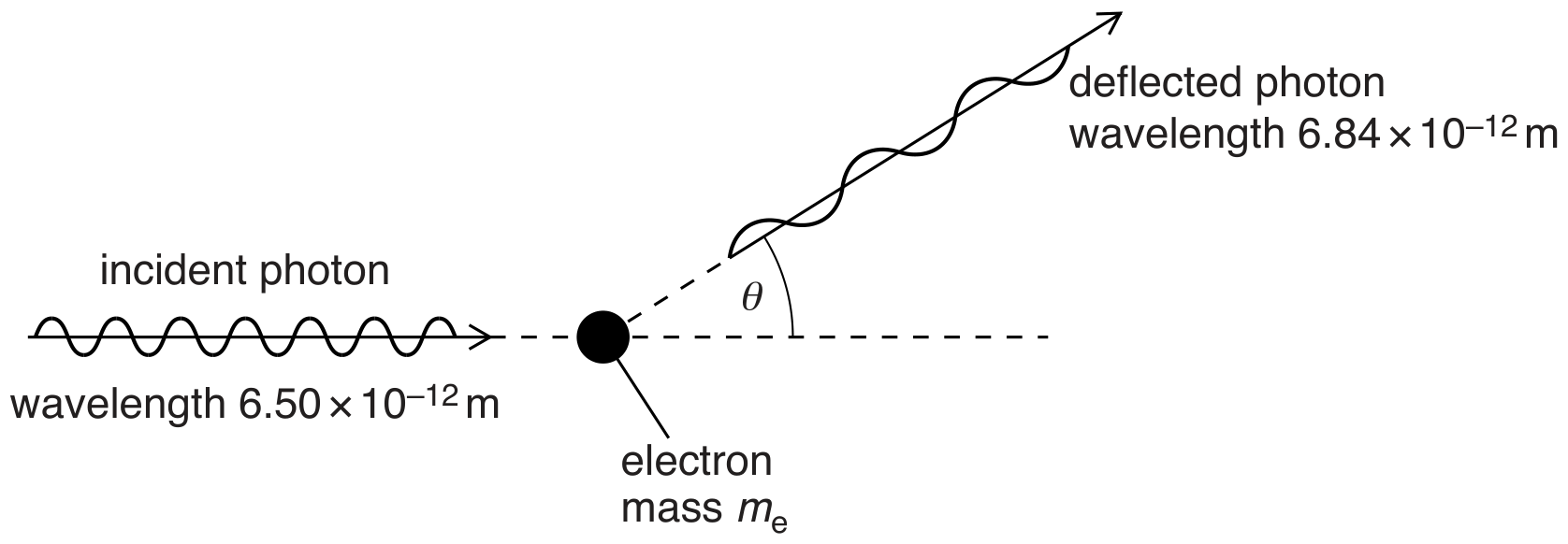
A photon of wavelength 6.50×10¹² m6.50 \times 10^{-12} \mathrm{~m} is incident on an isolated stationary electron, as illustrated in Fig. 8.1.

Fig. 8.1

Fig. 8.1

The photon is deflected elastically by the electron of mass mem_{\mathrm{e}}. The wavelength of the deflected photon is 6.84×10¹² m6.84 \times 10^{-12} \mathrm{~m}.

(a)

Calculate, for the incident photon,

[ 2 ]
(i)

its momentum,
momentum = Ns

[ 2 ]
(ii)

its energy.
energy =

(b)

The angle θ\theta through which the photon is deflected is given by the expression

Δλ=hmec(1cosθ)\Delta \lambda=\frac{h}{m_{\mathrm{e}} c}(1-\cos \theta)

where Δλ\Delta \lambda is the change in wavelength of the photon, h is the Planck constant and c is the speed of light in free space.

[ 5 ]
(i)

Calculate the angle θ\theta.

[ 2 ]
(ii)

Use energy considerations to suggest why Δλ\Delta \lambda must always be positive.

[ 3 ]
[Maximum number: 1]

The power for a space probe is to be supplied by the energy released when plutonium- 236 decays by the emission of α\alpha-particles.

The α\alpha-particles, each of energy 5.75 MeV , are captured and their energy is converted into electrical energy with an efficiency of 24 %.

(a)

Calculate

[ 1 ]
(i)

the energy, in joules, equal to 5.75 MeV ,
energy =
J

[ 1 ]
(a)

A photon has an energy of 3.11×10¹⁹ J3.11 \times 10^{-19} \mathrm{~J}.
Calculate the momentum of the photon.

momentum =
[ 2 ]
(b)

A laser beam has a power of 350 mW . The light from the laser has a wavelength of 640 nm .

[ 4 ]
(i)

Determine the number of photons emitted by the laser in a time of 1.0 s .

number =
[ 2 ]
(ii)

The laser beam is incident normally on a surface that absorbs all of the photons.

Show that the force F exerted on the surface by the laser beam is given by

F=PcF=\frac{P}{c}

where P is the power of the laser beam and c is the speed of light.

[ 2 ]
[Maximum number: 2]

8 Aπ08 \mathrm{~A} \pi^{0} meson is a sub-atomic particle.

A stationary π0\pi^{0} meson, which has mass 2.4×1028 kg2.4 \times 10^{-28} \mathrm{~kg}, decays to form two γ\gamma-ray photons. The nuclear equation for this decay is

π0γ+γ.\pi^{0} \rightarrow \gamma+\gamma .
(a)

Explain why the two γ\gamma-ray photons have the same energy.

[ 2 ]
(b)

Determine, for each γ\gamma-ray photon,

(i)

the momentum.

Answer all the questions in the spaces provided.

0