(a)
(i)
State what is meant by the internal energy of a system.
[ 2 ]
 EduNinja
State what is meant by the internal energy of a system.
the rate h of thermal energy gained by the ice from the surroundings.
W
State what is meant by internal energy.
A cylinder contains 5.12 mol of an ideal gas at pressure and volume .
The average kinetic energy of a molecule of the gas is given by the expression
where k is the Boltzmann constant and T is the thermodynamic temperature.
The gas is heated at constant pressure so that its temperature rises by 125 K .
Calculate the increase in internal energy of the gas. Explain your working.
the period of Deimos in its orbit about Mars.
period = hours
State what is meant by the internal energy of a substance.
Use the equation in (b)(ii) to explain that, for an ideal gas, a change in internal energy is given by
where is the change in temperature of the gas.
electric potential energy.
energy = J
Helium-4 may be assumed to behave as an ideal gas.
A cylinder has a constant volume of and contains helium-4 gas at a pressure of and at a temperature of 290 K .
Calculate, for the helium gas,
the total internal energy.
internal energy = J
A constant mass of an ideal gas has a volume of at a temperature of . When the gas is heated, 565 J of thermal energy causes it to expand to a volume of at . This is illustrated in Fig.2.1.
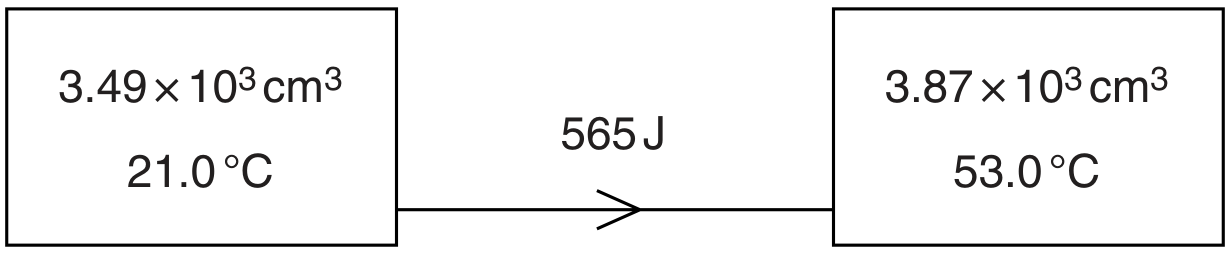
Fig. 2.1
Explain why the change in kinetic energy of the molecules of this ideal gas is equal to the change in internal energy.
A student suggests that, when an ideal gas is heated from to , the internal energy of the gas is doubled.
State what is meant by internal energy.
State and explain whether the student's suggestion is correct.
A negative temperature coefficient thermistor may be used as a type of resistance thermometer.
State one way in which the variation with temperature of the resistance of a thermistor differs from that of a platinum wire.
By referring to both kinetic energy and potential energy, explain what is meant by the internal energy of an ideal gas.
air and soft tissue.
State what is meant by the internal energy of a substance.
Explain why an increase in internal energy of an ideal gas is directly related to a rise in temperature of the gas.