
EduNinja
[Maximum number: 5]

An ideal gas has volume V and pressure p. For this gas, the product p V is given by the expression

pV=13Nm<c2>p V=\frac{1}{3} N m<c^{2}>

where m is the mass of a molecule of the gas.

(a)

A gas cylinder of volume 2.1×104 cm32.1 \times 10^{4} \mathrm{~cm}^{3} contains helium-4 gas at pressure 6.1×10⁵ Pa6.1 \times 10^{5} \mathrm{~Pa} and temperature 12C12^{\circ} \mathrm{C}. Helium-4 may be assumed to be an ideal gas.

[ 5 ]
(i)

Determine, for the helium gas,
1. the amount, in mol,
amount = mol [3]
2. the number of atoms.
number =

[ 5 ]
[Maximum number: 2]

the rate h of thermal energy gained by the ice from the surroundings.

h=

W

(a)

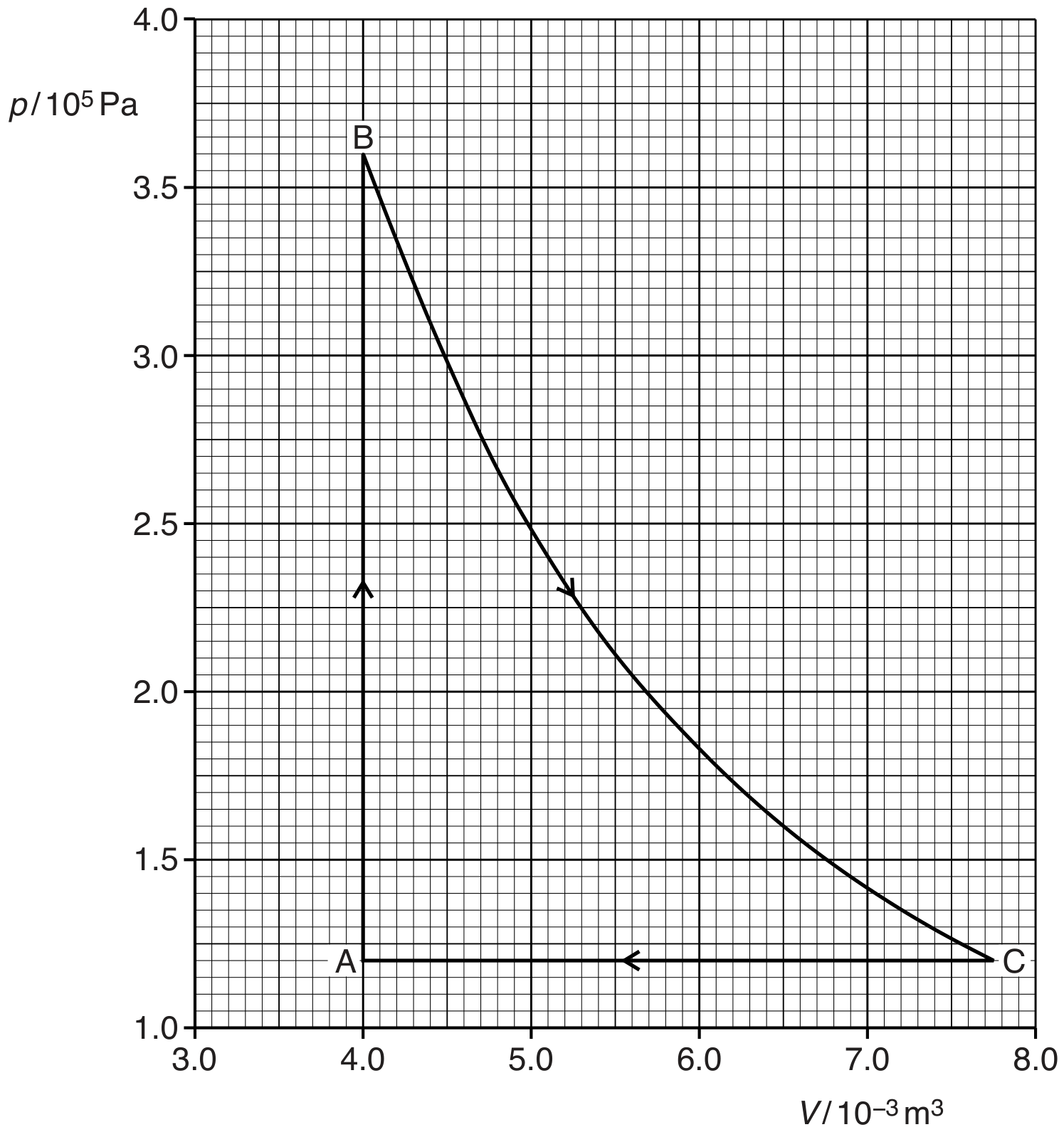
The variation with volume V of the pressure p of an ideal gas as it undergoes a cycle ABCA of changes is shown in Fig. 2.1.

Fig. 2.1

Fig. 2.1

The temperature of the gas at A is 290 K . The temperature at B is 870 K .

Determine

[ 2 ]
(i)

the amount, in mol, of gas, amount = mol

[ 2 ]
[Maximum number: 3]

+w.

(a)

Explain what is meant by the Avogadro constant.

[ 2 ]
(b)

Argon-40 (1840Ar)\left({ }_{18}^{40} \mathrm{Ar}\right) may be assumed to be an ideal gas.

A mass of 3.2 g of argon- 40 has a volume of 210 cm3210 \mathrm{~cm}^{3} at a temperature of 37C37^{\circ} \mathrm{C}.
Determine, for this mass of argon-40 gas,

[ 1 ]
(i)

the amount, in mol,
amount = mol

[ 1 ]
(a)

State what is meant by a mole.

[ 2 ]
[Maximum number: 2]

electric potential energy.
energy = J

(a)

Helium-4 may be assumed to behave as an ideal gas.

A cylinder has a constant volume of 7.8×103 cm37.8 \times 10^{3} \mathrm{~cm}^{3} and contains helium-4 gas at a pressure of 2.1×10⁷ Pa2.1 \times 10^{7} \mathrm{~Pa} and at a temperature of 290 K .

Calculate, for the helium gas,

[ 2 ]
(i)

the amount of gas,
amount = mol

[ 2 ]
(a)

A sealed vessel contains a mass of 0.0424 kg of an ideal gas at 227C227^{\circ} \mathrm{C}. The pressure of the gas is 1.37×10⁵ Pa1.37 \times 10^{5} \mathrm{~Pa} and the volume of the gas is 0.640 m30.640 \mathrm{~m}^{3}.

Calculate:

[ 1 ]
(i)

the mass of one molecule of the gas

mass =kg [1]
[ 1 ]
(a)

State what is meant by the Avogadro constant NAN_{\mathrm{A}}.

[ 1 ]
(a)

A storage cylinder for an ideal gas has a volume of 3.0×10⁴ m33.0 \times 10^{-4} \mathrm{~m}^{3}. The gas is at a temperature of 23C23^{\circ} \mathrm{C} and a pressure of 5.0×10⁷ Pa5.0 \times 10^{7} \mathrm{~Pa}.

[ 3 ]
(i)

The gas leaks slowly from the cylinder so that, after a time of 35 days, the pressure has reduced by 0.40 %. The temperature remains constant.
Calculate the average rate, in atoms per second, at which gas atoms escape from the cylinder.

[ 3 ]
(a)

A storage cylinder for an ideal gas has a volume of 3.0×10⁴ m33.0 \times 10^{-4} \mathrm{~m}^{3}. The gas is at a temperature of 23C23^{\circ} \mathrm{C} and a pressure of 5.0×10⁷ Pa5.0 \times 10^{7} \mathrm{~Pa}.

(i)

The gas leaks slowly from the cylinder so that, after a time of 35 days, the pressure has reduced by 0.40 %. The temperature remains constant.
Calculate the average rate, in atoms per second, at which gas atoms escape from the cylinder.

(a)

A sample of 0.26 m30.26 \mathrm{~m}^{3} of an ideal gas is at pressure 2.0×10⁵ Pa2.0 \times 10^{5} \mathrm{~Pa} and temperature 290 K .

Determine:

(i)

the number N of molecules of the gas

0