EduNinja
(a)
(i)

Define gravitational potential at a point.

[ 2 ]
(ii)

Starting from the equation for the gravitational potential due to a point mass, show that the gravitational potential energy EPE_{\mathrm{P}} of a point mass m at a distance r from another point mass M is given by

EP=GMmrE_{\mathrm{P}}=-\frac{G M m}{r}

where G is the gravitational constant.

[ 1 ]
(b)

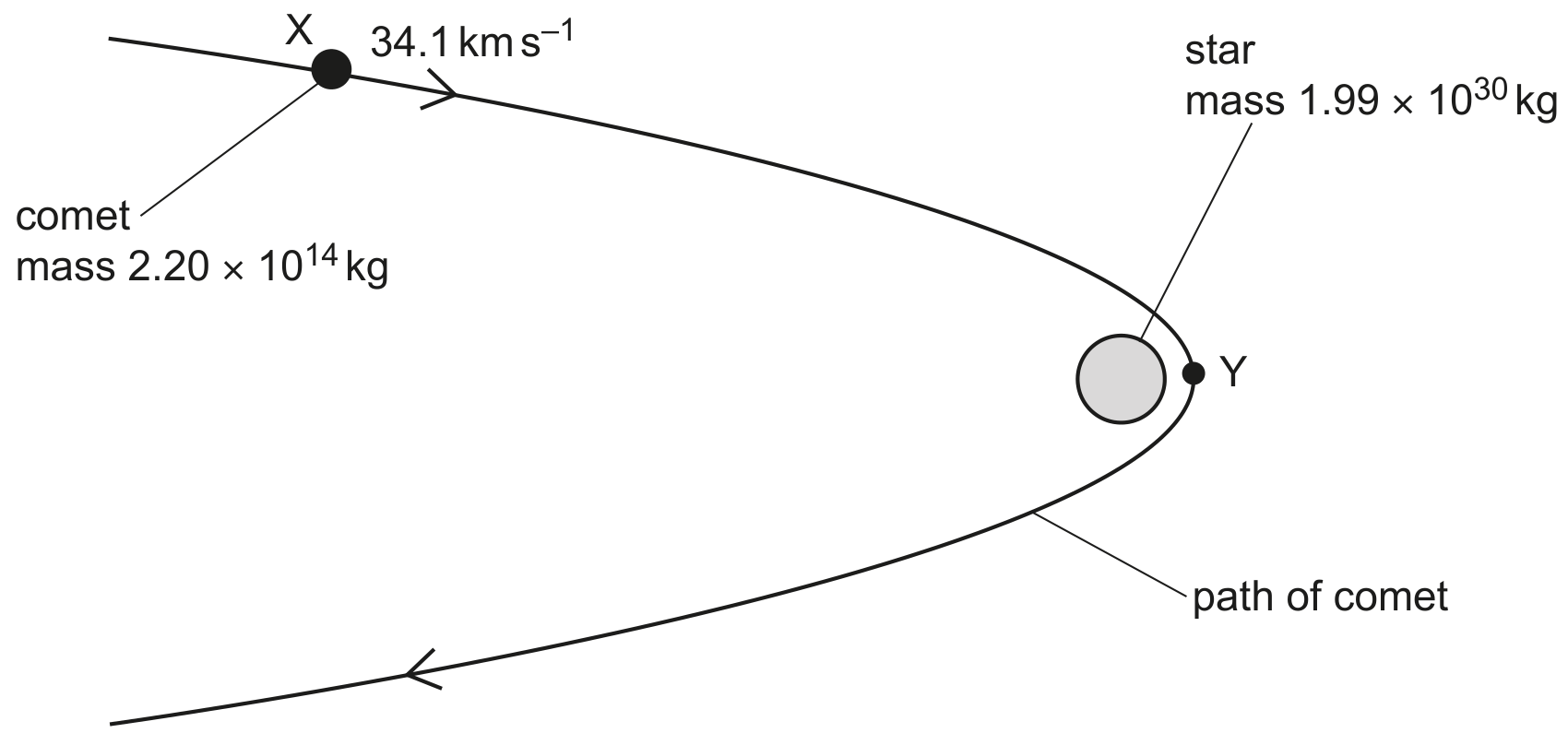
Fig. 1.1 shows the path of a comet of mass 2.20×10¹⁴ kg2.20 \times 10^{14} \mathrm{~kg} as it passes around a star of mass 1.99×1030 kg1.99 \times 10^{30} \mathrm{~kg}.

Fig. 1.1 (not to scale)

Fig. 1.1 (not to scale)

At point X , the comet is 8.44×10¹¹ m8.44 \times 10^{11} \mathrm{~m} from the centre of the star and is moving at a speed of 34.1 km s134.1 \mathrm{~km} \mathrm{~s}^{-1}.

At point Y , the comet passes its point of closest approach to the star. At this point, the comet is a distance of 6.38×10¹⁰ m6.38 \times 10^{10} \mathrm{~m} from the centre of the star.

Both the comet and the star can be considered as point masses at their centres.

[ 4 ]
(i)

Calculate the magnitude of the change in the gravitational potential energy ΔEp\Delta E_{\mathrm{p}} of the comet as it moves from position X to position Y .

ΔEp=\Delta E_{p}=
[ 3 ]
(ii)

State, with a reason, whether the change in gravitational potential energy in (b)(i) is an increase or a decrease.
[ 1 ]
(a)

Define gravitational potential at a point.

[ 1 ]
(b)

The gravitational potential ϕ\phi at distance r from point mass M is given by the expression

ϕ=GMr\phi=-\frac{G M}{r}

where G is the gravitational constant.
Explain the significance of the negative sign in this expression.

[ 2 ]
(c)

The planet in (c) has mass M and diameter 6.8×10³ km6.8 \times 10^{3} \mathrm{~km}. The product G M for this planet is 4.3×10¹³Nm2 kg14.3 \times 10^{13} \mathrm{Nm}^{2} \mathrm{~kg}^{-1}.

A rock, initially at rest a long distance from the planet, accelerates towards the planet. Assuming that the planet has negligible atmosphere, calculate the speed of the rock as it hits the surface of the planet.
speed = ms1\mathrm{ms}^{-1}

[ 3 ]
[Maximum number: 7]

Explain why the two separate electric fields have opposite signs.
2. On Fig. 4.2, sketch the variation with x of the combined electric field due to the α\alpha-particle and the proton for values of x from 4μ m4 \mu \mathrm{~m} to 16μ m16 \mu \mathrm{~m}.

(a)

Define gravitational potential at a point.

[ 2 ]
(b)

The Moon may be considered to be an isolated sphere of radius 1.74×10³ km1.74 \times 10^{3} \mathrm{~km} with its mass of 7.35×10²² kg7.35 \times 10^{22} \mathrm{~kg} concentrated at its centre.

[ 3 ]
(i)

A rock of mass 4.50 kg is situated on the surface of the Moon. Show that the change in gravitational potential energy of the rock in moving it from the Moon's surface to infinity is 1.27×10⁷ J1.27 \times 10^{7} \mathrm{~J}.

[ 1 ]
(ii)

The escape speed of the rock is the minimum speed that the rock must be given when it is on the Moon's surface so that it can escape to infinity. Use the answer in (i) to determine the escape speed. Explain your working.
speed = ms1\mathrm{ms}^{-1}

[ 2 ]
(c)

The Moon in (b) is assumed to be isolated in space. The Moon does, in fact, orbit the Earth.
State and explain whether the minimum speed for the rock to reach the Earth from the surface of the Moon is different from the escape speed calculated in (b).

[ 2 ]
[Maximum number: 3]

The mass M of a spherical planet may be assumed to be a point mass at the centre of the planet.

(a)

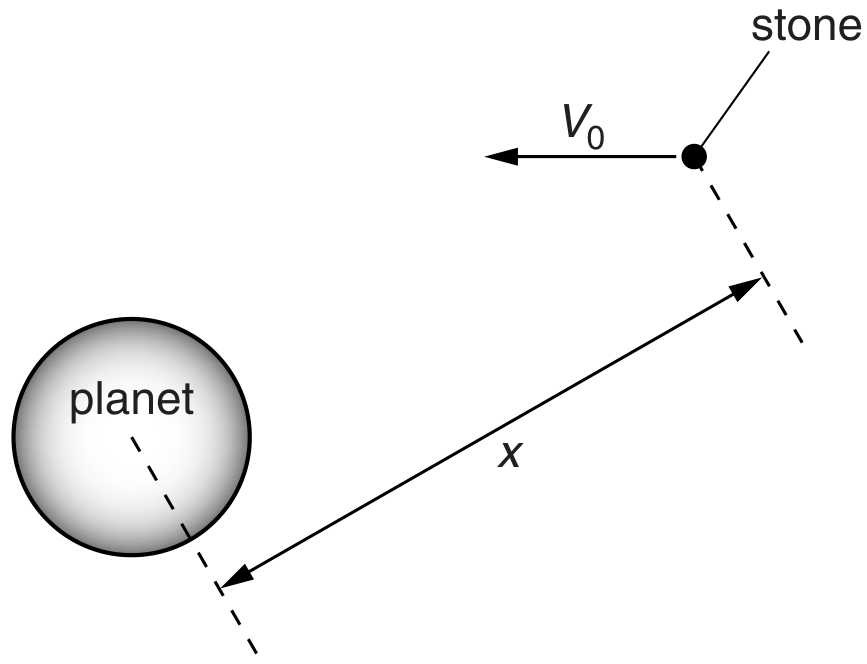
A second stone, initially at rest at infinity, travels towards the planet, as illustrated in Fig.1.2.

Fig.1.2 (not to scale)

Fig.1.2 (not to scale)

The stone does not hit the surface of the planet.

[ 3 ]
(i)

Determine, in terms of the gravitational constant G and the mass M of the planet, the speed V0V_{0} of the stone at a distance x from the centre of the planet. Explain your working. You may assume that the gravitational attraction on the stone is due only to the planet.

[ 3 ]
[Maximum number: 7]

+q,

(a)

Define gravitational potential at a point.

[ 2 ]
(b)

A stone of mass m has gravitational potential energy EPE_{\mathrm{P}} at a point X in a gravitational field. The magnitude of the gravitational potential at X is ϕ\phi.

State the relation between m,EPm, E_{\mathrm{P}} and ϕ\phi.

[ 1 ]
(c)

An isolated spherical planet of radius R may be assumed to have all its mass concentrated at its centre. The gravitational potential at the surface of the planet is 6.30×10⁷Jkg1-6.30 \times 10^{7} \mathrm{Jkg}^{-1}.

A stone of mass 1.30 kg is travelling towards the planet such that its distance from the centre of the planet changes from 6 R to 5 R.

Calculate the change in gravitational potential energy of the stone.
change in energy = J

[ 4 ]
[Maximum number: 4]

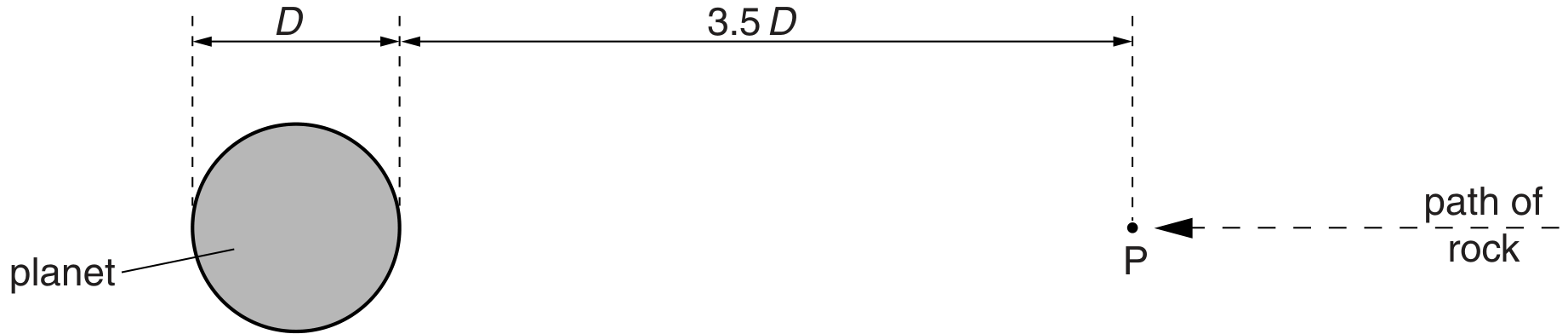
An isolated spherical planet has a diameter of 6.8×10⁶ m6.8 \times 10^{6} \mathrm{~m}. Its mass of 6.4×10²³ kg6.4 \times 10^{23} \mathrm{~kg} may be assumed to be a point mass at the centre of the planet.

(a)

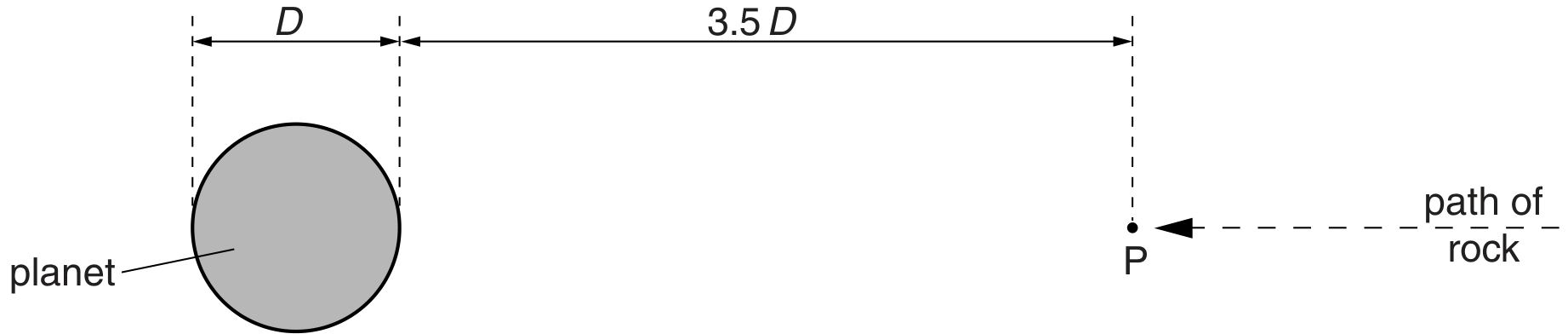
A rock, initially at rest at infinity, moves towards the planet. At point P , its height above the surface of the planet is 3.5 D, where D is the diameter of the planet, as shown in Fig.1.1.

Fig. 1.1

Fig. 1.1

Calculate the speed of the rock at point P , assuming that the change in gravitational potential energy is all transferred to kinetic energy.
speed =
ms1\mathrm{ms}^{-1}

[ 4 ]
[Maximum number: 4]

An isolated spherical planet has a diameter of 6.8×10⁶ m6.8 \times 10^{6} \mathrm{~m}. Its mass of 6.4×10²³ kg6.4 \times 10^{23} \mathrm{~kg} may be assumed to be a point mass at the centre of the planet.

(a)

A rock, initially at rest at infinity, moves towards the planet. At point P , its height above the surface of the planet is 3.5 D, where D is the diameter of the planet, as shown in Fig.1.1.

Fig. 1.1

Fig. 1.1

Calculate the speed of the rock at point P , assuming that the change in gravitational potential energy is all transferred to kinetic energy.
speed =
ms1\mathrm{ms}^{-1}

[ 4 ]
(a)

The mass of the Moon is 7.4×10²² kg7.4 \times 10^{22} \mathrm{~kg}.

(i)

Tidal action on the Earth's surface causes the radius of the orbit of the Moon to increase by 4.0 cm each year.

Use your answer in (i) to determine the change, in one year, of the gravitational potential energy of the Moon. Explain your working.
energy change =

(a)

Define gravitational potential at a point.

[ 2 ]
(b)

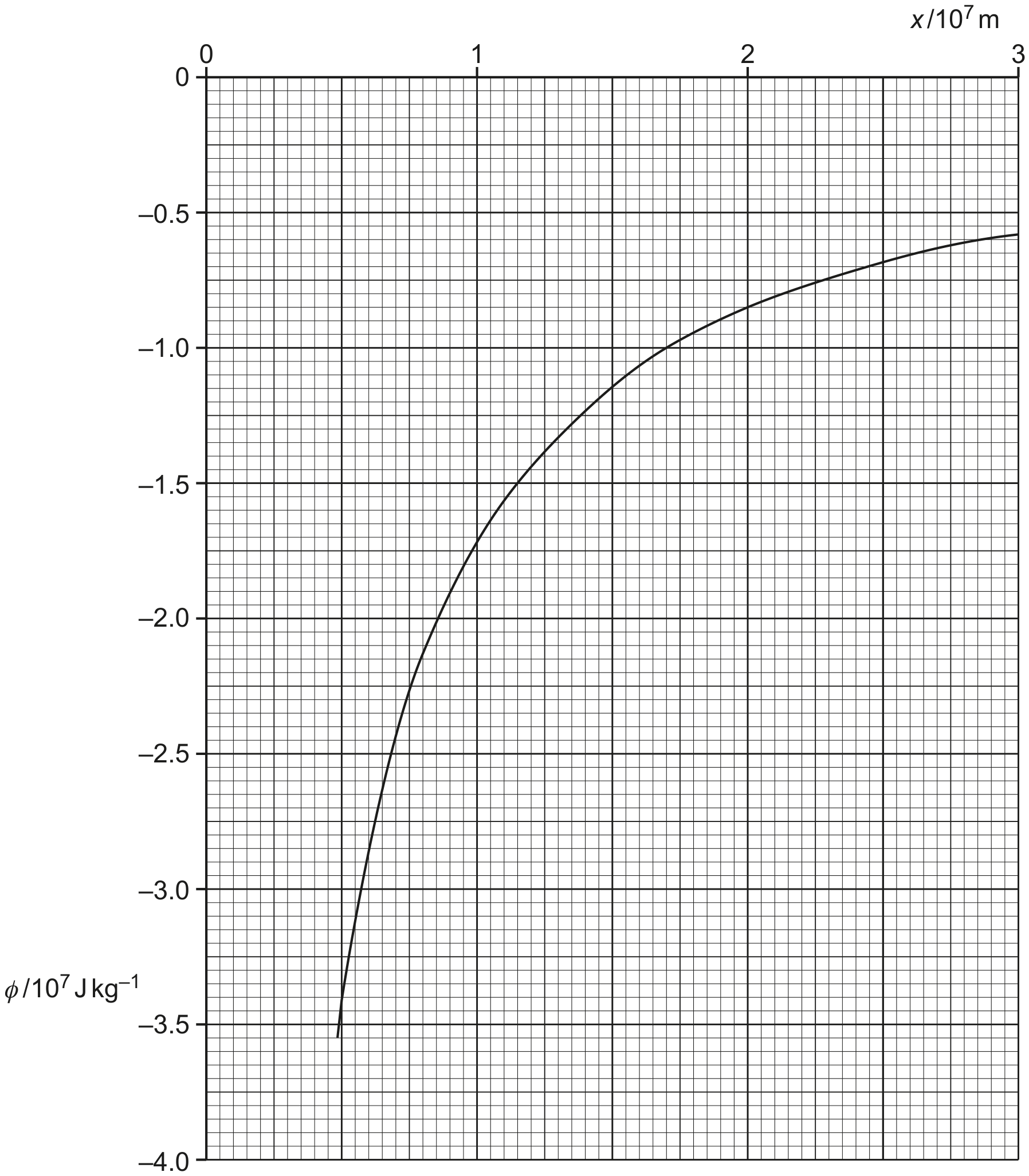
Artemis is a spherical planet that may be assumed to be isolated in space. The variation with distance x from the centre of Artemis of the gravitational potential ϕ\phi is shown in Fig. 1.1.

Fig. 1.1

Fig. 1.1

[ 1 ]
(i)

The radius of Artemis is 4800 km .

Determine the value of ϕ\phi on the surface of Artemis.

(ii)

Show that the mass of Artemis is 2.55×1024 kg2.55 \times 10^{24} \mathrm{~kg}.

[ 1 ]
(a)
(i)

State one similarity and one difference between the gravitational potential due to a point mass and the electric potential due to a point charge.
similarity:
difference:

[ 2 ]
0