(a)
On the axes of Fig. 2.2, sketch the variation with speed of the magnitude of the force on a charged particle moving at right-angles to a uniform magnetic field.
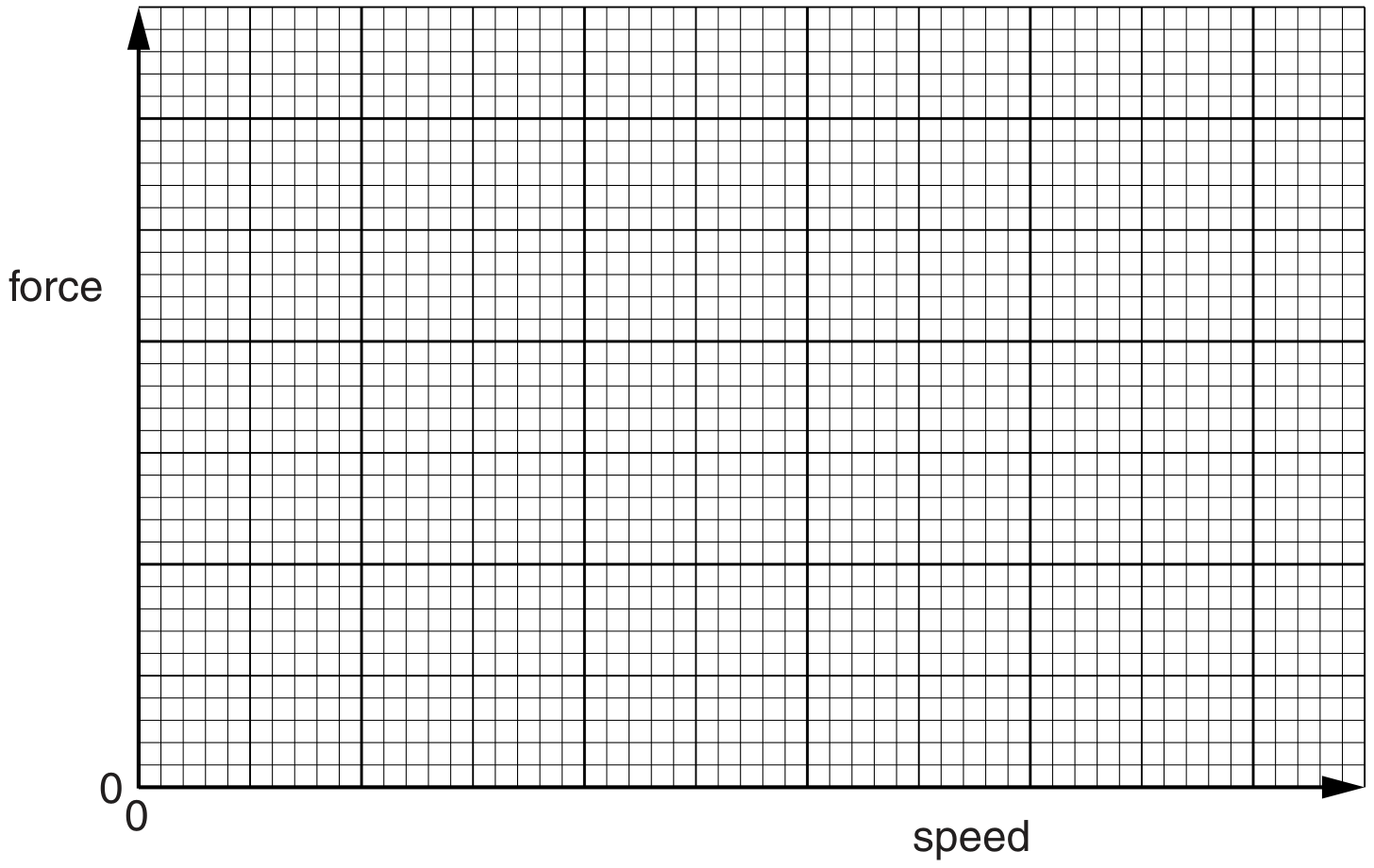
Fig. 2.2
[ 2 ]
 EduNinja
On the axes of Fig. 2.2, sketch the variation with speed of the magnitude of the force on a charged particle moving at right-angles to a uniform magnetic field.
Fig. 2.2
A sphere of mass has a charge of +0.27 nC . The sphere is in a uniform electric field that acts vertically upwards, as shown in the side view in Fig. 2.1.
SIDE VIEW
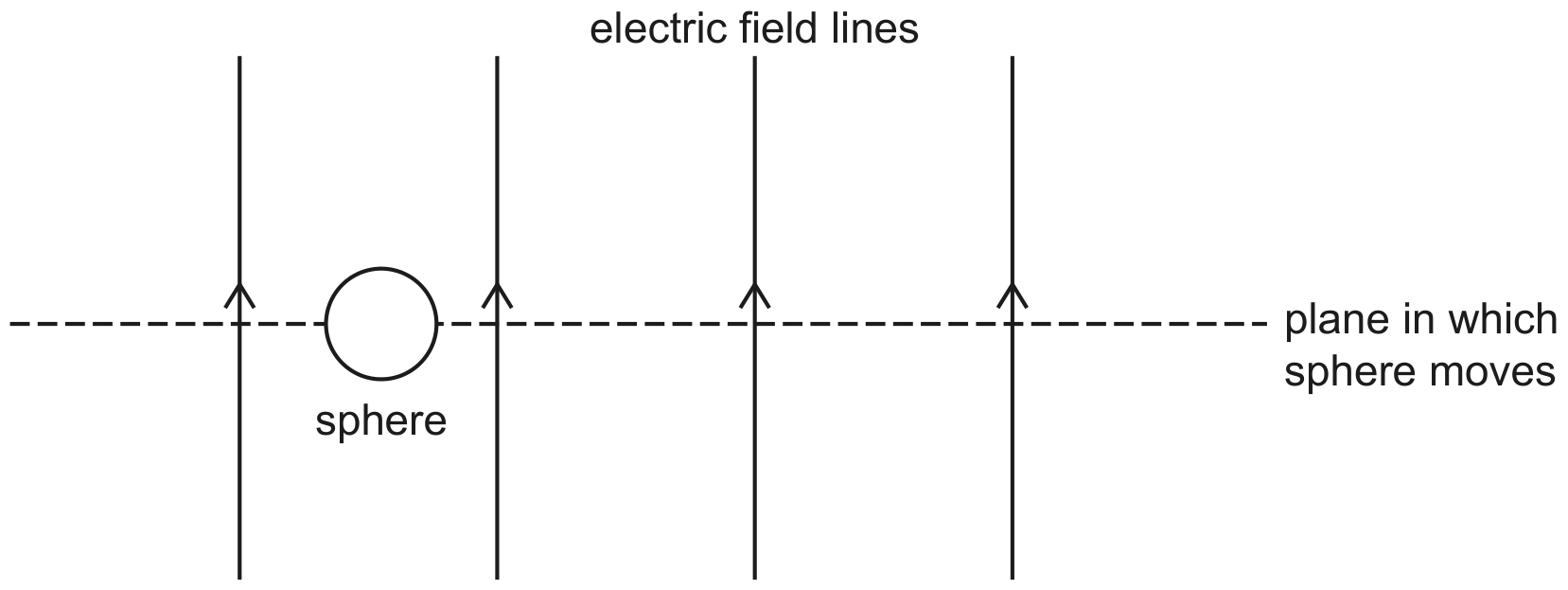
Fig. 2.1
The force exerted on the sphere by the electric field causes the sphere to remain at a fixed vertical height in a horizontal plane.
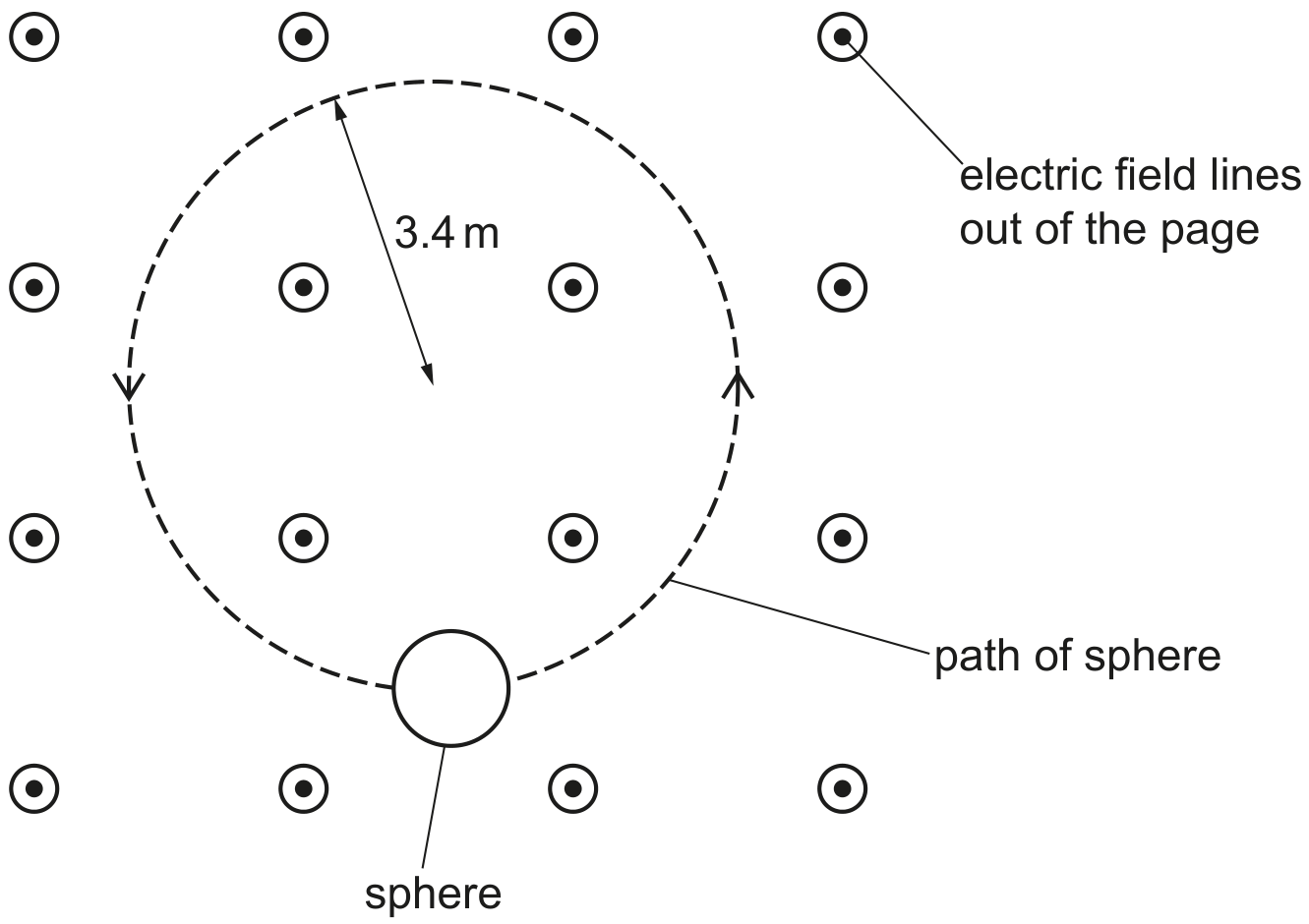
There is a uniform magnetic field in the region of the electric field. The sphere moves at a speed of in the horizontal plane. The magnetic field causes the sphere to move in a circular path of radius 3.4 m , as shown in the view from above in Fig. 2.2.
VIEW FROM ABOVE
Determine the direction of the uniform magnetic field.
Explain why the motion of the sphere in the horizontal plane is circular.
By considering the magnetic force on the sphere, show that the flux density of the uniform magnetic field is 0.14 T .
Positronium is a system in which an electron and a positron orbit, with the same period, around their common centre of mass, as shown in Fig. 2.1.
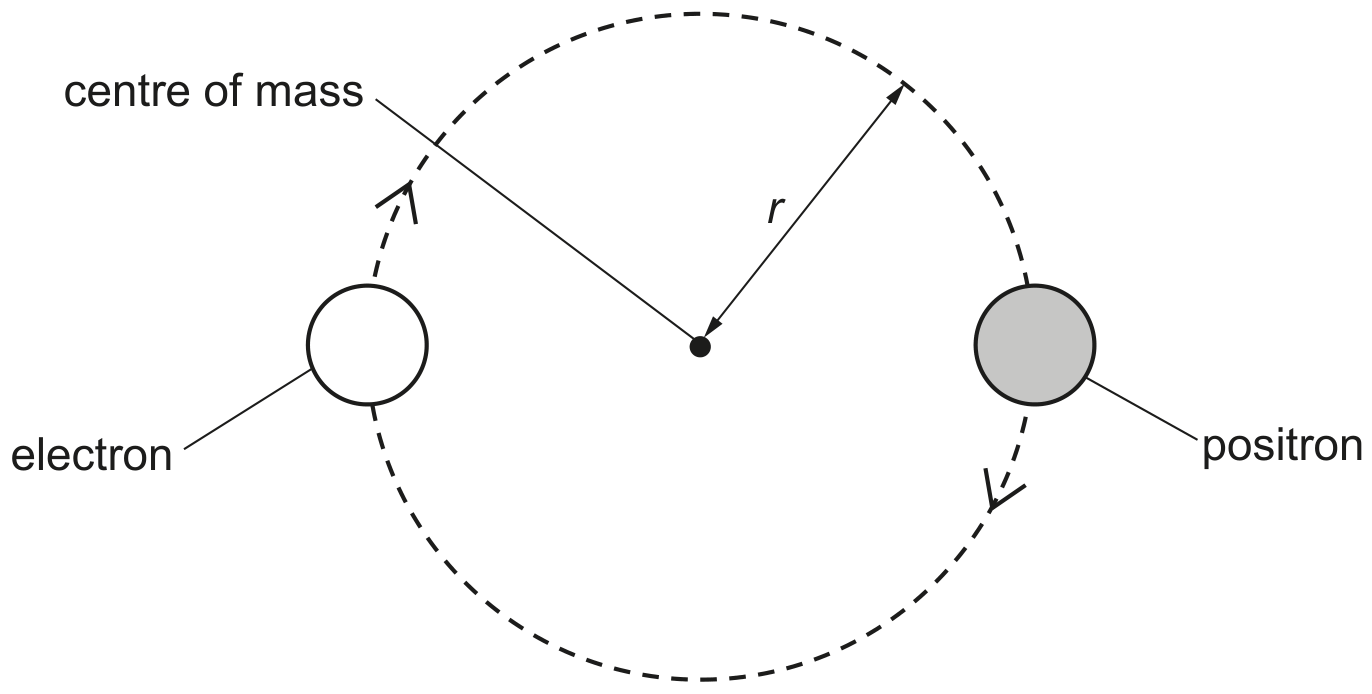
Fig. 2.1 (not to scale)
The radius r of the orbit of both particles is .
Explain how the electric force between the electron and the positron causes the path of the moving particles to be circular.
A proton of mass m and charge +q is travelling through a vacuum in a straight line with speed v.
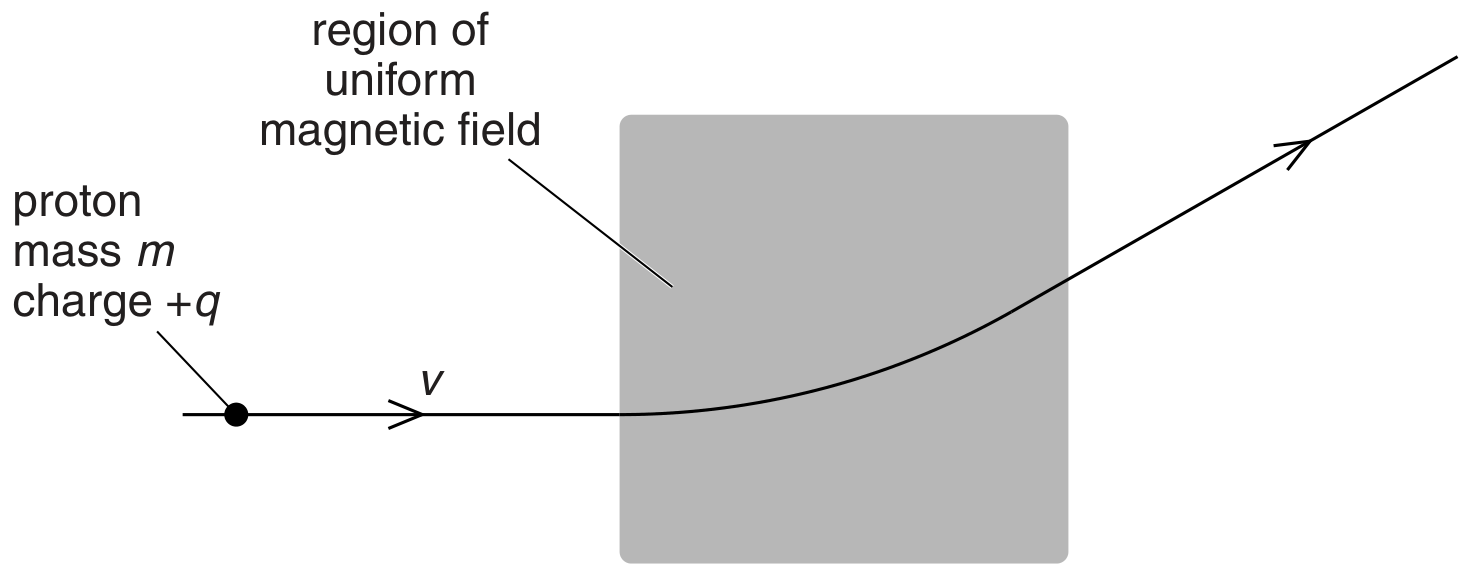
Fig. 4.1
The magnetic field is normal to the direction of motion of the proton.
Explain why the path of the proton in the magnetic field is an arc of a circle.
The angular speed of the proton in the magnetic field is . Derive an expression for in terms of B, q and m.
An electron enters the region between two parallel plates P and Q, that are separated by a distance of 18 mm , as shown in Fig. 4.3.
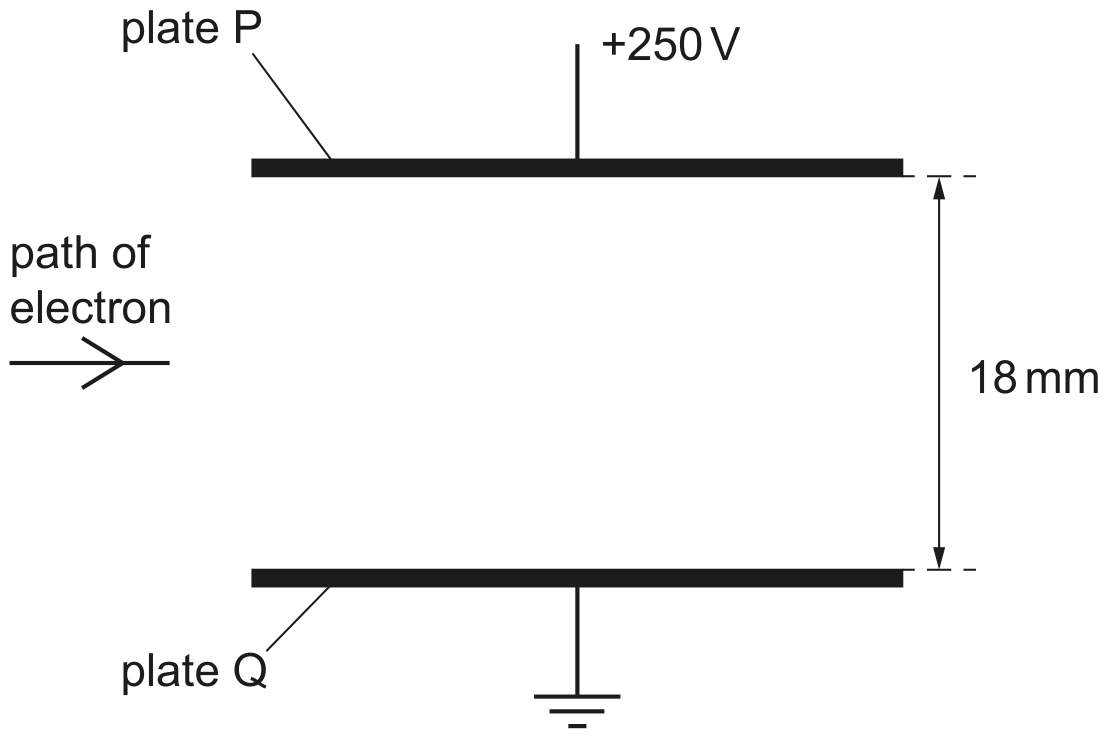
Fig. 4.3
The space between the plates is a vacuum.
The potential difference between the plates is 250 V . The electric field may be assumed to be uniform in the region between the plates and zero outside this region.
Explain why the electron does not follow a circular path.
A large horseshoe magnet has a uniform magnetic field between its poles. The magnetic field is zero outside the space between the poles.
A small Hall probe is moved at constant speed along a line XY that is midway between, and parallel to, the faces of the poles of the magnet, as shown in Fig. 5.1.
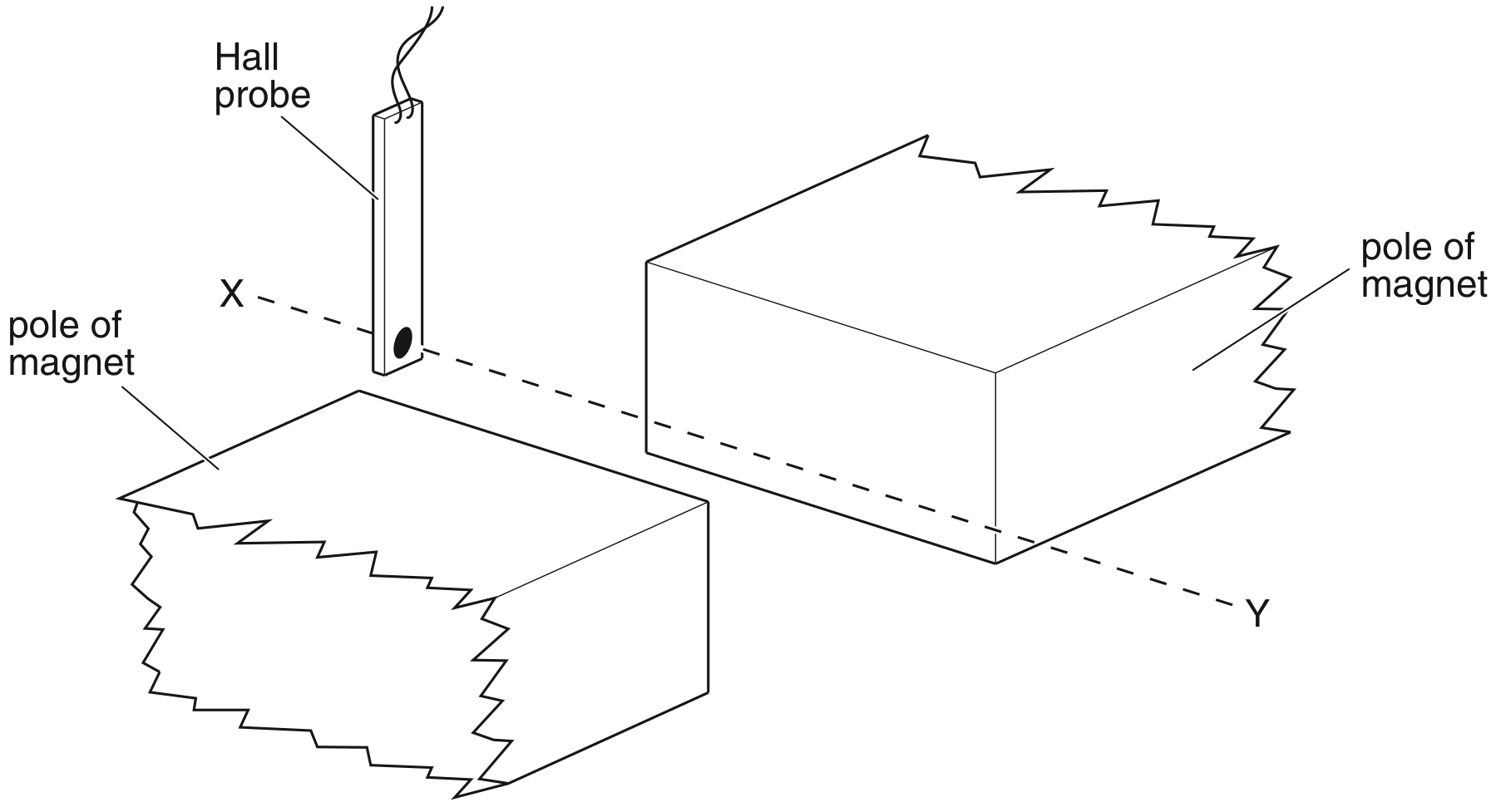
Fig. 5.1
An e.m.f. is produced by the Hall probe when it is in the magnetic field. The angle between the plane of the probe and the direction of the magnetic field is not varied.
On the axes of Fig. 5.2, sketch a graph to show the variation with time t of the e.m.f. produced by the Hall probe.
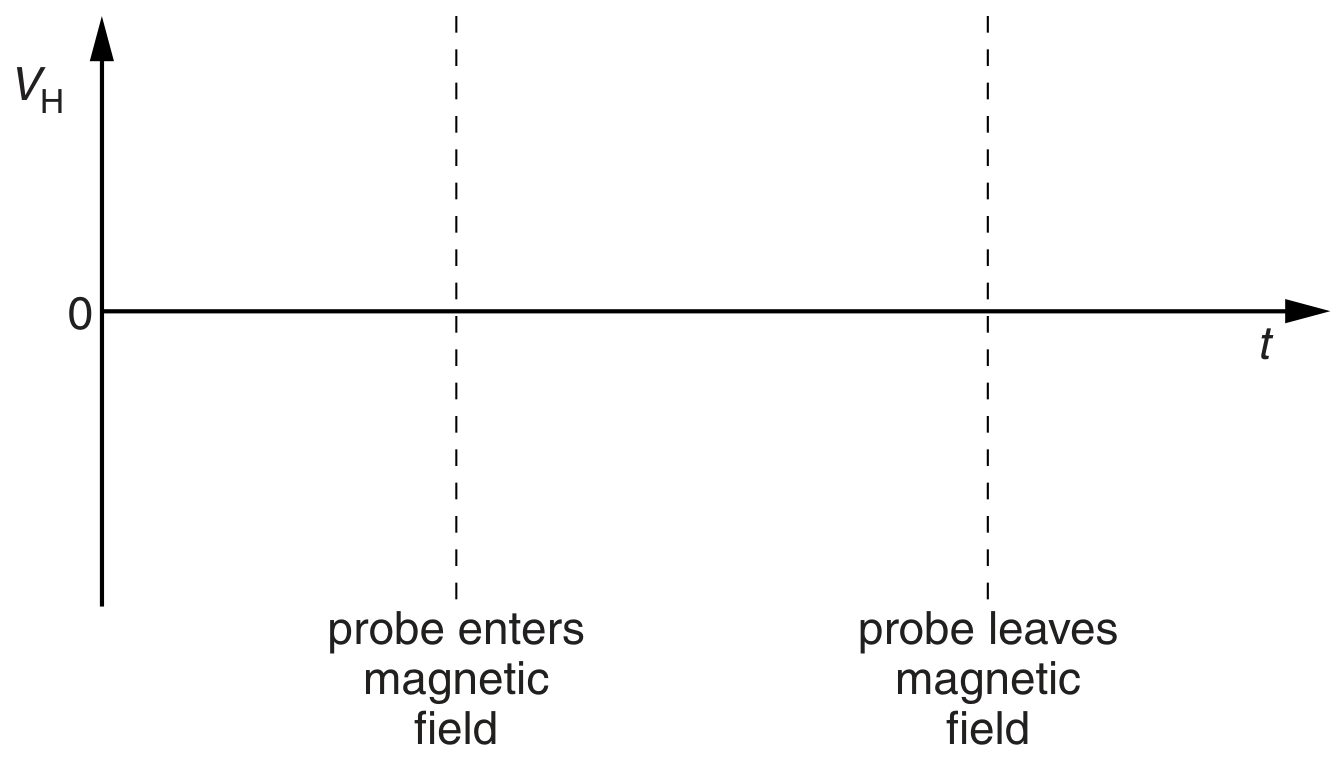
Fig. 5.2
A charged particle of mass m and charge +q is travelling with velocity v in a vacuum. It enters a region of uniform magnetic field of flux density B, as shown in Fig. 5.1.
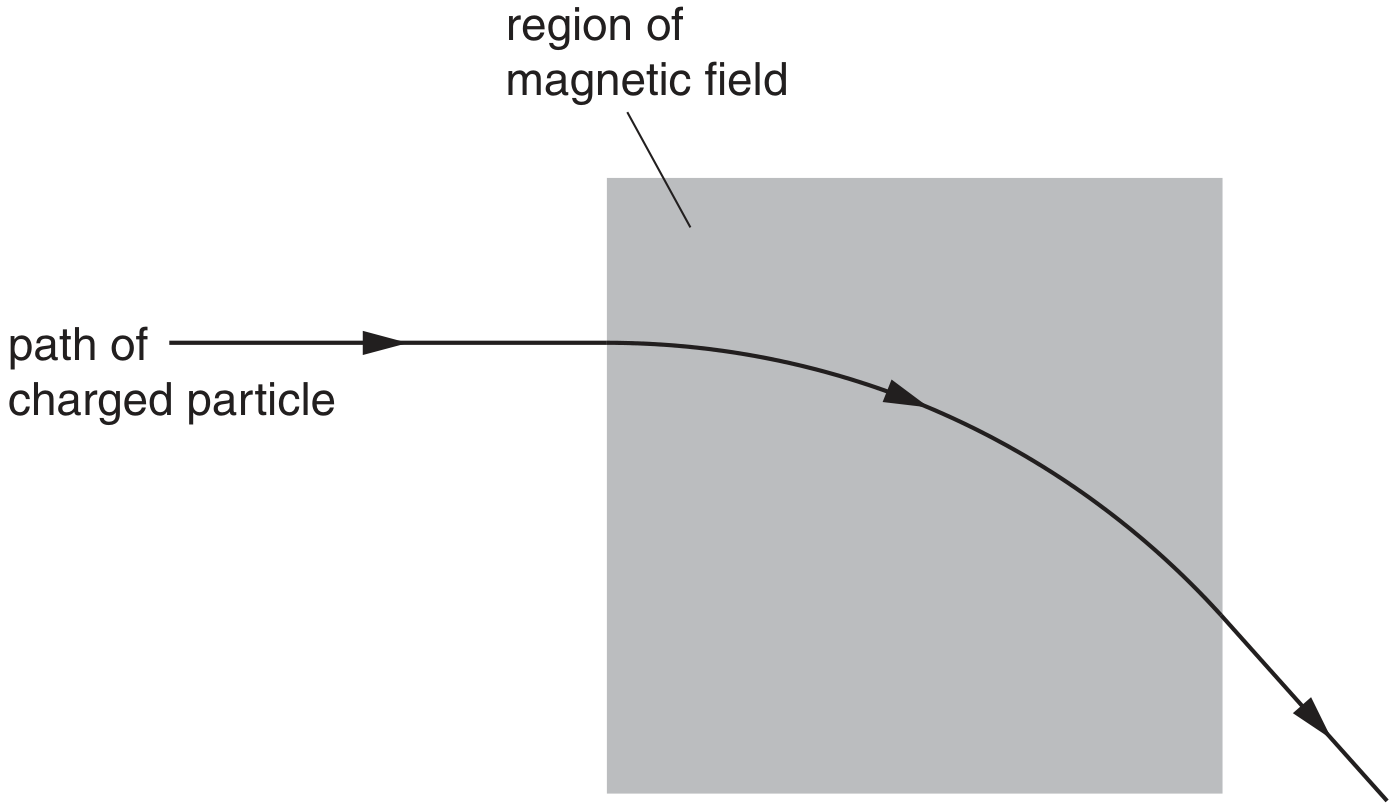
Fig. 5.1
The magnetic field is normal to the direction of motion of the particle. The path of the particle in the field is the arc of a circle of radius r.
Explain why the path of the particle in the field is the arc of a circle.
Show that the radius r is given by the expression
A thin metal foil is placed in the magnetic field in (b).
A second charged particle enters the region of the magnetic field. It loses kinetic energy as it passes through the foil. The particle follows the path shown in Fig. 5.2.
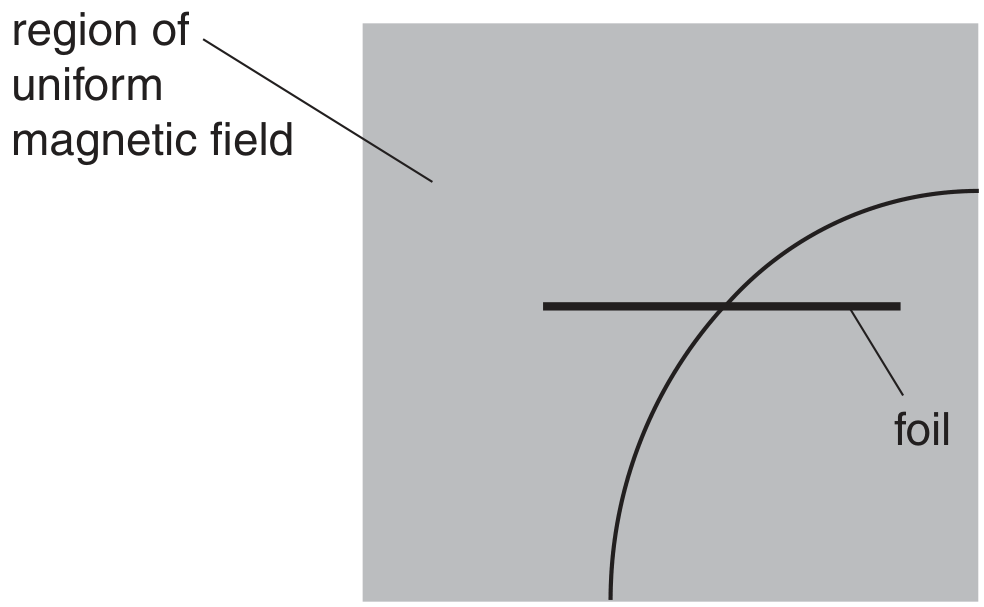
Fig. 5.2
On Fig. 5.2, mark with an arrow the direction of travel of the particle.
The path of the particle has different radii on each side of the foil.
The radii are 7.4 cm and 5.7 cm .
Determine the ratio
for the particle as it passes through the foil.
Explain the use of a uniform electric field and a uniform magnetic field for the selection of the velocity of a charged particle. You may draw a diagram if you wish.
Ions, all of the same isotope, are travelling in a vacuum with a speed of . The ions are incident normally on a uniform magnetic field of flux density 640 mT . The ions follow semicircular paths A and B before reaching a detector, as shown in Fig. 6.1.
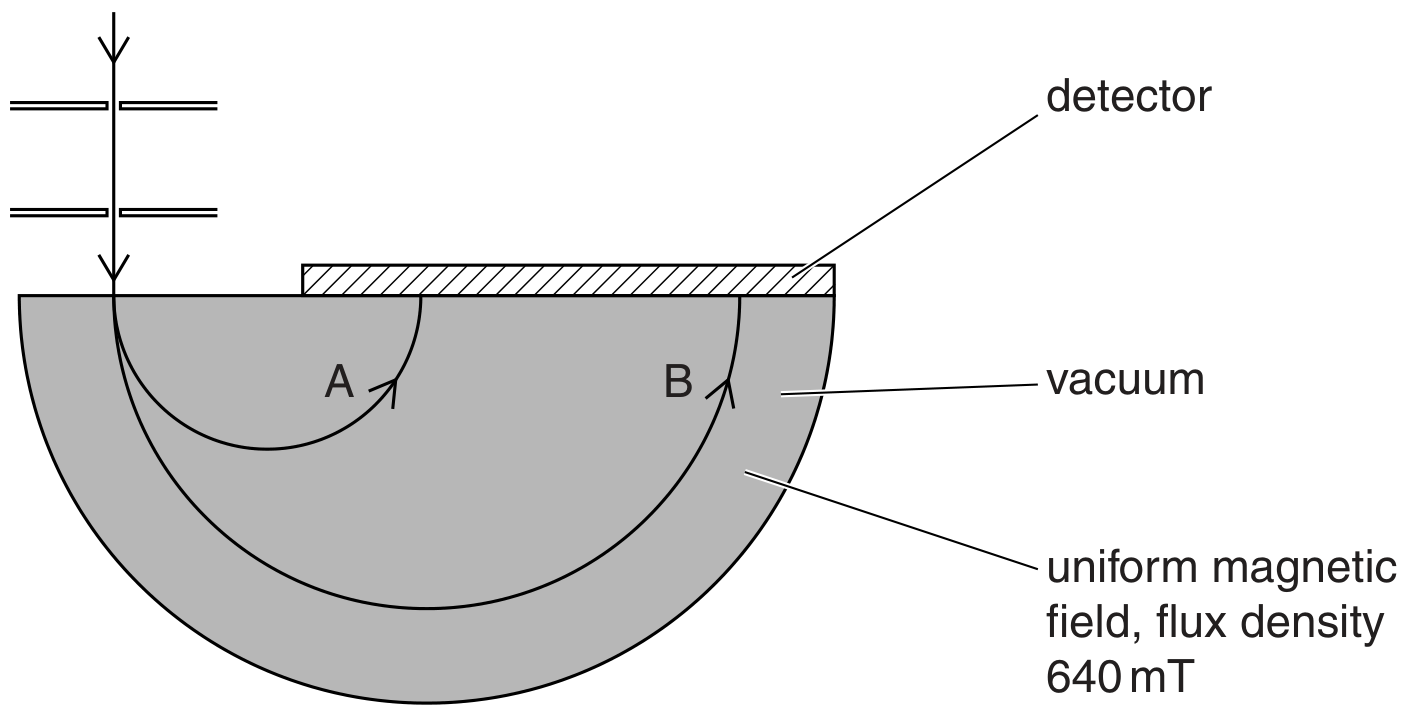
Fig. 6.1
Data for the diameters of the paths are shown in Fig. 6.2.
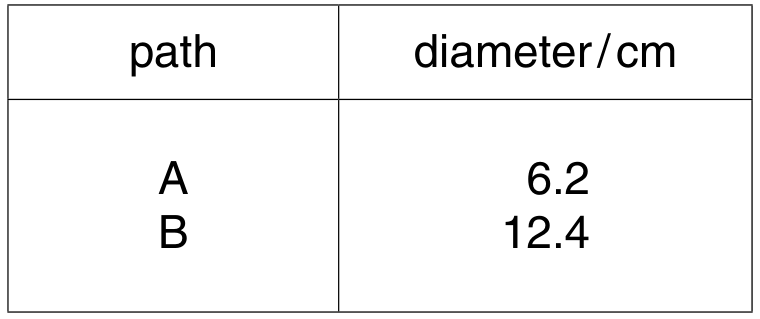
Fig. 6.2
The ions in path B each have charge .
Suggest and explain quantitatively a reason for the difference in radii of the paths A and B of the ions.
A solenoid is connected in series with a battery and a switch. A Hall probe is placed close to one end of the solenoid, as illustrated in Fig. 7.1.
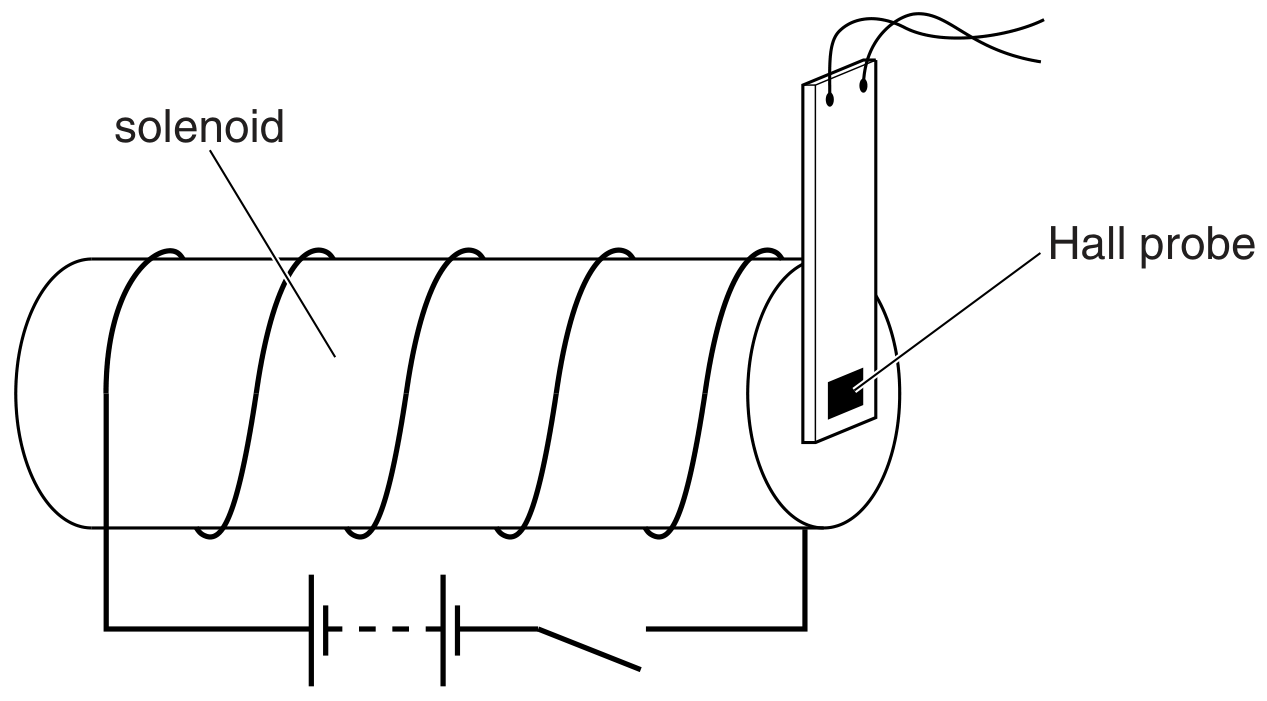
Fig. 7.1
The current in the solenoid is switched on. The Hall probe is adjusted in position to give the maximum reading. The current is then switched off.
The current in the solenoid is now switched on again. Several seconds later, it is switched off. The Hall probe is not moved.
On the axes of Fig. 7.2, sketch a graph to show the variation with time t of the Hall voltage .
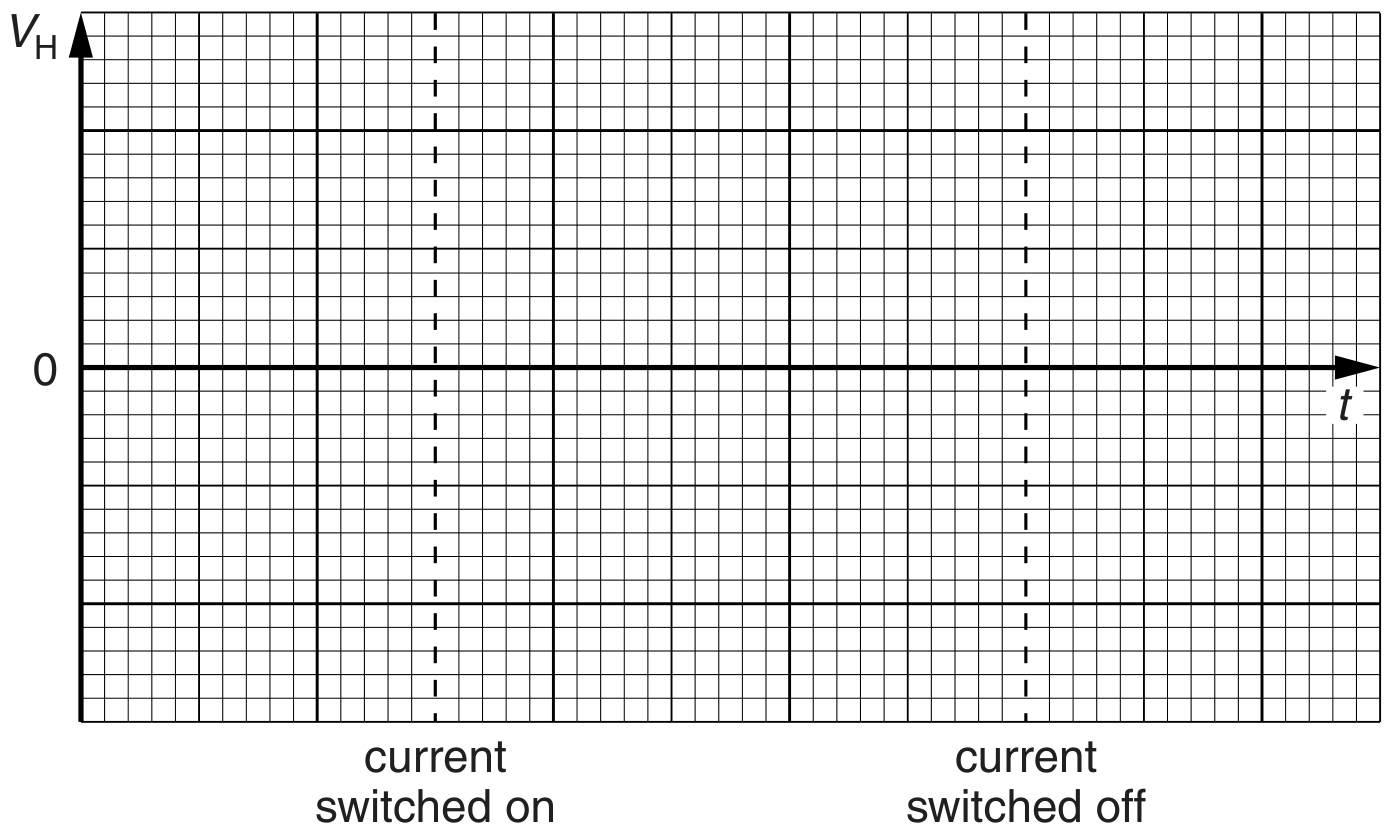
Fig. 7.2
A charged particle of mass m and with charge q enters a region of uniform magnetic field, perpendicular to the field lines. The magnetic flux density is B.
The particle travels in a circle with period T and radius r.
By considering the magnetic force acting on the particle, show that
The particle is an alpha particle. The period of the circular motion is .
Calculate B.
A second alpha particle is in the same uniform field. It travels in a circle of radius 2 r. State and explain how the periods of the motion of the two particles compare.
The speed of the alpha particle in (b)(ii) is . An electric field is applied so that this particle now moves with constant velocity.
Use your answer in (b)(ii) to calculate the electric field strength E. Give the unit with your answer.
E= unit