EduNinja
(a)

Define the radian.

[ 1 ]
(b)

A circular metal disc spins horizontally about a vertical axis, as shown in Fig. 1.1.
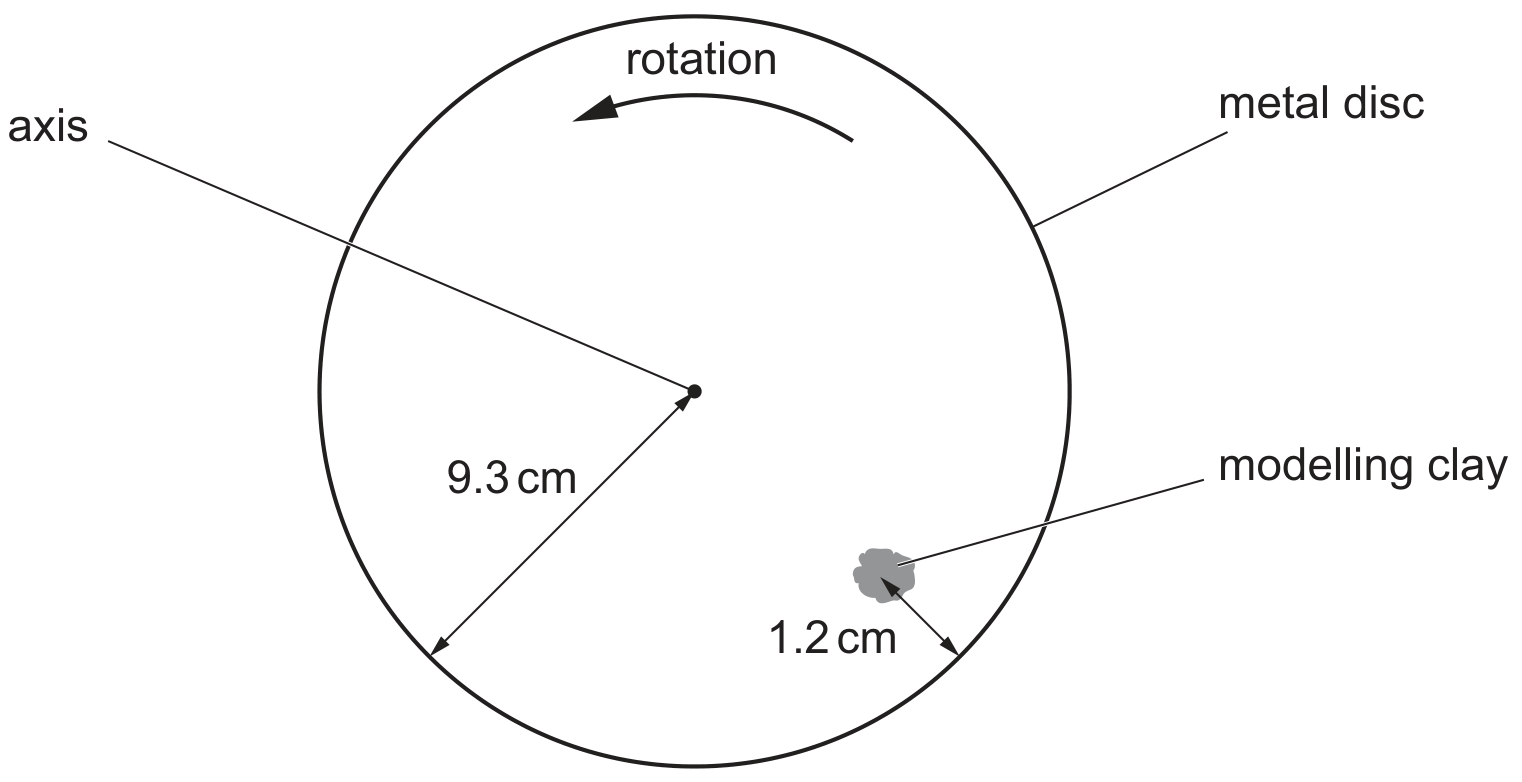
Fig. 1.1 (not to scale)

Fig. 1.1 (not to scale)

A piece of modelling clay is attached to the disc.
For the instant when the piece of modelling clay is in the position shown, draw on Fig. 1.1:

[ 1 ]
(i)

an arrow, labelled V , showing the direction of the velocity of the modelling clay

[ 1 ]
(c)

The metal disc in Fig. 1.1 has a radius of 9.3 cm .

The centre of gravity of the modelling clay is 1.2 cm from the rim of the disc and moves with a speed of 0.68 ms10.68 \mathrm{~ms}^{-1}.

(i)

Calculate the angular speed ω\omega of the disc.
ω=\omega=rads1\mathrm{rads}^{-1}

(a)

Define the radian.

[ 1 ]
(b)

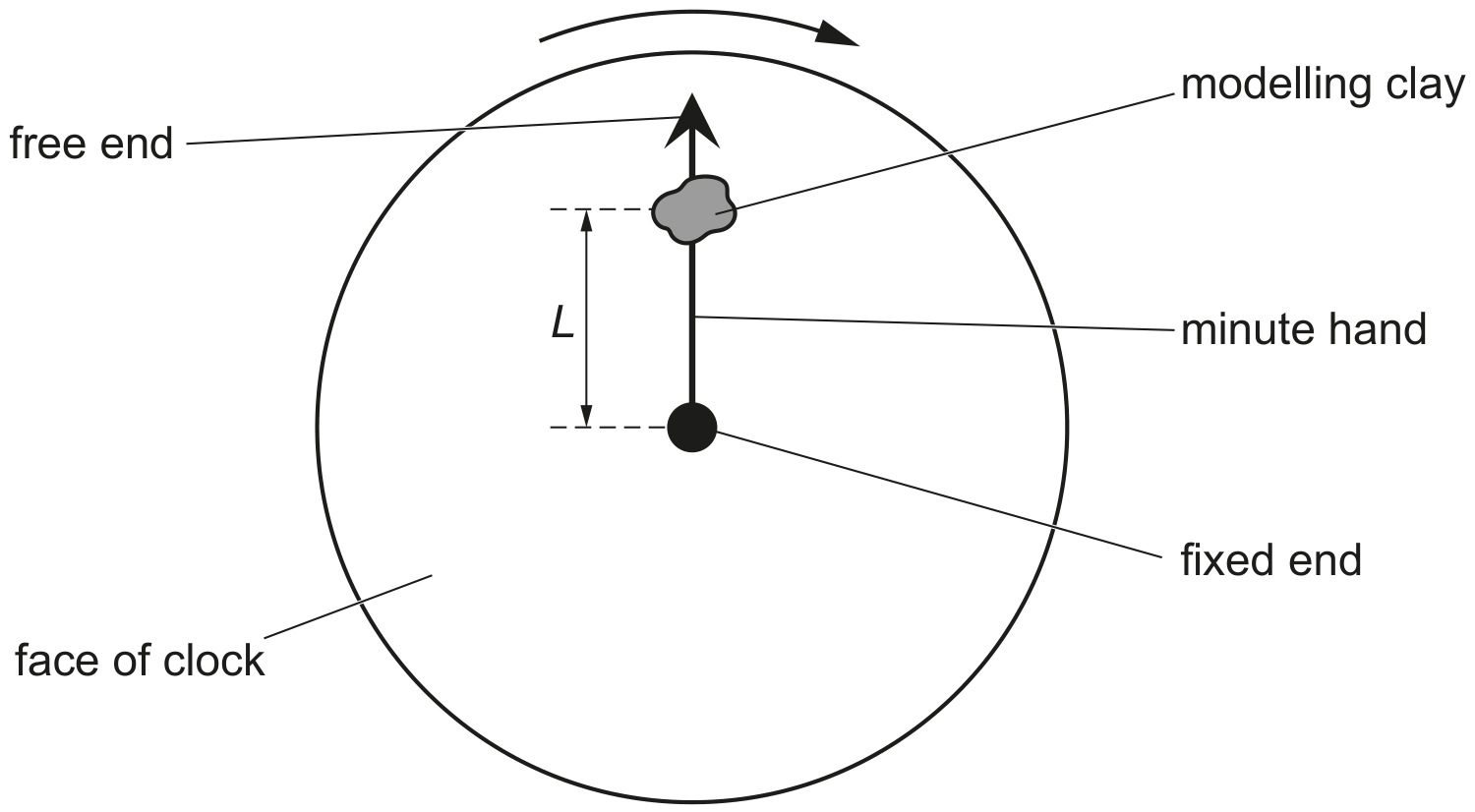
The minute hand of a clock revolves at constant angular speed around the face of the clock, completing one revolution every hour. A small piece of modelling clay is attached to the hand with its centre of gravity at a distance L from the fixed end of the hand, as shown in Fig. 1.1.

direction of revolution of minute hand

direction of revolution of minute hand

Calculate the angular speed ω\omega of the minute hand.

(c)

During a time interval of 1400 s , the centre of gravity of the piece of modelling clay in Fig. 1.1 moves through a total distance of 0.44 m .

[ 3 ]
(i)

Calculate the angle through which the minute hand moves in this time interval.

angle =rad [1]
[ 1 ]
(ii)

Determine distance L.

L =m [2]
[ 2 ]
(a)

Another satellite is in a circular orbit around the Earth with the same orbital radius and period as the satellite in (c).

[ 2 ]
(i)

Calculate the angular speed of the satellite in this orbit. Give a unit with your answer.
angular speed = unit

[ 2 ]
(a)

With reference to velocity and acceleration, describe uniform circular motion.

[ 2 ]
(a)

The Earth and the Moon may be considered to be isolated in space with their masses concentrated at their centres.
The orbit of the Moon around the Earth is circular with a radius of 3.84×10⁵ km3.84 \times 10^{5} \mathrm{~km}. The period of the orbit is 27.3 days.

Show that

[ 1 ]
(i)

the angular speed of the Moon in its orbit around the Earth is 2.66×10⁶rads12.66 \times 10^{-6} \mathrm{rad} \mathrm{s}^{-1},

[ 1 ]
[Maximum number: 5]

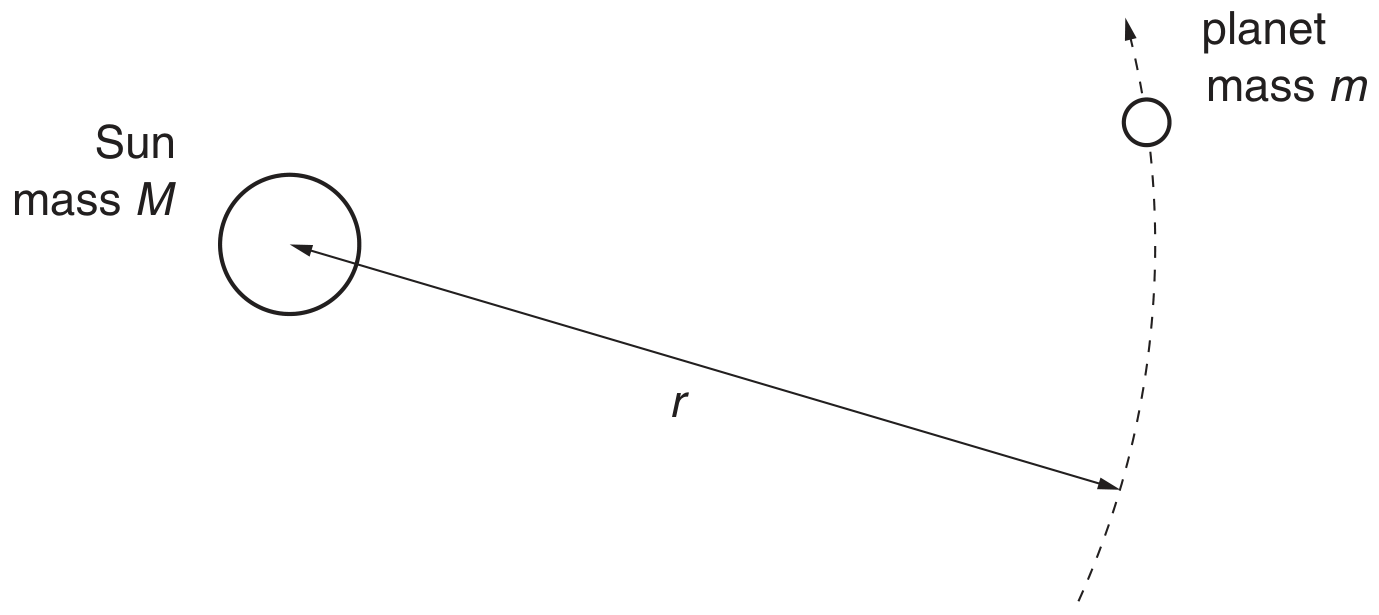
A planet of mass m is in a circular orbit of radius r about the Sun of mass M, as illustrated in Fig. 1.1.

Fig. 1.1

Fig. 1.1

The magnitude of the angular velocity and the period of revolution of the planet about the Sun are ω\omega and T respectively.

(a)

State

[ 3 ]
(i)

what is meant by angular velocity,

[ 2 ]
(ii)

the relation between ω\omega and T.

[ 1 ]
(b)

Data for the planets Venus and Neptune are given in Fig. 1.2.

Fig. 1.2

Fig. 1.2

Assume that the orbits of both planets are circular.

[ 2 ]
(i)

Determine the linear speed of Venus in its orbit.
speed = kms1\mathrm{km} \mathrm{s}^{-1}

[ 2 ]
[Maximum number: 6]

gravitational potential energy,
energy = J

(a)

Define the radian.

[ 2 ]
(b)

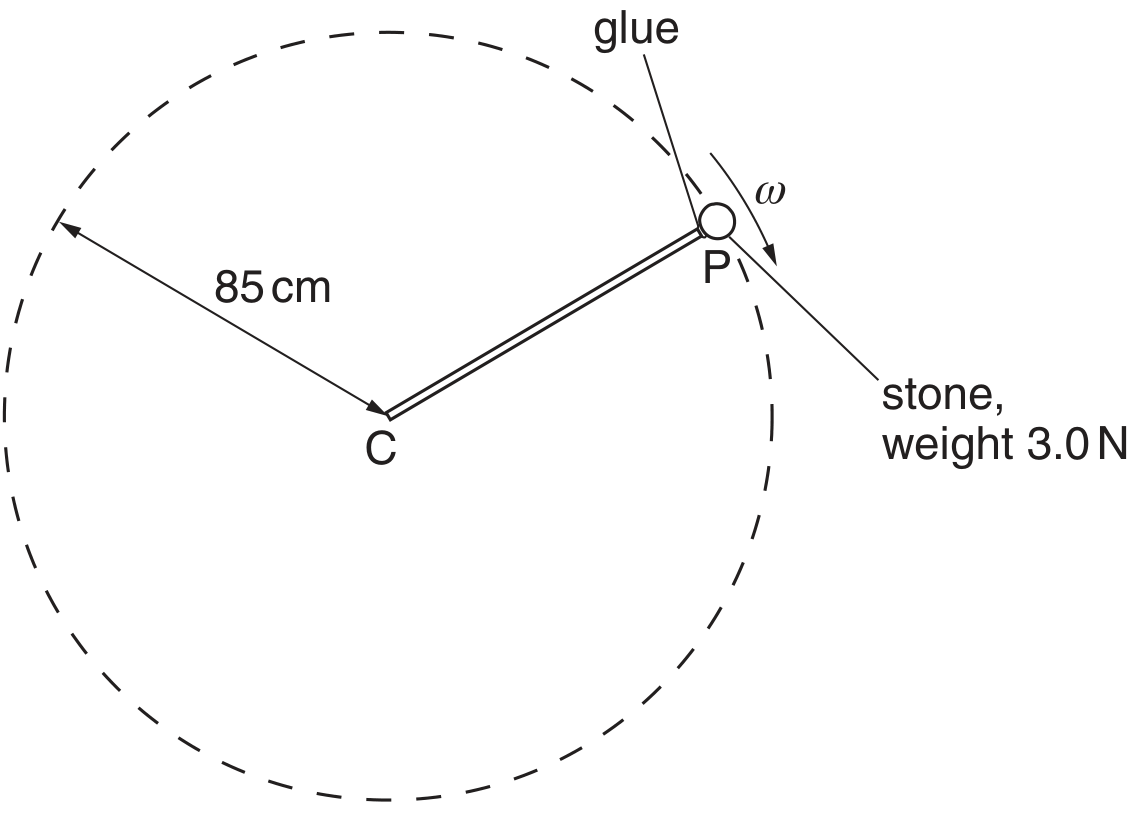
A stone of weight 3.0 N is fixed, using glue, to one end P of a rigid rod C P, as shown in Fig. 1.1.

Fig. 1.1

Fig. 1.1

The rod is rotated about end C so that the stone moves in a vertical circle of radius 85 cm .
The angular speed ω\omega of the rod and stone is gradually increased from zero until the glue snaps. The glue fixing the stone snaps when the tension in it is 18 N .

For the position of the stone at which the glue snaps,

[ 4 ]
(i)

calculate the angular speed ω\omega of the stone.
rads1[4]\mathrm{rad} \mathrm{s}^{-1}[4]

[ 4 ]
(a)

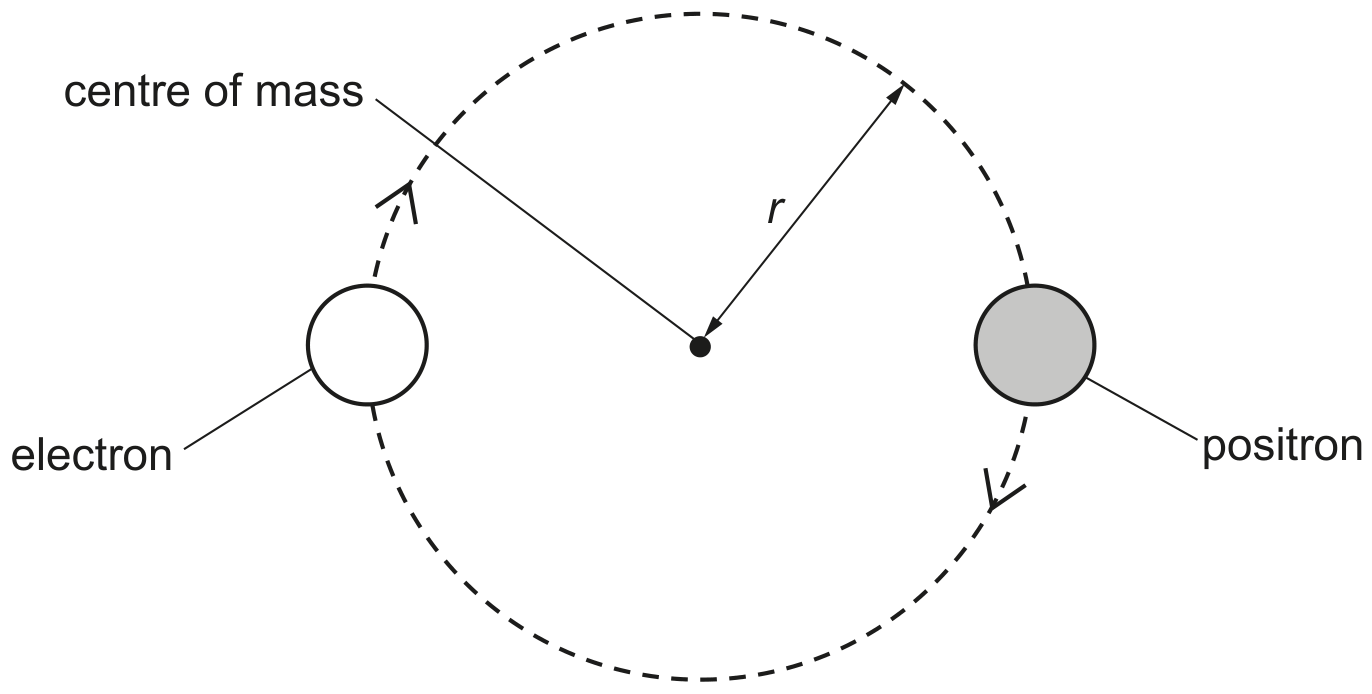
Positronium is a system in which an electron and a positron orbit, with the same period, around their common centre of mass, as shown in Fig. 2.1.

Fig. 2.1 (not to scale)

Fig. 2.1 (not to scale)

The radius r of the orbit of both particles is 1.59×10¹⁰ m1.59 \times 10^{-10} \mathrm{~m}.

[ 2 ]
(i)

Use the information in (b)(ii) to determine the period of the circular orbit of the two particles.

period =
[ 2 ]
[Maximum number: 3]

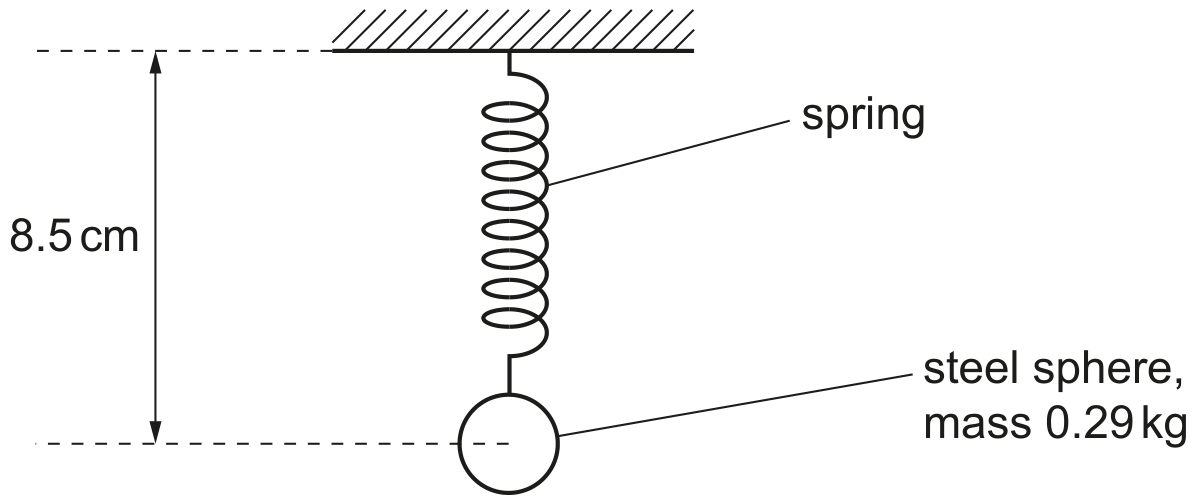
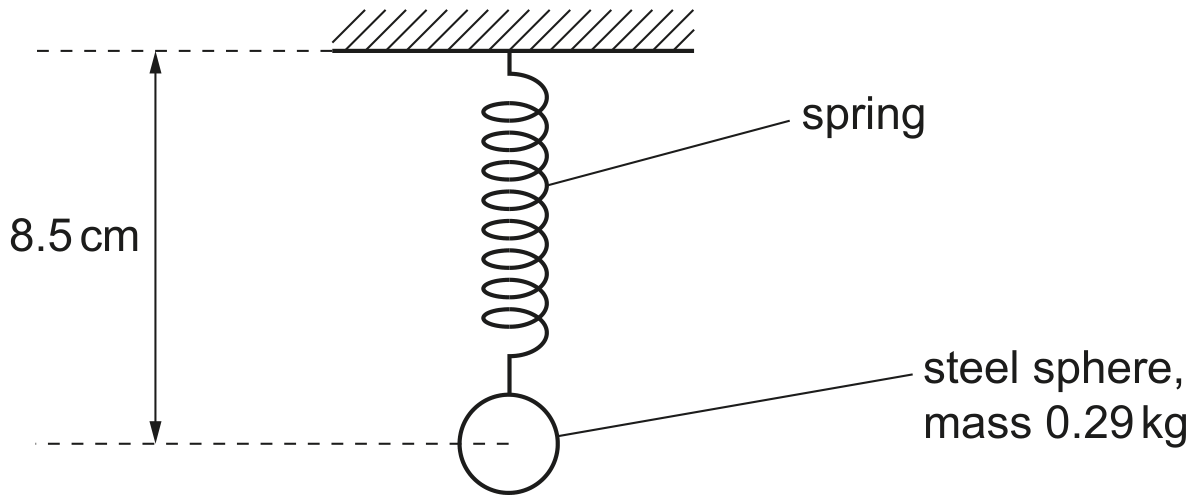
A steel sphere of mass 0.29 kg is suspended in equilibrium from a vertical spring. The centre of the sphere is 8.5 cm from the top of the spring, as shown in Fig. 2.1.

Fig. 2.1

Fig. 2.1

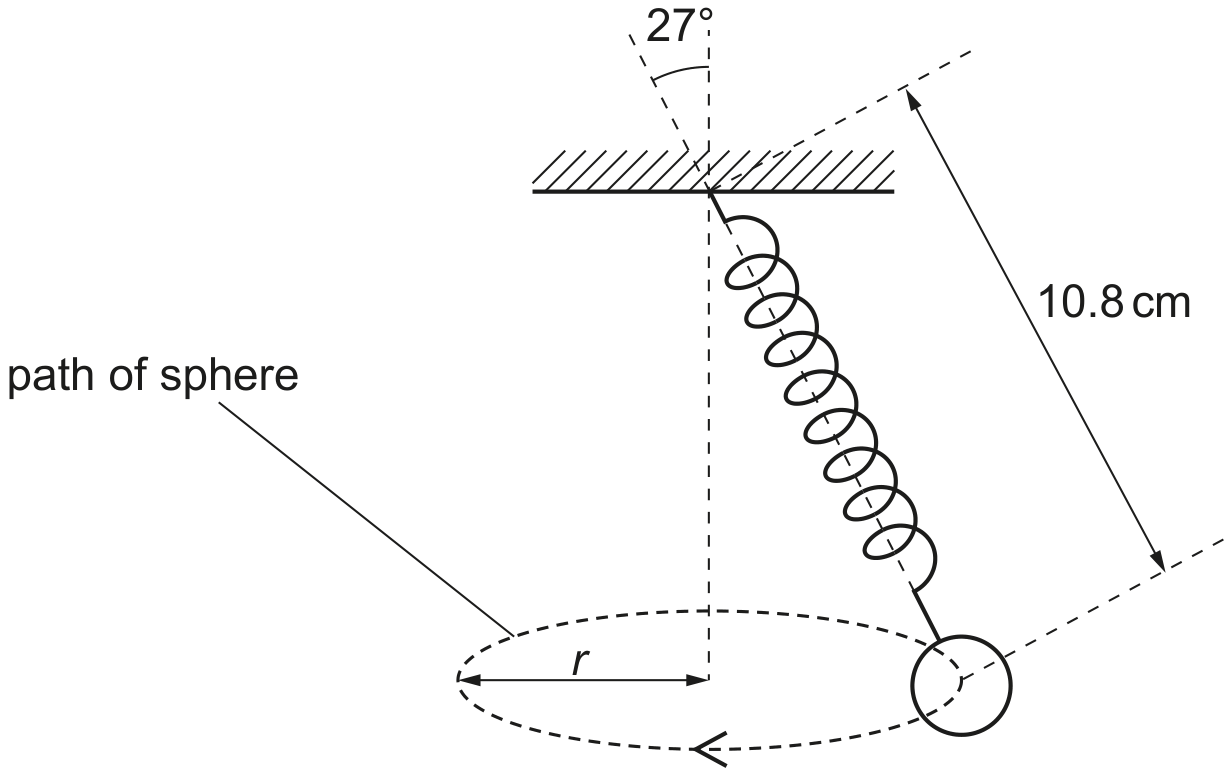
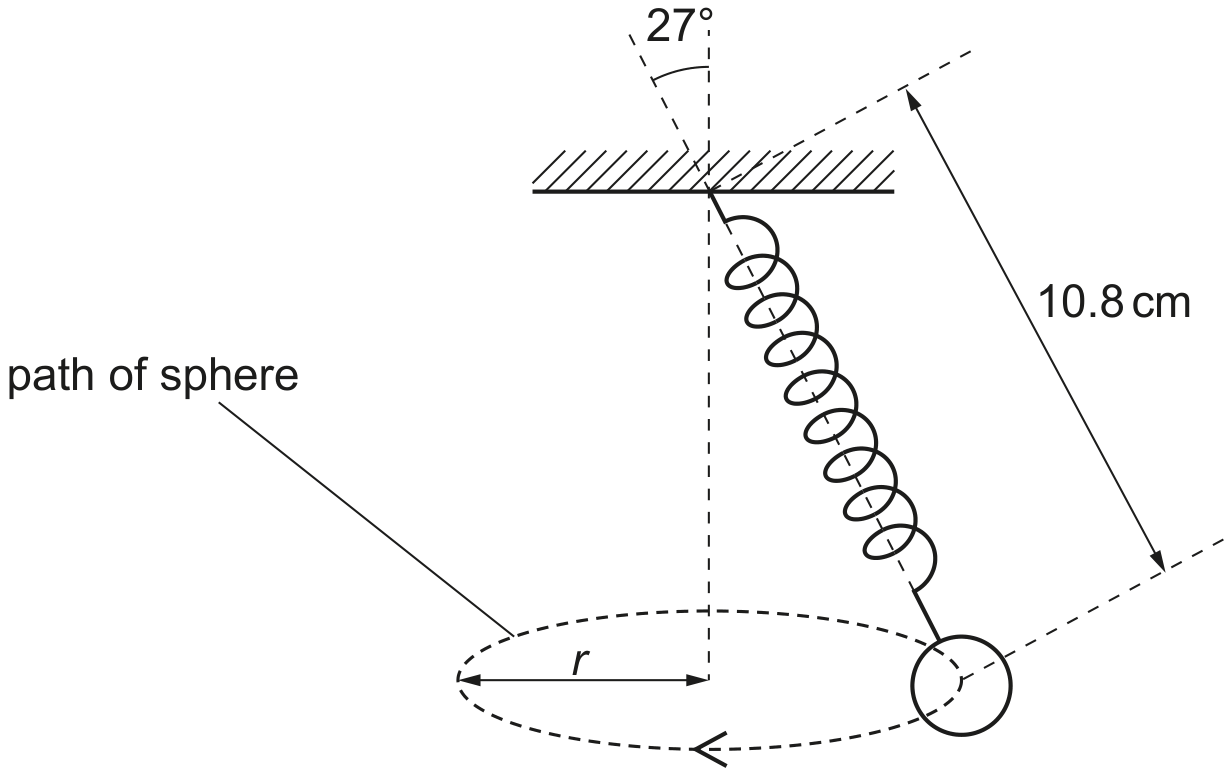
The sphere is now set in motion so that it is moving in a horizontal circle at constant speed, as shown in Fig. 2.2.

Fig. 2.2

Fig. 2.2

The distance from the centre of the sphere to the top of the spring is now 10.8 cm .

(a)

The angle between the linear axis of the spring and the vertical is 2727^{\circ}.

[ 1 ]
(i)

Show that the radius r of the circle is 4.9 cm .

[ 1 ]
(b)
(i)

Calculate the period of the circular motion of the sphere.

[ 2 ]
[Maximum number: 4]

A steel sphere of mass 0.29 kg is suspended in equilibrium from a vertical spring. The centre of the sphere is 8.5 cm from the top of the spring, as shown in Fig. 2.1.

Fig. 2.1

Fig. 2.1

The sphere is now set in motion so that it is moving in a horizontal circle at constant speed, as shown in Fig. 2.2.

Fig. 2.2

Fig. 2.2

The distance from the centre of the sphere to the top of the spring is now 10.8 cm .

(a)

The angle between the linear axis of the spring and the vertical is 2727^{\circ}.

[ 1 ]
(i)

Show that the radius r of the circle is 4.9 cm .

[ 1 ]
(b)
(i)

Calculate the period of the circular motion of the sphere.
period =

[ 3 ]
0