(a)
(i)
State what is indicated by the direction of the gravitational field line at a point in a gravitational field.
[ 1 ]
 EduNinja
State what is indicated by the direction of the gravitational field line at a point in a gravitational field.
Define gravitational field.
Assume that the Earth is a uniform conducting sphere of mass . The surface of the Earth carries a charge of that is evenly distributed.
State how the direction of the electric field at the surface of the Earth compares with the direction of the gravitational field.
Define gravitational field.
A spherical planet can be considered as a point mass at its centre.
On Fig. 1.1, draw gravitational field lines outside the planet to represent the gravitational field due to the planet.
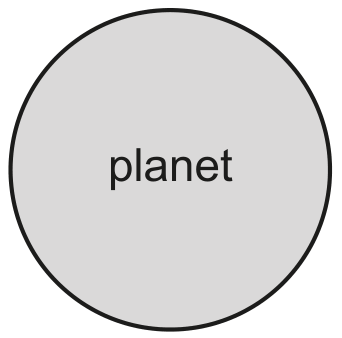
Fig. 1.1
The Earth has a mass of and a radius of .
The Moon has a mass of and a radius of .
The Earth and the Moon can both be considered as point masses at their centres. Their centres are a distance of apart.
Explain why there is a point X on the line between the centres of the Earth and the Moon where the resultant gravitational field strength due to the Earth and the Moon is zero.
The Earth has a mass of and a radius of .
The Moon has a mass of and a radius of .
The Earth and the Moon can both be considered as point masses at their centres. Their centres are a distance of apart.
Explain why there is a point X on the line between the centres of the Earth and the Moon where the resultant gravitational field strength due to the Earth and the Moon is zero.
The point P in Fig. 1.1 represents a point mass.
On Fig. 1.1, draw lines to represent the gravitational field around P.
- P
Fig. 1.1
the amplitude,
amplitude = cm
State what is meant by a gravitational field.
State what is meant by a field of force.
Gravitational fields and electric fields are two examples of fields of force. State one similarity and one difference between these two fields of force.
similarity:
difference:
gel and soft tissue,
Define gravitational field strength.
The Earth E and the Moon M can both be considered as isolated point masses at their centres. The mass of the Earth is and the mass of the Moon is . The Earth and the Moon are separated by a distance of , as shown in Fig. 2.1.
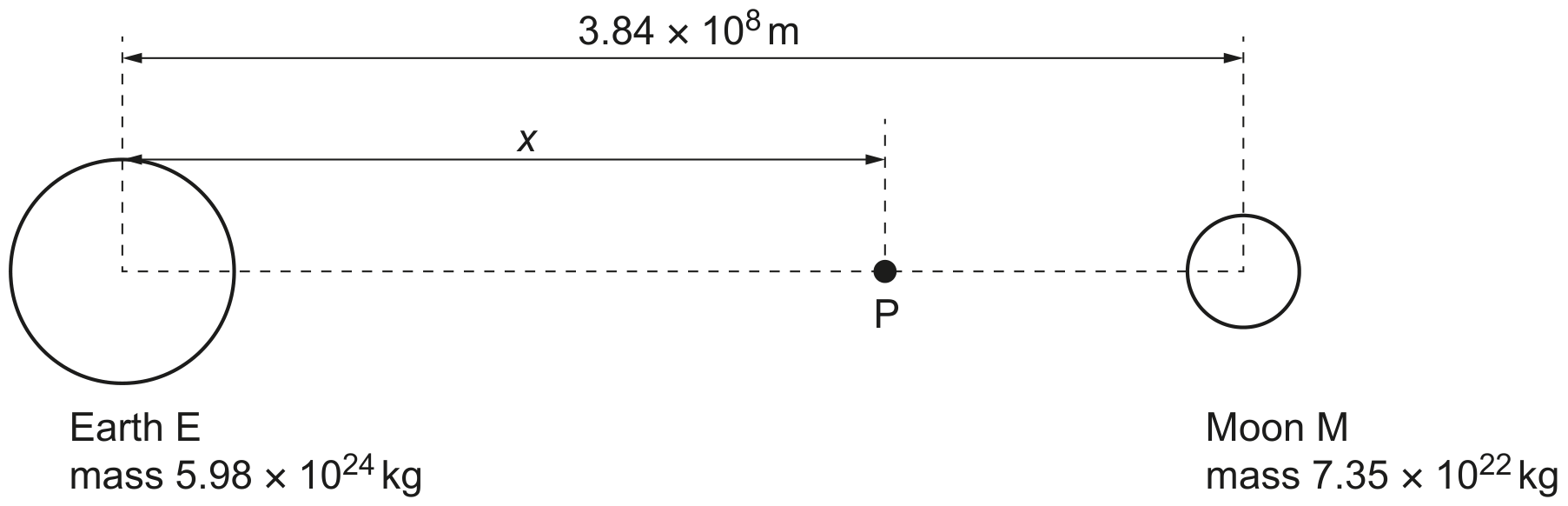
Fig. 2.1 (not to scale)
P is a point, on the line joining the centres of E and M, where the resultant gravitational field strength is zero. Point P is at a distance x from the centre of the Earth.
Explain how it is possible for the gravitational field strength to be zero despite the presence of two large masses nearby.