EduNinja
(a)

The mean kinetic energy <EK><E_{\mathrm{K}}> of a molecule of an ideal gas is given by the expression

<EK>=32kT<E_{\mathrm{K}}>=\frac{3}{2} k T

where k is the Boltzmann constant and T is the thermodynamic temperature of the gas.
A cylinder contains 1.0 mol of an ideal gas. The gas is heated so that its temperature changes from 280 K to 460 K .

[ 3 ]
(i)

During the heating, the gas expands, doing 1.5×10³ J1.5 \times 10^{3} \mathrm{~J} of work. State the first law of thermodynamics. Use the law and your answer in (i) to determine the total energy supplied to the gas.
total energy =
J

[ 3 ]
[Maximum number: 2]

the rate h of thermal energy gained by the ice from the surroundings.

h=

W

(a)

Explain why the change from C to A involves external work and a change in internal energy.

[ 2 ]
[Maximum number: 3]

the rise in temperature of the gas.
temperature rise = K

(a)

The gas is now allowed to expand. No thermal energy enters or leaves the gas. The gas does 120 J of work when expanding against the external pressure.

State and explain whether the final temperature of the gas is above or below 297 K .

[ 3 ]
[Maximum number: 4]

A cylinder contains 5.12 mol of an ideal gas at pressure 5.60×10⁵ Pa5.60 \times 10^{5} \mathrm{~Pa} and volume 3.80×10² m33.80 \times 10^{-2} \mathrm{~m}^{3}.

(a)
(i)

Use the information in (b)(i) to calculate the external work done during the expansion of the gas.

work done =J [2]
[ 2 ]
(ii)

Use the first law of thermodynamics to determine the total thermal energy transferred to the gas in (b). Explain your reasoning.
energy = J

[ 2 ]
[Maximum number: 4]

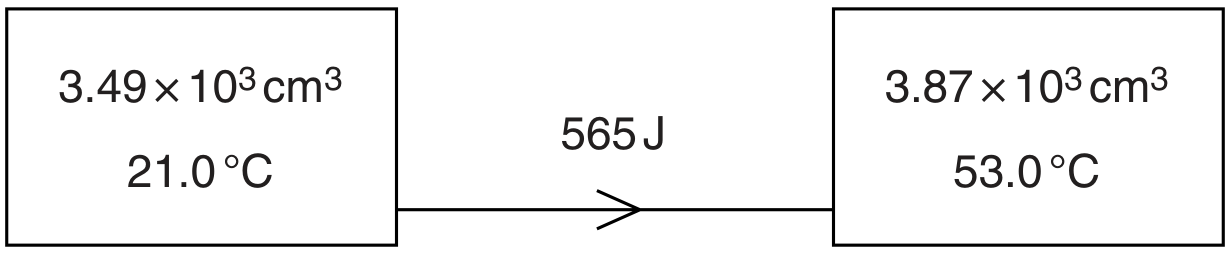
A constant mass of an ideal gas has a volume of 3.49×103 cm33.49 \times 10^{3} \mathrm{~cm}^{3} at a temperature of 21.0C21.0^{\circ} \mathrm{C}. When the gas is heated, 565 J of thermal energy causes it to expand to a volume of 3.87×103 cm33.87 \times 10^{3} \mathrm{~cm}^{3} at 53.0C53.0^{\circ} \mathrm{C}. This is illustrated in Fig.2.1.

Fig. 2.1

Fig. 2.1

(a)

The pressure of the gas is 4.20×10⁵ Pa4.20 \times 10^{5} \mathrm{~Pa}.

For this heating of the gas,

[ 4 ]
(i)

calculate the work done by the gas,
work done = J

[ 2 ]
(ii)

use the first law of thermodynamics and your answer in (i) to determine the change in internal energy of the gas.
change in internal energy = J

[ 2 ]
(a)

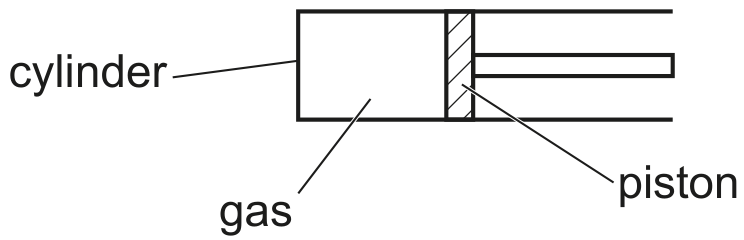
A fixed mass of an ideal gas at a temperature of 20C20^{\circ} \mathrm{C} is sealed in a cylinder by a piston, as shown in Fig. 2.1.

Fig. 2.1

Fig. 2.1

The initial volume of the gas is 1.24×10⁴ m31.24 \times 10^{-4} \mathrm{~m}^{3}.
Thermal energy is supplied to the gas and its volume increases by 5.20×10⁵ m35.20 \times 10^{-5} \mathrm{~m}^{3}.

[ 2 ]
(i)

The piston is freely moving so that the gas is always at atmospheric pressure.

Atmospheric pressure is 1.01×10⁵ Pa1.01 \times 10^{5} \mathrm{~Pa}.
Calculate the work done by the gas.
work done by gas = J

[ 2 ]
(b)

The gas in (b) is allowed to return to its starting temperature. The piston is now fixed in position.

Thermal energy is supplied to increase the temperature to the same final temperature as in (b).
Use the first law of thermodynamics to suggest and explain how the specific heat capacity of the gas for this situation compares with the value in (b)(iii).

[ 3 ]
[Maximum number: 4]

The product of the pressure p and the volume V of an ideal gas is given by the expression

pV=13Nm<c2>p V=\frac{1}{3} N m<c^{2}>

where m is the mass of one molecule of the gas.

(a)

A cylinder contains 1.0 mol of an ideal gas.

[ 4 ]
(i)

The volume of the cylinder is constant. Calculate the energy required to raise the temperature of the gas by 1.0 kelvin.
energy = J

[ 2 ]
(ii)

The volume of the cylinder is now allowed to increase so that the gas remains at constant pressure when it is heated.
Explain whether the energy required to raise the temperature of the gas by 1.0 kelvin is now different from your answer in (i).

[ 2 ]
[Maximum number: 3]

air and soft tissue.

α=\alpha=
(a)

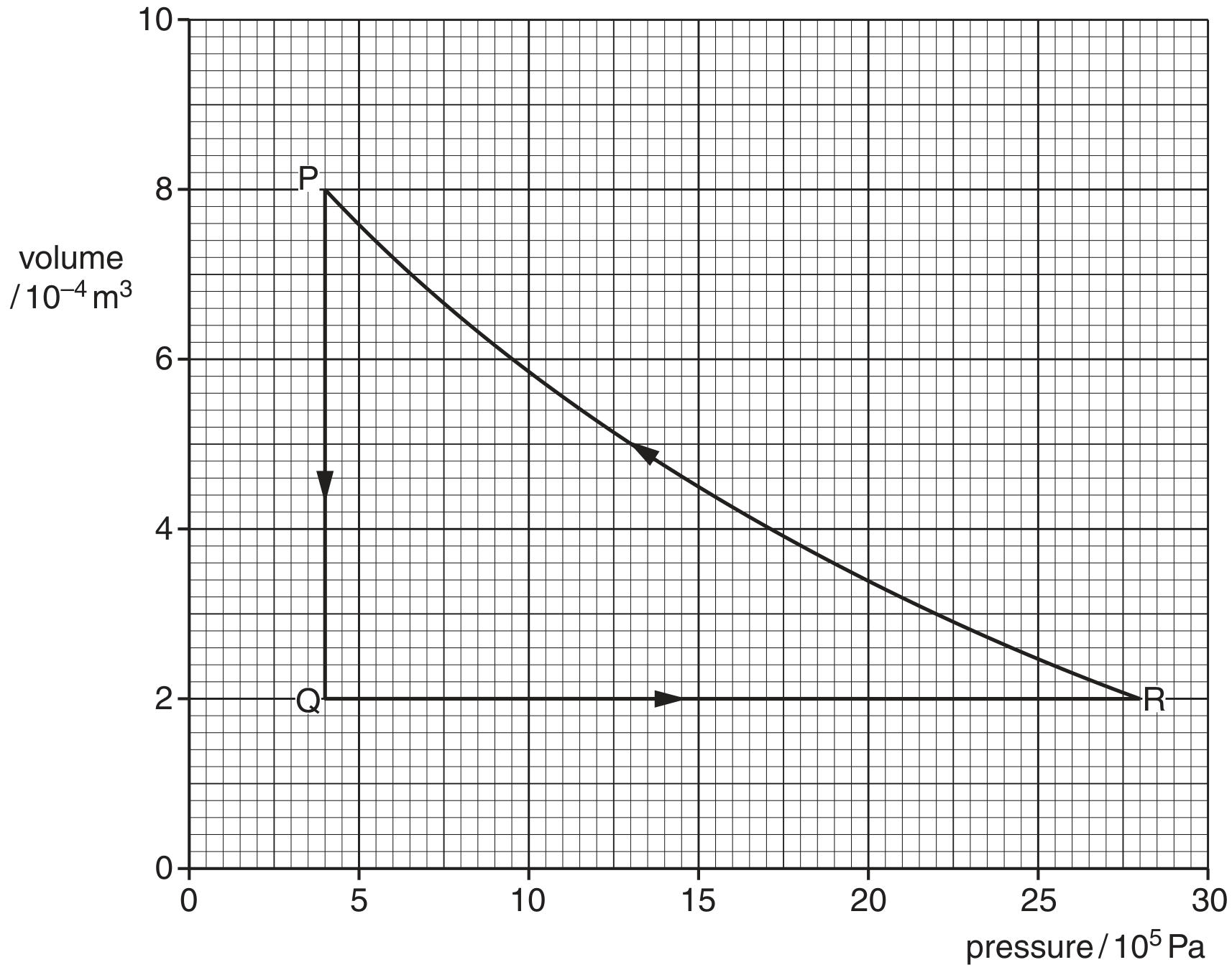
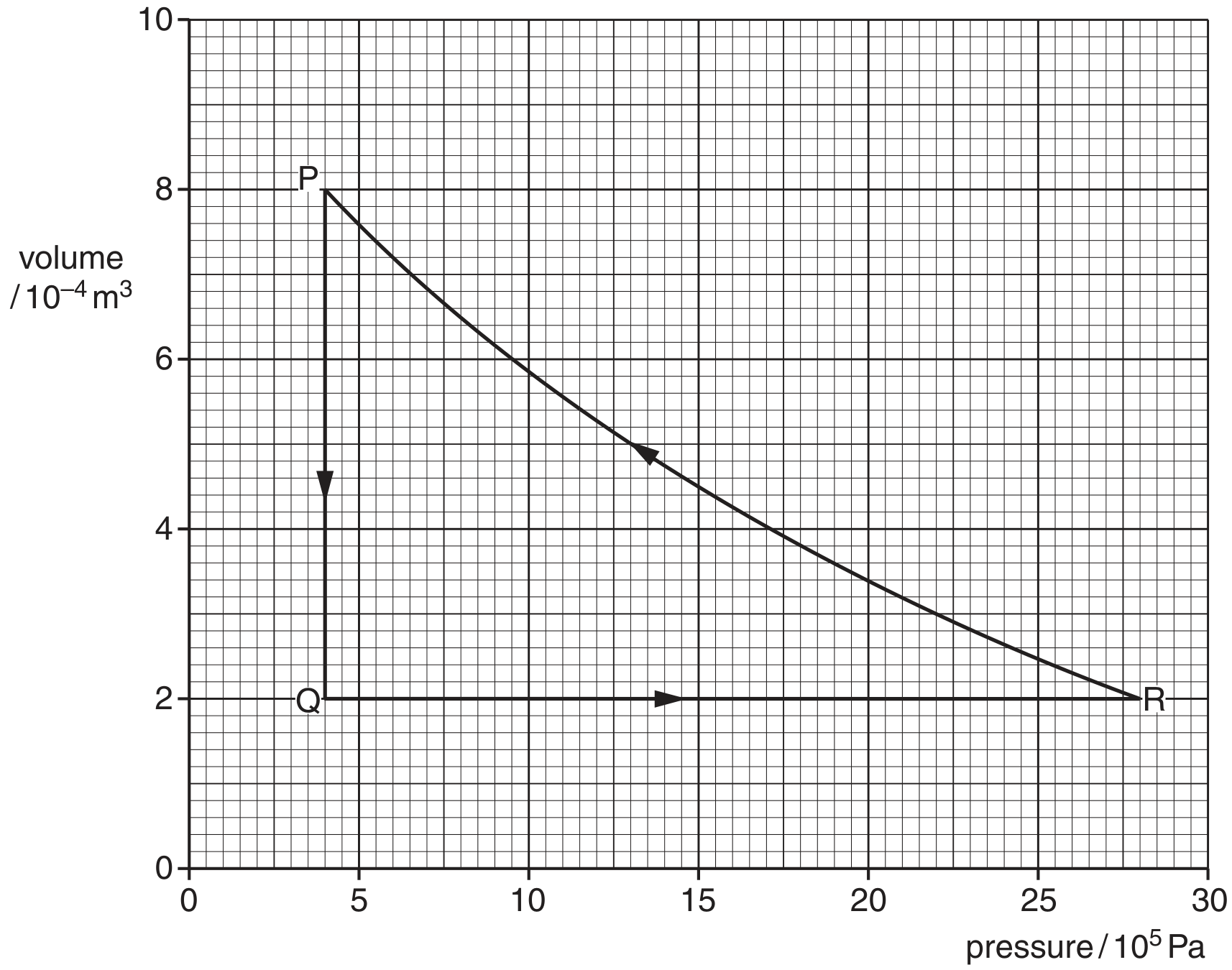
A fixed mass of an ideal gas undergoes a cycle PQRP of changes as shown in Fig. 2.1.

Fig. 2.1

Fig. 2.1

[ 3 ]
(i)

State the change in internal energy of the gas during one complete cycle P Q R P.
change =

(ii)

Calculate the work done on the gas during the change from P to Q.
work done =

(iii)

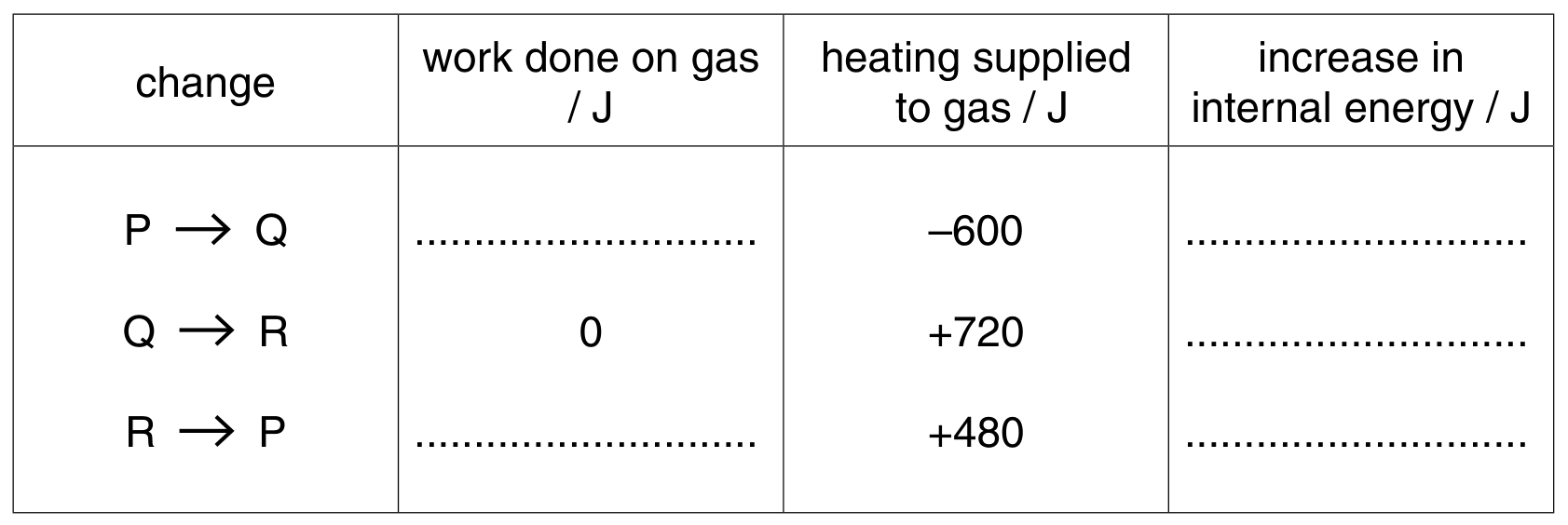
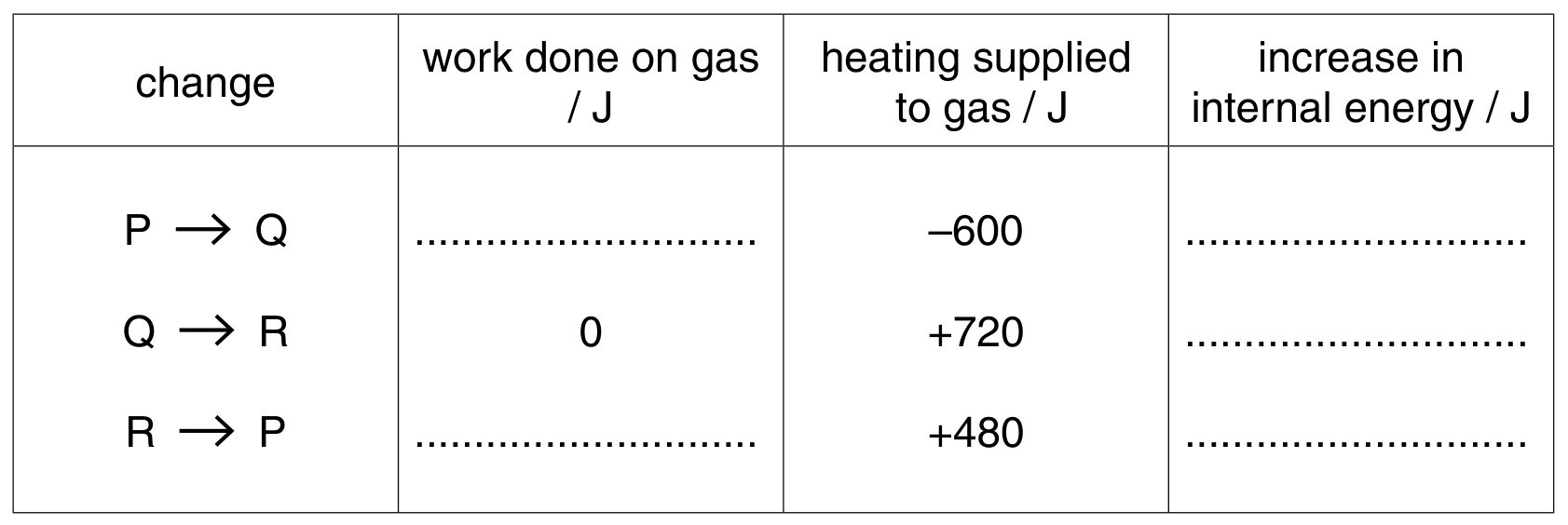
Some energy changes during the cycle PQRP are shown in Fig. 2.2.

Fig. 2.2

Fig. 2.2

Complete Fig. 2.2 to show all of the energy changes.

[ 3 ]
[Maximum number: 5]

A fixed mass of an ideal gas has a volume V and a pressure p.
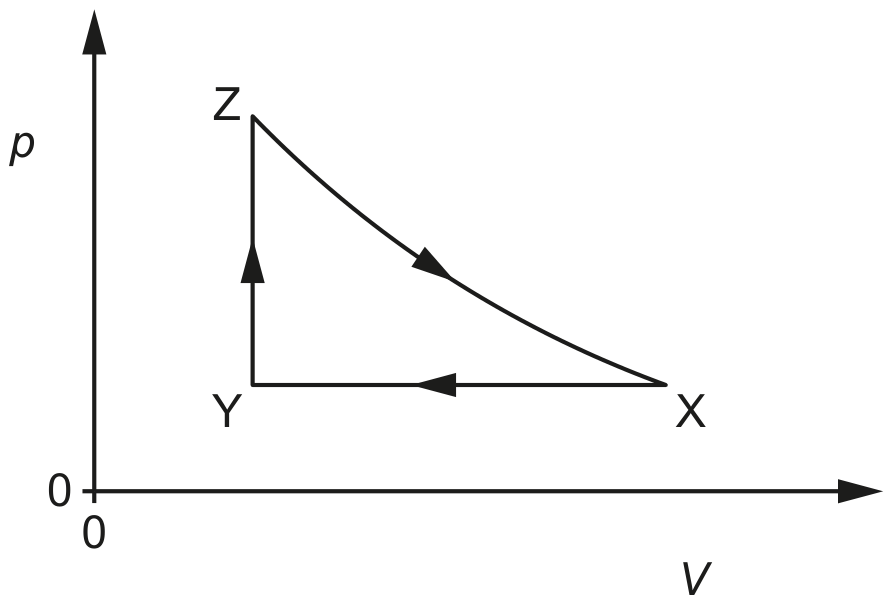
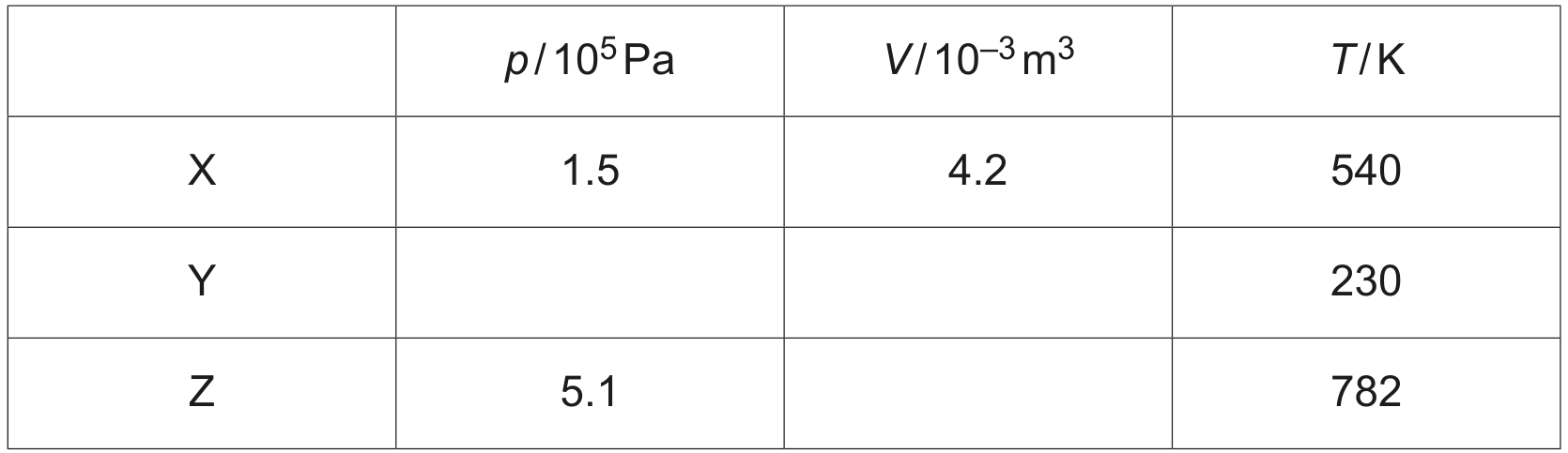
The gas undergoes a cycle of changes, X to Y to Z to X, as shown in Fig. 2.1.

Fig. 2.1

Fig. 2.1

Table 2.1 shows data for p, V and temperature T for the gas at points X, Y and Z .

Table 2.1

Table 2.1

(a)
(i)

The first law of thermodynamics for a system may be represented by the equation

ΔU=q+W.\Delta U=q+W .

State, with reference to the system, what is meant by:
ΔU:\Delta U:
q :
W :

[ 3 ]
(ii)

Explain how the first law of thermodynamics applies to the change Z to X .

[ 2 ]
[Maximum number: 3]

air and soft tissue.

α=\alpha=
(a)

A fixed mass of an ideal gas undergoes a cycle PQRP of changes as shown in Fig. 2.1.

Fig. 2.1

Fig. 2.1

[ 3 ]
(i)

State the change in internal energy of the gas during one complete cycle P Q R P.
change =

(ii)

Calculate the work done on the gas during the change from P to Q.
work done =

(iii)

Some energy changes during the cycle PQRP are shown in Fig. 2.2.

Fig. 2.2

Fig. 2.2

Complete Fig. 2.2 to show all of the energy changes.

[ 3 ]
0