
EduNinja
[Maximum number: 3]

Fig. 2.1 shows a laboratory thermometer that is calibrated to measure temperature in degrees Celsius.
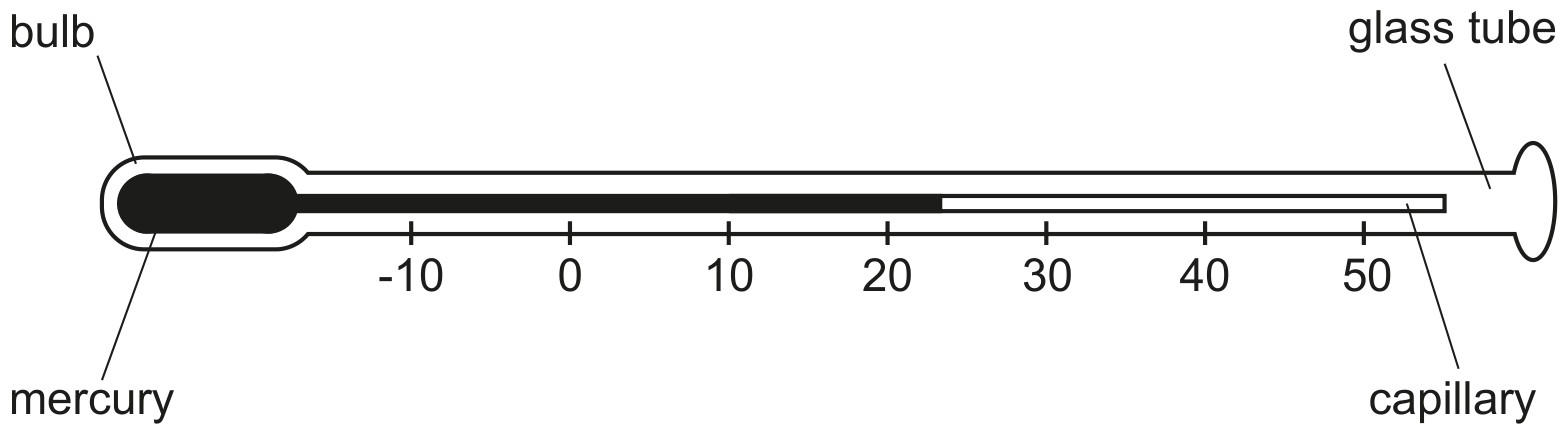
Fig. 2.1

Fig. 2.1

The thermometer makes use of the fact that the density of mercury varies with temperature.

(a)

The thermometer is initially at 23.0C23.0^{\circ} \mathrm{C}, as shown in Fig. 2.1. It is used to measure the temperature of an insulated beaker of water that is at 37.4C37.4^{\circ} \mathrm{C}. The bulb of the thermometer is inserted into the water, and the water is stirred until the reading on the thermometer becomes steady.

The mass of water in the beaker is 18.7 g .
The mass of mercury in the thermometer is 6.94 g .
The specific heat capacity of water is 4.18 J g1 K14.18 \mathrm{~J} \mathrm{~g}^{-1} \mathrm{~K}^{-1}.
The specific heat capacity of mercury is 0.140 J g1 K10.140 \mathrm{~J} \mathrm{~g}^{-1} \mathrm{~K}^{-1}.
The glass of the thermometer and the beaker containing the water can be considered to have negligible heat capacity.

[ 3 ]
(i)

Calculate, to three significant figures, the final steady temperature indicated by the thermometer in the water. C{ }^{\circ} \mathrm{C}
[ 3 ]
(a)

With reference to thermal energy, state what is meant by two objects being in thermal equilibrium.

[ 1 ]
(a)

Two metal spheres are in thermal equilibrium. State and explain what is meant by thermal equilibrium.

[ 2 ]
[Maximum number: 1]

Below are four short paragraphs describing the molecules in a beaker of water at 50C50^{\circ} \mathrm{C}.
Which paragraph correctly describes the molecules?

A

The molecules all travel at the same speed. This speed is not large enough for any of the molecules to leave the surface of the water. There are attractive forces between the molecules.

B

The molecules have a range of speeds. Some molecules travel sufficiently fast to leave the surface of the water. There are no forces between the molecules.

C

The molecules have a range of speeds. Some molecules travel sufficiently fast to leave the surface of the water. There are attractive forces between the molecules.

D

The molecules have a range of speeds. The fastest molecules are unable to leave the surface of the water. There are attractive forces between the molecules.

[Maximum number: 1]

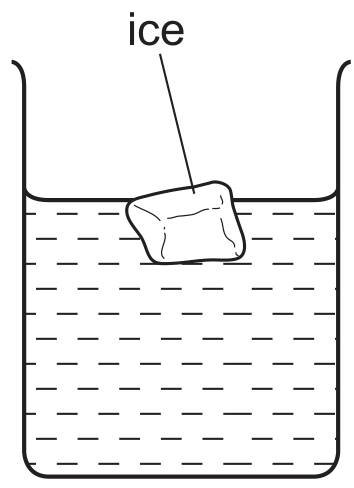
The diagram shows an ice cube floating in water.

Question image

Both the ice cube and the water are at 0C0^{\circ} \mathrm{C}.
Which statement correctly compares the molecular properties of the ice and those of the water?

A

The mean inter-molecular potential energies are the same for both the ice molecules and the water molecules.

B

The mean inter-molecular separations are the same for both the ice and the water.

C

The mean kinetic energies are the same for both the ice molecules and the water molecules.

D

The mean total energies are the same for both the ice molecules and the water molecules.

(a)

State the reason why two objects that are at the same temperature are described as being in thermal equilibrium.

[ 1 ]
(a)

State the reason why two objects that are at the same temperature are described as being in thermal equilibrium.

[ 1 ]
[Maximum number: 1]

Which row correctly describes the spacing and motion of the molecules in water and in ice when both are at a temperature of 0C0^{\circ} \mathrm{C} ?

spacing

motion

molecules in ice are
further apart than
molecules in water

molecules in both ice
and water have the
same average speed

molecules in ice are
further apart than
molecules in water

molecules in ice travel
more slowly than those
in water

molecules in ice are
closer than molecules
in water

molecules in ice travel
more slowly than those
in water

molecules in ice are
closer than molecules
in water

molecules in both ice
and water have the
same average speed

[Maximum number: 1]

An electronic sensor may be represented by the block diagram of Fig. 10.1.

Fig. 10.1

Fig. 10.1

(a)

State suitable sensing devices, one in each case, for the detection of

[ 1 ]
(i)

change of temperature,

[ 1 ]
0
