EduNinja
(a)

State Coulomb's law.

[ 2 ]
(b)

Positronium is a system in which an electron and a positron orbit, with the same period, around their common centre of mass, as shown in Fig. 2.1.
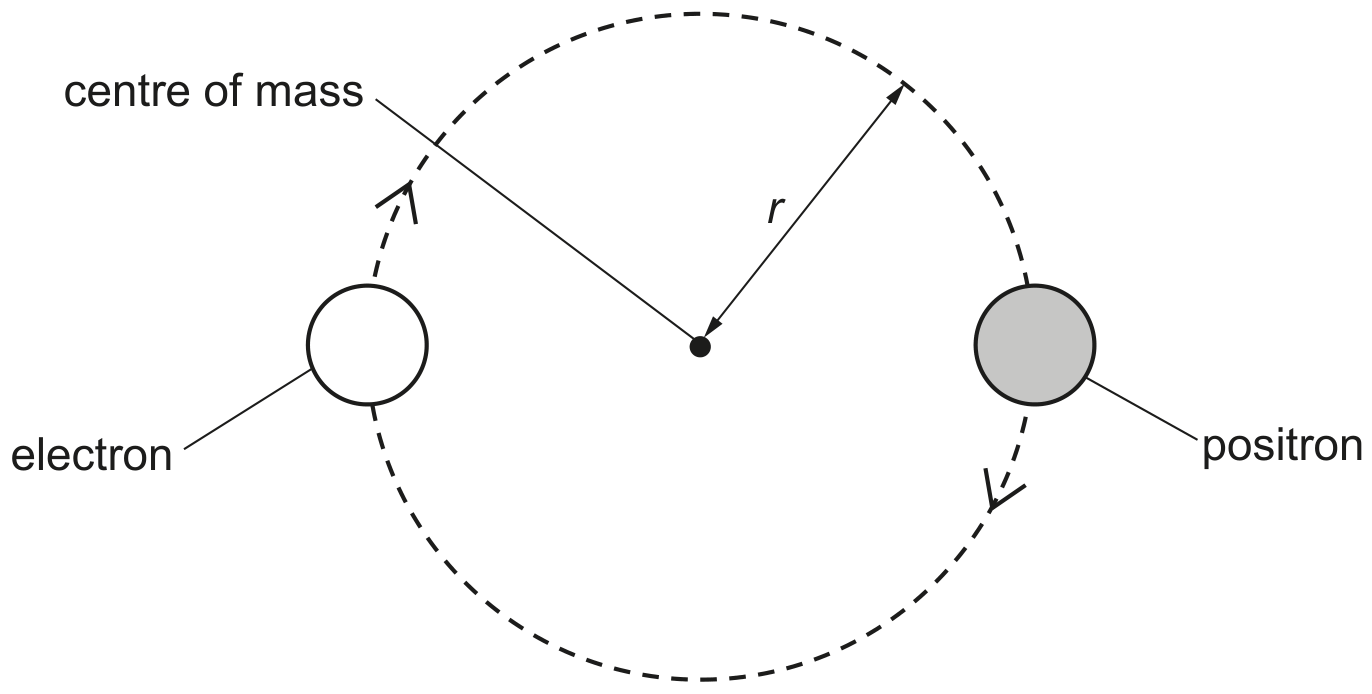
Fig. 2.1 (not to scale)

Fig. 2.1 (not to scale)

The radius r of the orbit of both particles is 1.59×10¹⁰ m1.59 \times 10^{-10} \mathrm{~m}.

[ 2 ]
(i)

Show that the magnitude of the electric force between the electron and the positron is 2.28×10⁹ N2.28 \times 10^{-9} \mathrm{~N}.

[ 2 ]
[Maximum number: 2]

A helium nucleus contains two protons.
In a model of the helium nucleus, each proton is considered to be a charged point mass. The separation of these point masses is assumed to be 2.0×10¹⁵ m2.0 \times 10^{-15} \mathrm{~m}.

(a)

For the two protons in this model, calculate

[ 2 ]
(i)

the electrostatic force,
electrostatic force = N

[ 2 ]
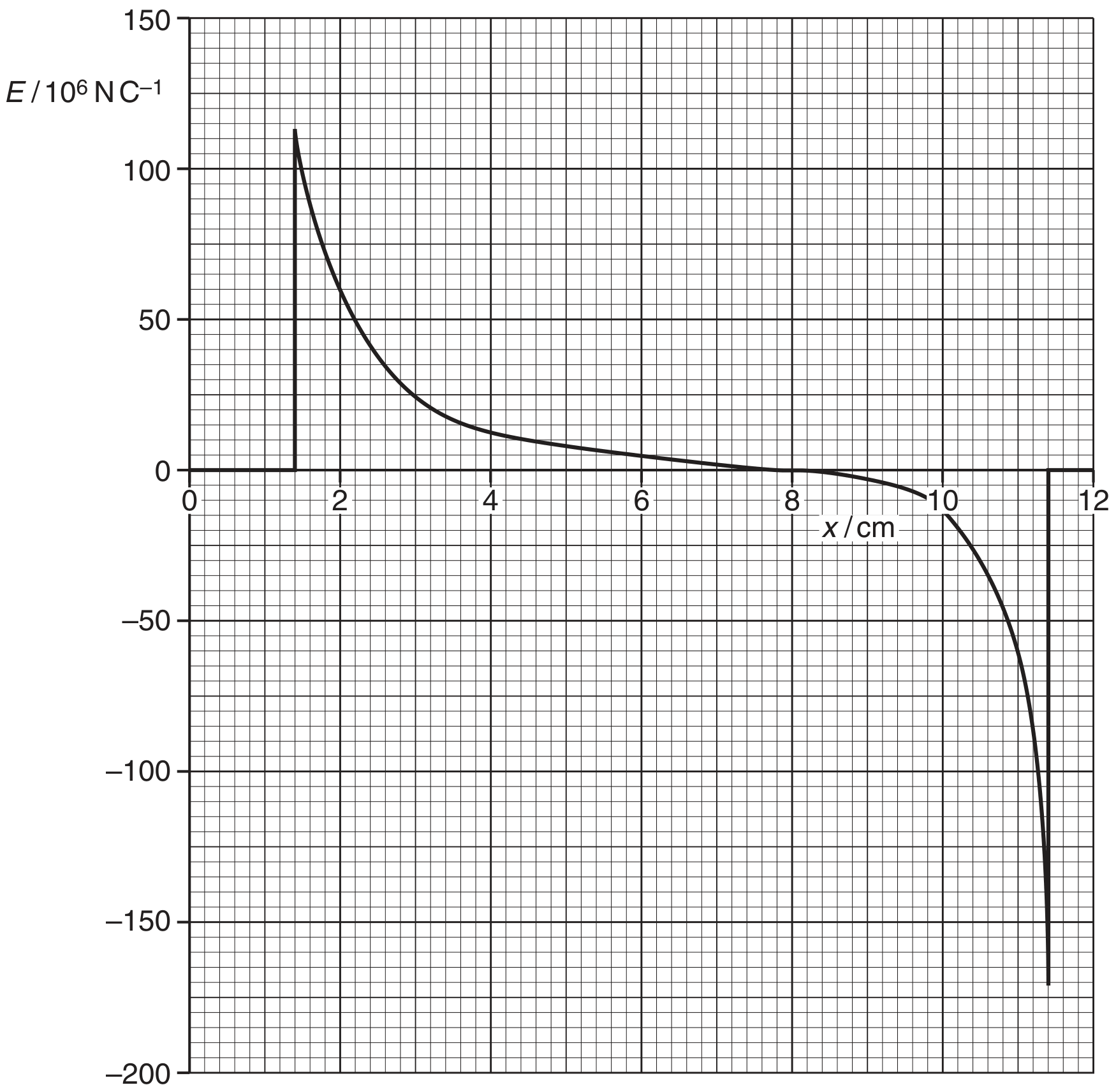
(a)

By reference to Fig. 4.2, state and explain

[ 2 ]
(i)

whether the two charges have the same, or opposite, sign,

[ 2 ]
(a)

State Coulomb's law.

[ 2 ]
[Maximum number: 2]

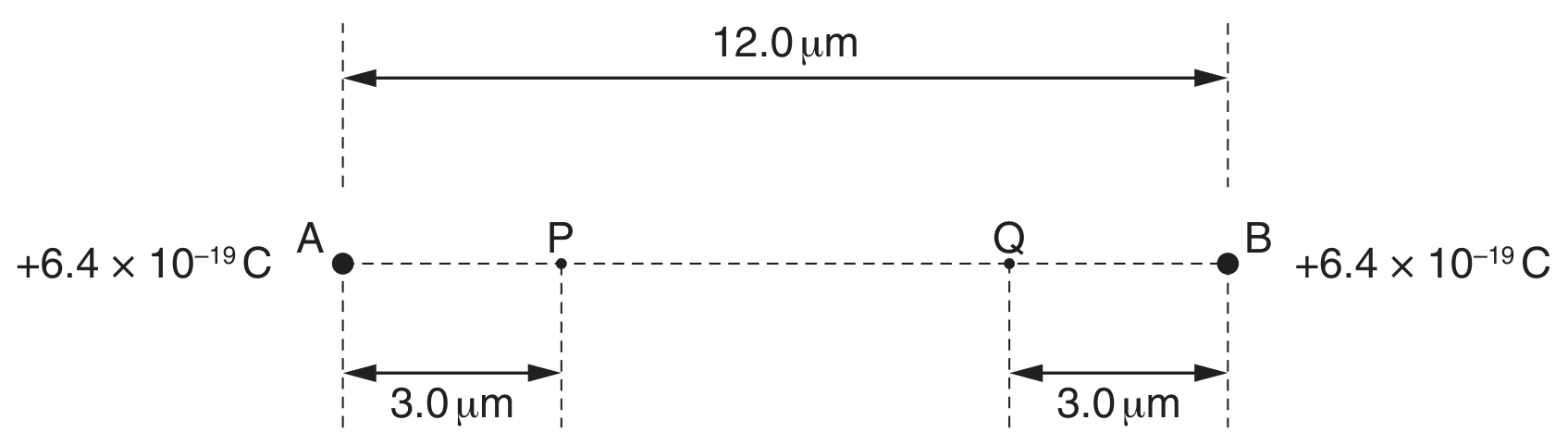
Two point charges A and B each have a charge of +6.4×10¹⁹C+6.4 \times 10^{-19} \mathrm{C}. They are separated in a vacuum by a distance of 12.0μ m12.0 \mu \mathrm{~m}, as shown in Fig. 4.1.

Fig. 4.1

Fig. 4.1

Points P and Q are situated on the line A B. Point P is 3.0μ m3.0 \mu \mathrm{~m} from charge A and point Q is 3.0μ m3.0 \mu \mathrm{~m} from charge B.

(a)

Calculate the force of repulsion between the charges A and B .
force =

[ 2 ]
(a)

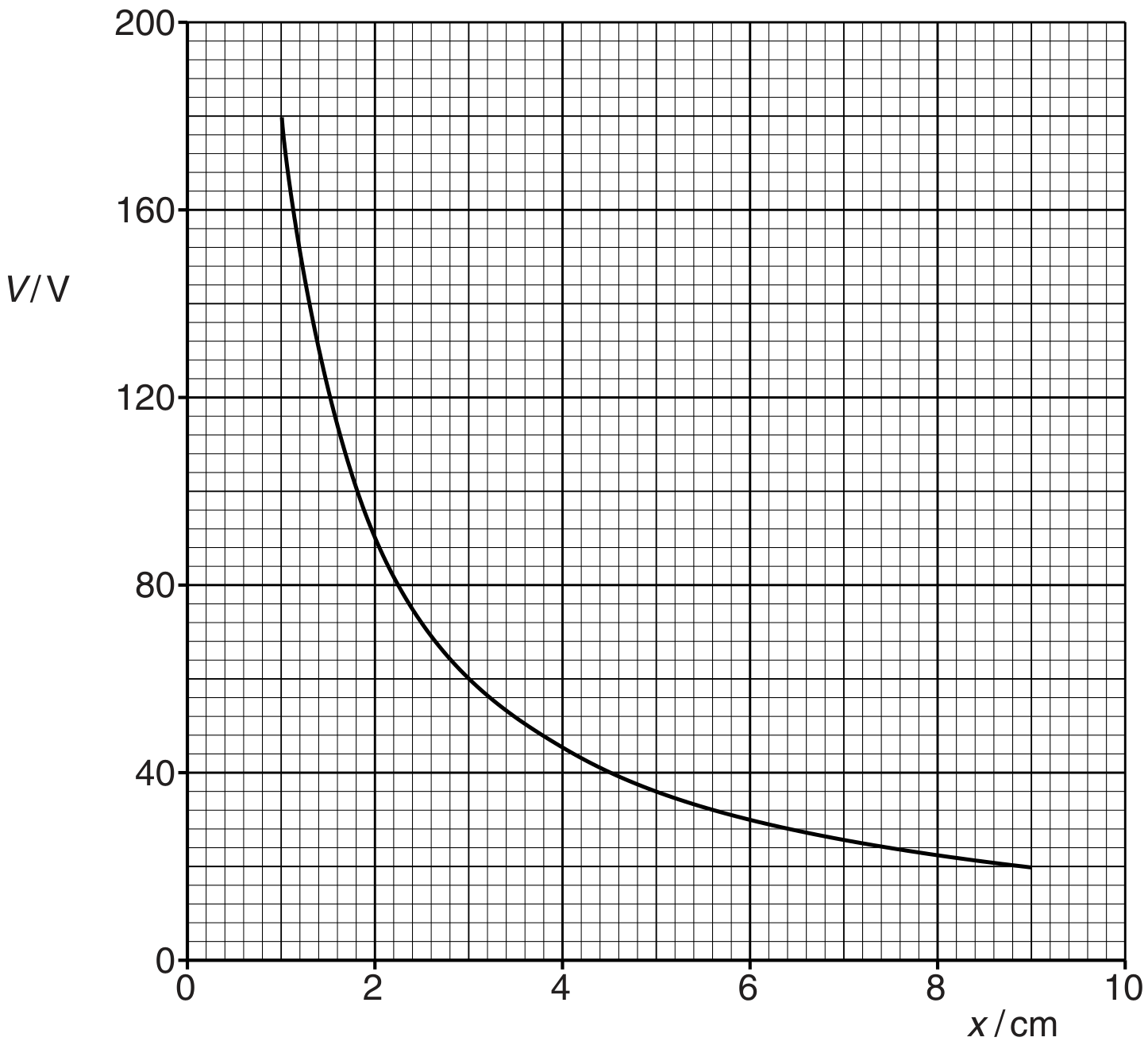
An isolated solid metal sphere is positively charged.

The variation of the potential V with distance x from the centre of the sphere is shown in Fig. 5.1.

Fig. 5.1

Fig. 5.1

Use Fig. 5.1 to suggest

[ 3 ]
(i)

that the charge on the sphere behaves as if it were a point charge.

[ 3 ]
[Maximum number: 4]

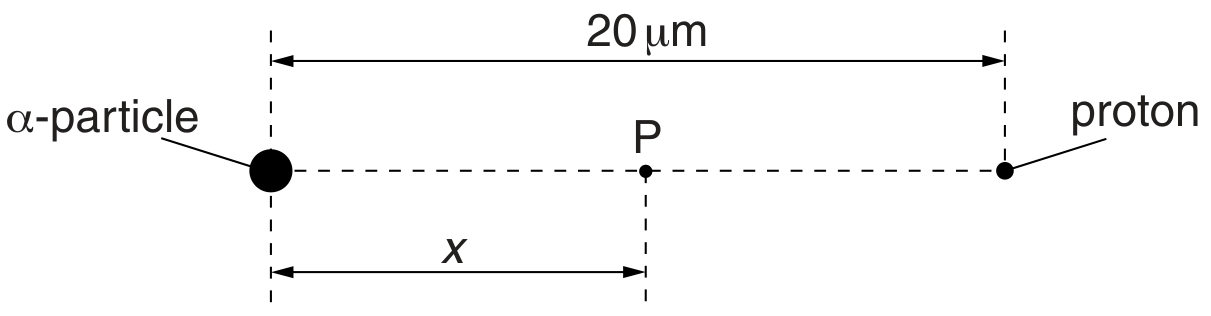
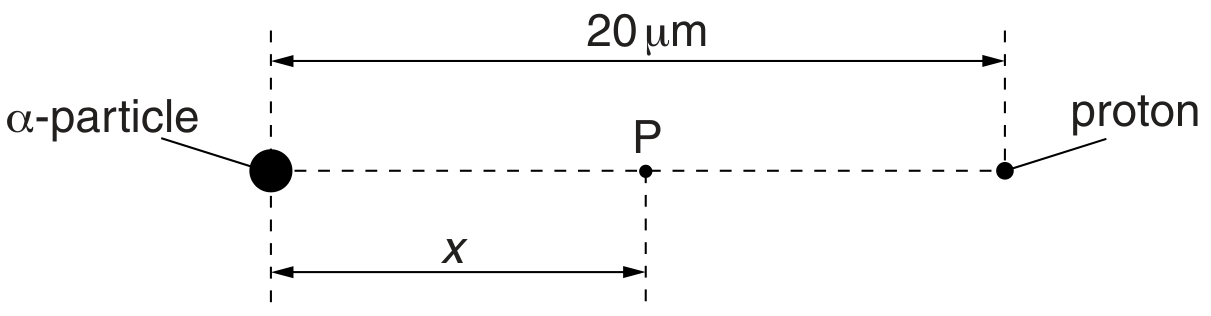
An α\alpha-particle and a proton are at rest a distance 20μ m20 \mu \mathrm{~m} apart in a vacuum, as illustrated in Fig. 4.1.

Fig. 4.1

Fig. 4.1

(a)
(i)

State Coulomb's law.

[ 2 ]
(ii)

The α\alpha-particle and the proton may be considered to be point charges. Calculate the electric force between the α\alpha-particle and the proton.
force = N

[ 2 ]
[Maximum number: 2]

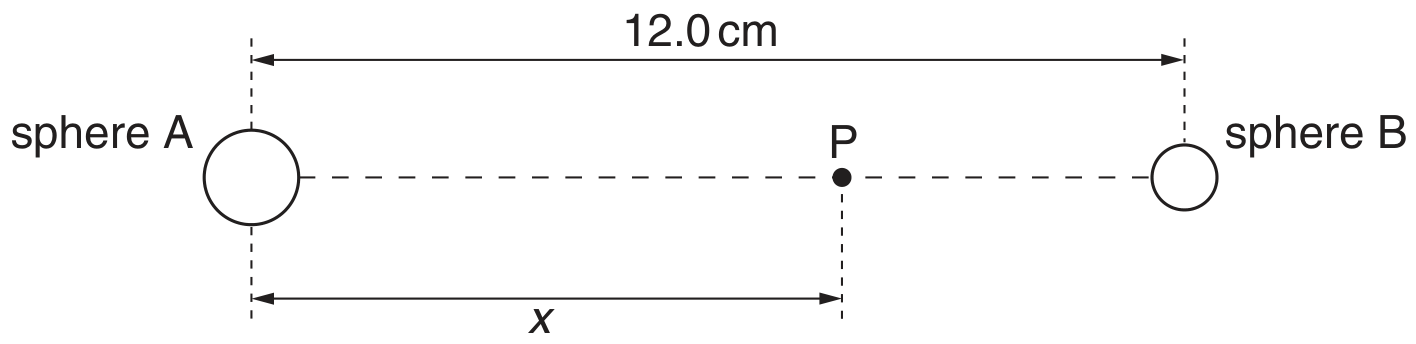
Two small charged metal spheres A and B are situated in a vacuum. The distance between the centres of the spheres is 12.0 cm , as shown in Fig. 4.1.

Fig. 4.1 (not to scale)

Fig. 4.1 (not to scale)

The charge on each sphere may be assumed to be a point charge at the centre of the sphere.
Point P is a movable point that lies on the line joining the centres of the spheres and is distance x from the centre of sphere A .
The variation with distance x of the electric field strength E at point P is shown in Fig. 4.2.

Fig. 4.2

Fig. 4.2

(a)

State the evidence provided by Fig. 4.2 for the statements that

[ 2 ]
(i)

the charges on the spheres are either both positive or both negative.

[ 2 ]
[Maximum number: 4]

An α\alpha-particle and a proton are at rest a distance 20μ m20 \mu \mathrm{~m} apart in a vacuum, as illustrated in Fig. 4.1.

Fig. 4.1

Fig. 4.1

(a)
(i)

State Coulomb's law.

[ 2 ]
(ii)

The α\alpha-particle and the proton may be considered to be point charges. Calculate the electric force between the α\alpha-particle and the proton.
force = N

[ 2 ]
(a)

State Coulomb's law.

[ 2 ]
0