(a)
A deuterium nucleus and a proton collide. A nuclear reaction occurs, represented by the equation
[ 2 ]
(i)
State and explain whether the reaction represents nuclear fission or nuclear fusion.
[ 2 ]
 EduNinja
A deuterium nucleus and a proton collide. A nuclear reaction occurs, represented by the equation
State and explain whether the reaction represents nuclear fission or nuclear fusion.
Two deuterium nuclei each have initial kinetic energy and are initially separated by a large distance.
The nuclei may be considered to be spheres of diameter with their masses and charges concentrated at their centres.
The nuclei move from their initial positions to their final position of just touching, as illustrated in Fig. 4.1.
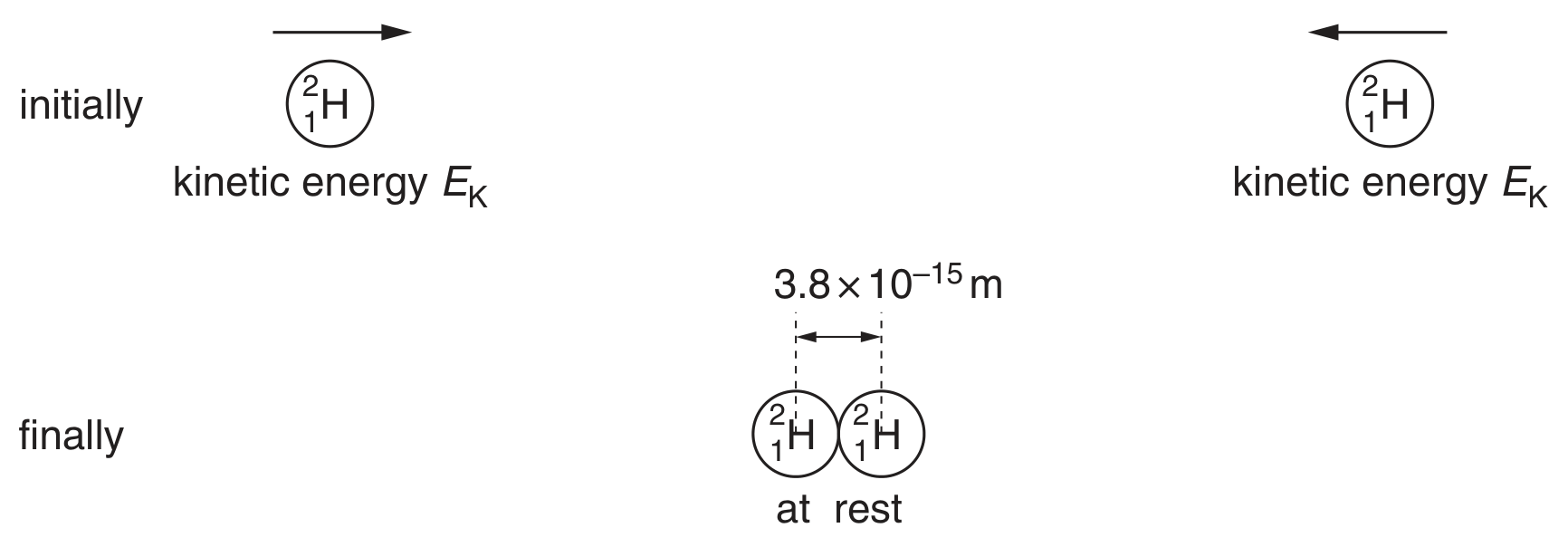
Fig. 4.1
For the two nuclei approaching each other, calculate the total change in
Use your answers in (i) to show that the initial kinetic energy of each nucleus is 0.19 MeV .
The two nuclei may rebound from each other. Suggest one other effect that could happen to the two nuclei if the initial kinetic energy of each nucleus is greater than that calculated in (ii).
A uranium-235 nucleus absorbs a neutron and then splits into two nuclei. A possible nuclear reaction is given by
Suggest a possible form of energy released in this reaction.
Explain, using the law of mass-energy conservation, how energy is released in this reaction.
The sum of the masses on the left-hand side of the equation in (a) is not the same as the sum of the masses on the right-hand side.
Explain why mass seems not to be conserved.
A slow-moving neutron collides with a nucleus of uranium-235. This results in a nuclear reaction that is represented by the following nuclear equation
where x represents one or more particles.
What does × represent?
one neutron
two electrons
two neutrons
two protons
A polonium nucleus is radioactive and decays with the emission of an -particle. The nuclear reaction for this decay is given by
Explain why mass seems not to be conserved in the reaction.
State what is meant by the binding energy of a nucleus.
Show that the energy equivalence of 1.0 u is 930 MeV .
Data for the masses of some particles and nuclei are given in Fig. 8.1.
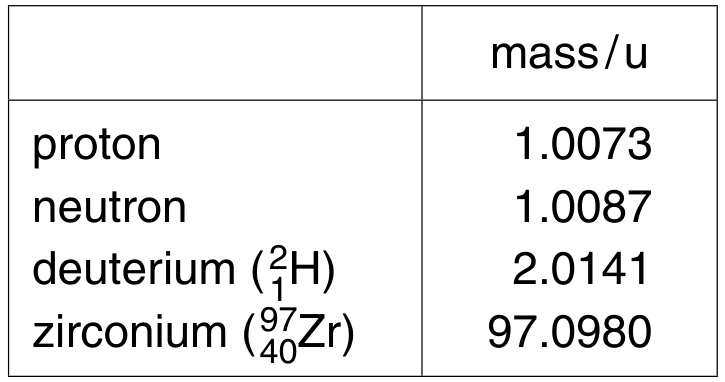
Fig. 8.1
Use data from Fig. 8.1 and information from (b) to determine, in MeV,
the binding energy of deuterium,
binding energy = MeV
the binding energy per nucleon of zirconium.
Answer all the questions in the spaces provided.
Explain what is meant by the binding energy of a nucleus.
Data for the masses of some particles are given in Fig. 10.1.
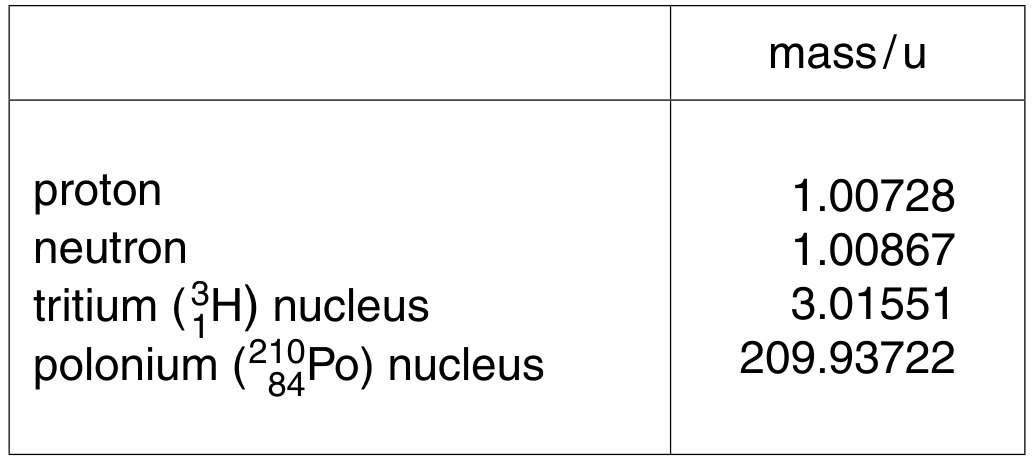
Fig. 10.1
The energy equivalent of 1.0 u is 930 MeV .
Calculate the binding energy, in MeV , of a tritium nucleus.
binding energy = MeV
The total mass of the separate nucleons that make up a polonium-210 nucleus is 211.70394 u.
Calculate the binding energy per nucleon of polonium-210.
binding energy per nucleon = MeV
One possible fission reaction is
By reference to binding energy, explain, without any calculation, why this fission reaction is energetically possible.
Answer all the questions in the spaces provided.
Explain what is meant by the binding energy of a nucleus.
Data for the masses of some particles are given in Fig. 10.1.
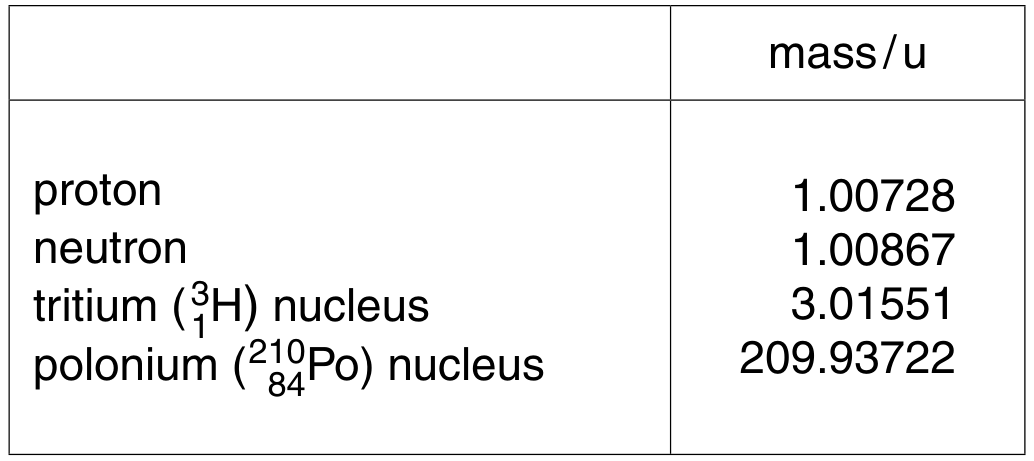
Fig. 10.1
The energy equivalent of 1.0 u is 930 MeV .
Calculate the binding energy, in MeV , of a tritium nucleus.
The total mass of the separate nucleons that make up a polonium-210 nucleus is 211.70394 u.
Calculate the binding energy per nucleon of polonium-210.
binding energy per nucleon = MeV
One possible fission reaction is
By reference to binding energy, explain, without any calculation, why this fission reaction is energetically possible.
Answer all the questions in the spaces provided.
One possible nuclear reaction involves the bombardment of a stationary nitrogen-14 nucleus by an -particle to form oxygen-17 and another particle.
The total mass-energy of the nitrogen-14 nucleus and the -particle is less than that of the particles resulting from the reaction. This mass-energy difference is 1.1 MeV .
1. Suggest how it is possible for mass-energy to be conserved in this reaction.
2. Calculate the speed of an -particle having kinetic energy of 1.1 MeV .
speed =