EduNinja
(a)
(i)

Explain, with reference to gravitational field lines, why the gravitational field near the surface of the Earth is approximately constant for small changes in height.

[ 2 ]
(b)

A large isolated uniform sphere has mass M and radius R.

Point P lies on a straight line passing through the centre of the sphere, at a variable displacement x from the centre, as shown in Fig. 1.1.
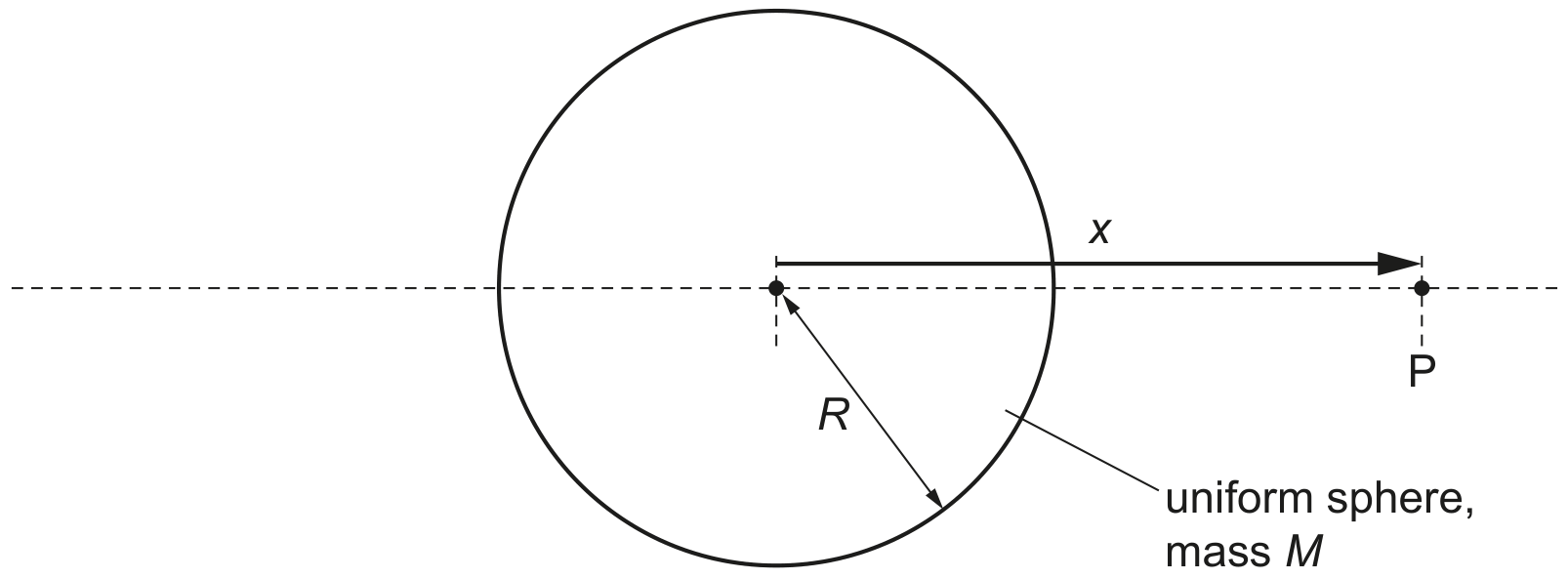
Fig. 1.1

Fig. 1.1

Fig. 1.2 shows the variation with x of the gravitational field g at point P due to the sphere for the values of x for which P is inside the sphere.
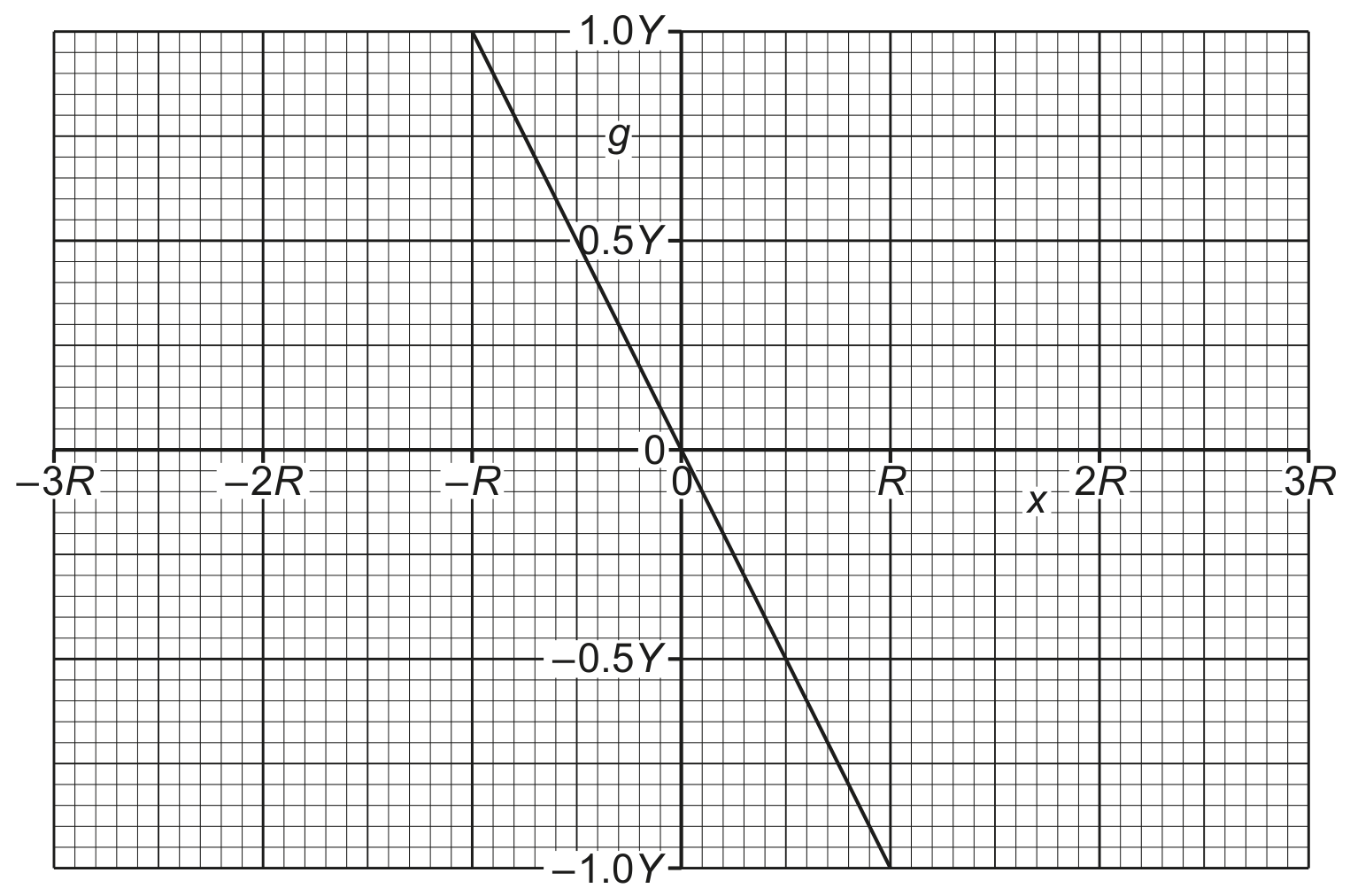
Fig. 1.2

Fig. 1.2

The magnitude of the gravitational field at the surface of the sphere is Y.

[ 7 ]
(i)

Determine an expression for Y in terms of M and R. Identify any other symbols that you use.

[ 2 ]
(ii)

Explain why, at the surface of the sphere, g always has the opposite sign to x.

[ 2 ]
(iii)

Complete Fig. 1.2 to show the variation of g with x for values of x, up to ±3R\pm 3 R, for which point P is outside the sphere.
[ 3 ]
(a)

An isolated uniform conducting sphere has mass M and charge Q.

The gravitational field strength at the surface of the sphere is g.
The electric field strength at the surface of the sphere is E.

[ 3 ]
(i)

Show that

MQ=αgE\frac{M}{Q}=\alpha \frac{g}{E}

where α\alpha is a constant.

[ 3 ]
(a)

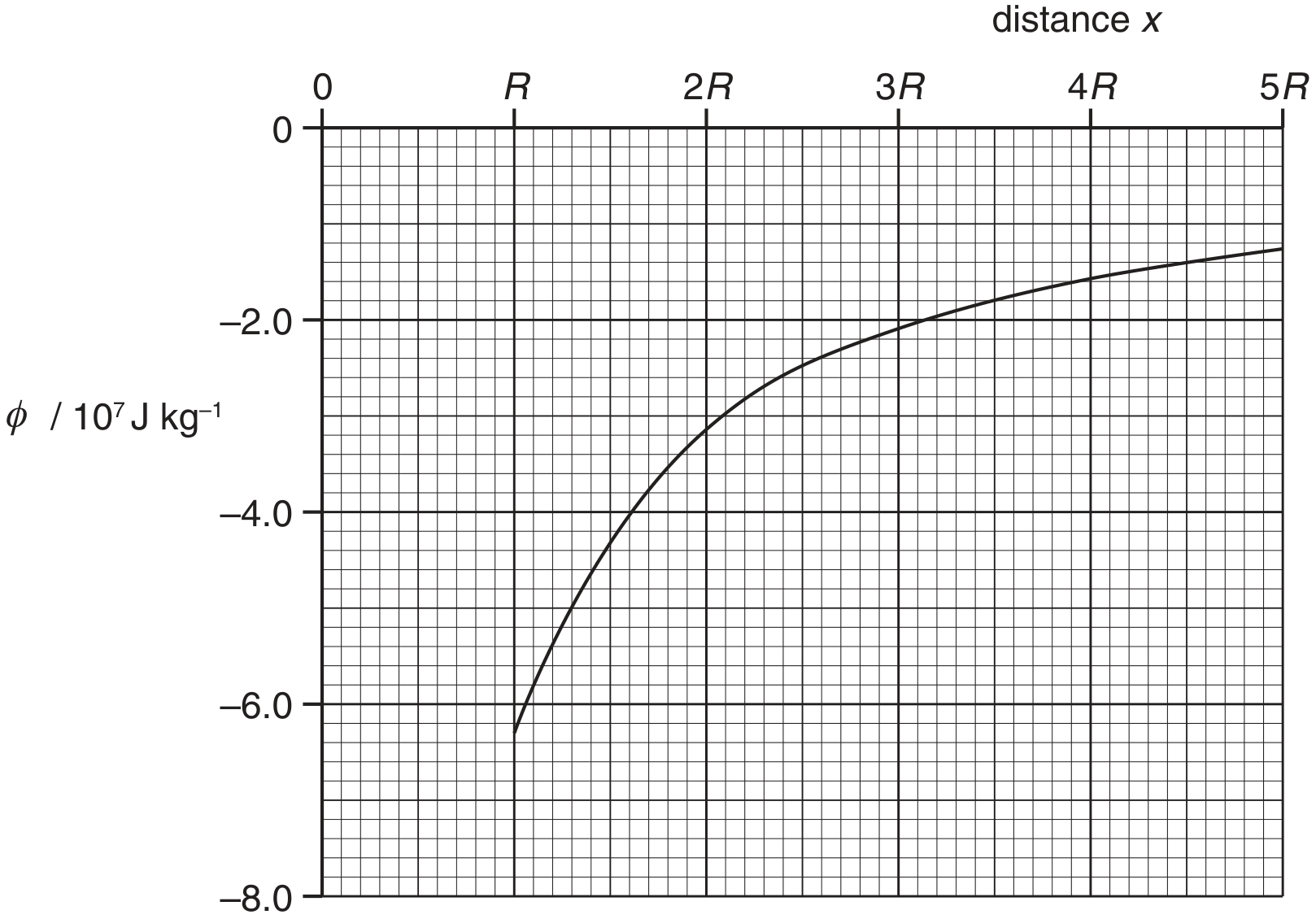
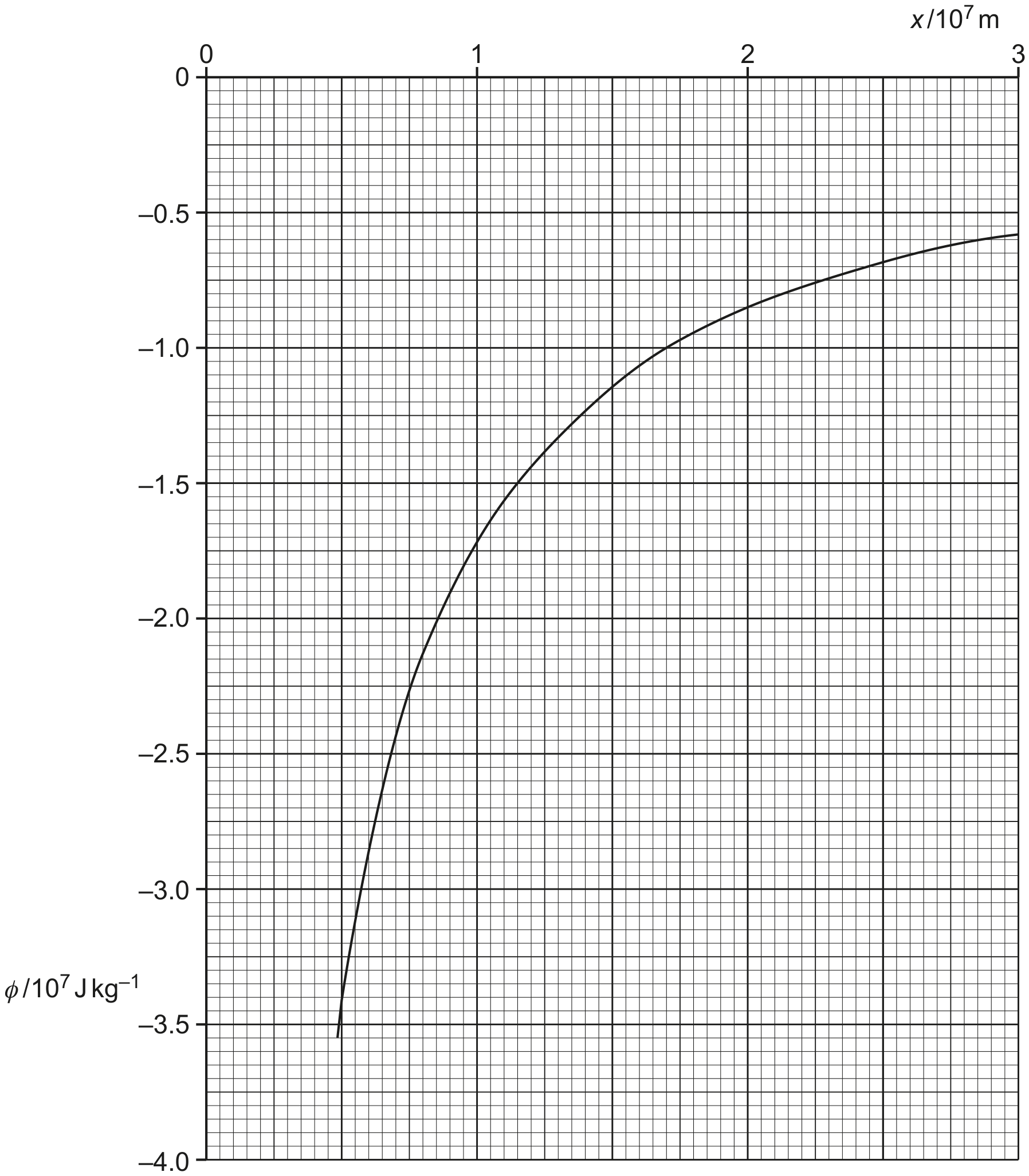
Artemis is a spherical planet that may be assumed to be isolated in space. The variation with distance x from the centre of Artemis of the gravitational potential ϕ\phi is shown in Fig. 1.1.

Fig. 1.1

Fig. 1.1

(i)

Calculate the gravitational field strength g on the surface of Artemis.

(a)
(i)

Use Newton's law of gravitation to show that the gravitational field strength g at a distance r away from a point mass M is given by

g=GMr2.g=\frac{G M}{r^{2}} .
[ 2 ]
(b)

The Earth has a mass of 5.98×1024 kg5.98 \times 10^{24} \mathrm{~kg} and a radius of 6.37×10⁶ m6.37 \times 10^{6} \mathrm{~m}.

The Moon has a mass of 7.35×10²² kg7.35 \times 10^{22} \mathrm{~kg} and a radius of 1.74×10⁶ m1.74 \times 10^{6} \mathrm{~m}.
The Earth and the Moon can both be considered as point masses at their centres. Their centres are a distance of 3.84×10⁸ m3.84 \times 10^{8} \mathrm{~m} apart.

[ 1 ]
(i)

Show that the gravitational field strength at the surface of the Moon due to the mass of the Moon is 1.62 N kg11.62 \mathrm{~N} \mathrm{~kg}^{-1}.

[ 1 ]
(a)
(i)

Use Newton's law of gravitation to show that the gravitational field strength g at a distance r away from a point mass M is given by

g=GMr2.g=\frac{G M}{r^{2}} .
[ 2 ]
(b)

The Earth has a mass of 5.98×1024 kg5.98 \times 10^{24} \mathrm{~kg} and a radius of 6.37×10⁶ m6.37 \times 10^{6} \mathrm{~m}.

The Moon has a mass of 7.35×10²² kg7.35 \times 10^{22} \mathrm{~kg} and a radius of 1.74×10⁶ m1.74 \times 10^{6} \mathrm{~m}.
The Earth and the Moon can both be considered as point masses at their centres. Their centres are a distance of 3.84×10⁸ m3.84 \times 10^{8} \mathrm{~m} apart.

[ 1 ]
(i)

Show that the gravitational field strength at the surface of the Moon due to the mass of the Moon is 1.62 N kg11.62 \mathrm{~N} \mathrm{~kg}^{-1}.

[ 1 ]
[Maximum number: 2]

An isolated spherical planet has a diameter of 6.8×10⁶ m6.8 \times 10^{6} \mathrm{~m}. Its mass of 6.4×10²³ kg6.4 \times 10^{23} \mathrm{~kg} may be assumed to be a point mass at the centre of the planet.

(a)

Show that the gravitational field strength at the surface of the planet is 3.7Nkg13.7 \mathrm{Nkg}^{-1}.

[ 2 ]
[Maximum number: 2]

An isolated spherical planet has a diameter of 6.8×10⁶ m6.8 \times 10^{6} \mathrm{~m}. Its mass of 6.4×10²³ kg6.4 \times 10^{23} \mathrm{~kg} may be assumed to be a point mass at the centre of the planet.

(a)

Show that the gravitational field strength at the surface of the planet is 3.7Nkg13.7 \mathrm{Nkg}^{-1}.

[ 2 ]
(a)

A spherical planet may be assumed to be an isolated point mass with its mass concentrated at its centre. A small mass m is moving near to, and normal to, the surface of the planet. The mass moves away from the planet through a short distance h.

State and explain why the change in gravitational potential energy ΔEP\Delta E_{\mathrm{P}} of the mass is given by the expression

ΔEp=mgh\Delta E_{\mathrm{p}}=m g h

where g is the acceleration of free fall.

[ 4 ]
[Maximum number: 2]

gel and soft tissue,

α=\alpha=
(a)

An isolated star has radius R. The mass of the star may be considered to be a point mass at the centre of the star.
The gravitational field strength at the surface of the star is gsg_{\mathrm{s}}.
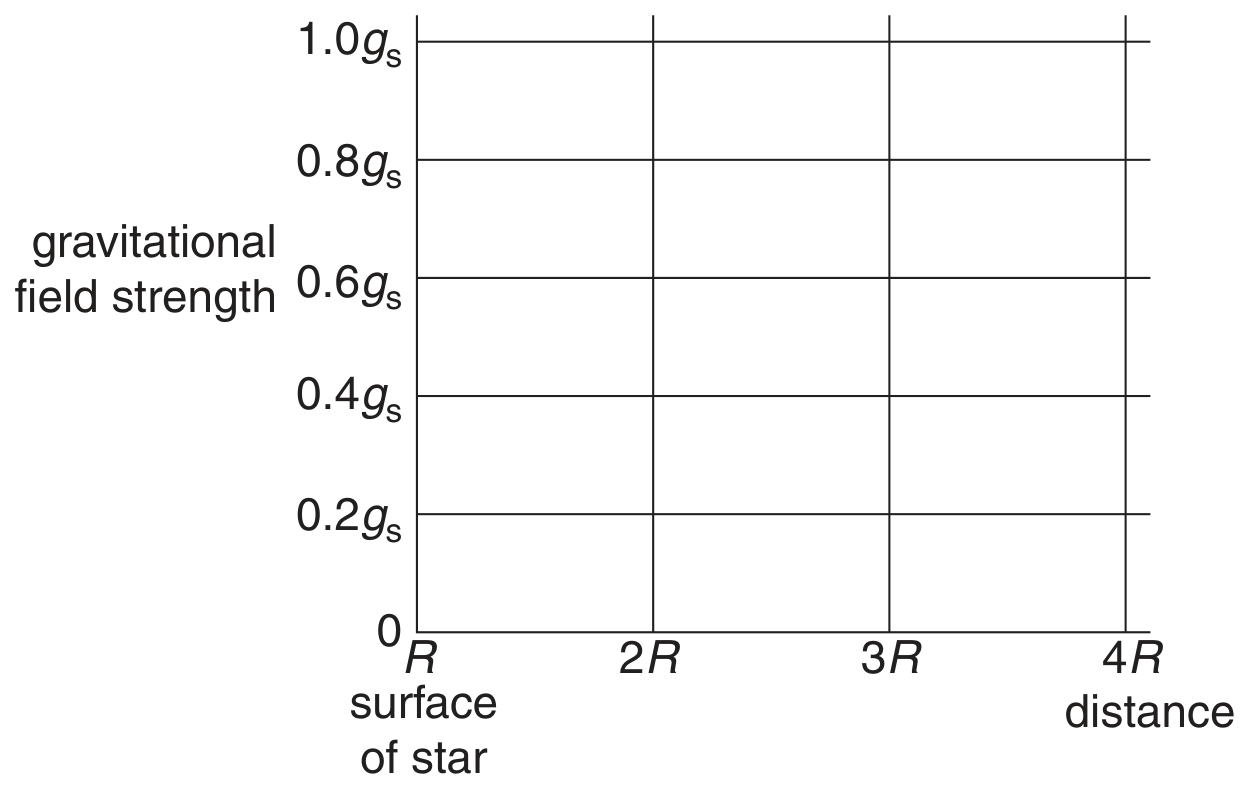
On Fig. 1.1, sketch a graph to show the variation of the gravitational field strength of the star with distance from its centre. You should consider distances in the range R to 4 R.

Fig. 1.1

Fig. 1.1

[ 2 ]
[Maximum number: 3]


2.

(a)

The Earth may be considered to be an isolated sphere of radius R with its mass concentrated at its centre.
The variation of the gravitational potential ϕ\phi with distance x from the centre of the Earth is shown in Fig. 1.1.

Fig. 1.1

Fig. 1.1

The radius R of the Earth is 6.4×10⁶ m6.4 \times 10^{6} \mathrm{~m}.

[ 3 ]
(i)

By considering the gravitational potential at the Earth's surface, determine a value for the mass of the Earth.

[ 3 ]
0