EduNinja
(a)

The emission spectrum of atomic hydrogen consists of a number of discrete wavelengths. Explain how this observation leads to an understanding that there are discrete electron energy levels in atoms.

[ 2 ]
(b)

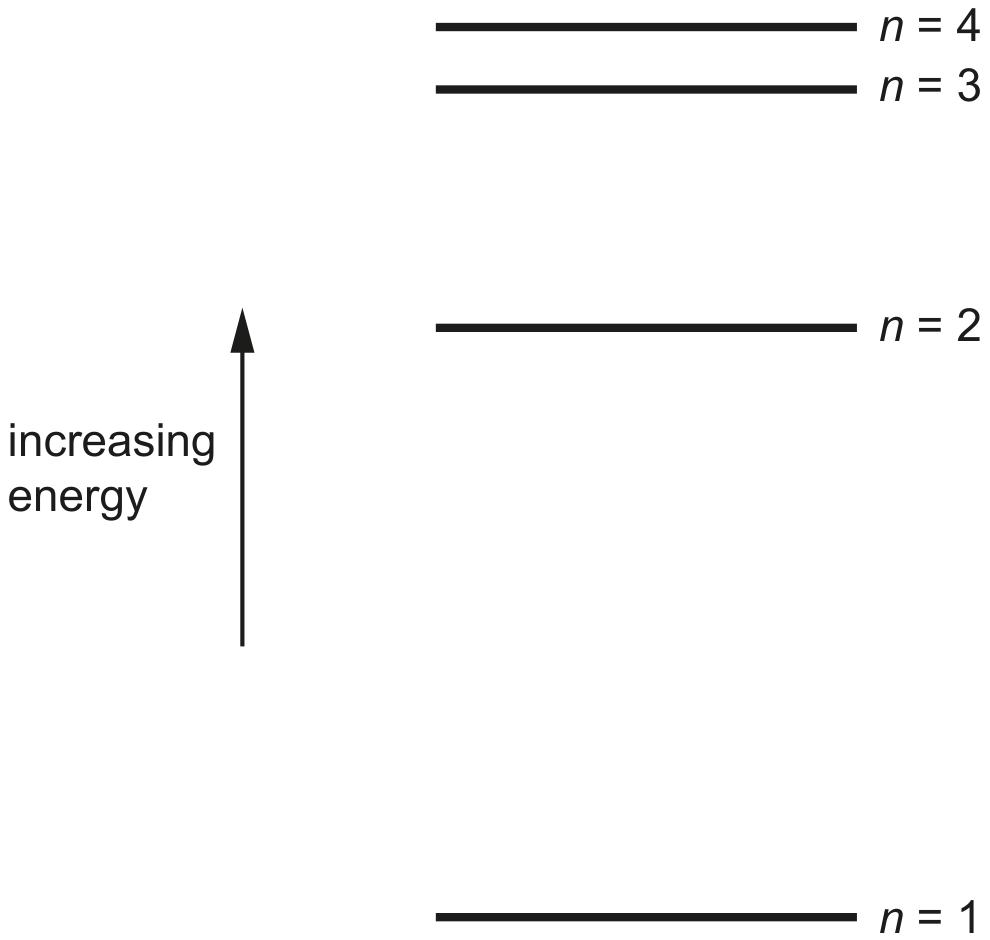
Some electron energy levels in atomic hydrogen are illustrated in Fig. 7.1.
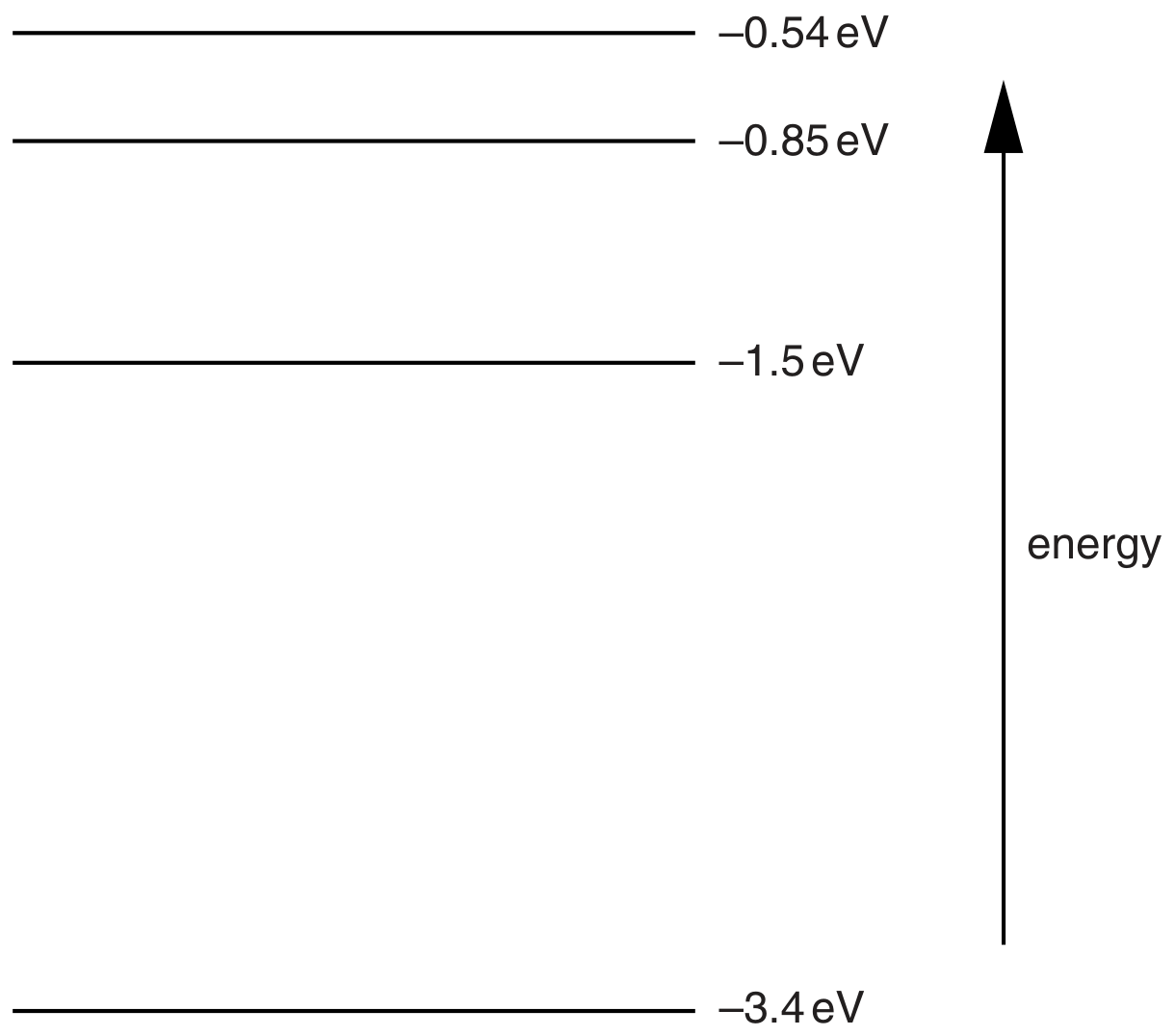
Fig. 7.1

Fig. 7.1

The longest wavelength produced as a result of electron transitions between two of the energy levels shown in Fig. 7.1 is 4.0×10⁶ m4.0 \times 10^{-6} \mathrm{~m}.

[ 5 ]
(i)

On Fig. 7.1,
1. draw, and mark with the letter L , the transition giving rise to the wavelength of 4.0×10⁶ m4.0 \times 10^{-6} \mathrm{~m},
2. draw, and mark with the letter S , the transition giving rise to the shortest wavelength.

[ 2 ]
(ii)

Calculate the wavelength for the transition you have shown in (i) part 2.

wavelength =

m

[ 3 ]
(c)

Photon energies in the visible spectrum vary between approximately 3.66 eV and 1.83 eV .

Determine the energies, in eV, of photons in the visible spectrum that are produced by transitions between the energy levels shown in Fig. 7.1.
photon energies eV
[ 2 ]
[Maximum number: 4]

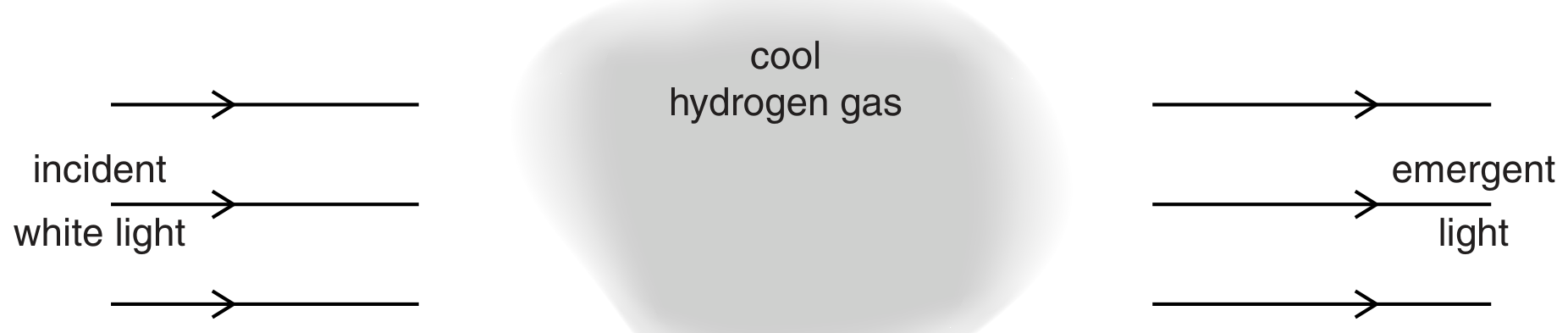
White light is incident on a cloud of cool hydrogen gas, as illustrated in Fig. 8.1.

Fig. 8.1

Fig. 8.1

The spectrum of the light emerging from the gas cloud is found to contain a number of dark lines.

(a)

Explain why these dark lines occur.

[ 3 ]
(b)

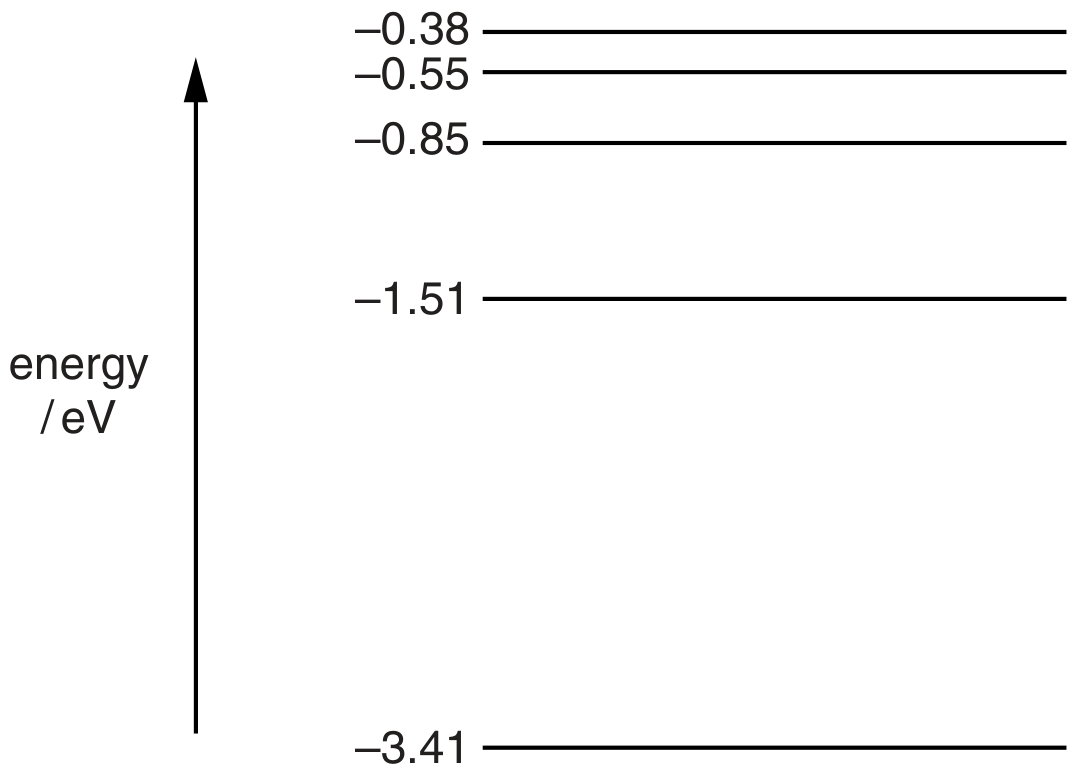
Some electron energy levels in a hydrogen atom are illustrated in Fig. 8.2.

Fig. 8.2

Fig. 8.2

One dark line is observed at a wavelength of 435 nm .

[ 1 ]
(i)

On Fig. 8.2, draw an arrow to indicate the energy change that gives rise to this dark line.

[ 1 ]
(a)

An emission spectrum is seen as a series of differently coloured lines on a black background.

Suggest how this observation provides evidence for discrete electron energy levels in atoms.

[ 2 ]
(a)

Explain how the line spectrum of hydrogen provides evidence for the existence of discrete electron energy levels in atoms.

[ 3 ]
(b)

Some electron energy levels in atomic hydrogen are illustrated in Fig. 7.1.

Fig. 7.1

Fig. 7.1

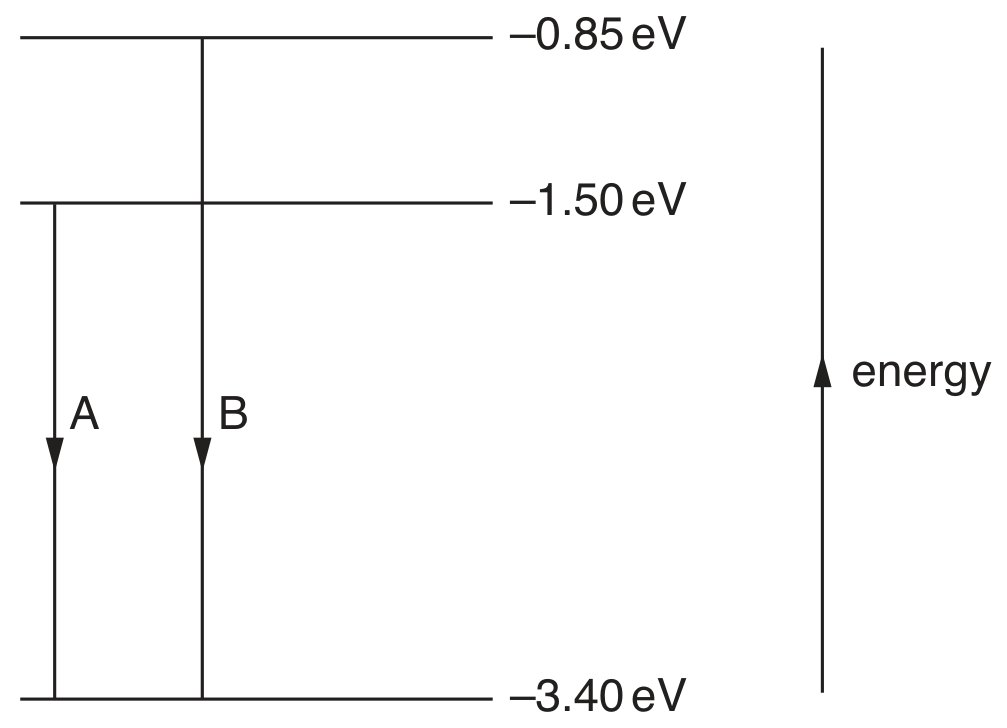
Two possible electron transitions A and B giving rise to an emission spectrum are shown.
These electron transitions cause light of wavelengths 654 nm and 488 nm to be emitted.

[ 4 ]
(i)

On Fig. 7.1, draw an arrow to show a third possible transition.

[ 1 ]
(ii)

Calculate the wavelength of the emitted light for the transition in (i).
wavelength = m

[ 3 ]
(c)

The light in a beam has a continuous spectrum of wavelengths from 400 nm to 700 nm . The light is incident on some cool hydrogen gas, as illustrated in Fig. 7.2.

Using the values of wavelength in (b), state and explain the appearance of the spectrum of the emergent light.

[ 4 ]
(a)

A beam of white light passes through a cloud of cool gas. The spectrum of the transmitted light is viewed and contains a number of dark lines.

Explain why these dark lines occur.

[ 4 ]
(b)

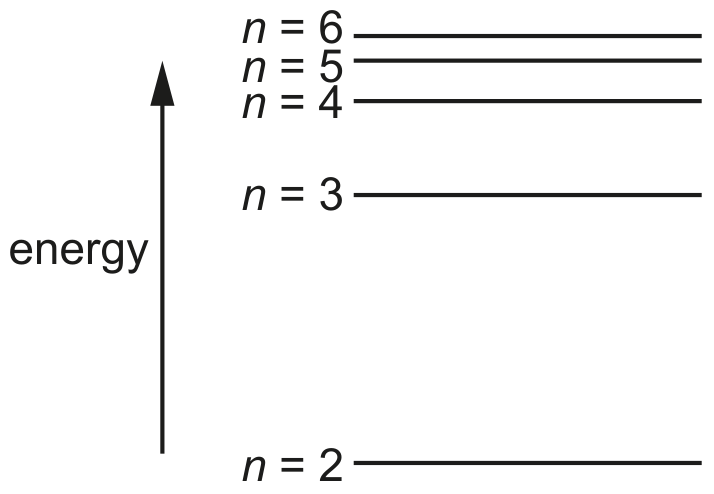
Some energy levels for the electron in an isolated hydrogen atom are illustrated in Fig. 7.1.

Fig. 7.1

Fig. 7.1

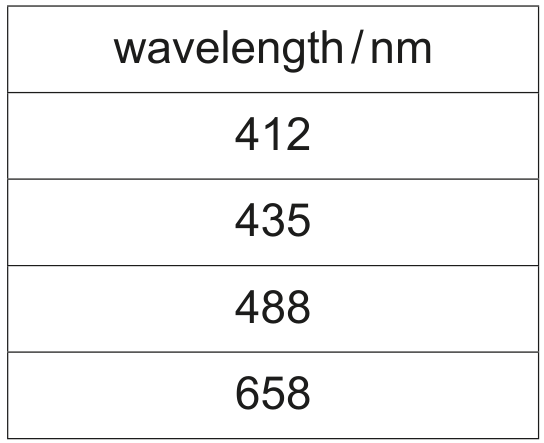
Table 7.1 shows the wavelengths of photons that are emitted in the transitions to n=2 from the other energy levels shown in Fig. 7.1.

Table 7.1

Table 7.1

The energy associated with the energy level n=2 is -3.40 eV .

Calculate the energy, in J , of energy level n=3.
energy = ..... J

[ 3 ]
[Maximum number: 2]

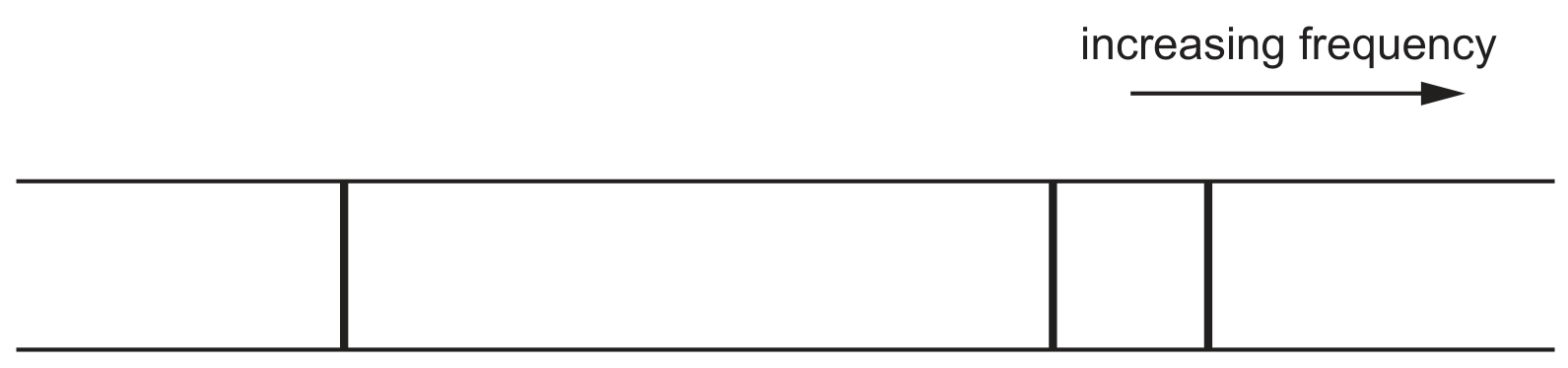
Fig. 8.1 shows part of the emission spectrum of visible radiation emitted by hydrogen gas in a star in a distant galaxy.

Fig. 8.1

Fig. 8.1

The galaxy is moving away from the Earth at a speed of 6.2×10⁶ ms16.2 \times 10^{6} \mathrm{~ms}^{-1}

(a)
(i)

(ii)Determine the energy,in eV ,of the energy level from which the electron transition originates to cause the emission of this radiation.
energy level=
eV[2]

Question image
[ 2 ]
[Maximum number: 6]

Fig. 8.1 shows the lowest four energy levels of an electron in an isolated atom.

Fig. 8.1

Fig. 8.1

Fig. 8.2 shows the lines in the emission spectrum of the atom that correspond to the transitions of the electron from n=3 to n=1 and from n=4 to n=1.

Fig. 8.2

Fig. 8.2

(a)

Explain, with reference to photons, why there is a single frequency of electromagnetic radiation that corresponds to each of these transitions.

[ 2 ]
(b)
(i)

On Fig. 8.2, draw a line that corresponds to the transition of the electron from n=2 to n=1. Label this line A.

[ 2 ]
(ii)

On Fig. 8.2, draw a line that corresponds to the transition of the electron from n=3 to n=2. Label this line B.

[ 2 ]
(c)

The frequency of radiation represented by line A is fAf_{\mathrm{A}}. The frequency of radiation represented by line B is fBf_{\mathrm{B}}. The energy of the ground state (n=1) is E1E_{1}.

Determine an expression, in terms of fA,fB,E1f_{\mathrm{A}}, f_{\mathrm{B}}, E_{1} and the Planck constant h, for the energy E3E_{3} of the energy level n=3.

E3=E_{3}=
(a)

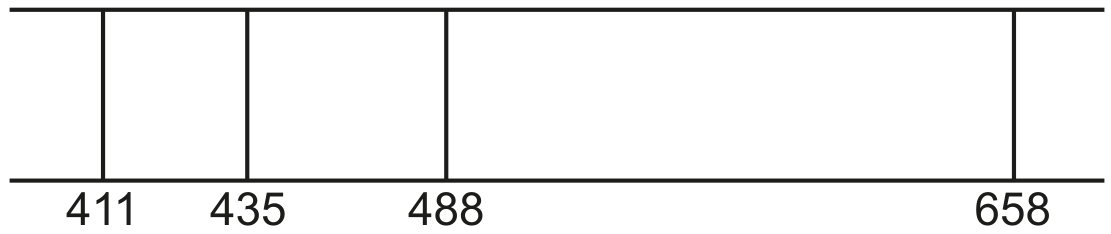
Fig. 9.1 shows the visible part of the emission spectrum from hydrogen gas in a laboratory on the Earth. The numbers indicate the wavelength, in nm , represented by each line.

Fig. 9.1

Fig. 9.1

[ 6 ]
(i)

Explain how the emission spectrum provides evidence for the existence of discrete energy levels for the electron in a hydrogen atom.

[ 3 ]
(ii)

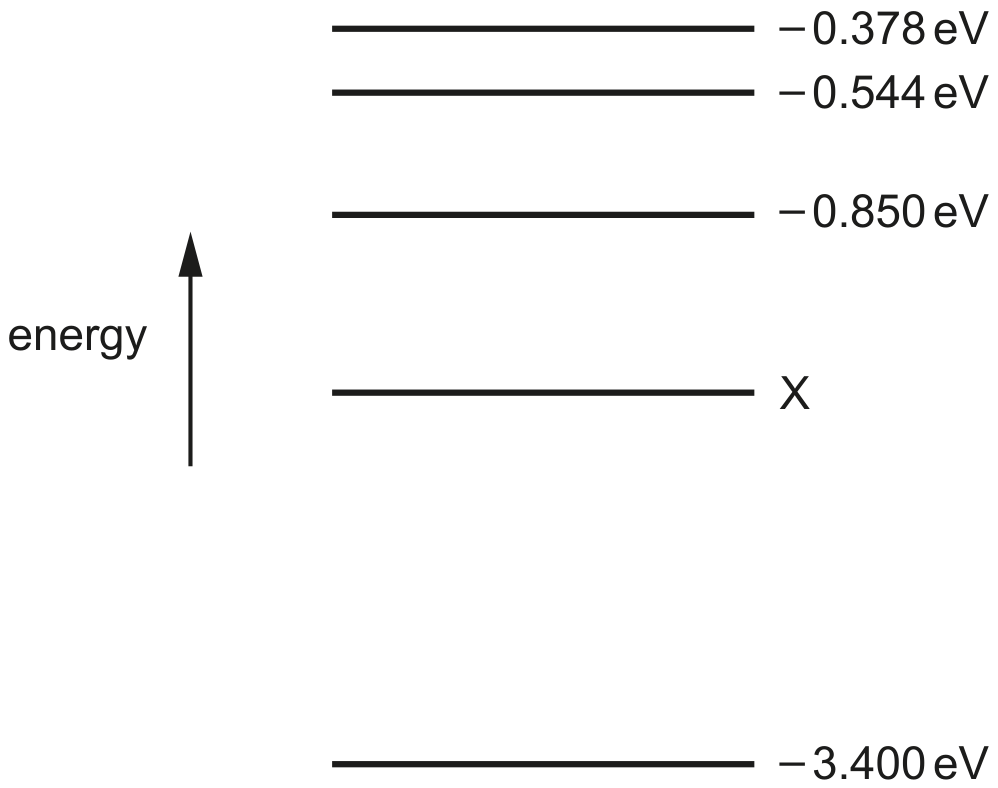
Fig. 9.2 shows five of the energy levels in the hydrogen atom. The wavelengths of radiation shown in Fig. 9.1 relate to transitions to the -3.400 eV level in Fig. 9.2.

Fig. 9.2 (not to scale)

Fig. 9.2 (not to scale)

Show that the energy level X is -1.51 eV .

[ 3 ]
0