EduNinja
(a)

Assume that the Earth is a uniform conducting sphere of mass 5.98×1024 kg5.98 \times 10^{24} \mathrm{~kg}. The surface of the Earth carries a charge of 4.80×10⁵C-4.80 \times 10^{5} \mathrm{C} that is evenly distributed.

[ 2 ]
(i)

Use the information in (b) to determine the electric field strength at the surface of the Earth. Give a unit with your answer.
electric field strength = unit

[ 2 ]
(a)

By reference to Fig. 4.2, state and explain

[ 2 ]
(i)

the effect, if any, on the shape of the graph of doubling the charge on particle P .

[ 2 ]
(a)

An isolated metal sphere is to be used to store charge at high potential. The charge stored may be assumed to be a point charge at the centre of the sphere. The sphere has a radius of 25 cm . Electrical breakdown (a spark) occurs in the air surrounding the sphere when the electric field strength at the surface of the sphere exceeds 1.8×10⁴Vcm11.8 \times 10^{4} \mathrm{Vcm}^{-1}.

[ 2 ]
(i)

Show that the maximum charge that can be stored on the sphere is 12.5μC12.5 \mu \mathrm{C}.

[ 2 ]
[Maximum number: 3]

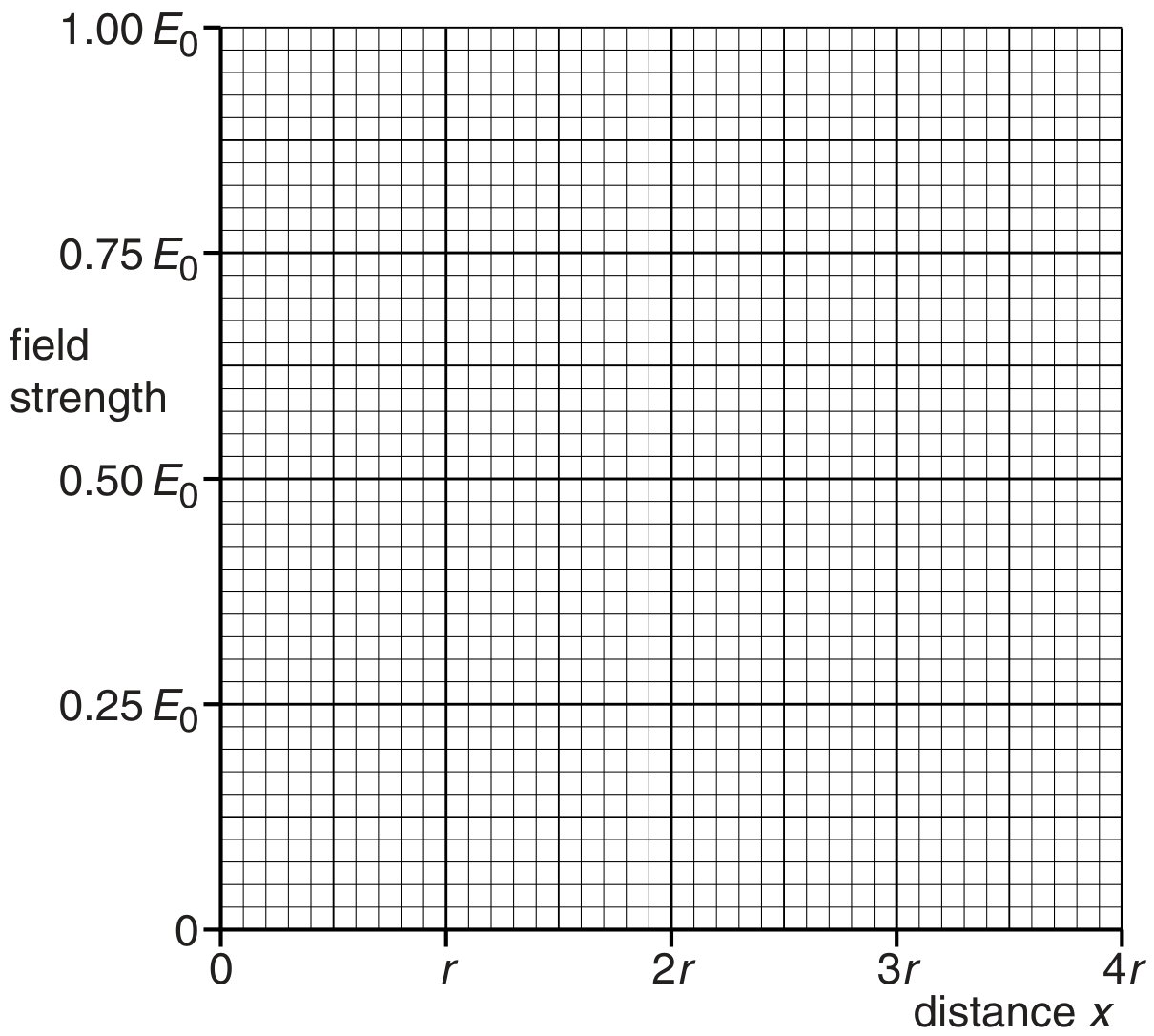
An isolated solid metal sphere of radius r is given a positive charge. The distance from the centre of the sphere is x.

(a)

The electric field strength at the surface of the sphere is E0E_{0}.

On the axes of Fig.5.2, sketch a graph to show the variation with distance x of the electric field strength due to the charged sphere, for values of x from x=0 to x=4 r.

Fig. 5.2

Fig. 5.2

[ 3 ]
(a)

An isolated solid metal sphere is positively charged.

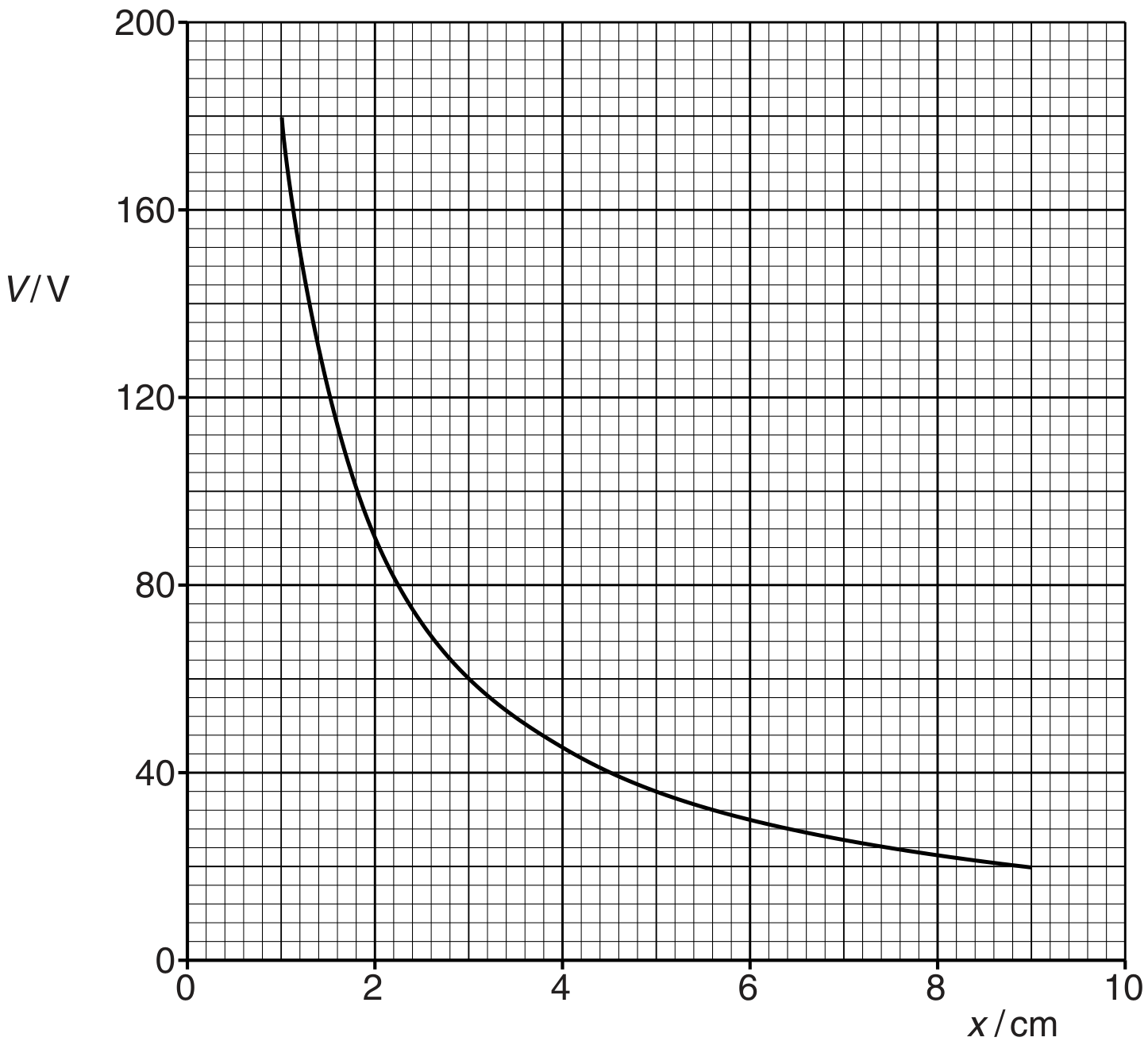
The variation of the potential V with distance x from the centre of the sphere is shown in Fig. 5.1.

Fig. 5.1

Fig. 5.1

Use Fig. 5.1 to suggest

[ 1 ]
(i)

why the radius of the sphere cannot be greater than 1.0 cm ,

[ 1 ]
(b)

Assuming that the charge on the sphere does behave as a point charge, use data from Fig. 5.1 to determine the charge on the sphere.
charge =
C

[ 2 ]

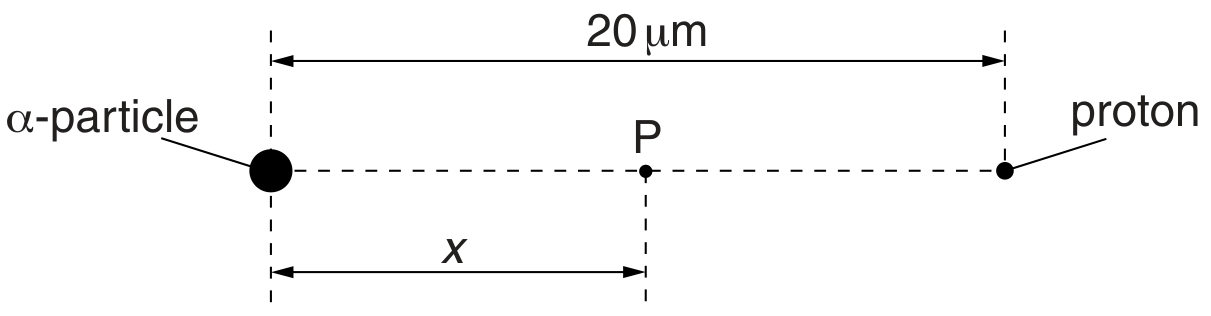
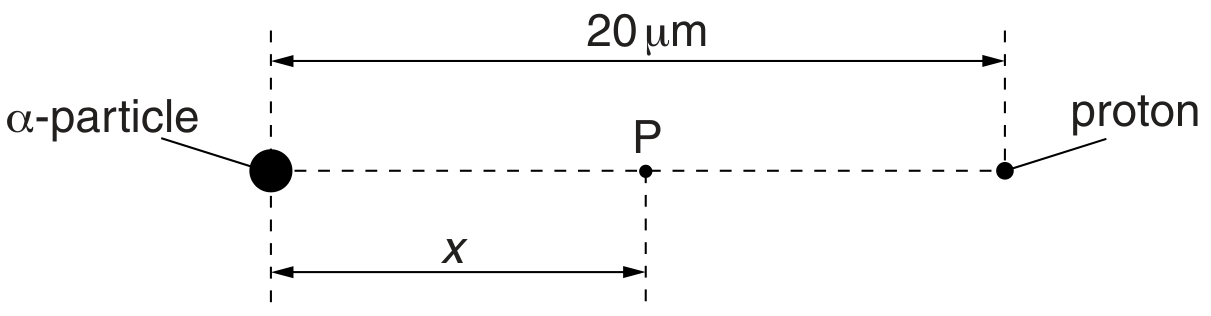
An α\alpha-particle and a proton are at rest a distance 20μ m20 \mu \mathrm{~m} apart in a vacuum, as illustrated in Fig. 4.1.

Fig. 4.1

Fig. 4.1

(a)
(i)

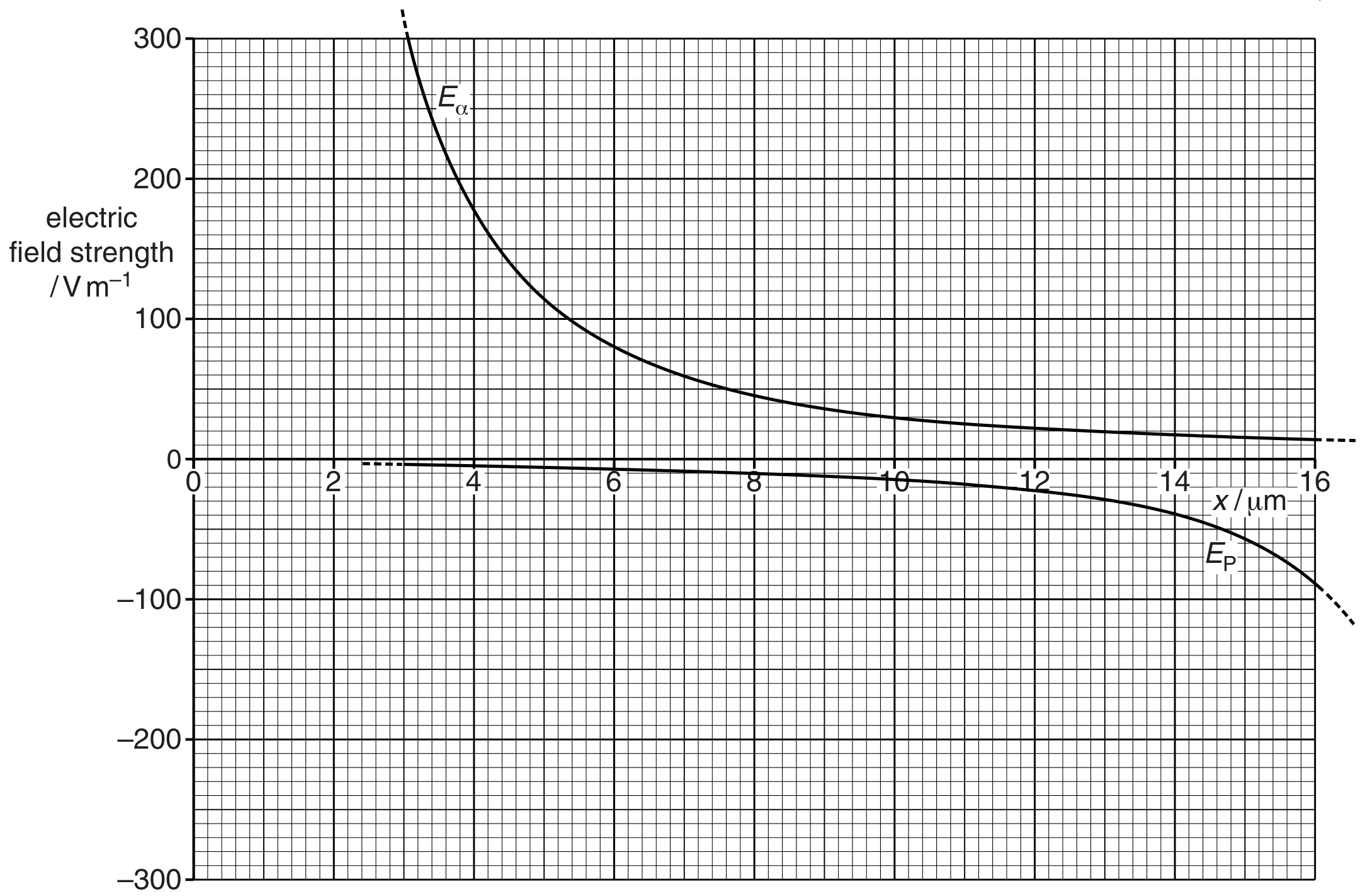
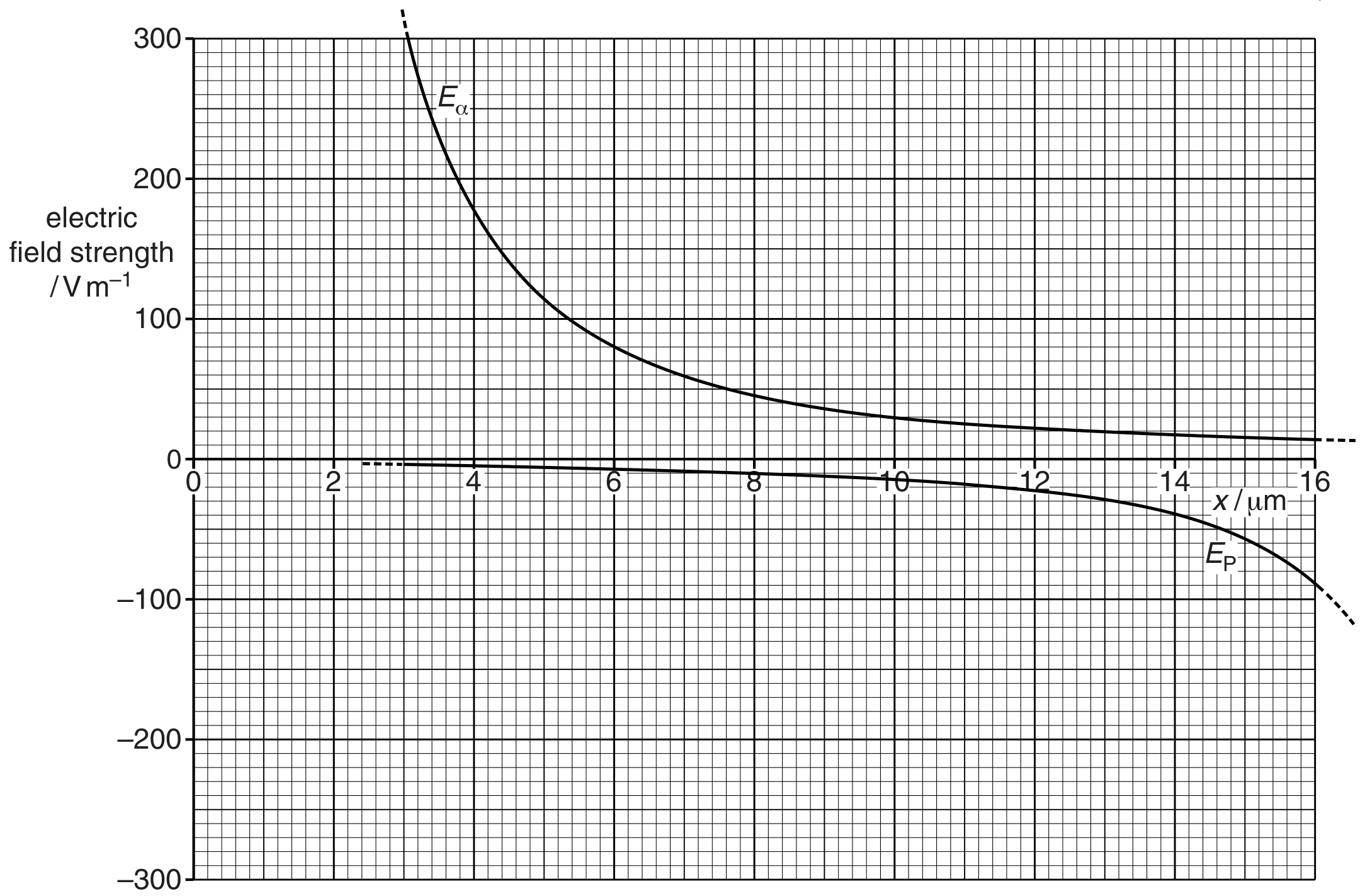
A point P is distance x from the α\alpha-particle along the line joining the α\alpha-particle to the proton (see Fig. 4.1). The variation with distance x of the electric field strength EαE_{\alpha} due to the α\alpha-particle alone is shown in Fig. 4.2.

Fig. 4.2

Fig. 4.2

The variation with distance x of the electric field strength EpE_{\mathrm{p}} due to the proton alone is also shown in Fig. 4.2.

[Maximum number: 2]

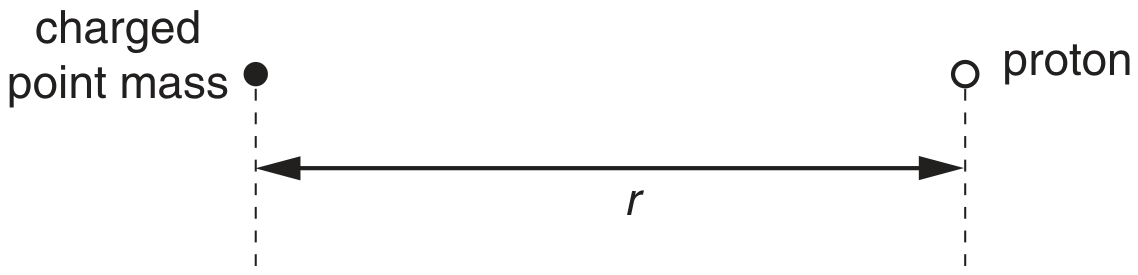
A charged point mass is situated in a vacuum. A proton travels directly towards the mass, as illustrated in Fig. 4.1.

Fig. 4.1

Fig. 4.1

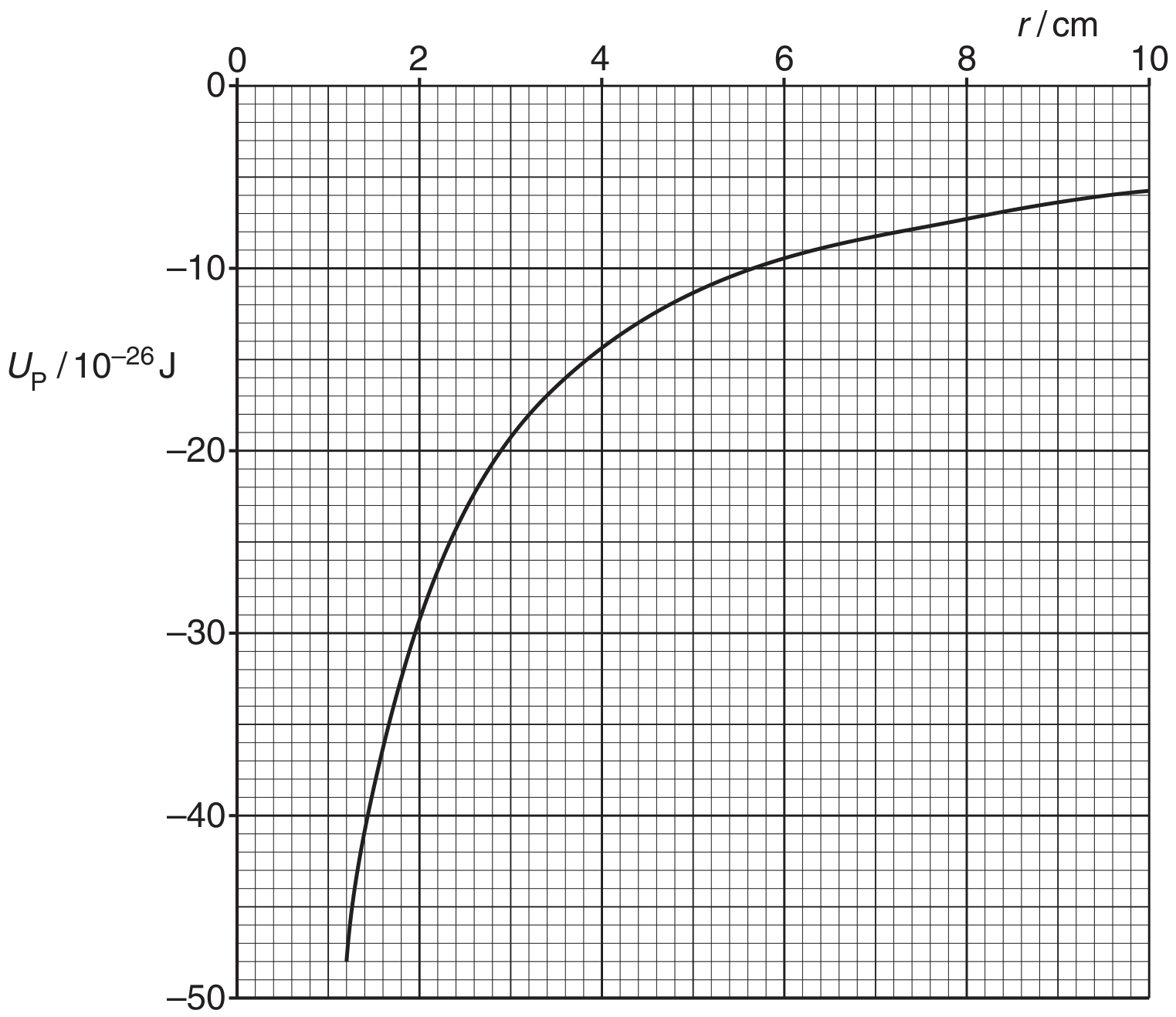
When the separation of the mass and the proton is r, the electric potential energy of the system is UpU_{p}.

The variation with r of the potential energy UpU_{\mathrm{p}} is shown in Fig. 4.2.

Fig. 4.2

Fig. 4.2

(a)
(i)

Use Fig. 4.2 to state and explain whether the mass is charged positively or negatively.

[ 2 ]

An α\alpha-particle and a proton are at rest a distance 20μ m20 \mu \mathrm{~m} apart in a vacuum, as illustrated in Fig. 4.1.

Fig. 4.1

Fig. 4.1

(a)
(i)

A point P is distance x from the α\alpha-particle along the line joining the α\alpha-particle to the proton (see Fig. 4.1). The variation with distance x of the electric field strength EαE_{\alpha} due to the α\alpha-particle alone is shown in Fig. 4.2.

Fig. 4.2

Fig. 4.2

The variation with distance x of the electric field strength EpE_{\mathrm{p}} due to the proton alone is also shown in Fig. 4.2.

0