EduNinja
[Maximum number: 2]

A sphere of mass 1.6×10¹⁰ kg1.6 \times 10^{-10} \mathrm{~kg} has a charge of +0.27 nC . The sphere is in a uniform electric field that acts vertically upwards, as shown in the side view in Fig. 2.1.
SIDE VIEW
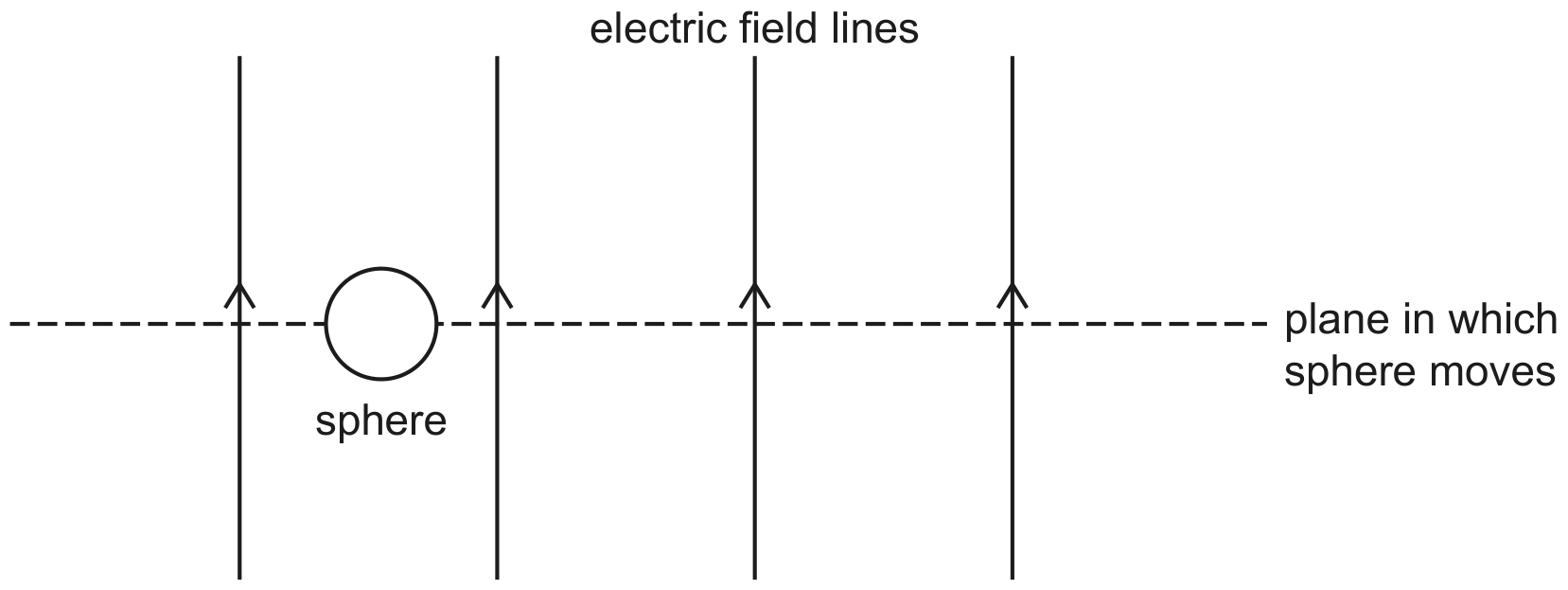
Fig. 2.1

Fig. 2.1

The force exerted on the sphere by the electric field causes the sphere to remain at a fixed vertical height in a horizontal plane.

There is a uniform magnetic field in the region of the electric field. The sphere moves at a speed of 0.78 m s10.78 \mathrm{~m} \mathrm{~s}^{-1} in the horizontal plane. The magnetic field causes the sphere to move in a circular path of radius 3.4 m , as shown in the view from above in Fig. 2.2.
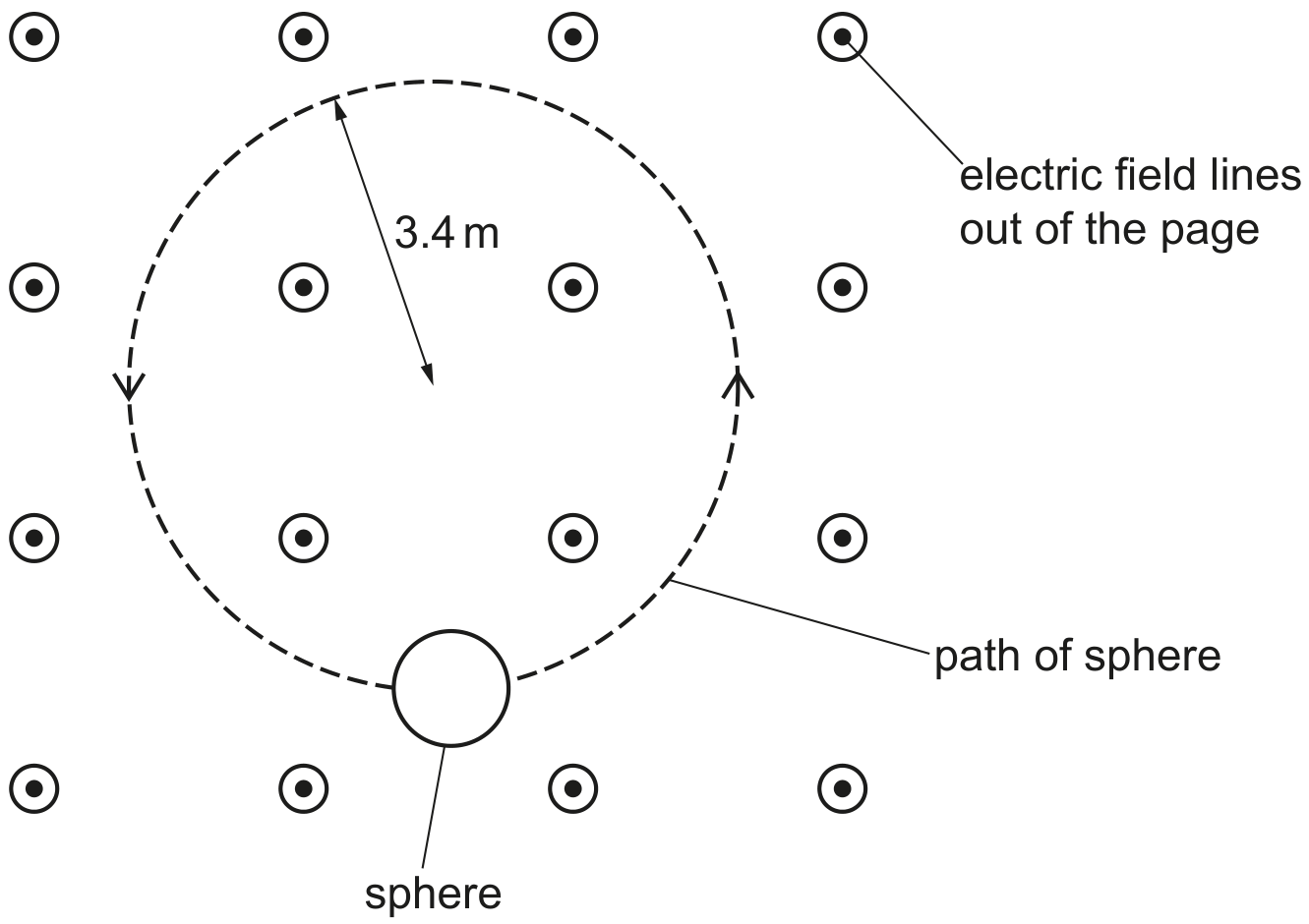
VIEW FROM ABOVE

VIEW FROM ABOVE

(a)

Calculate the strength of the uniform electric field.

\text { electric field strength = \mathrm{NC}^{-1}
[ 2 ]
[Maximum number: 1]

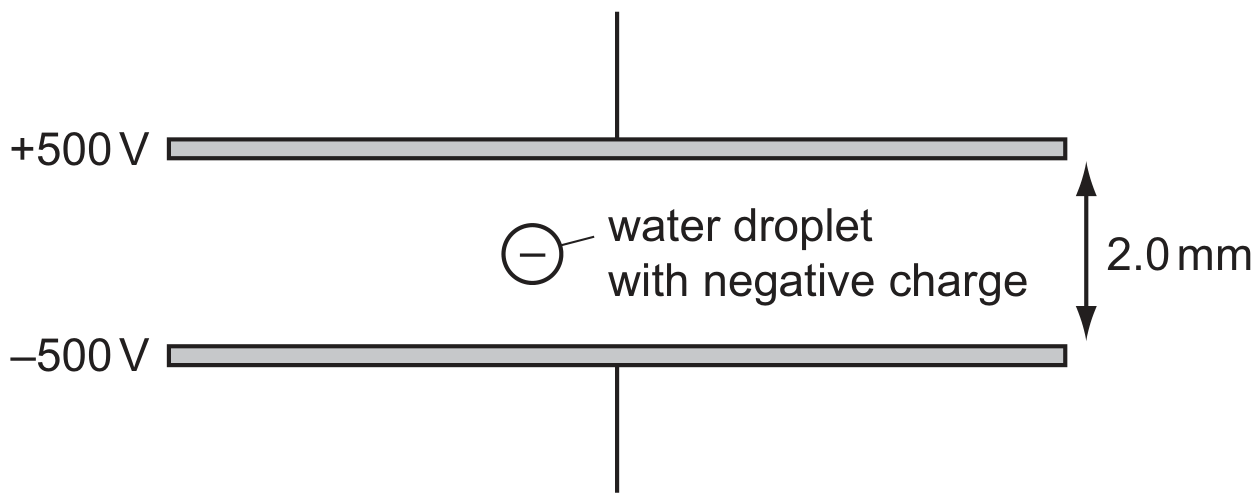
A small water droplet of mass 3.0μ g3.0 \mu \mathrm{~g} carries a charge of 6.0×10¹¹C-6.0 \times 10^{-11} \mathrm{C}. The droplet is situated in the Earth's gravitational field between two horizontal metal plates. The potential of the upper plate is +500 V and the potential of the lower plate is -500 V .

Question image

What is the motion of the droplet?

A

It accelerates downwards.

B

It remains stationary.

C

It accelerates upwards.

D

It moves upwards at a constant velocity.

(a)

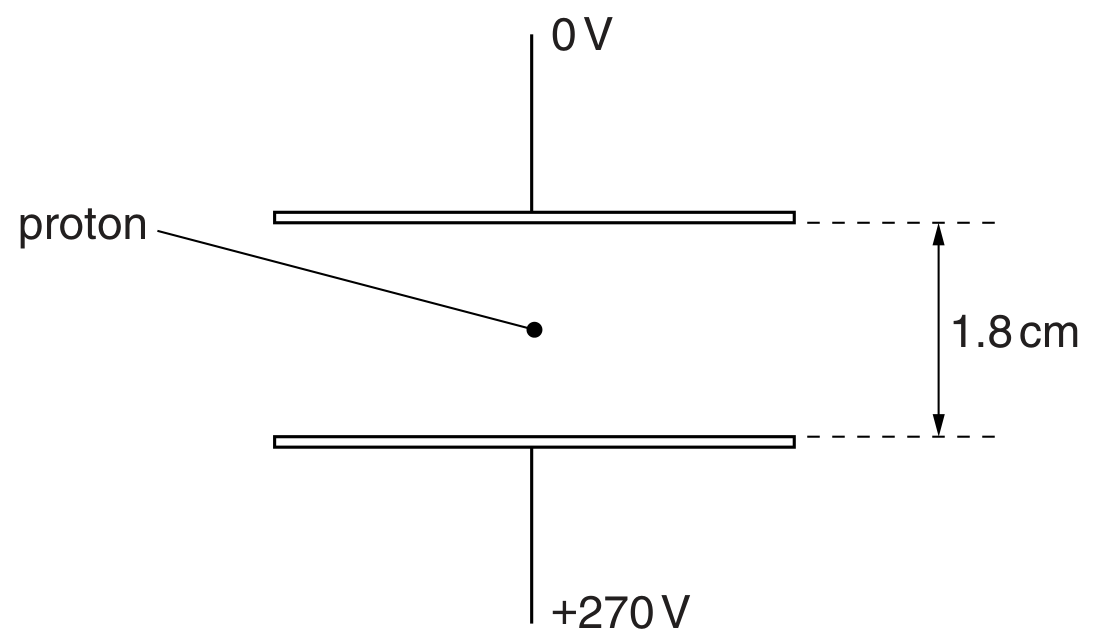
Two horizontal metal plates are separated by a distance of 1.8 cm in a vacuum. A potential difference of 270 V is maintained between the plates, as shown in Fig. 3.1.

Fig. 3.1

Fig. 3.1

A proton is in the space between the plates.
Explain quantitatively why, when predicting the motion of the proton between the plates, the gravitational field is not taken into consideration.

[ 4 ]
(a)

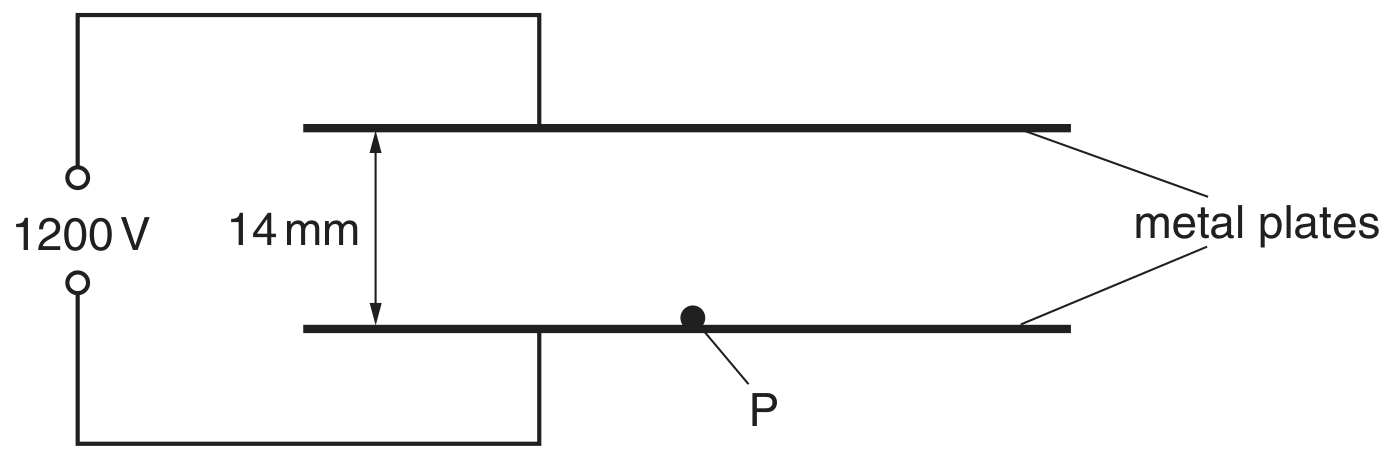
A uniform electric field is produced by applying a potential difference of 1200 V across two parallel metal plates in a vacuum, as shown in Fig. 4.1.

Fig. 4.1

Fig. 4.1

The separation of the plates is 14 mm . A particle P with charge 3.2×10¹⁹C3.2 \times 10^{-19} \mathrm{C} and mass 6.6×1027 kg6.6 \times 10^{-27} \mathrm{~kg} starts from rest at the lower plate and is moved vertically to the top plate by the electric field.

Calculate

[ 2 ]
(i)

the electric field strength between the plates,
electric field strength = Vm1\mathrm{Vm}^{-1}

[ 2 ]
(a)

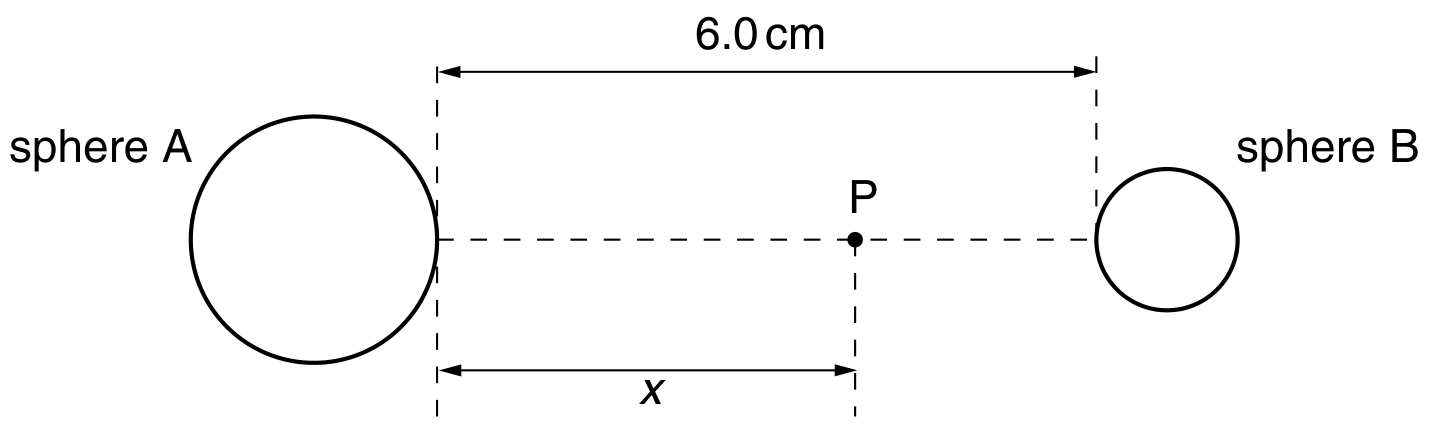
Two charged metal spheres A and B are situated in a vacuum, as illustrated in Fig. 4.1.

Fig. 4.1

Fig. 4.1

The shortest distance between the surfaces of the spheres is 6.0 cm .
A movable point P lies along the line joining the centres of the two spheres, a distance x from the surface of sphere A.

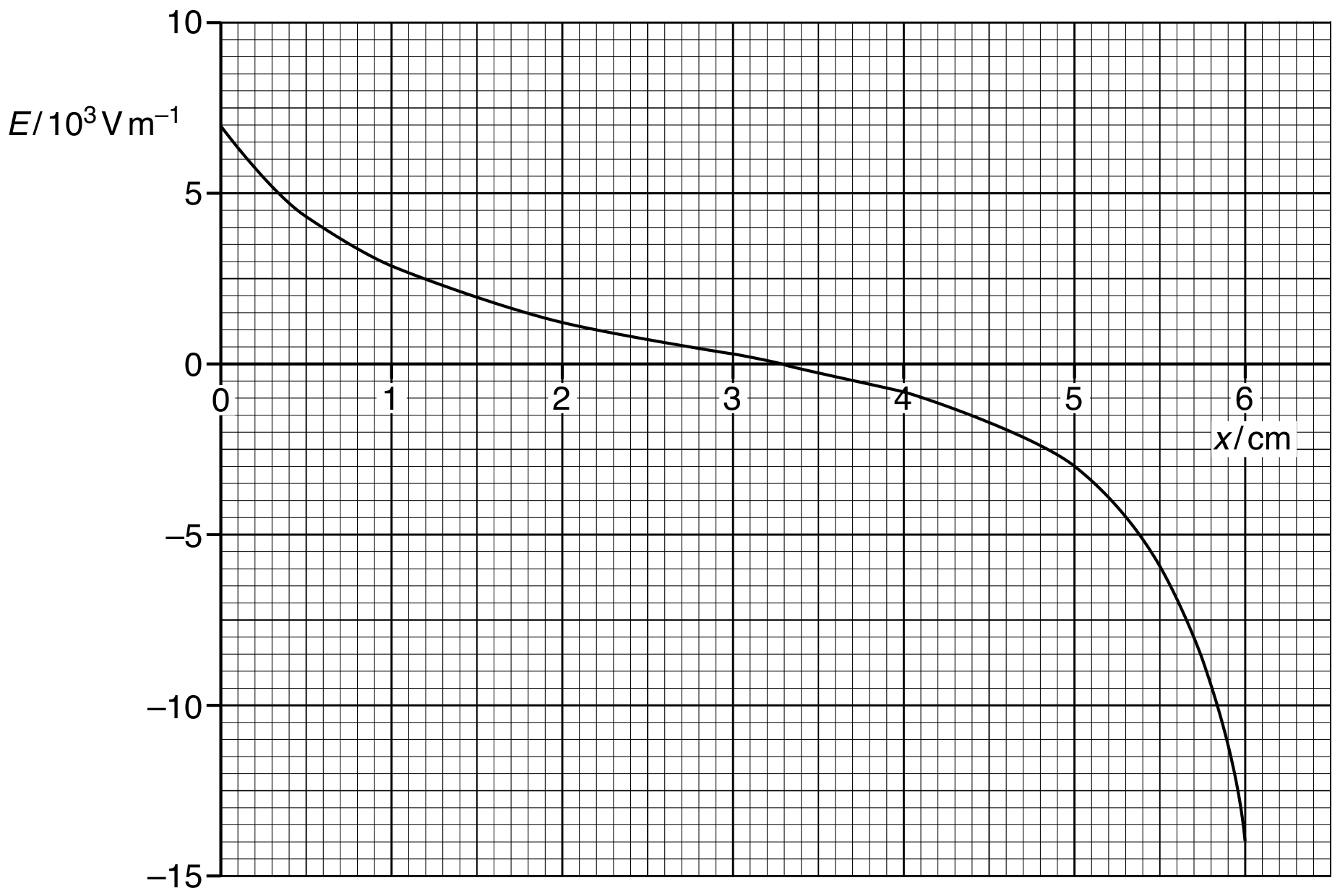
The variation with distance x of the electric field E at point P is shown in Fig. 4.2.

Fig. 4.2

Fig. 4.2

[ 3 ]
(i)

A proton is at point P where x=5.0 cmx=5.0 \mathrm{~cm}. Use data from Fig. 4.2 to determine the magnitude of the acceleration of the proton.
acceleration = ms2[3]\mathrm{m} \mathrm{s}^{-2}[3]

[ 3 ]
(a)

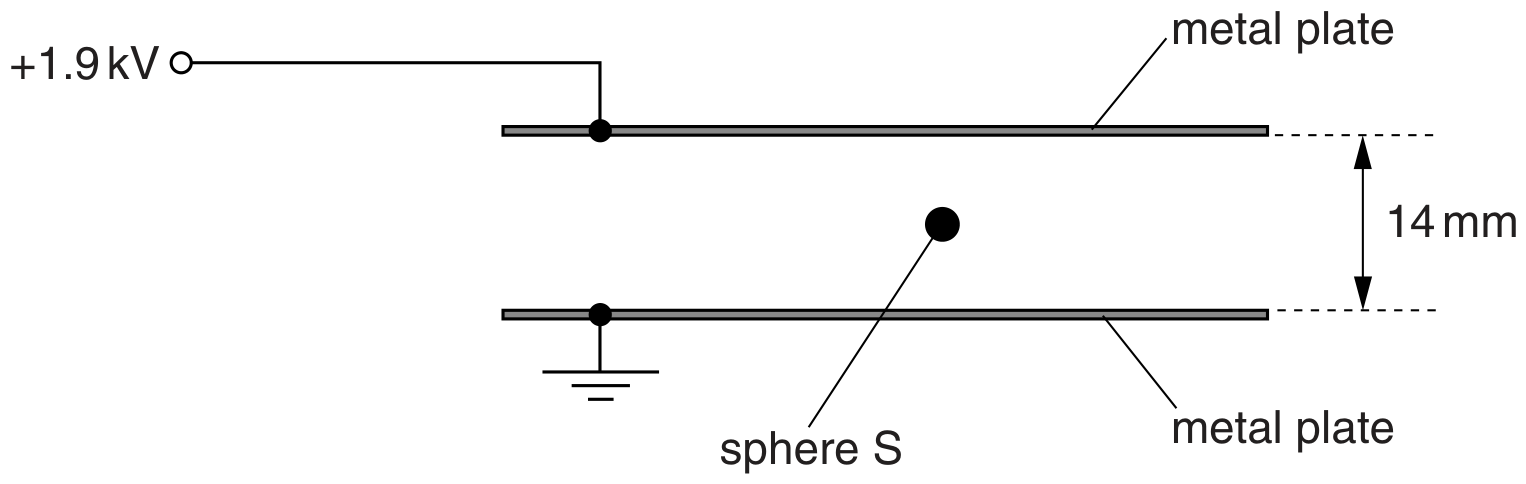
Two horizontal metal plates are 14 mm apart in a vacuum. A potential difference (p.d.) of 1.9 kV is applied across the plates, as shown in Fig. 3.1.

Fig. 3.1

Fig. 3.1

A uniform electric field is produced between the plates.
The sphere S in (b) is charged and is held stationary between the plates by the electric field.

[ 2 ]
(i)

Calculate the electric field strength between the plates.
electric field strength = Vm1\mathrm{Vm}^{-1}

[ 2 ]
(a)

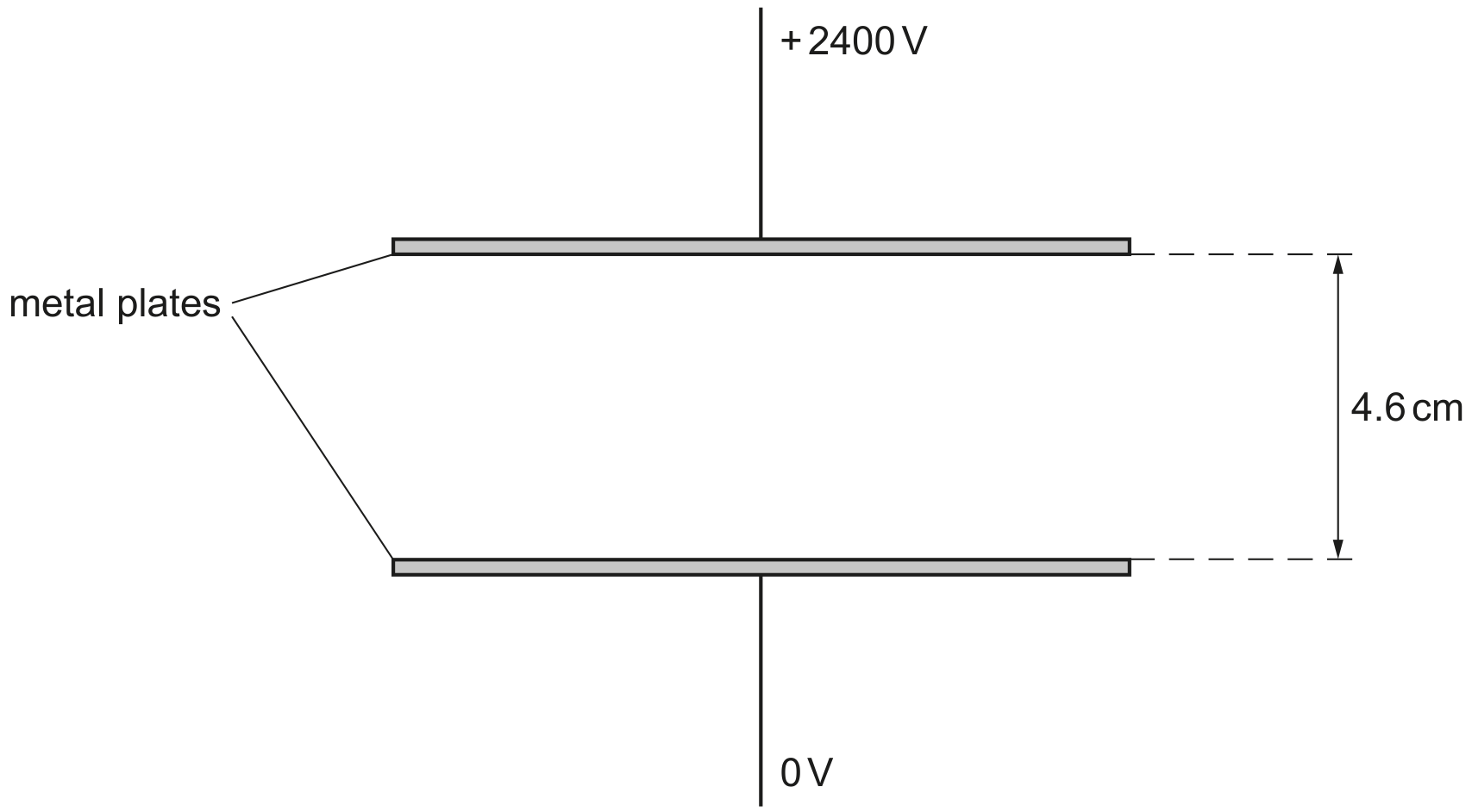
Fig. 4.1 shows a pair of parallel metal plates with a potential difference (p.d.) of 2400 V between them.

Fig. 4.1

Fig. 4.1

The plates are separated by a distance of 4.6 cm . The plates are in a vacuum.

[ 2 ]
(i)

Calculate the strength of the electric field between the plates.
electric field strength = NC1\mathrm{NC}^{-1}

[ 2 ]
(b)

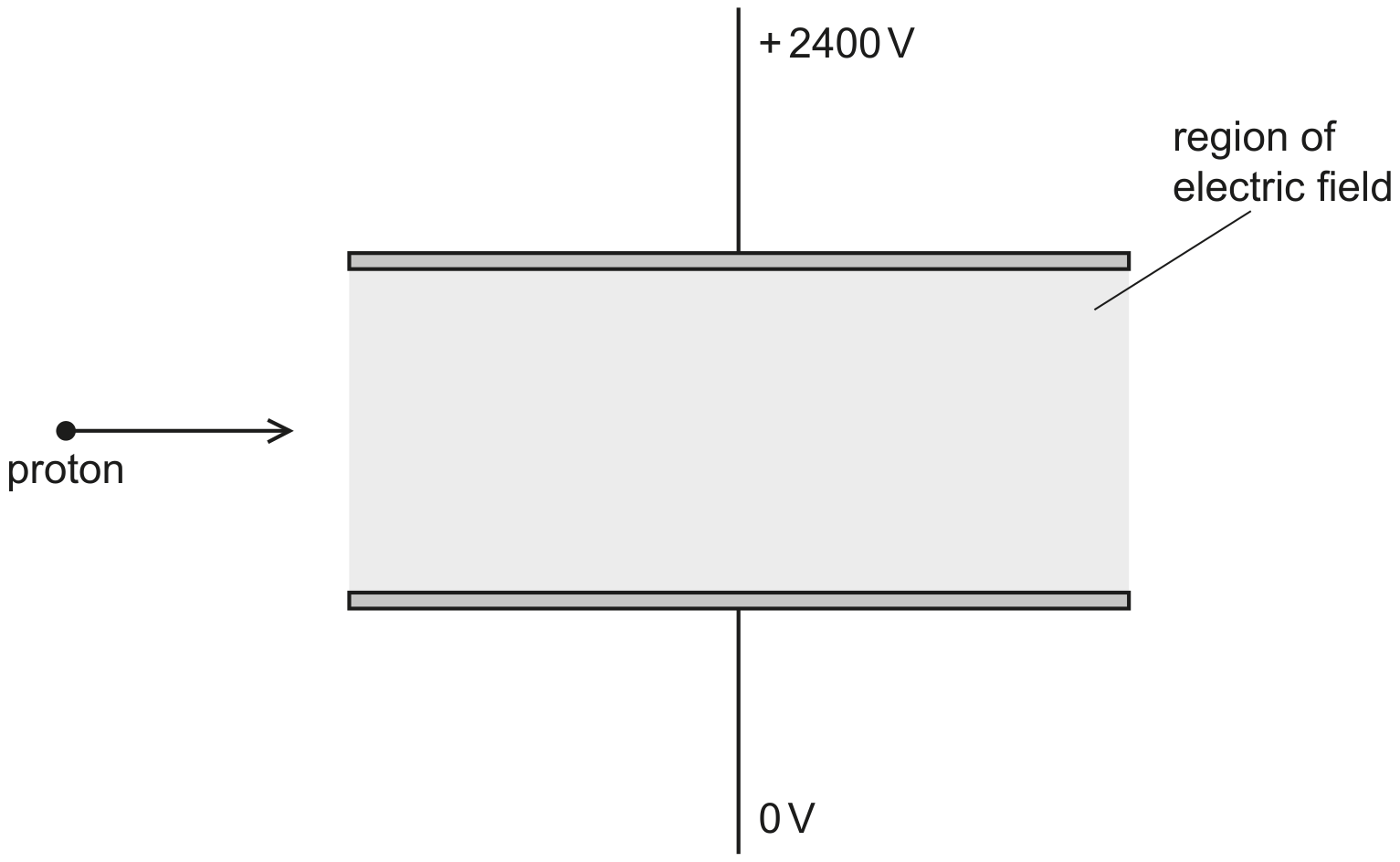
A moving proton enters the region between the plates from the left, as shown in Fig. 4.2.

Fig. 4.2

Fig. 4.2

[ 5 ]
(i)

The proton is deflected by the electric field.

On Fig. 4.2, draw a line to show the path of the proton as it moves through and out of the region of the electric field.

[ 2 ]
(ii)

A helium nucleus (24He)\left({ }_{2}^{4} \mathrm{He}\right) now enters the region of the electric field along the same initial path as the proton and travelling at the same initial speed.

State and explain how the final speed of the helium nucleus compares with the final speed of the proton after leaving the region of the electric field.

[ 3 ]
(a)

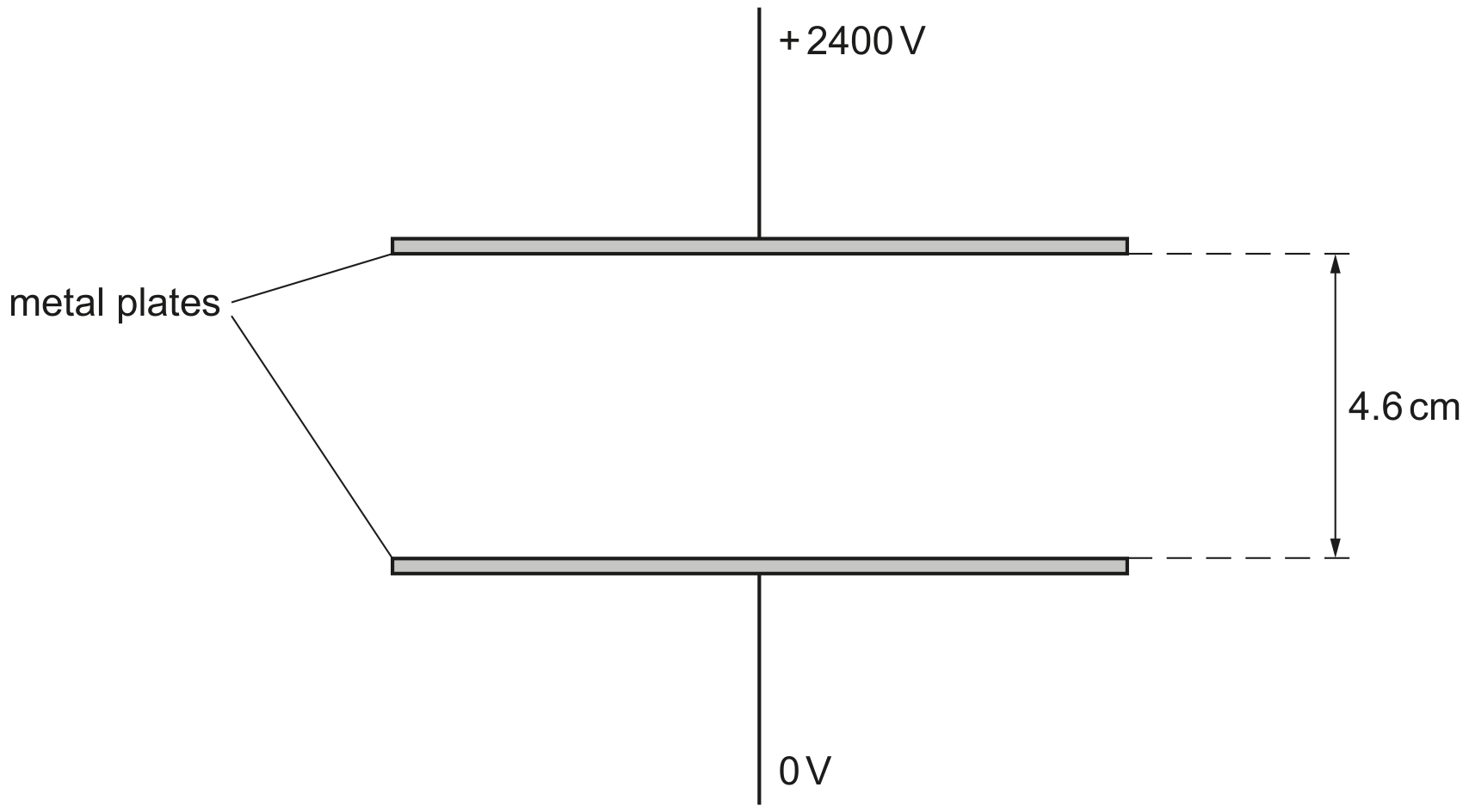
Fig. 4.1 shows a pair of parallel metal plates with a potential difference (p.d.) of 2400 V between them.

Fig. 4.1

Fig. 4.1

The plates are separated by a distance of 4.6 cm . The plates are in a vacuum.

[ 2 ]
(i)

Calculate the strength of the electric field between the plates.
electric field strength = NC1\mathrm{NC}^{-1}

[ 2 ]
(a)

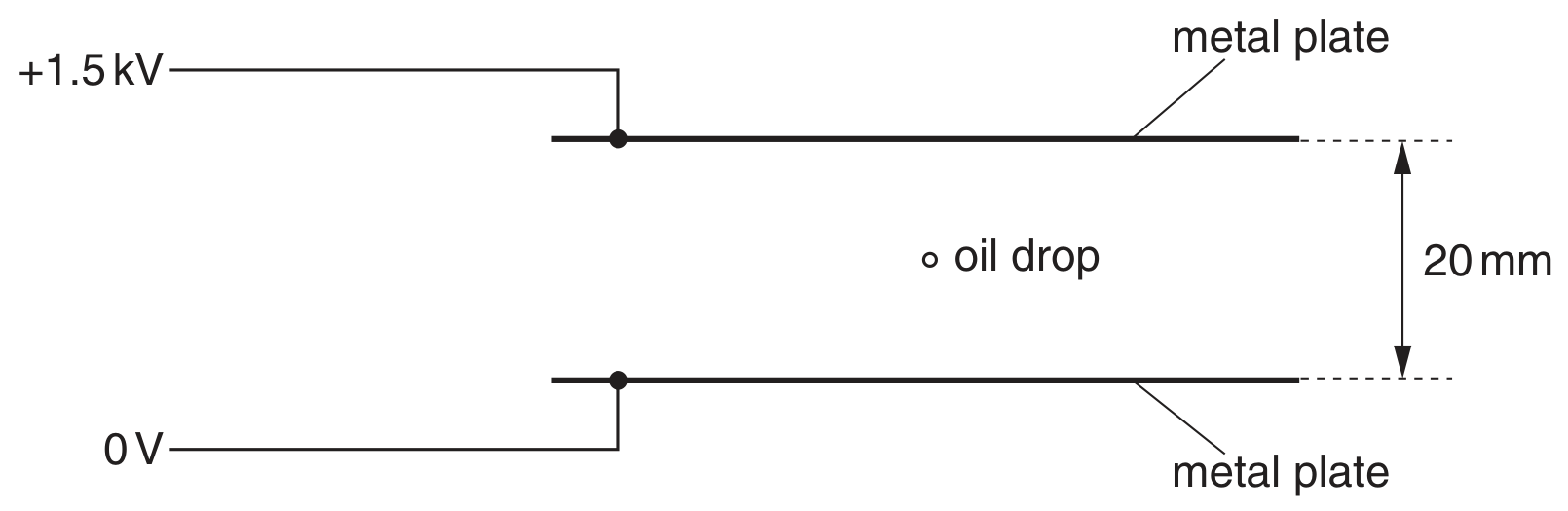
Two horizontal metal plates are 20 mm apart in a vacuum. A potential difference of 1.5 kV is applied across the plates, as shown in Fig. 4.1.

Fig. 4.1

Fig. 4.1

A charged oil drop of mass 5.0×10¹⁵ kg5.0 \times 10^{-15} \mathrm{~kg} is held stationary by the electric field.

[ 7 ]
(i)

Calculate the electric field strength between the plates.
electric field strength = Vm1\mathrm{Vm}^{-1}

[ 1 ]
(ii)

Calculate the charge on the drop.
charge = C

[ 4 ]
(iii)

The potential of the upper plate is increased. Describe and explain the subsequent motion of the drop.

[ 2 ]
[Maximum number: 3]

Two oppositely-charged parallel metal plates are situated in a vacuum, as shown in Fig. 7.1.
particle, mass m
charge +q
speed v

Fig. 7.1

Fig. 7.1

The plates have length L.
The uniform electric field between the plates has magnitude E. The electric field outside the plates is zero.

A positively-charged particle has mass m and charge +q. Before the particle reaches the region between the plates, it is travelling with speed v parallel to the plates. The particle passes between the plates and into the region beyond them.

(a)
(i)

On Fig. 7.1, draw the path of the particle between the plates and beyond them.

[ 2 ]
(ii)

For the particle in the region between the plates, state expressions, in terms of E, m, q, v and L, as appropriate, for
1. the force F on the particle,
2. the time t for the particle to cross the region between the plates.

[ 1 ]
0