EduNinja
[Maximum number: 1]

A class of students used dice to simulate radioactive decay. After each throw, those dice showing a ' 6 ' were removed. The graph shows the results.
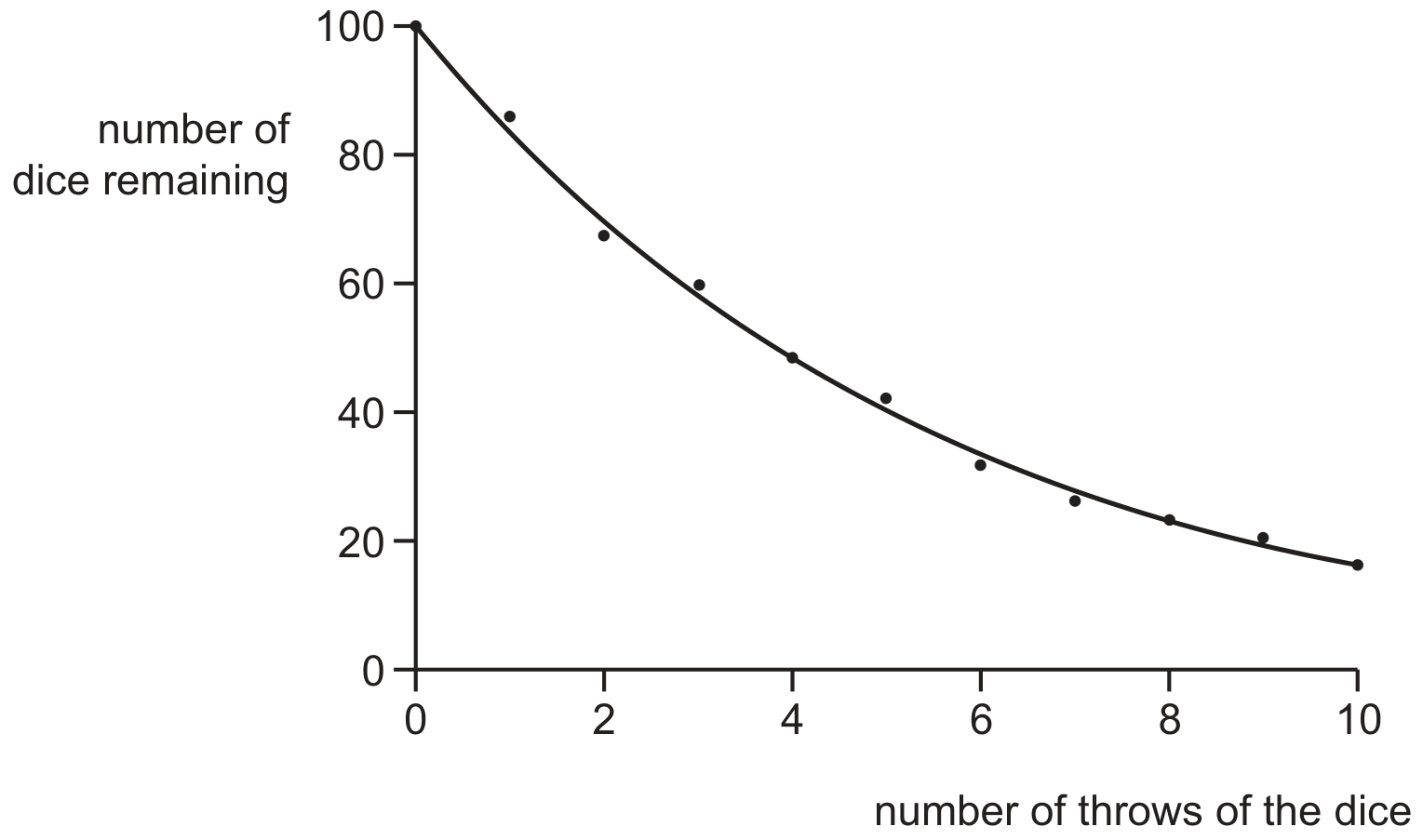
Question image

What could the scatter of points about the best-fit curve represent for actual radioactive decay?

A

background count not being taken into account

B

more than one type of radiation being present

C

the random nature of radioactive decay

D

the spontaneous nature of radioactive decay

(a)

β\beta-radiation is emitted during the spontaneous radioactive decay of an unstable nucleus.

[ 1 ]
(i)

Explain the meaning of spontaneous radioactive decay.

[ 1 ]
[Maximum number: 1]

Nuclear decay is both spontaneous and random in nature.
Which row gives the correct experimental evidence for these properties?

spontaneous nature of decay

random nature of decay

the decay rate is not affected by
pressure

the decay rate is not affected by
temperature

the decay rate is not affected by
pressure

the rate at which radiation is received
at a counter fluctuates

the decay rate is not affected by
temperature

the decay rate is not affected by
pressure

the rate at which radiation is received
at a counter fluctuates

the decay rate is not affected by
pressure

[Maximum number: 1]

A polonium nucleus 84210Po{ }_{84}^{210} \mathrm{Po} is radioactive and decays with the emission of an α\alpha-particle. The nuclear reaction for this decay is given by

84210PoXWQ+ZYα.{ }_{84}^{210} \mathrm{Po} \rightarrow{ }_{X}^{W} \mathrm{Q}+{ }_{Z}^{Y} \alpha .
(a)

The reaction is spontaneous. Explain the meaning of spontaneous.

[ 1 ]
[Maximum number: 1]

In a radioactive decay series, three successive decays each result in a particle being emitted.
The first decay results in the emission of a β\beta-particle. The second decay results in the emission of an α\alpha-particle. The third decay results in the emission of another β\beta-particle.

Question image

Nuclides P and S are compared.
Which statement is correct?

A

P and S are identical in all respects.

B

P and S are isotopes of the same element.

C

S is a different element of lower atomic number.

D

S is a different element of reduced mass.

[Maximum number: 1]

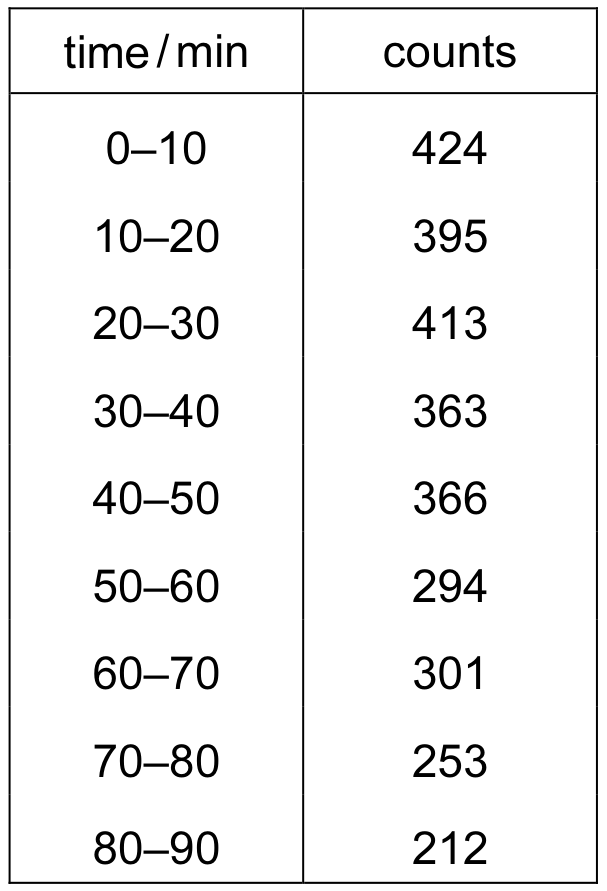
A counter recording radioactive decays from a radioactive source gives the following counts in equal intervals of time.

Table

What can be deduced from these readings?

A

that radioactivity is random and that the half-life is 90 minutes

B

that radioactivity is random and that the half-life is uncertain

C

that radioactivity is spontaneous and that the half-life is 90 minutes

D

that radioactivity is spontaneous and that the half-life is uncertain

[Maximum number: 5]

The element strontium has at least 16 isotopes. One of these isotopes is strontium-89. This isotope has a half-life of 52 days.

(a)

Calculate the probability per second of decay of a nucleus of strontium-89.

probability =

s1\mathrm{s}^{-1}

[ 3 ]
(b)

A laboratory prepares a strontium- 89 source.

The activity of this source is measured 21 days after preparation of the source and is found to be 7.4×10⁶ Bq7.4 \times 10^{6} \mathrm{~Bq}.

Determine, for the strontium-89 source at the time that it was prepared,

[ 2 ]
(i)

the activity,

activity =

Bq

[ 2 ]
(ii)

the mass of strontium-89.

Answer all the questions in the spaces provided.

[Maximum number: 6]

The power for a space probe is to be supplied by the energy released when plutonium- 236 decays by the emission of α\alpha-particles.

The α\alpha-particles, each of energy 5.75 MeV , are captured and their energy is converted into electrical energy with an efficiency of 24 %.

(a)

Calculate

[ 2 ]
(i)

the number of α\alpha-particles per second required to generate 1.9 kW of electrical power.
number per second =
s1[2]\mathrm{s}^{-1}[2]

[ 2 ]
(b)

Each plutonium-236 nucleus, on disintegration, produces one α\alpha-particle.

Plutonium- 236 has a half-life of 2.8 years.

[ 2 ]
(i)

Calculate the decay constant, in s1\mathrm{s}^{-1}, of plutonium-236.
decay constant =
s1[2]\mathrm{s}^{-1}[2]

[ 2 ]
(ii)

Use your answers in (a)(ii) and (b)(i) to determine the mass of plutonium-236 required for the generation of 1.9 kW of electrical power.

mass =
(c)

The minimum electrical power required for the space probe is 0.84 kW .

Calculate the time, in years, for which the sample of plutonium-236 in (b)(ii) will provide sufficient power.
time =
years [2]

Answer all the questions in the spaces provided.

[ 2 ]
(a)
(i)

State how the random nature of radioactive decay may be inferred from observations of the count rate.

[ 1 ]
(ii)

A radioactive source has a long half-life so that, over a period of several days, its rate of decay remains constant.
State the effect, if any, of a rise in temperature on this decay rate.

[ 1 ]
(a)
(i)

State what is meant by the decay constant of a radioactive isotope.

(ii)

Show that the decay constant λ\lambda and the half-life t12\frac{t_{1}}{2} of an isotope are related by the expression

λt12=0.693\lambda t_{\frac{1}{2}}=0.693
[ 3 ]
(b)

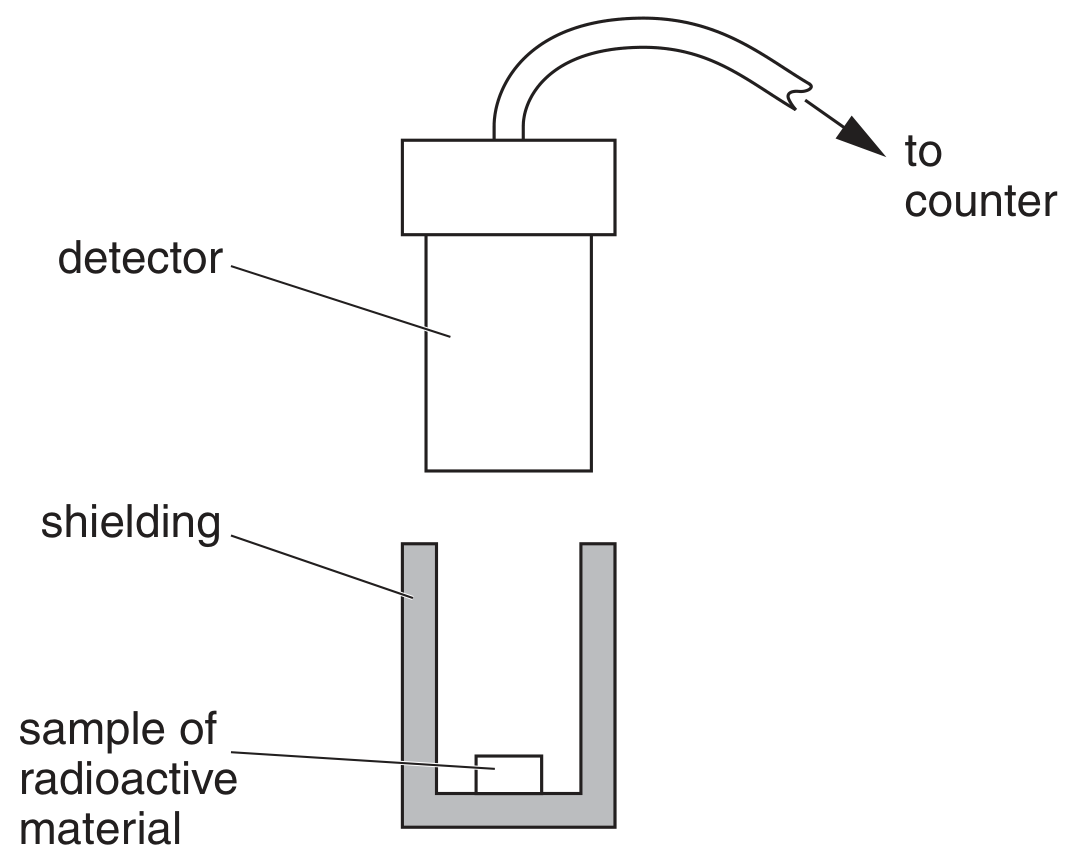
In order to determine the half-life of a sample of a radioactive isotope, a student measures the count rate near to the sample, as illustrated in Fig. 9.1.

Fig. 9.1

Fig. 9.1

Initially, the measured count rate is 538 per minute. After a time of 8.0 hours, the measured count rate is 228 per minute.

Use these data to estimate the half-life of the isotope.
half-life = hours

[ 3 ]
(c)

The accepted value of the half-life of the isotope in (b) is 5.8 hours. The difference between this value for the half-life and that calculated in (b) cannot be explained by reference to faulty equipment.

Suggest two possible reasons for this difference.
1
2.

Answer all the questions in the spaces provided.

[ 2 ]
0