EduNinja
[Maximum number: 6]

The photoelectric effect may be represented by the equation
photon energy = work function energy + maximum kinetic energy of electron.

(a)

State what is meant by work function energy.

[ 1 ]
(b)

The variation with frequency f of the maximum kinetic energy EKE_{\mathrm{K}} of photoelectrons emitted from the surface of sodium metal is shown in Fig. 7.1.
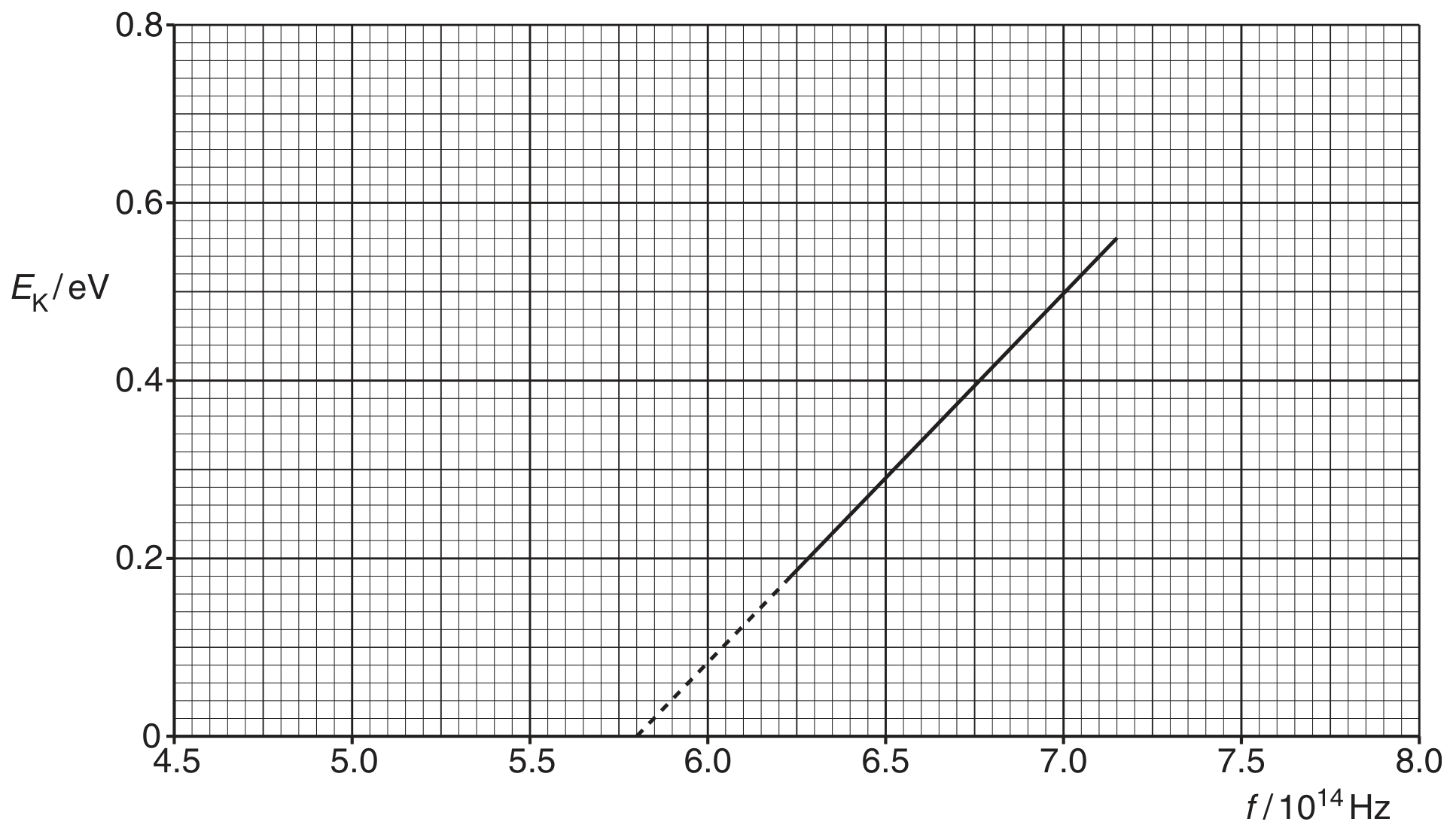
Fig. 7.1

Fig. 7.1

Use the gradient of the graph of Fig. 7.1 to determine a value for the Planck constant h. Show your working.
h= Js

[ 2 ]
(c)

The sodium metal in (b) has a work function energy of 2.4 eV . The sodium is replaced by calcium which has a work function energy of 2.9 eV .

On Fig. 7.1, draw a line to show the variation with frequency f of the maximum kinetic energy EKE_{\mathrm{K}} of photoelectrons emitted from the surface of calcium.

[ 3 ]
[Maximum number: 8]

For a particular metal surface, it is observed that there is a minimum frequency of light below which photoelectric emission does not occur. This observation provides evidence for a particulate nature of electromagnetic radiation.

(a)

State three further observations from photoelectric emission that provide evidence for a particulate nature of electromagnetic radiation.
1.
2.
3.

[ 3 ]
(b)

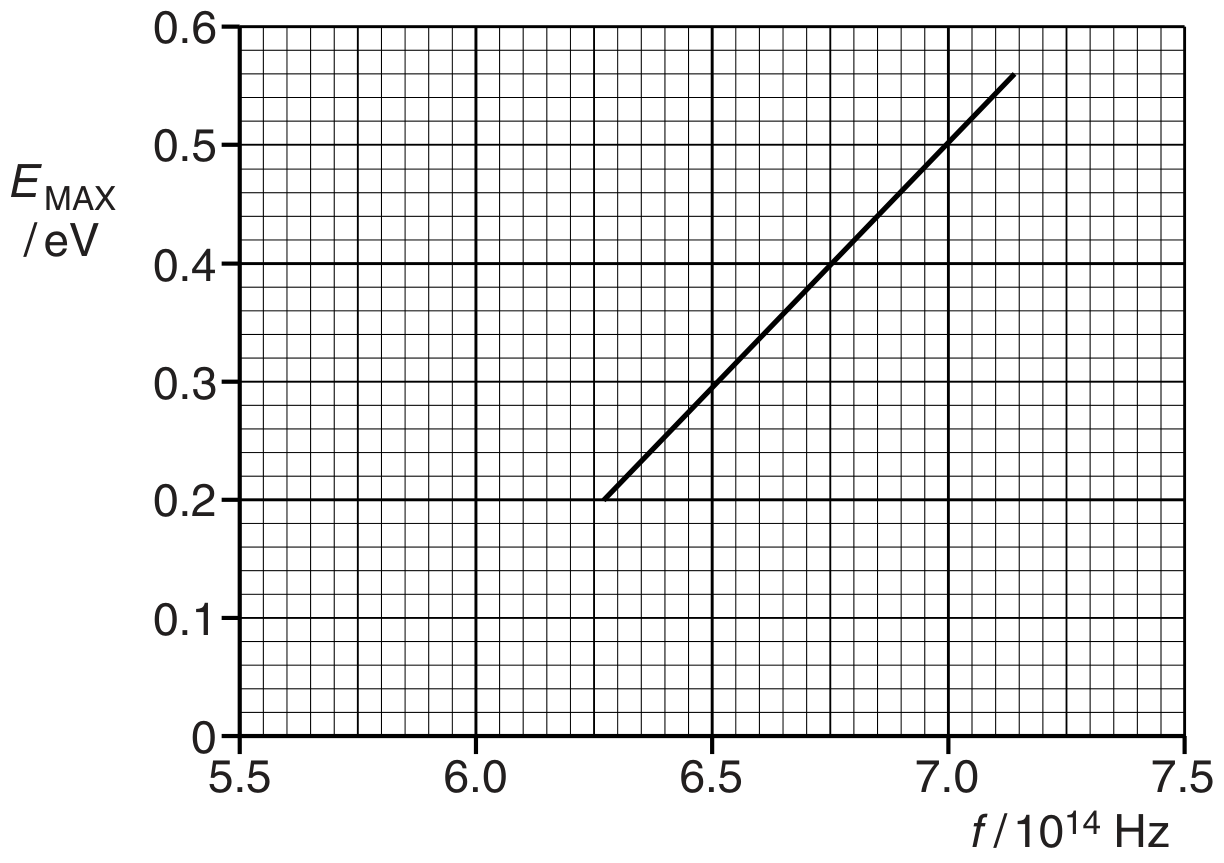
Some data for the variation with frequency f of the maximum kinetic energy EMAXE_{\mathrm{MAX}} of electrons emitted from a metal surface are shown in Fig. 9.1.

Fig. 9.1

Fig. 9.1

[ 5 ]
(i)

Explain why emitted electrons may have kinetic energy less than the maximum at any particular frequency.

[ 2 ]
(ii)

Use Fig.9.1 to determine
1. the threshold frequency,

Question image

2. the work function energy, in eV, of the metal surface.
work function energy = eV

[ 3 ]
[Maximum number: 9]

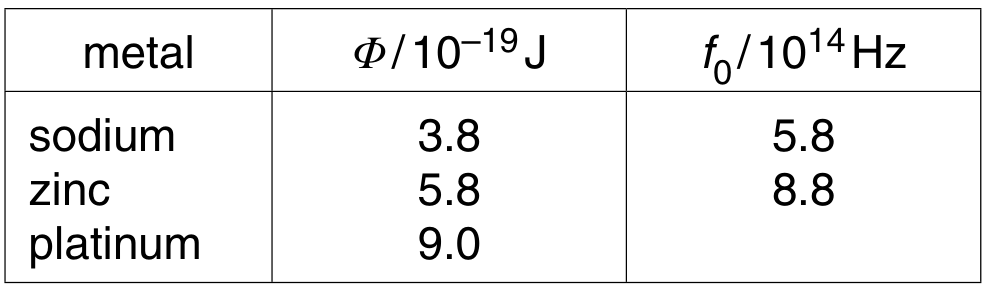
Some data for the work function energy Φ\Phi and the threshold frequency f0f_{0} of some metal surfaces are given in Fig. 7.1.

Fig. 7.1

Fig. 7.1

(a)
(i)

State what is meant by the threshold frequency.

[ 2 ]
(ii)

Calculate the threshold frequency for platinum.
threshold frequency = Hz

[ 2 ]
(b)

Electromagnetic radiation having a continuous spectrum of wavelengths between 300 nm and 600 nm is incident, in turn, on each of the metals listed in Fig. 7.1.
Determine which metals, if any, will give rise to the emission of electrons.

[ 2 ]
(c)

When light of a particular intensity and frequency is incident on a metal surface, electrons are emitted.
State and explain the effect, if any, on the rate of emission of electrons from this surface for light of the same intensity and higher frequency.

[ 3 ]
[Maximum number: 9]

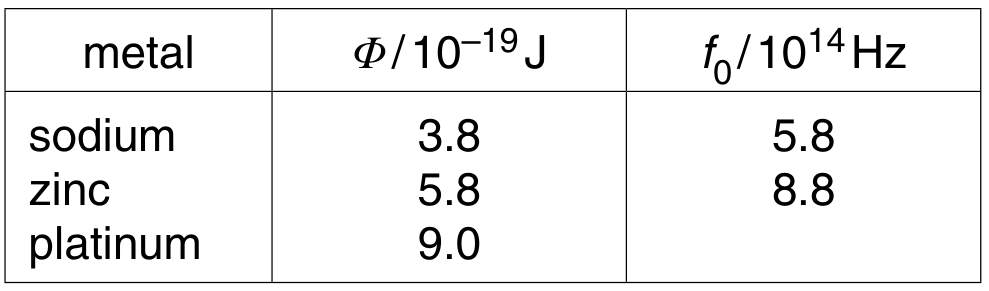
Some data for the work function energy Φ\Phi and the threshold frequency f0f_{0} of some metal surfaces are given in Fig. 7.1.

Fig. 7.1

Fig. 7.1

(a)
(i)

State what is meant by the threshold frequency.

[ 2 ]
(ii)

Calculate the threshold frequency for platinum.
threshold frequency = Hz

[ 2 ]
(b)

Electromagnetic radiation having a continuous spectrum of wavelengths between 300 nm and 600 nm is incident, in turn, on each of the metals listed in Fig. 7.1.
Determine which metals, if any, will give rise to the emission of electrons.

[ 2 ]
(c)

When light of a particular intensity and frequency is incident on a metal surface, electrons are emitted.
State and explain the effect, if any, on the rate of emission of electrons from this surface for light of the same intensity and higher frequency.

[ 3 ]
(a)

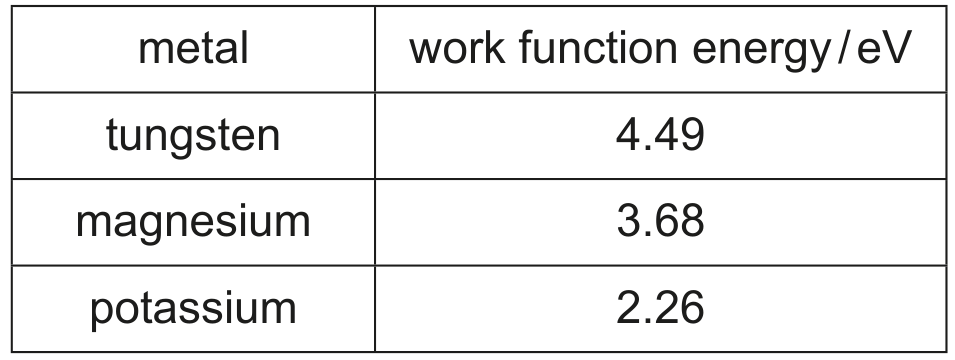
Light of a single wavelength is incident on the surface of different metals. The work function energy of the metals is given in Table 7.1.

Table 7.1

Table 7.1

[ 3 ]
(i)

Explain the term threshold wavelength.

[ 1 ]
(ii)

For the metals in Table 7.1, calculate the value of the largest threshold wavelength.
threshold wavelength = m

[ 2 ]
[Maximum number: 11]

Experiments are conducted to investigate the photoelectric effect.

(a)

It is found that, on exposure of a metal surface to light, either electrons are emitted immediately or they are not emitted at all.

Suggest why this observation does not support a wave theory of light.

[ 3 ]
(b)

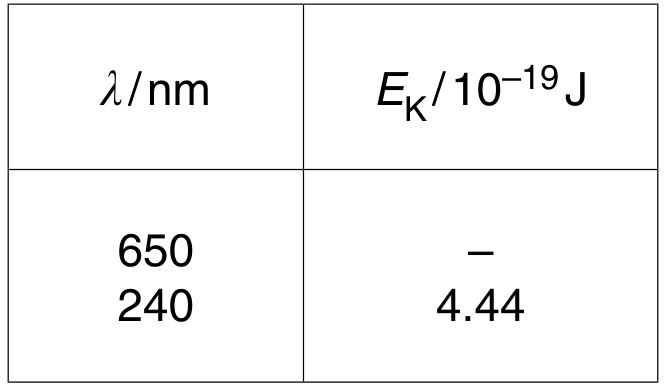
Data for the wavelength λ\lambda of the radiation incident on the metal surface and the maximum kinetic energy EKE_{\mathrm{K}} of the emitted electrons are shown in Fig. 7.1.

Fig. 7.1

Fig. 7.1

[ 4 ]
(i)

Without any calculation, suggest why no value is given for EKE_{\mathrm{K}} for radiation of wavelength 650 nm .

[ 1 ]
(ii)

Use data from Fig. 7.1 to determine the work function energy of the surface.
work function energy = J

[ 3 ]
(c)

Radiation of wavelength 240 nm gives rise to a maximum photoelectric current I. The intensity of the incident radiation is maintained constant and the wavelength is now reduced.

State and explain the effect of this change on

[ 4 ]
(i)

the maximum kinetic energy of the photoelectrons,

[ 2 ]
(ii)

the maximum photoelectric current I.

[ 2 ]
[Maximum number: 2]

Fig. 8.1 shows part of the emission spectrum of visible radiation emitted by hydrogen gas in a star in a distant galaxy.

Fig. 8.1

Fig. 8.1

The galaxy is moving away from the Earth at a speed of 6.2×10⁶ ms16.2 \times 10^{6} \mathrm{~ms}^{-1}

(a)
(i)

(i)Calculate the energy of a photon of this radiation.

photon energy =J [2]
[ 2 ]
(a)

It has been observed that, where photoelectric emission of electrons takes place, there is negligible time delay between illumination of the surface and emission of an electron.

State three other pieces of evidence provided by the photoelectric effect for the particulate nature of electromagnetic radiation.
1.
2.

[ 3 ]
(b)

The work function of a metal surface is 3.5 eV . Light of wavelength 450 nm is incident on the surface.
Determine whether electrons will be emitted, by the photoelectric effect, from the surface.

Please turn over for Section B.

Answer all the questions in the spaces provided.

[ 3 ]
[Maximum number: 6]

An explanation of the photoelectric effect includes the terms photon energy and work function energy.

(a)

Explain what is meant by

[ 1 ]
(i)

work function energy.

[ 1 ]
(b)

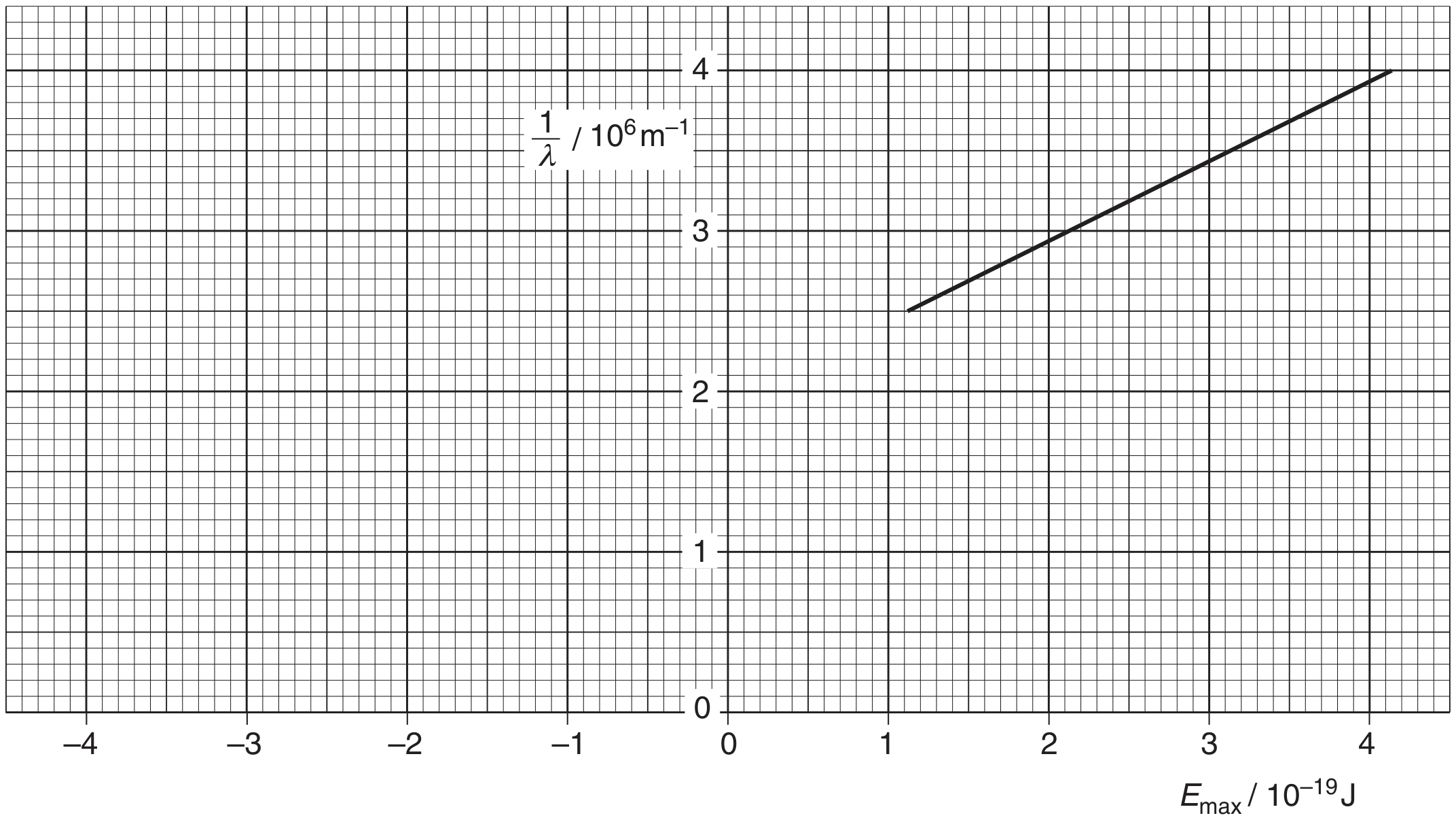
In an experiment to investigate the photoelectric effect, a student measures the wavelength λ\lambda of the light incident on a metal surface and the maximum kinetic energy EmaxE_{\max } of the emitted electrons. The variation with EmaxE_{\max } of 1λ\frac{1}{\lambda} is shown in Fig. 7.1.

Fig. 7.1

Fig. 7.1

[ 5 ]
(i)

The work function energy of the metal surface is Φ\Phi.

State an equation, in terms of λ,Φ\lambda, \Phi and Emax E_{\text {max }}, to represent conservation of energy for the photoelectric effect. Explain any other symbols you use.

[ 2 ]
(ii)

Use your answer in (i) and Fig. 7.1 to determine
1. the work function energy Φ\Phi of the metal surface,
2. a value for the Planck constant.

Planck constant = Js

[ 3 ]
(a)

Describe two phenomena associated with the photoelectric effect that cannot be explained using a wave theory of light.

1
2

[ 2 ]
(b)

The maximum energy Emax E_{\text {max }} of electrons emitted from a metal surface when illuminated by light of wavelength λ\lambda is given by the expression

Emax=hc(1λ1λ0)E_{\max }=h c\left(\frac{1}{\lambda}-\frac{1}{\lambda_{0}}\right)

where h is the Planck constant and c is the speed of light.

[ 5 ]
(i)

Identify the symbol λ0\lambda_{0}.

[ 1 ]
(ii)

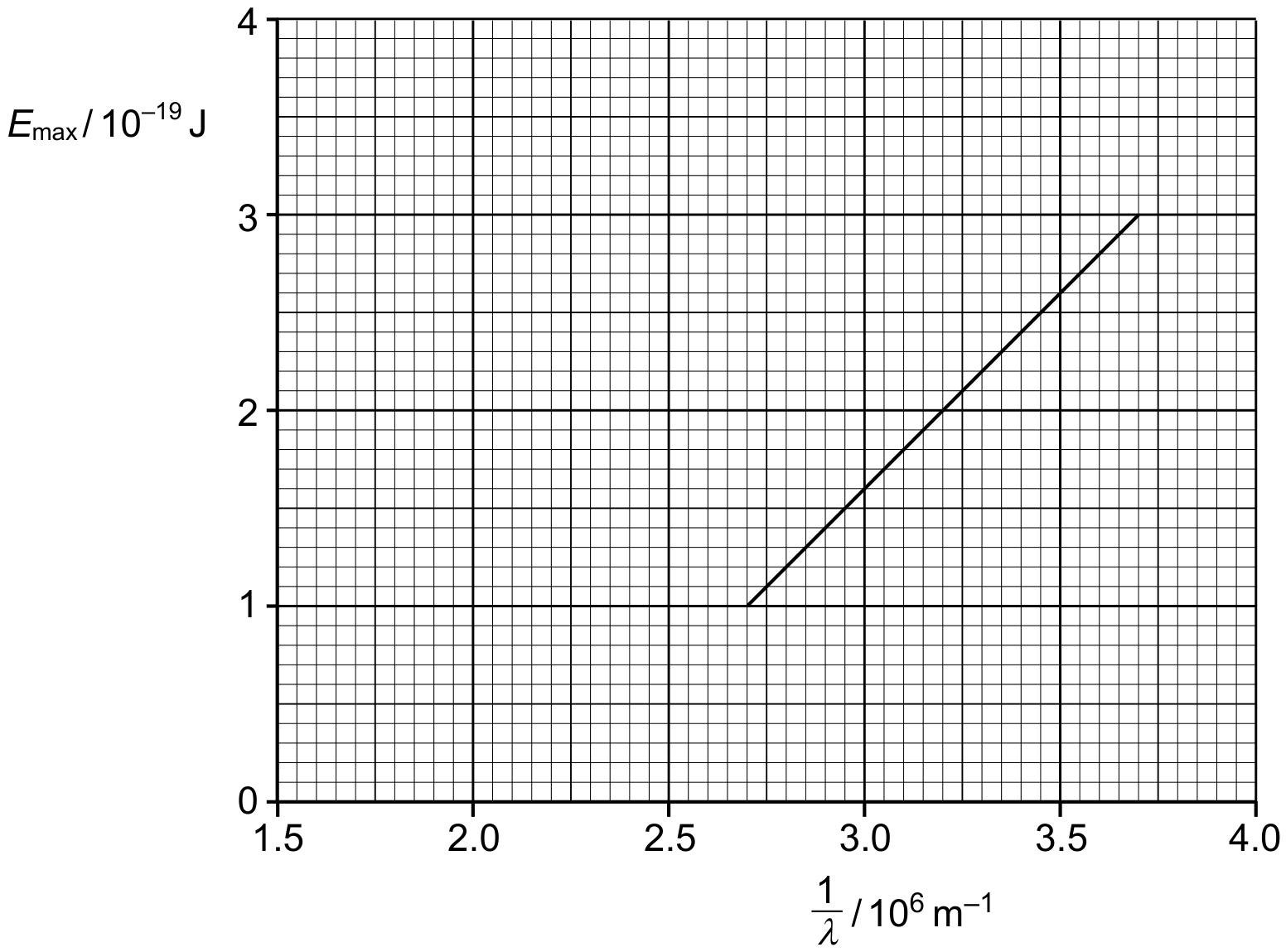
The variation with 1λ\frac{1}{\lambda} of EmaxE_{\max } for the metal surface is shown in Fig. 8.1.

Fig. 8.1

Fig. 8.1

Use Fig. 8.1 to determine the magnitude of λ0\lambda_{0}.

λ0=\lambda_{0}=
[ 2 ]
(iii)

Use the gradient of Fig. 8.1 to determine a value for the Planck constant h. Show your working.

h=
[ 2 ]
(c)

The metal surface in (b) becomes oxidised.

Photoelectric emission is still observed but the work function energy is increased.

On Fig. 8.1, draw a line to show the variation with 1λ\frac{1}{\lambda} of EmaxE_{\max } for the oxidised surface.

[ 2 ]
0