
EduNinja
[Maximum number: 5]

The planet Mars may be considered to be an isolated sphere of diameter 6.79×10⁶ m6.79 \times 10^{6} \mathrm{~m} with its mass of 6.42×10²³ kg6.42 \times 10^{23} \mathrm{~kg} concentrated at its centre.
A rock of mass 1.40 kg rests on the surface of Mars.
For this rock,

(a)

The mean translational kinetic energy <EK><E_{\mathrm{K}}> of a molecule of an ideal gas is given by the expression

<EK>=32kT<E_{\mathrm{K}}>=\frac{3}{2} k T

where T is the thermodynamic temperature of the gas and k is the Boltzmann constant.

[ 5 ]
(i)

Determine the temperature at which the root-mean-square (r.m.s.) speed of hydrogen molecules is equal to the speed calculated in (b).
Hydrogen may be assumed to be an ideal gas.
A molecule of hydrogen has a mass of 2 u .
temperature =

[ 3 ]
(ii)

State and explain one reason why hydrogen molecules may escape from Mars at temperatures below that calculated in (i).

[ 2 ]
[Maximum number: 2]

An ideal gas has volume V and pressure p. For this gas, the product p V is given by the expression

pV=13Nm<c2>p V=\frac{1}{3} N m<c^{2}>

where m is the mass of a molecule of the gas.

(a)

State the meaning of the symbol

[ 2 ]
(i)

N,

[ 1 ]
(ii)

c2\left\langle c^{2}\right\rangle.

[ 1 ]
(b)

A gas cylinder of volume 2.1×104 cm32.1 \times 10^{4} \mathrm{~cm}^{3} contains helium-4 gas at pressure 6.1×10⁵ Pa6.1 \times 10^{5} \mathrm{~Pa} and temperature 12C12^{\circ} \mathrm{C}. Helium-4 may be assumed to be an ideal gas.

(i)

Calculate the root-mean-square (r.m.s.) speed of the helium atoms.

(a)
(i)

Explain why, for an ideal gas, the internal energy is equal to the total kinetic energy of the molecules of the gas.

[ 2 ]
(b)

The mean kinetic energy <EK><E_{\mathrm{K}}> of a molecule of an ideal gas is given by the expression

<EK>=32kT<E_{\mathrm{K}}>=\frac{3}{2} k T

where k is the Boltzmann constant and T is the thermodynamic temperature of the gas.
A cylinder contains 1.0 mol of an ideal gas. The gas is heated so that its temperature changes from 280 K to 460 K .

[ 2 ]
(i)

Calculate the change in total kinetic energy of the gas molecules.
change in energy = J

[ 2 ]
[Maximum number: 3]

+w.

(a)

Argon-40 (1840Ar)\left({ }_{18}^{40} \mathrm{Ar}\right) may be assumed to be an ideal gas.

A mass of 3.2 g of argon- 40 has a volume of 210 cm3210 \mathrm{~cm}^{3} at a temperature of 37C37^{\circ} \mathrm{C}.
Determine, for this mass of argon-40 gas,

[ 3 ]
(i)

the root-mean-square (r.m.s.) speed of an argon atom.
r.m.s. speed = ms1\mathrm{ms}^{-1}

[ 3 ]
[Maximum number: 7]

electric potential energy.
energy = J

(a)

The pressure p of an ideal gas is given by the expression

p=13ρ<c2>p=\frac{1}{3} \rho<c^{2}>

where ρ\rho is the density of the gas.

[ 5 ]
(i)

State the meaning of the symbol c2\left\langle c^{2}\right\rangle.

[ 1 ]
(ii)

Use the expression to show that the mean kinetic energy <EK><E_{\mathrm{K}}> of the atoms of an ideal gas is given by the expression

<EK>=32kT<E_{\mathrm{K}}>=\frac{3}{2} k T

Explain any symbols that you use.

[ 4 ]
(b)

Helium-4 may be assumed to behave as an ideal gas.

A cylinder has a constant volume of 7.8×103 cm37.8 \times 10^{3} \mathrm{~cm}^{3} and contains helium-4 gas at a pressure of 2.1×10⁷ Pa2.1 \times 10^{7} \mathrm{~Pa} and at a temperature of 290 K .

Calculate, for the helium gas,

[ 2 ]
(i)

the mean kinetic energy of the atoms,
mean kinetic energy = J

[ 2 ]
[Maximum number: 5]

the period of Deimos in its orbit about Mars.
period = hours

(a)

One assumption of the kinetic theory of gases is that gas molecules behave as if they are hard, elastic identical spheres.

State two other assumptions of the kinetic theory of gases.
1.
2.

[ 2 ]
(b)

Using the kinetic theory of gases, it can be shown that the product of the pressure p and the volume V of an ideal gas is given by the expression

pV=13Nmc2p V=\frac{1}{3} N m\left\langle c^{2}\right\rangle

where m is the mass of a gas molecule.

[ 3 ]
(i)

State the meaning of the symbol
1. N,
2. c2\left\langle c^{2}\right\rangle.

[ 1 ]
(ii)

Use the expression to deduce that the mean kinetic energy <EK><E_{\mathrm{K}}> of a gas molecule at temperature T is given by the equation

<EK>=32kT<E_{\mathrm{K}}>=\frac{3}{2} k T

where k is a constant.

[ 2 ]
(a)

The kinetic theory of gases is based on some simplifying assumptions. The molecules of the gas are assumed to behave as hard elastic identical spheres. State the assumption about ideal gas molecules based on

[ 3 ]
(i)

the nature of their movement,

[ 1 ]
(ii)

their volume.

[ 2 ]
(b)

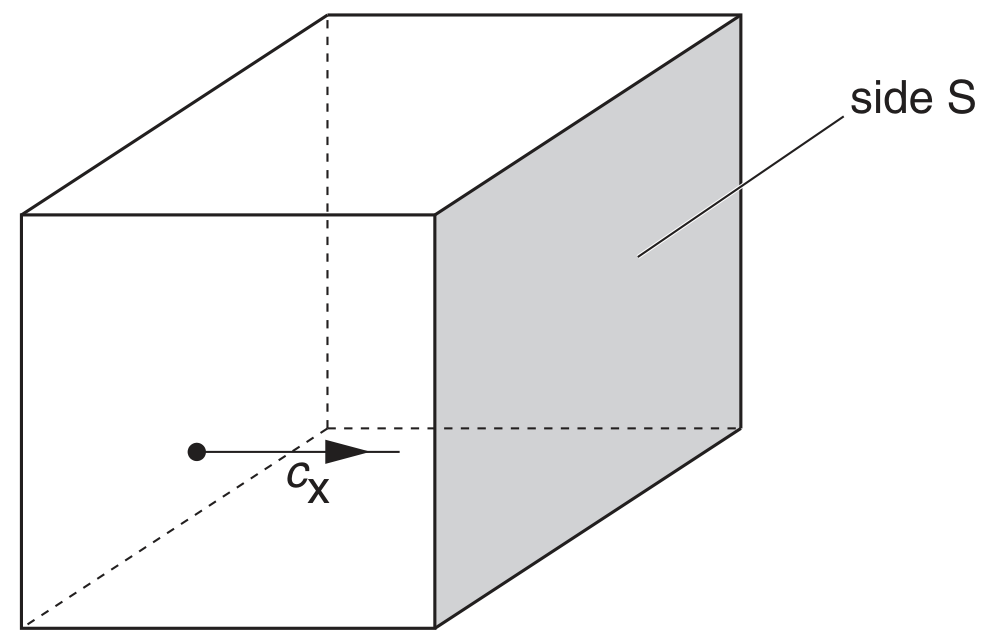
A cube of volume V contains N molecules of an ideal gas. Each molecule has a component cXc_{\mathrm{X}} of velocity normal to one side S of the cube, as shown in Fig. 2.1.

Fig. 2.1

Fig. 2.1

The pressure p of the gas due to the component cXc_{X} of velocity is given by the expression

pV=Nmcx2p V=N m c_{x}^{2}

where m is the mass of a molecule.
Explain how the expression leads to the relation

pV=13Nm<c2>p V=\frac{1}{3} N m<c^{2}>

where <c2><c^{2}> is the mean square speed of the molecules.

[ 3 ]
(c)

The molecules of an ideal gas have a root-mean-square (r.m.s.) speed of 520 m s1520 \mathrm{~m} \mathrm{~s}^{-1} at a temperature of 27C27^{\circ} \mathrm{C}.

Calculate the r.m.s. speed of the molecules at a temperature of 100C100^{\circ} \mathrm{C}.

[ 3 ]
[Maximum number: 4]

In a sample of gas at room temperature, five atoms have the following speeds:

1.32×10³ m s11.50×103 m s11.46×103 m s11.28×103 m s11.64×103 ms1\begin{aligned} & 1.32 \times 10^{3} \mathrm{~m} \mathrm{~s}^{-1} \\ & 1.50 \times 10^{3} \mathrm{~m} \mathrm{~s}^{-1} \\ & 1.46 \times 10^{3} \mathrm{~m} \mathrm{~s}^{-1} \\ & 1.28 \times 10^{3} \mathrm{~m} \mathrm{~s}^{-1} \\ & 1.64 \times 10^{3} \mathrm{~ms}^{-1} \end{aligned}

For these five atoms, calculate, to three significant figures,

(a)

the mean speed,
mean speed = ms1[1]\mathrm{ms}^{-1}[1]

[ 1 ]
(b)

the mean-square speed,
mean-square speed = m2 s2[2]\mathrm{m}^{2} \mathrm{~s}^{-2}[2]

[ 2 ]
(c)

the root-mean-square speed.
root-mean-square speed = ms1[1]\mathrm{ms}^{-1}[1]

[ 1 ]
[Maximum number: 3]

A student suggests that, when an ideal gas is heated from 100C100^{\circ} \mathrm{C} to 200C200^{\circ} \mathrm{C}, the internal energy of the gas is doubled.

(a)
(i)

By reference to one of the assumptions of the kinetic theory of gases and your answer in (i), deduce what is meant by the internal energy of an ideal gas.

[ 3 ]
[Maximum number: 3]

The product of the pressure p and the volume V of an ideal gas is given by the expression

pV=13Nm<c2>p V=\frac{1}{3} N m<c^{2}>

where m is the mass of one molecule of the gas.

(a)

State the meaning of the symbol

[ 1 ]
(i)

c2\left\langle c^{2}\right\rangle.

[ 1 ]
(b)

The product p V is also given by the expression

p V=N k T.

Deduce an expression, in terms of the Boltzmann constant k and the thermodynamic temperature T, for the mean kinetic energy of a molecule of the ideal gas.

[ 2 ]
0