EduNinja
(a)

Chloride ions can be identified using aqueous silver nitrate, AgNO3(aq)\mathrm{AgNO}_{3}(\mathrm{aq}).

Ag+(aq)+Cl(aq)AgCl( s)\mathrm{Ag}^{+}(\mathrm{aq})+\mathrm{Cl}^{-}(\mathrm{aq}) \rightarrow \mathrm{AgCl}(\mathrm{~s})

0.303 g of a chloride of sulfur is completely hydrolysed with water. All the chlorine atoms present in the chloride of sulfur are converted into chloride ions. The solution is diluted to 100.0 cm3100.0 \mathrm{~cm}^{3}.
A 25.00 cm325.00 \mathrm{~cm}^{3} sample of this solution is titrated with 0.0500 moldm3AgNO3(aq)0.0500 \mathrm{~mol} \mathrm{dm}^{-3} \mathrm{AgNO}_{3}(\mathrm{aq}). The titration requires 22.40 cm322.40 \mathrm{~cm}^{3} of 0.0500 moldm3AgNO3(aq)0.0500 \mathrm{~mol} \mathrm{dm}^{-3} \mathrm{AgNO}_{3}(\mathrm{aq}).

Calculate the empirical formula of the chloride of sulfur. Show all your working.

[ 3 ]
[Maximum number: 3]

The model of the nuclear atom was first proposed by Ernest Rutherford. He developed this model on the basis of results obtained from an experiment using gold metal foil.

(a)

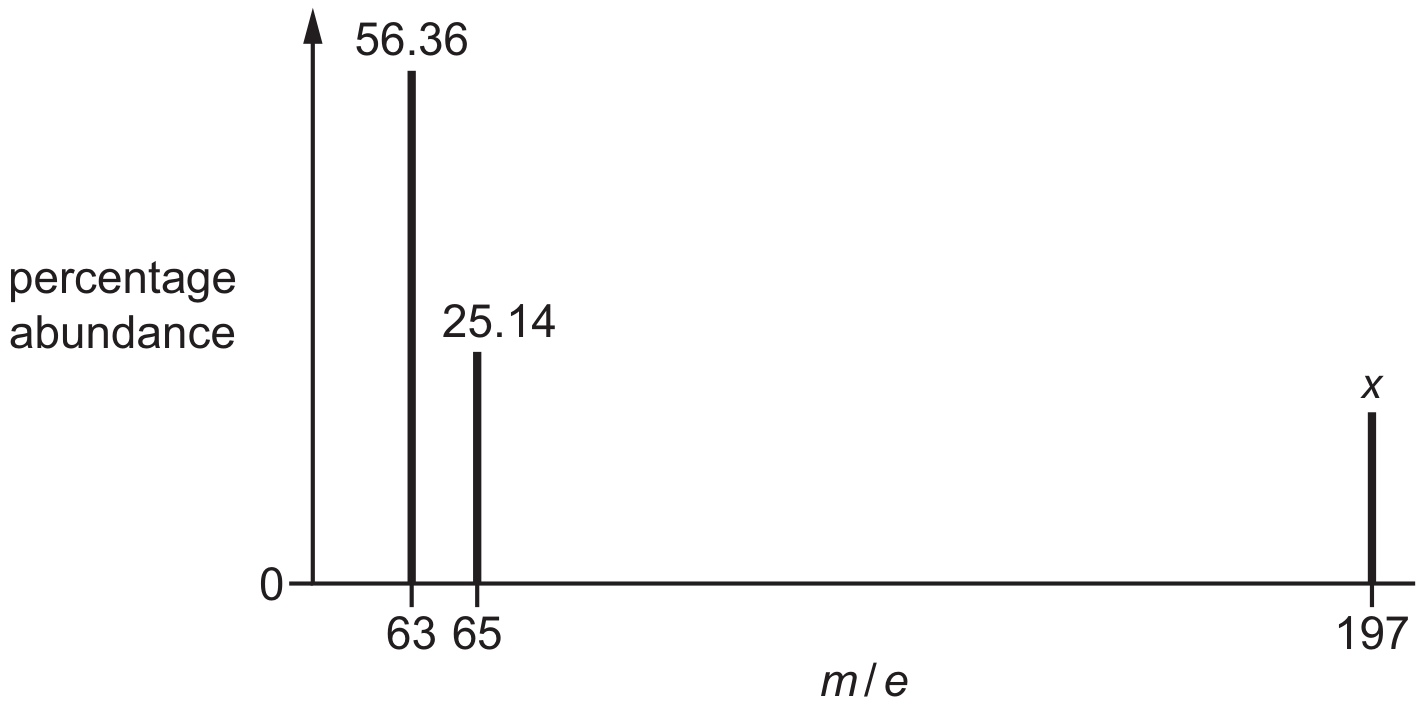
Tumbaga is an alloy of copper and gold. A sample of tumbaga was analysed. The mass spectrum of the sample is shown.

Question image
[ 3 ]
(i)

Calculate the percentage abundance of gold, x, in the sample of tumbaga.

x= % [1] \begin{aligned} & x= \\ & \text { \% [1] } \end{aligned}
[ 1 ]
(ii)

Calculate the relative atomic mass, ArA_{r}, of the copper present in this sample.

Give your answer to two decimal places.

Ar(Cu)=A_{r}(\mathrm{Cu})=
[ 2 ]
[Maximum number: 2]

Gallium is an element in Group 13.
A sample of gallium is analysed using a mass spectrometer. The mass spectrum produced is shown.

Question image
(a)

Calculate the relative atomic mass of gallium in this sample. Give your answer to 4 significant figures.

Show your working.
relative atomic mass =

[ 2 ]
(a)

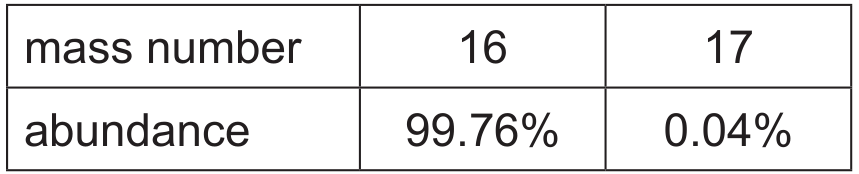
A sample of oxygen exists as a mixture of three isotopes. Information about two of these isotopes is given in the table.

Table
[ 1 ]
(i)

Calculate the abundance of the third isotope.
abundance = \%

[ 1 ]
(ii)

The relative atomic mass of this sample of oxygen is 16.0044 .

Calculate the mass number of the third isotope. You must show your working.

mass number =
(a)

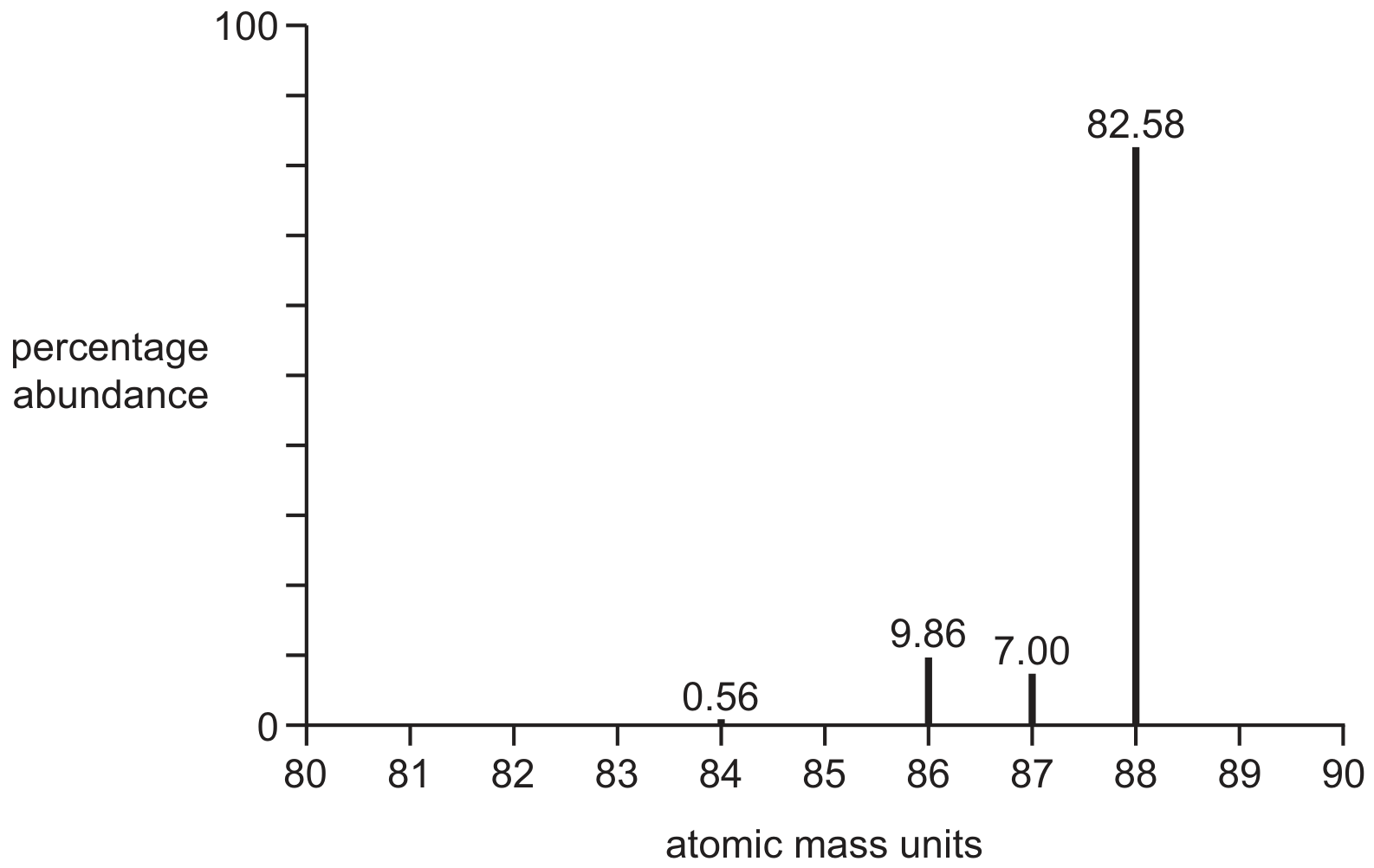
The relative atomic mass of an element can be determined using data from its mass spectrum.

The mass spectrum of element X is shown, with the percentage abundance of each isotope labelled.

Question image
[ 2 ]
(i)

Use the data in the mass spectrum to calculate the relative atomic mass, ArA_{\mathrm{r}}, of X. Give your answer to two decimal places and suggest the identity of X.
ArA_{r} of X identity of X

[ 2 ]
(a)

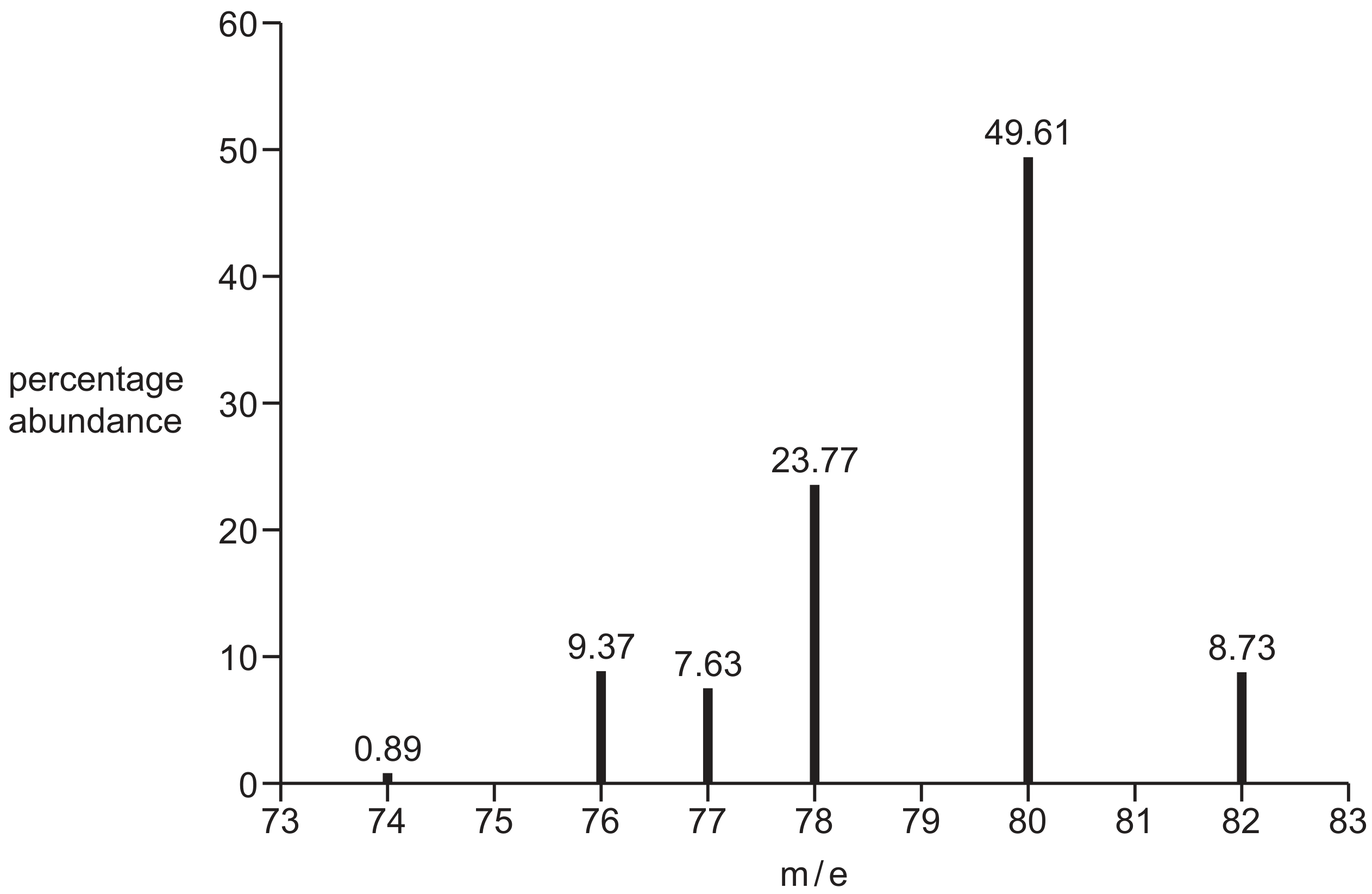
A sample of strontium, atomic number 38, gave the mass spectrum shown. The percentage abundances are given above each peak.

Question image
[ 1 ]
(i)

Explain why there are four different peaks in the mass spectrum of strontium.

[ 1 ]
(a)

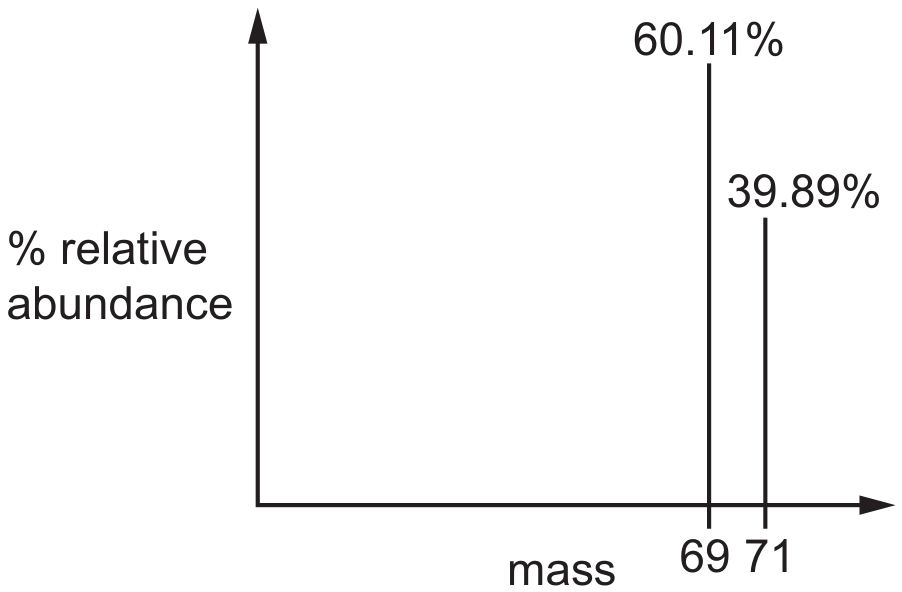
Bromine exists naturally as a mixture of two stable isotopes, 79Br{ }^{79} \mathrm{Br} and 81Br{ }^{81} \mathrm{Br}, with relative isotopic masses of 78.92 and 80.92 respectively.

[ 3 ]
(i)

Using the relative atomic mass of bromine, 79.90, calculate the relative isotopic abundances of 79Br{ }^{79} \mathrm{Br} and 81Br{ }^{81} \mathrm{Br}.

[ 3 ]
[Maximum number: 1]

Copper is used in electrical equipment. It has a melting point of 1085C1085^{\circ} \mathrm{C}.

(a)

The relative isotopic masses and natural abundances of the two isotopes in a sample of copper are shown in Table 1.1.

Table 1.1

Table 1.1

(i)

Calculate the relative atomic mass, ArA_{\mathrm{r}}, of copper in this sample using the data in Table 1.1.

Show your working.

Ar=A_{r}=
(b)

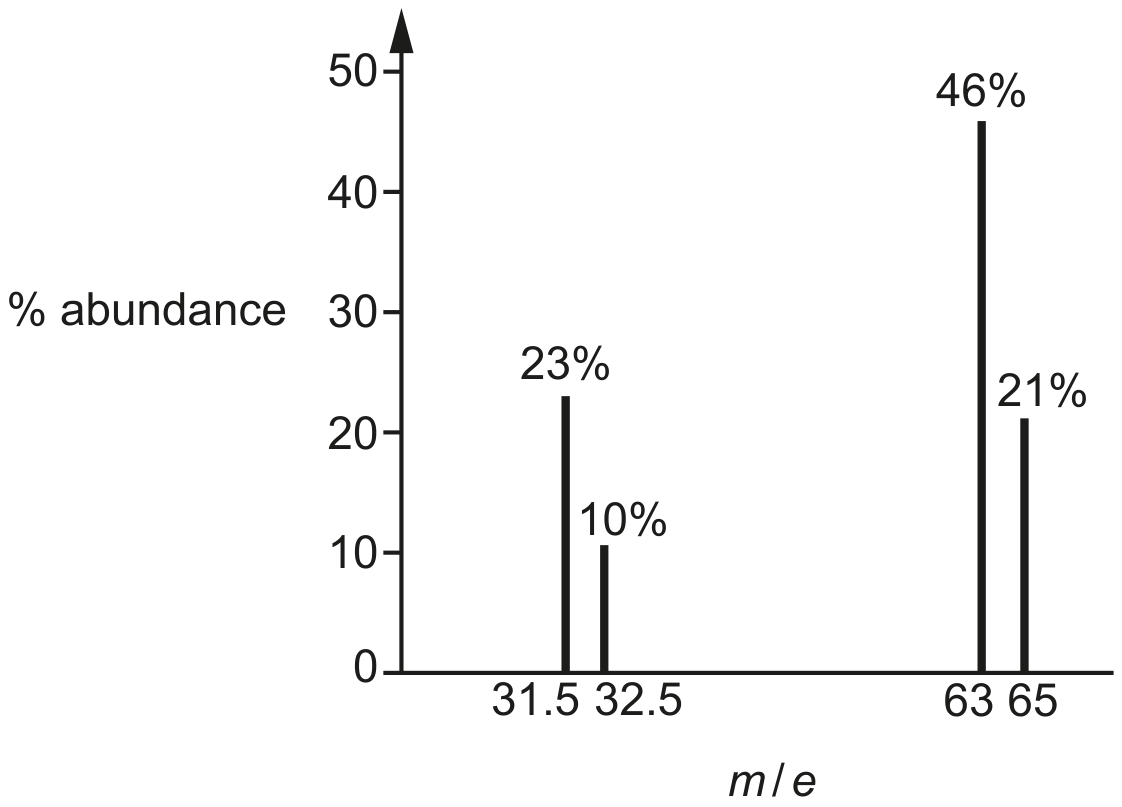
The mass spectrum of a sample of pure copper is shown in Fig. 1.1.

Fig. 1.1

Fig. 1.1

Identify the ion with an abundance of 23 % in the sample.

[ 1 ]
(a)

The number of moles of water of crystallisation in a hydrated ionic salt can be determined by titration using aqueous EDTA 4{ }^{4-} ions with a suitable indicator.
- 0.255 g of hydrated chromium(III) sulfate, Cr2(SO4)3nH2O\mathrm{Cr}_{2}\left(\mathrm{SO}_{4}\right)_{3} \cdot n \mathrm{H}_{2} \mathrm{O}, is dissolved in water and made up to 100 cm3100 \mathrm{~cm}^{3} in a volumetric flask.
- 25.0 cm325.0 \mathrm{~cm}^{3} of this solution requires 26.2 cm326.2 \mathrm{~cm}^{3} of 0.00800moldm30.00800 \mathrm{moldm}^{-3} aqueous EDTA 4{ }^{4-} ions to reach the end-point.

The reaction occurs as shown.

[Cr(H2O)6]3++ EDTA 4[CrEDTA]+6H2O\left[\mathrm{Cr}\left(\mathrm{H}_{2} \mathrm{O}\right)_{6}\right]^{3+}+\text { EDTA }^{4-} \rightarrow[\mathrm{CrEDTA}]^{-}+6 \mathrm{H}_{2} \mathrm{O}

Use the data to calculate the value of n in the formula of Cr2(SO4)3nH2O\mathrm{Cr}_{2}\left(\mathrm{SO}_{4}\right)_{3} \cdot n \mathrm{H}_{2} \mathrm{O}.
Show your working.

n=
[ 3 ]
[Maximum number: 4]

paper chromatography,

(a)

Chlorine exists naturally as a mixture of two isotopes, 35Cl{ }^{35} \mathrm{Cl} and 37Cl{ }^{37} \mathrm{Cl}, in the abundance ratio of 3: 1.
The mass spectrum of chlorine consists of five peaks.

[ 4 ]
(i)

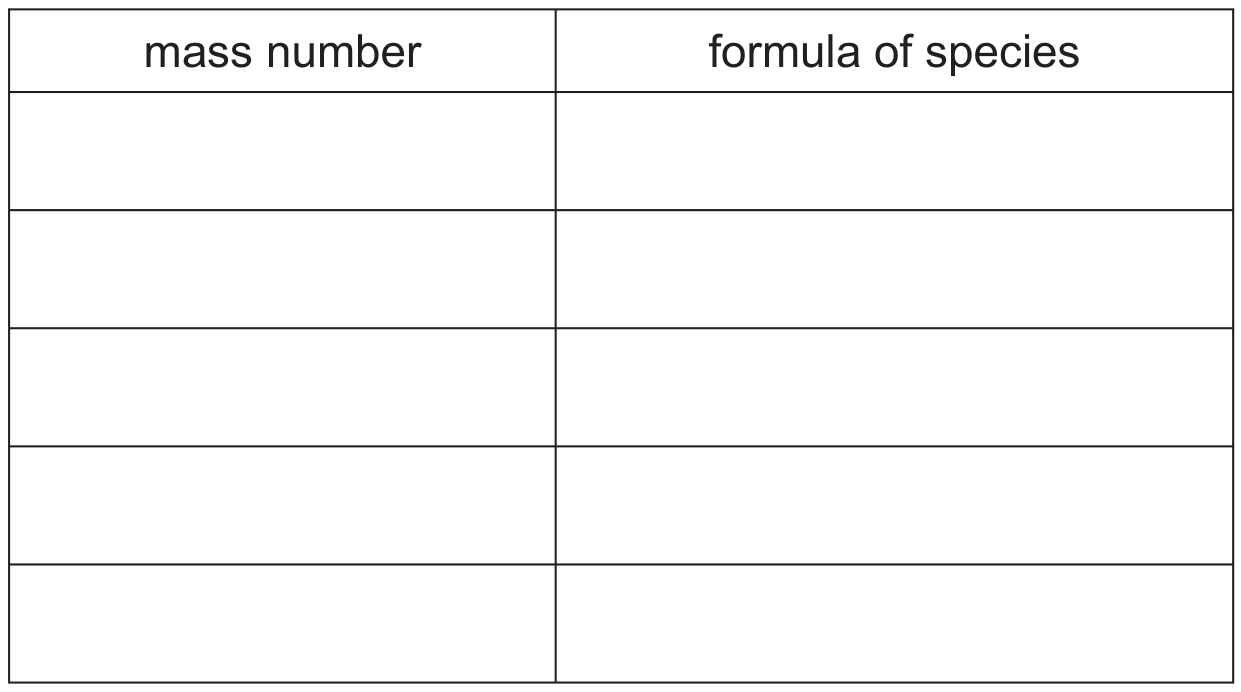
Suggest the mass numbers for these five peaks and the identities of the species responsible.

Table
(ii)

Predict the ratios of the abundances of the three species with the highest mass numbers.

ratio of abundances =
[ 4 ]
0