EduNinja
[Maximum number: 2]

The elements phosphorus, sulfur and chlorine are in Period 3 of the Periodic Table.

Table 1.1 shows some properties of the elements P to Cl .
The first ionisation energy of S is not shown.
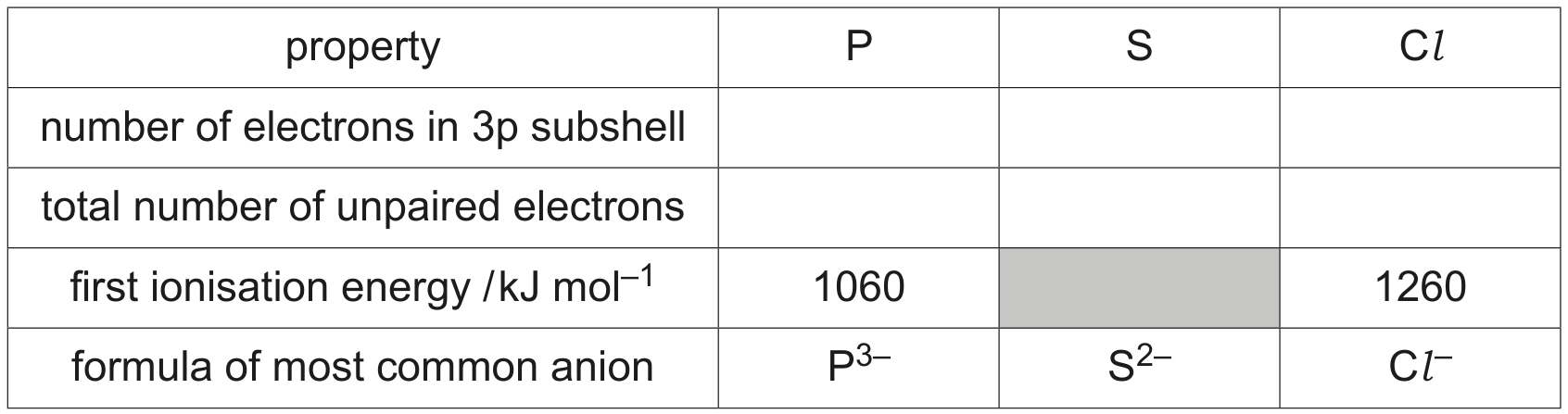
Table 1.1

Table 1.1

(a)

POCl3\mathrm{POCl}_{3} shows similar chemical properties to PCl5\mathrm{PCl}_{5}.
POCl3\mathrm{POCl}_{3} has a melting point of 1C1^{\circ} \mathrm{C} and a boiling point of 106C106^{\circ} \mathrm{C}.
POCl3\mathrm{POCl}_{3} reacts vigorously with water, forming misty fumes and an acidic solution.

[ 2 ]
(i)

Explain how the information in (d) suggests the structure and bonding of POCl3\mathrm{POCl}_{3} is simple covalent.

[ 2 ]
[Maximum number: 5]

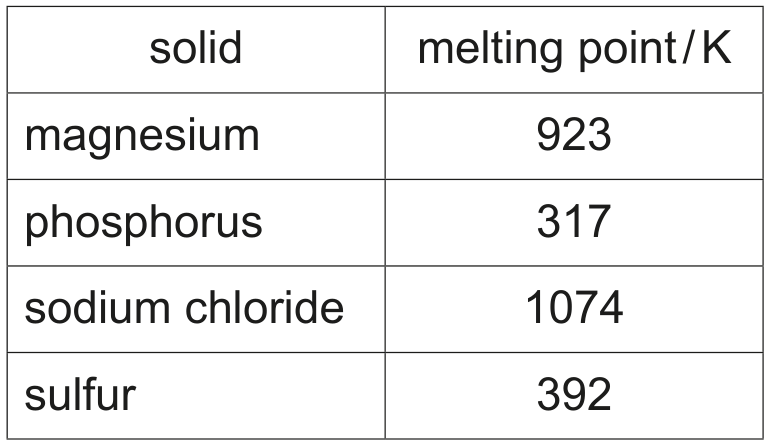
The melting points of some solids are shown in Table 1.1.

Table 1.1

Table 1.1

(a)
(i)

Name the strongest intermolecular force that exists between NH3(I)\mathrm{NH}_{3}(\mathrm{I}) molecules.

[ 1 ]
(ii)

Draw a diagram to show the formation of the strongest intermolecular force between two molecules of NH3(I)\mathrm{NH}_{3}(\mathrm{I}).

Include any relevant lone pairs of electrons and dipoles.

[ 2 ]
(iii)

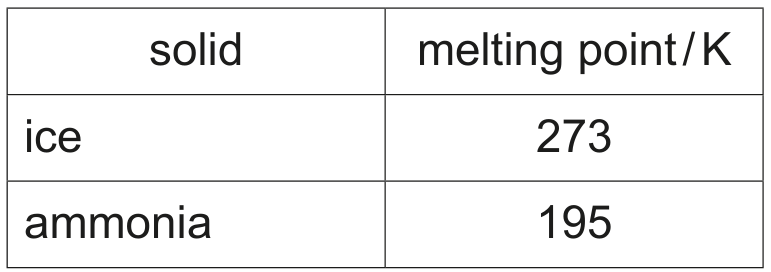
The melting points of ice and ammonia are shown in Table 1.2.

Table 1.2

Table 1.2

Suggest two reasons for the difference in the melting points of ice and ammonia.

[ 2 ]
[Maximum number: 2]

The Pauling electronegativity values of elements can be used to predict the chemical properties of compounds.

Use the information in Table 1.1 to answer the following questions.

Table 1.1

Table 1.1

(a)
(i)

Complete Table 1.2 by placing a tick ()(\checkmark) to show which of the compounds have molecules with an overall dipole moment.

Table 1.2

Table 1.2

[ 2 ]
[Maximum number: 4]

Hydrogen iodide, HI, is a colourless gas at room temperature.

(a)
(i)

Explain why HI has a higher boiling point than HCl and HBr .

[ 2 ]
(ii)

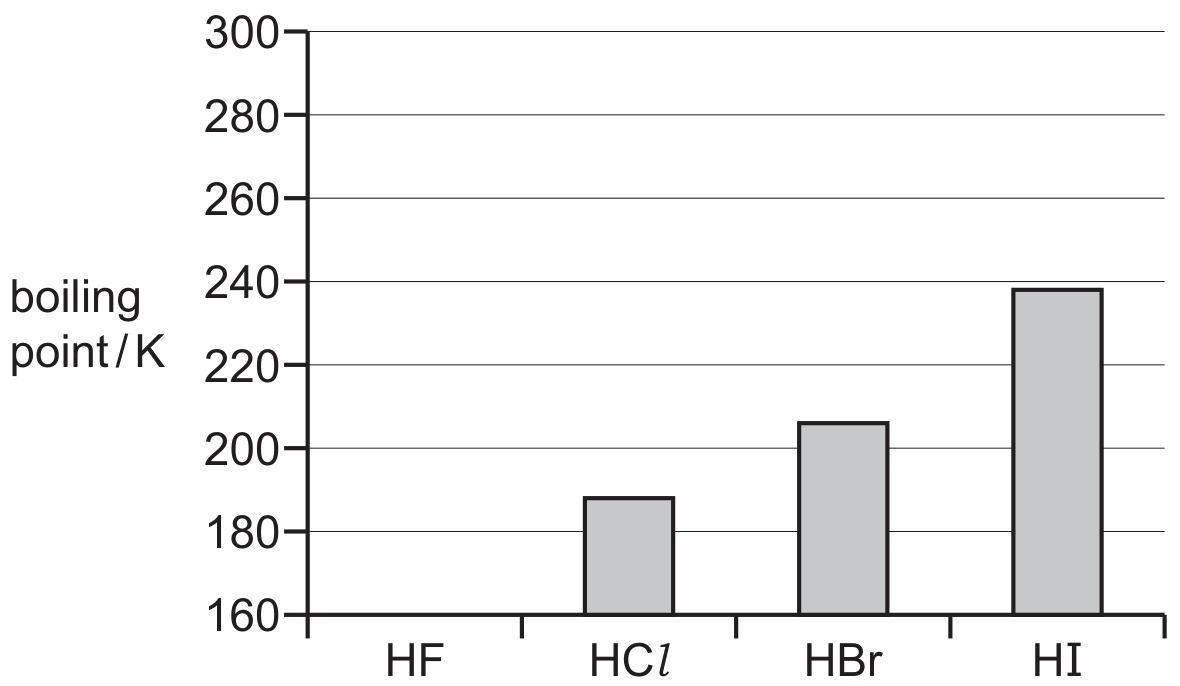
The bar chart shows the boiling points of HCl, HBr and HI . The boiling point of HF is not shown.

Question image

Hydrogen bonds form between HF molecules.
Draw a bar on the bar chart to predict the boiling point of HF .
Explain your answer.

[ 2 ]
[Maximum number: 2]

The elements sodium to sulfur react with chlorine. The melting points of some of the chlorides formed are shown.

Table
(a)
(i)

Explain why the melting point of SiCl4\mathrm{SiCl}_{4} is higher than that of PCl3\mathrm{PCl}_{3}.

[ 2 ]
(a)

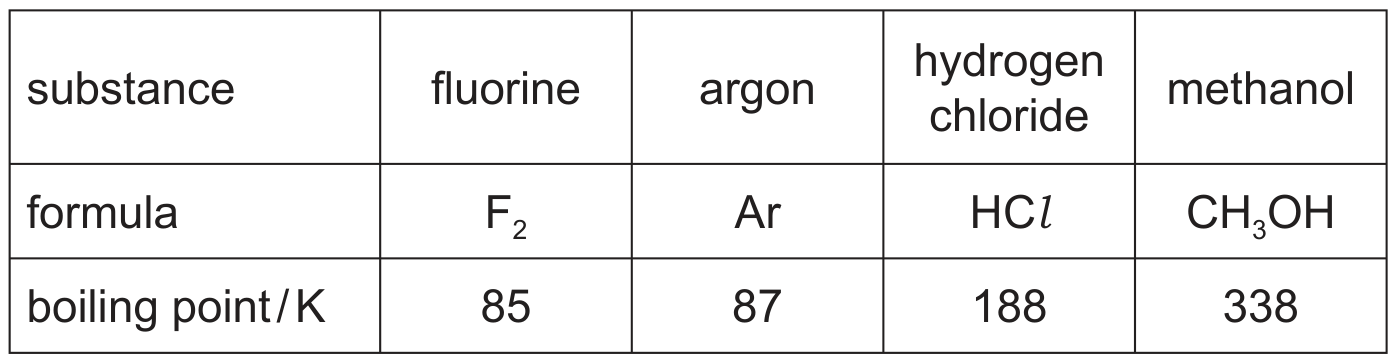
The boiling points of some molecules with equal numbers of electrons are given.

Table
[ 6 ]
(i)

Explain why the boiling points of fluorine and argon are so similar.

[ 2 ]
(ii)

Explain why the boiling point of hydrogen chloride is higher than that of fluorine.

[ 2 ]
(iii)

Explain why methanol has the highest boiling point of all these molecules.

[ 2 ]
(a)

Group VII is the only group in the Periodic Table containing elements in all three states of matter at room conditions.

State and explain, in terms of intermolecular forces, the trend in the boiling points of the elements down Group VII.

[ 4 ]
[Maximum number: 4]

Ammonia, NH3\mathrm{NH}_{3}, and methane, CH4\mathrm{CH}_{4}, are the hydrides of elements which are next to one another in the Periodic Table.

(a)

Ammonia is polar whereas methane is non-polar. The physical properties of the two compounds are different.

[ 4 ]
(i)

Explain, using ammonia as the example, the meaning of the term bond polarity.

(ii)

Explain why the ammonia molecule is polar.

(iii)

State one physical property of ammonia which is caused by its polarity.

[ 4 ]
[Maximum number: 4]

Elements and compounds which have small molecules usually exist as gases or liquids.

(a)

Chlorine, Cl2\mathrm{Cl}_{2}, is a gas at room temperature whereas bromine, Br2\mathrm{Br}_{2}, is a liquid under the same conditions.

Explain these observations.

[ 2 ]
(b)

The gases nitrogen, N2\mathrm{N}_{2}, and carbon monoxide, CO , are isoelectronic, that is they have the same number of electrons in their molecules.

Suggest why N2\mathrm{N}_{2} has a lower boiling point than CO .

[ 2 ]
[Maximum number: 2]

Sulfides are compounds that contain sulfur but not oxygen.

(a)

Carbon disulfide, CS2\mathrm{CS}_{2}, is a volatile liquid at room temperature and pressure.

[ 2 ]
(i)

CS2\mathrm{CS}_{2} is a liquid under room conditions, while CO2\mathrm{CO}_{2} is a gas.

Explain what causes the difference in the physical properties between CS2\mathrm{CS}_{2} and CO2\mathrm{CO}_{2}.

[ 2 ]
0