EduNinja
[Maximum number: 4]

Species such as NH4+,CO32\mathrm{NH}_{4}{ }^{+}, \mathrm{CO}_{3}{ }^{2-} and PO43\mathrm{PO}_{4}{ }^{3-} are examples of molecular ions.

(a)

OH(aq)\mathrm{OH}^{-}(\mathrm{aq}) reacts with 2-bromo-2-methylpropane in an SN1\mathrm{S}_{\mathrm{N}} 1 reaction. The molecular ion (CH3)3C+\left(\mathrm{CH}_{3}\right)_{3} \mathrm{C}^{+}forms as the intermediate in this reaction.

[ 4 ]
(i)

Draw the mechanism for the SN1\mathrm{S}_{\mathrm{N}} 1 reaction of OH\mathrm{OH}^{-}with 2-bromo-2-methylpropane. Include charges, dipoles, lone pairs of electrons and curly arrows as appropriate. Draw the structures of the organic reactant and organic product.
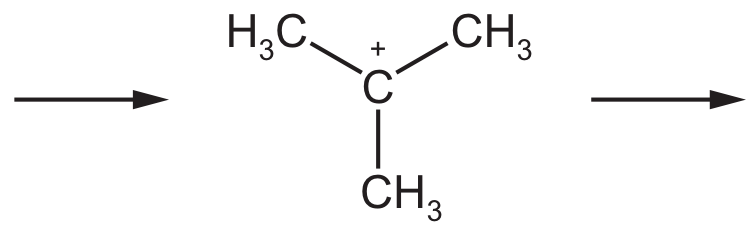
Question image
[ 3 ]
(ii)

2-bromo-2-methylpropane is a tertiary bromoalkane.

Define tertiary bromoalkane.

[ 1 ]
(a)

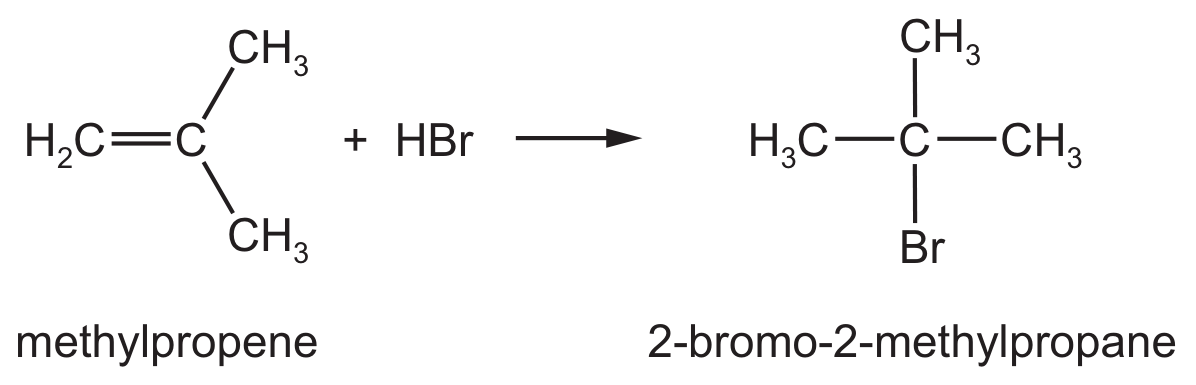
Halogenoalkanes can be formed from the reaction of an alkene with a hydrogen halide. Methylpropene reacts with hydrogen bromide to form 2-bromo-2-methylpropane.

Question image
[ 4 ]
(i)

Draw the mechanism of this reaction. Include all relevant curly arrows, dipoles and charges.

[ 3 ]
(ii)

1-bromo-2-methylpropane is also formed in this reaction.

Explain why 2-bromo-2-methylpropane will be the major product in this reaction.

[ 1 ]
[Maximum number: 15]

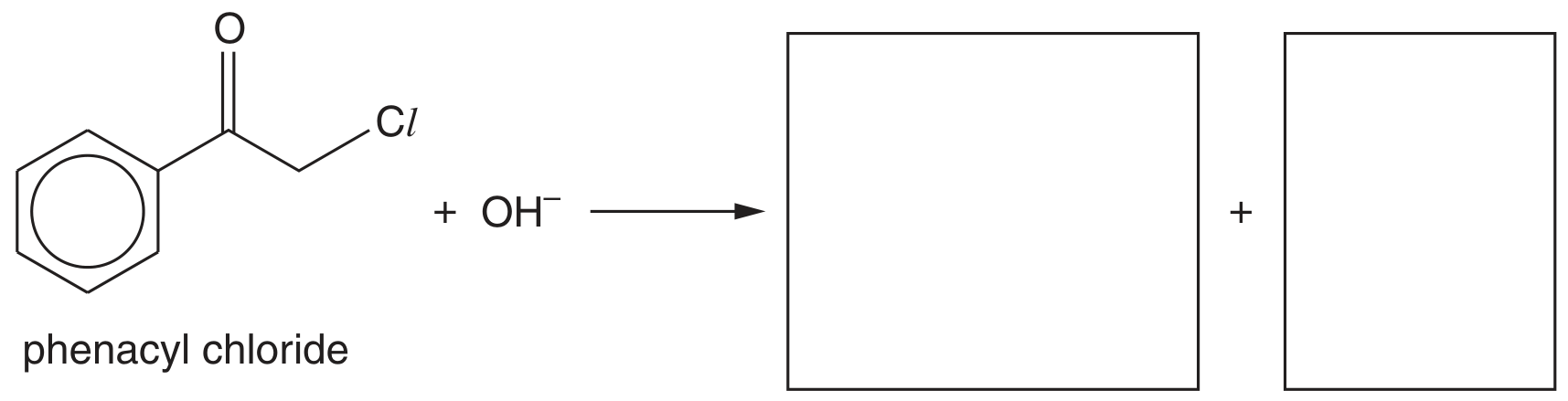
Phenacyl chloride has been used as a component of some tear gases. Its lachrymatory and irritant properties are due to it reacting with water inside body tissues to produce hydrochloric acid.

It undergoes a nucleophilic substitution reaction with NaOH(aq).

Question image
(a)
(i)

Describe the mechanism for this reaction that is consistent with your overall rate equation.

You should show all intermediates and/or transition states and partial charges, and you should represent the movements of electron pairs by curly arrows.

[ 7 ]
(b)
(i)

Describe an experiment that would show that CH3COCl\mathrm{CH}_{3} \mathrm{COCl} reacts with water at a much faster rate than phenacyl chloride. Include the reagents you would use, and the observations you would make with each chloride.

[ 4 ]
(ii)

Suggest an explanation for this difference in reactivity.

[ 4 ]
(a)

Both chloroalkanes and acyl chlorides react with water, but only acyl chlorides fume in moist air.

[ 1 ]
(i)

State which product causes the fumes in this reaction.

[ 1 ]
(a)
(i)

Suggest the mechanism for the reaction of 2-chlorobutane with iodide ions. Draw out the steps involved, including the following.
- all relevant lone pairs and dipoles
- curly arrows to show the movement of electron pairs
- the structure of any transition state or intermediate

[ 3 ]
(ii)

This reaction was carried out using a single optical isomer of 2-chlorobutane.

Use your mechanism in (i) to predict whether the product will be a single optical isomer or a mixture of two optical isomers. Explain your answer.

[ 1 ]
[Maximum number: 1]

Butanedioic acid occurs in amber, algae, lichens, sugar cane and beets. It may be synthesised in two steps from 1,2-dibromoethane.

BrCH2CH2Br step 1 × step 2 HO2CCH2CH2CO2H\mathrm{BrCH}_{2} \mathrm{CH}_{2} \mathrm{Br} \xrightarrow{\text { step 1 }} \times \xrightarrow{\text { step 2 }} \mathrm{HO}_{2} \mathrm{CCH}_{2} \mathrm{CH}_{2} \mathrm{CO}_{2} \mathrm{H}

Which reagents could be used for this synthesis?

step 1

step 2

HCN(g)

HCl(aq)

HCO2Na(aq)\mathrm{HCO}_{2} \mathrm{Na}(\mathrm{aq})

HCl(aq)

KCN(aq / alcoholic )

H2SO4(aq)\mathrm{H}_{2} \mathrm{SO}_{4}(\mathrm{aq})

NaOH(aq)

K2Cr2O7/H2SO4(aq)\mathrm{K}_{2} \mathrm{Cr}_{2} \mathrm{O}_{7} / \mathrm{H}_{2} \mathrm{SO}_{4}(\mathrm{aq})

[Maximum number: 2]

The Group 17 elements, chlorine, bromine and iodine, are non-metals that show trends in their physical and chemical properties.

(a)

Lucas's reagent is a mixture of HCl and ZnCl2\mathrm{ZnCl}_{2}. Primary, secondary and tertiary alcohols can be distinguished by their reaction with Lucas's reagent.

Alcohols react with the HCl in Lucas's reagent to form halogenoalkanes.
ZnCl2\mathrm{ZnCl}_{2} acts as a homogeneous catalyst for these reactions.

[ 2 ]
(i)

Pentan-3-ol, C2H5CH(OH)C2H5\mathrm{C}_{2} \mathrm{H}_{5} \mathrm{CH}(\mathrm{OH}) \mathrm{C}_{2} \mathrm{H}_{5}, reacts slowly with HC l to form a secondary halogenoalkane. Complete the equation for this reaction using structural formulae.
C2H5CH(OH)C2H5+\mathrm{C}_{2} \mathrm{H}_{5} \mathrm{CH}(\mathrm{OH}) \mathrm{C}_{2} \mathrm{H}_{5}+

[ 1 ]
(ii)

Tertiary alcohols tend to react with Lucas's reagent using the same mechanism as in their reaction with HCl .

Suggest the type of reaction shown by tertiary alcohols with Lucas's reagent.

[ 1 ]
[Maximum number: 1]

Bromoethane reacts with cyanide ions, producing propanenitrile.
Which statement about the SN2\mathrm{S}_{\mathrm{N}} 2 mechanism of this reaction is correct?

A

The lone pair of electrons on C of CN\mathrm{CN}^{-}attacks the carbon atom of the C-Br bond.

B

The lone pair of electrons on C of CN\mathrm{CN}^{-}attacks the carbocation formed when the C-Br bond breaks.

C

The lone pair of electrons on N of CN\mathrm{CN}^{-}attacks the carbon atom of the C-Br bond.

D

The lone pair of electrons on N of CN\mathrm{CN}^{-}attacks the carbocation formed when the C-Br bond breaks.

[Maximum number: 1]

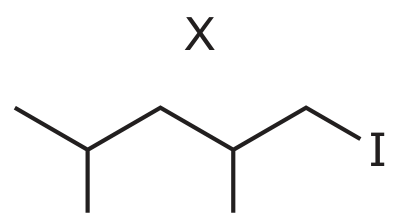
The Finkelstein reaction occurs when NaI in propanone reacts with a chloroalkane or bromoalkane. The halogen is directly replaced by I. The reaction only works for primary halogenoalkanes.

Which halogenoalkane produces compound X ?

Question image
A

(CH3)2CHCH(CH3)CH2CH2Br\left(\mathrm{CH}_{3}\right)_{2} \mathrm{CHCH}\left(\mathrm{CH}_{3}\right) \mathrm{CH}_{2} \mathrm{CH}_{2} \mathrm{Br}

B

(CH3)2CHCH(CH3)CH2Br\left(\mathrm{CH}_{3}\right)_{2} \mathrm{CHCH}\left(\mathrm{CH}_{3}\right) \mathrm{CH}_{2} \mathrm{Br}

C

(CH3)2CHCH2CH2CH(CH3)Cl\left(\mathrm{CH}_{3}\right)_{2} \mathrm{CHCH}_{2} \mathrm{CH}_{2} \mathrm{CH}\left(\mathrm{CH}_{3}\right) \mathrm{Cl}

D

(CH3)2CHCH2CH(CH3)CH2Cl\left(\mathrm{CH}_{3}\right)_{2} \mathrm{CHCH}_{2} \mathrm{CH}\left(\mathrm{CH}_{3}\right) \mathrm{CH}_{2} \mathrm{Cl}

[Maximum number: 1]

Chlorine is a very reactive element.

(a)

CHCl3\mathrm{CHCl}_{3} and HF are used to form CHClF2\mathrm{CHClF}_{2} in a substitution reaction.

Construct an equation for this reaction.

[ 1 ]
0