EduNinja
[Maximum number: 1]

The rate of the reaction H2( g)+I2( g)2HI(g)\mathrm{H}_{2}(\mathrm{~g})+\mathrm{I}_{2}(\mathrm{~g}) \rightleftharpoons 2 \mathrm{HI}(\mathrm{g}) is studied.

(a)

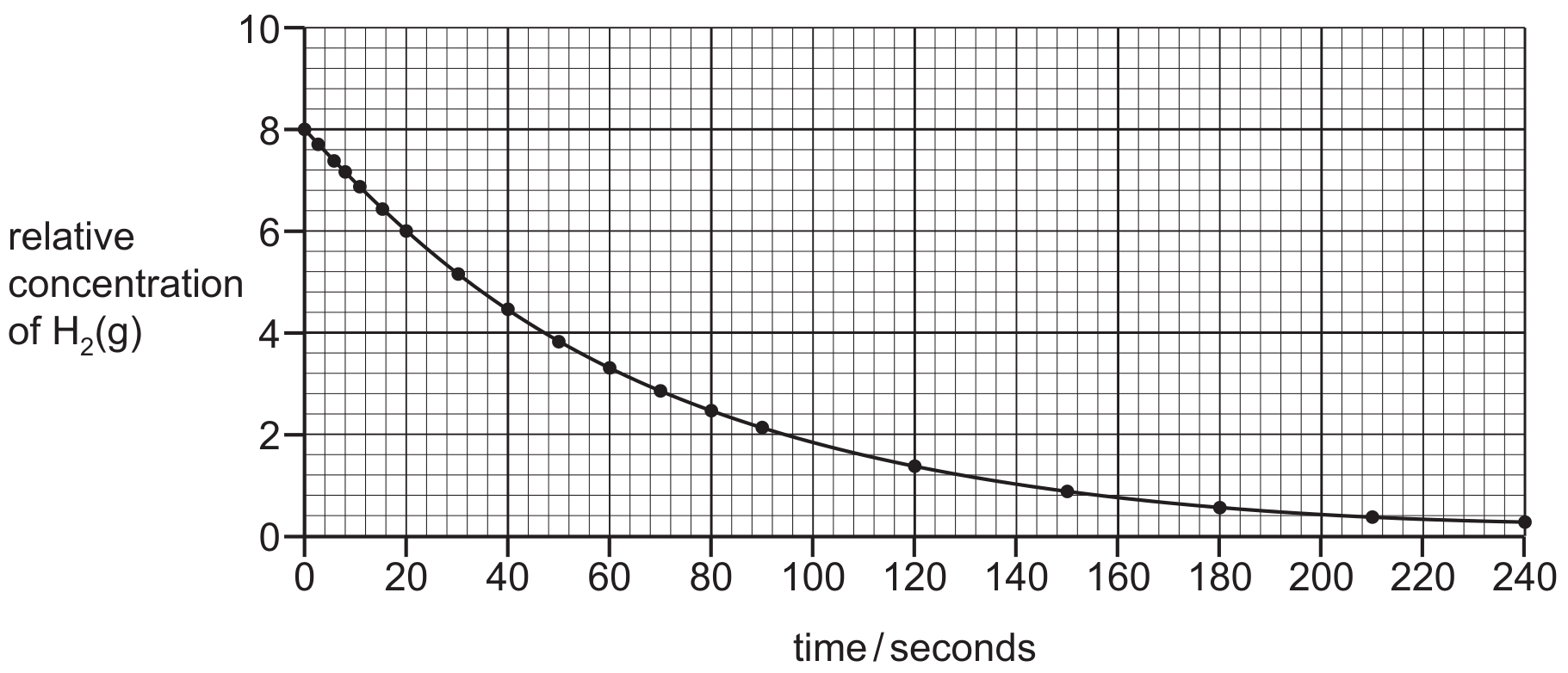
A small amount of H2( g)\mathrm{H}_{2}(\mathrm{~g}) is mixed with a large excess of I2( g)\mathrm{I}_{2}(\mathrm{~g}) at a temperature of 400 K and the reaction is monitored. The graph obtained is shown.
Question image
[ 1 ]
(i)

Suggest why a large excess of I2( g)\mathrm{I}_{2}(\mathrm{~g}) is used in this experiment.

[ 1 ]
[Maximum number: 12]

Hydrazine, N2H4\mathrm{N}_{2} \mathrm{H}_{4}, can be used as a rocket fuel and is stored as a liquid. It reacts exothermically with oxygen to give only gaseous products.

The enthalpy change of a reaction such as that between hydrazine and oxygen may be calculated by using standard enthalpy changes of formation.

(a)

Hydrazine reacts with oxygen according to the following equation.

N2H4(l)+O2( g)N2( g)+2H2O( g)\mathrm{N}_{2} \mathrm{H}_{4}(\mathrm{l})+\mathrm{O}_{2}(\mathrm{~g}) \rightarrow \mathrm{N}_{2}(\mathrm{~g})+2 \mathrm{H}_{2} \mathrm{O}(\mathrm{~g})
(i)

Although the above reaction is highly exothermic, hydrazine does not burn spontaneously in oxygen.
Suggest a reason for this.

[Maximum number: 3]

Sulfuric acid is manufactured by the Contact process.
One stage in this process is the conversion of sulfur dioxide into sulfur trioxide in the presence of a heterogeneous catalyst of vanadium(V) oxide, V2O5\mathrm{V}_{2} \mathrm{O}_{5}.

Question image
(a)
(i)

State and explain the effect of increasing temperature on the rate of production of SO3\mathrm{SO}_{3}.

[ 3 ]
[Maximum number: 3]

The elements sodium to chlorine, in the third period, all form oxides.

(a)

SO3\mathrm{SO}_{3} is produced by the reaction between SO2\mathrm{SO}_{2} and O2\mathrm{O}_{2} in the Contact process. A dynamic equilibrium is established.

2SO2( g)+O2( g)2SO3( g)ΔH=196 kJ mol12 \mathrm{SO}_{2}(\mathrm{~g})+\mathrm{O}_{2}(\mathrm{~g}) \rightleftharpoons 2 \mathrm{SO}_{3}(\mathrm{~g}) \quad \Delta H=-196 \mathrm{~kJ} \mathrm{~mol}^{-1}
[ 3 ]
(i)

Explain why the gradients of the SO2\mathrm{SO}_{2} and O2\mathrm{O}_{2} lines decrease with time.

[ 2 ]
(ii)

Suggest a reason why the initial gradient of the SO2\mathrm{SO}_{2} line is steeper than that of the O2\mathrm{O}_{2} line.

[ 1 ]
[Maximum number: 2]

Calcium, magnesium and radium are Group 2 elements. Radium follows the same trends as the other members of Group 2.

(a)

Cold water reacts slowly with a piece of Mg to produce bubbles of H2( g)\mathrm{H}_{2}(\mathrm{~g}). Cold water reacts rapidly with burning Mg to produce H2( g)\mathrm{H}_{2}(\mathrm{~g}) in an explosive mixture.

Mg+2H2OMg(OH)2+H2\mathrm{Mg}+2 \mathrm{H}_{2} \mathrm{O} \rightarrow \mathrm{Mg}(\mathrm{OH})_{2}+\mathrm{H}_{2}

Explain why the rate of reaction of cold water with burning magnesium is greater.

[ 2 ]
[Maximum number: 1]

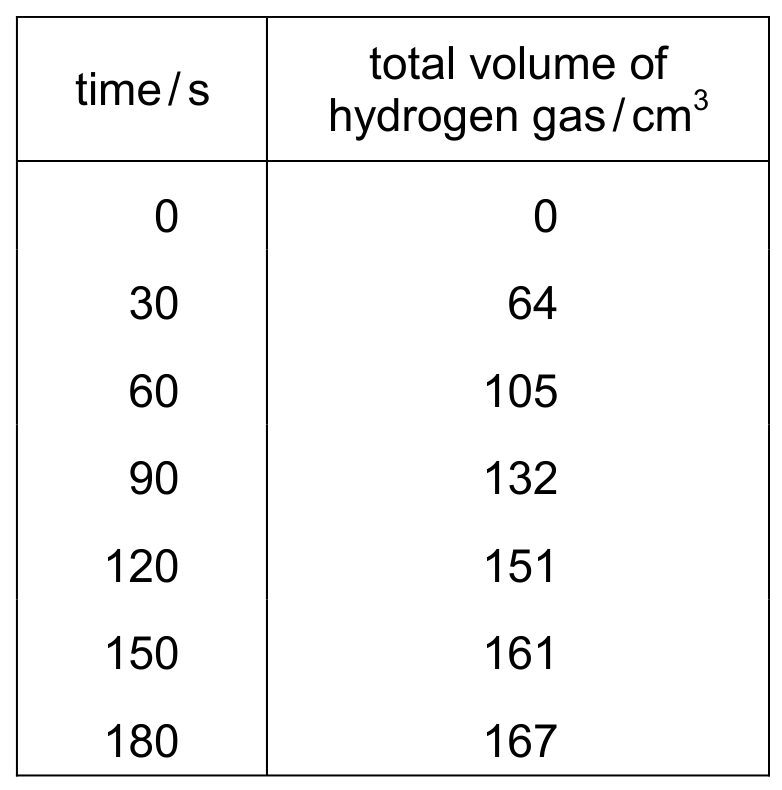
The rate of the reaction between a reactive metal and an excess of a dilute acid is investigated. The total volume of hydrogen gas produced is recorded every 30 seconds for 3 minutes.

Table

The average rate of reaction during the first 30 seconds is P.
The average rate of reaction during the last 30 seconds is Q.
What is the value of P-Q ?

A

1.21 cm3 s11.21 \mathrm{~cm}^{3} \mathrm{~s}^{-1}

B

1.93 cm3 s11.93 \mathrm{~cm}^{3} \mathrm{~s}^{-1}

C

2.13 cm3 s12.13 \mathrm{~cm}^{3} \mathrm{~s}^{-1}

D

3.43 cm3 s13.43 \mathrm{~cm}^{3} \mathrm{~s}^{-1}

[Maximum number: 1]

A student carries out four experiments to investigate the rate of reaction between 3.0 g of calcium carbonate and hydrochloric acid.

CaCO3( s)+2HCl(aq)CaCl2(aq)+CO2( g)+H2O(l)\mathrm{CaCO}_{3}(\mathrm{~s})+2 \mathrm{HCl}(\mathrm{aq}) \rightarrow \mathrm{CaCl}_{2}(\mathrm{aq})+\mathrm{CO}_{2}(\mathrm{~g})+\mathrm{H}_{2} \mathrm{O}(\mathrm{l})

experiment 1CaCO31 \quad \mathrm{CaCO}_{3} powder +2.0moldm3HCl+2.0 \mathrm{moldm}^{-3} \mathrm{HCl} at 35C35^{\circ} \mathrm{C}
experiment 2CaCO32 \mathrm{CaCO}_{3} powder +2.0moldm3HCl+2.0 \mathrm{moldm}^{-3} \mathrm{HCl} at 35C35^{\circ} \mathrm{C}
experiment 3 large chips of CaCO3+1.0moldm3HCl\mathrm{CaCO}_{3}+1.0 \mathrm{moldm}^{-3} \mathrm{HCl} at room temperature
experiment 4 large chips of CaCO3+1.0moldm3HCl\mathrm{CaCO}_{3}+1.0 \mathrm{moldm}^{-3} \mathrm{HCl} at 35C35^{\circ} \mathrm{C}

The student collects the CO2( g)\mathrm{CO}_{2}(\mathrm{~g}) and times how long it takes to produce the same volume of gas for each experiment.

What could be the correct times for the four experiments?

experiment 1 /s

experiment 2 /s

experiment 3 /s

experiment 4 /s

5

10

30

95

5

10

95

30

5

30

95

10

95

30

10

5

[Maximum number: 1]

Na2 S2O3\mathrm{Na}_{2} \mathrm{~S}_{2} \mathrm{O}_{3} reacts with dilute HCl to give a pale yellow precipitate. If 1 cm31 \mathrm{~cm}^{3} of 0.1moldm3HCl0.1 \mathrm{moldm}^{-3} \mathrm{HCl} is added to 10 cm310 \mathrm{~cm}^{3} of 0.02 moldm3Na2 S2O30.02 \mathrm{~mol} \mathrm{dm}^{-3} \mathrm{Na}_{2} \mathrm{~S}_{2} \mathrm{O}_{3} the precipitate forms slowly.

If the experiment is repeated with 1 cm31 \mathrm{~cm}^{3} of 0.1 moldm3HCl0.1 \mathrm{~mol} \mathrm{dm}^{-3} \mathrm{HCl} and 10 cm310 \mathrm{~cm}^{3} of 0.05moldm3Na2 S2O30.05 \mathrm{moldm}^{-3} \mathrm{Na}_{2} \mathrm{~S}_{2} \mathrm{O}_{3} the precipitate forms more quickly.

Why is this?

A

The activation energy of the reaction is lower when 0.05moldm3Na2 S2O30.05 \mathrm{moldm}^{-3} \mathrm{Na}_{2} \mathrm{~S}_{2} \mathrm{O}_{3} is used.

B

The collisions between reactant particles are more violent when 0.05moldm3Na2 S2O30.05 \mathrm{moldm}^{-3} \mathrm{Na}_{2} \mathrm{~S}_{2} \mathrm{O}_{3} is used.

C

The reactant particles collide more frequently when 0.05moldm3Na2 S2O30.05 \mathrm{moldm}^{-3} \mathrm{Na}_{2} \mathrm{~S}_{2} \mathrm{O}_{3} is used.

D

The reaction proceeds by a different pathway when 0.05moldm3Na2 S2O30.05 \mathrm{moldm}^{-3} \mathrm{Na}_{2} \mathrm{~S}_{2} \mathrm{O}_{3} is used.

[Maximum number: 1]

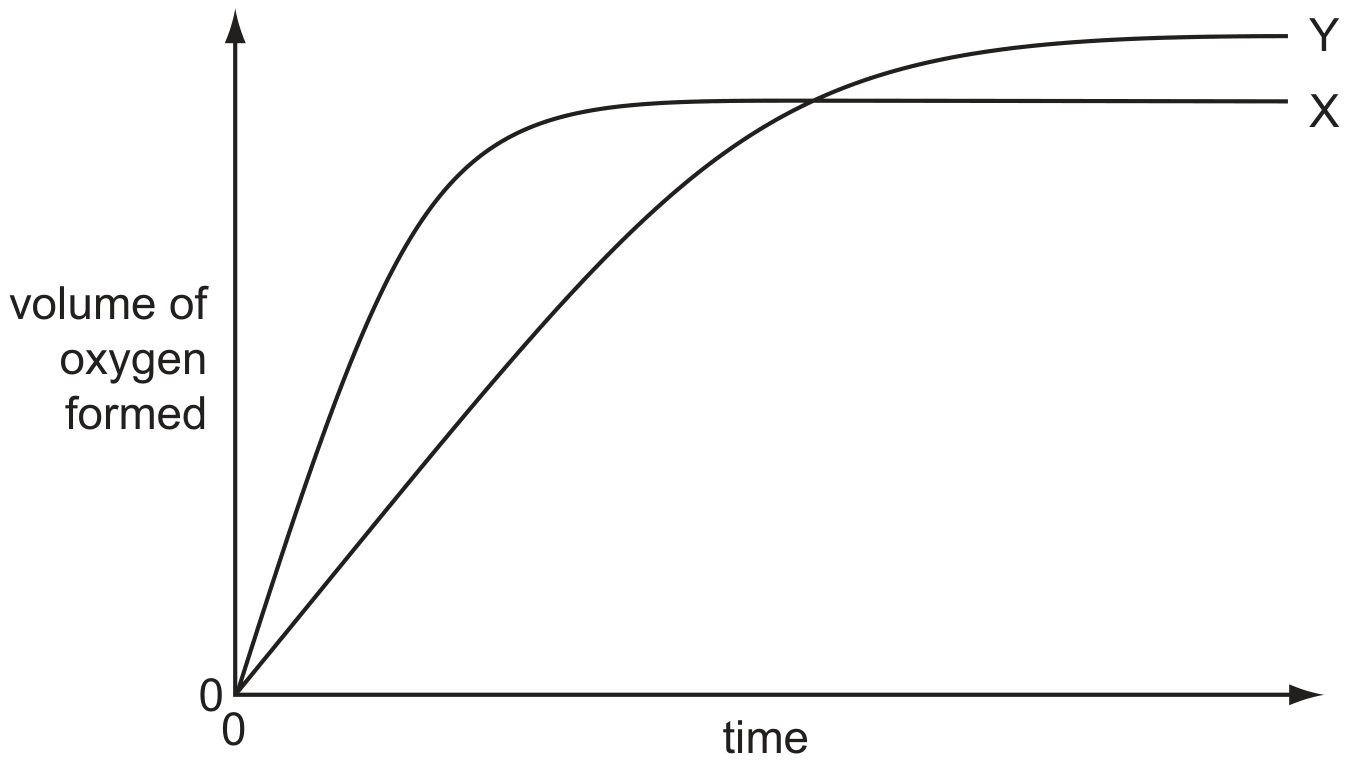
In the diagram, curve X was obtained by observing the decomposition of 100 cm3100 \mathrm{~cm}^{3} of 1.0 moldm31.0 \mathrm{~mol} \mathrm{dm}^{-3} hydrogen peroxide, catalysed by manganese(IV) oxide.

Question image

Which alteration to the original experimental conditions would produce curve Y ?

A

adding more manganese(IV) oxide

B

adding some 0.1 moldm30.1 \mathrm{~mol} \mathrm{dm}^{-3} hydrogen peroxide

C

adding water

D

raising the temperature

[Maximum number: 1]

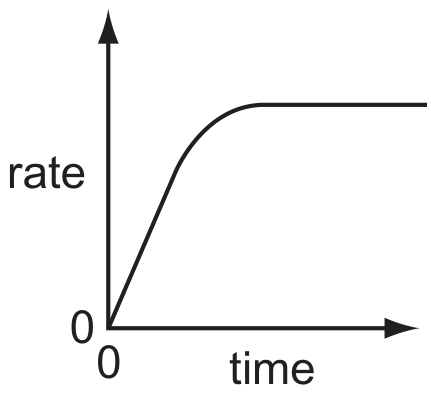
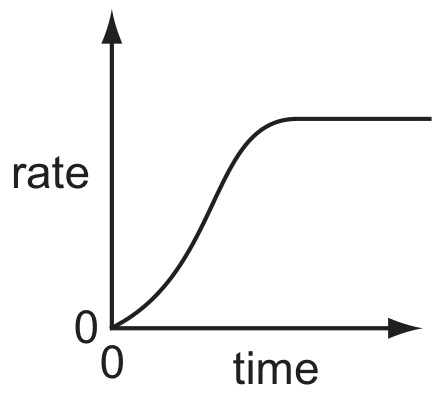
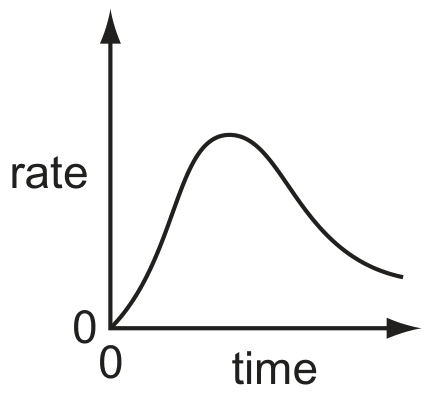
An autocatalytic reaction is a reaction in which one of the products catalyses the reaction.
Which curve was obtained if the rate of reaction was plotted against time for an autocatalytic reaction?

A
Question image
B
Question image
C
Question image
D
Question image
0