EduNinja
[Maximum number: 1]

Sulfuric acid is manufactured by the Contact process.
One stage in this process is the conversion of sulfur dioxide into sulfur trioxide in the presence of a heterogeneous catalyst of vanadium(V) oxide, V2O5\mathrm{V}_{2} \mathrm{O}_{5}.

Question image
(a)
(i)

State the meaning of the term heterogeneous as applied to catalysts.

[ 1 ]
[Maximum number: 1]

In the Haber process for the manufacture of ammonia, why is the heterogeneous catalyst iron in a finely divided state?

A

to increase its surface area

B

to produce the maximum reduction in the activation energy

C

to reduce its loss during the reaction

D

to reduce its surface area

[Maximum number: 1]

Ammonia is manufactured by the Haber Process, in an exothermic reaction.
Assuming that the amount of catalyst remains constant, which change will not bring about an increase in the rate of the forward reaction?

A

decreasing the size of the catalyst pieces

B

increasing the pressure

C

increasing the temperature

D

removing the ammonia as it is formed

[Maximum number: 1]

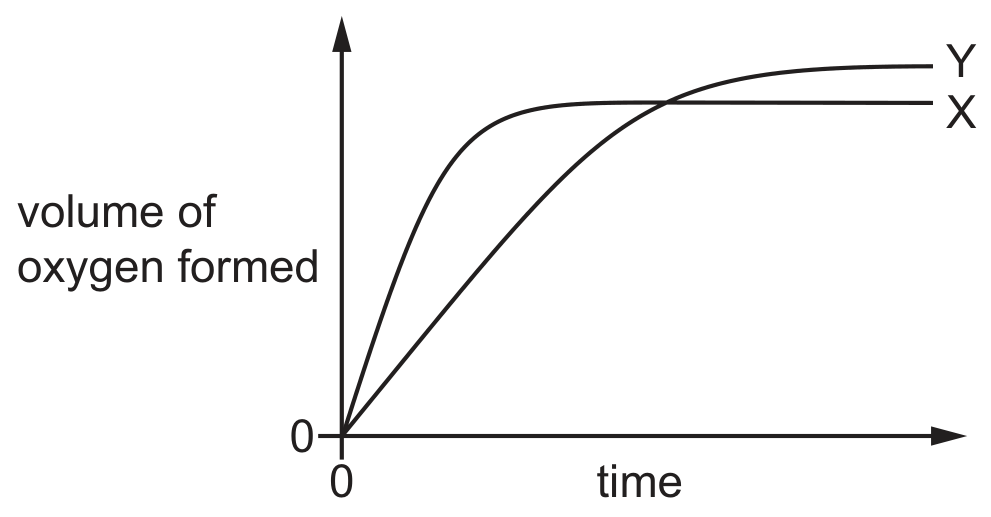
In the diagram, curve X was obtained by measuring the volume of oxygen produced during the decomposition of 100 cm3100 \mathrm{~cm}^{3} of 1.0 moldm31.0 \mathrm{~mol} \mathrm{dm}^{-3} hydrogen peroxide. A catalyst of manganese(IV) oxide was used.

Question image

Which alteration to the original experimental conditions would produce curve Y ?

A

adding more manganese(IV) oxide

B

adding some 0.1 moldm30.1 \mathrm{~mol} \mathrm{dm}^{-3} hydrogen peroxide

C

adding water

D

raising the temperature

[Maximum number: 3]

Some oxides of elements in Period 3 are shown.

Na2OAl2O3P4O6P4O10SO2SO3\begin{array}{llllll} \mathrm{Na}_{2} \mathrm{O} & \mathrm{Al}_{2} \mathrm{O}_{3} & \mathrm{P}_{4} \mathrm{O}_{6} & \mathrm{P}_{4} \mathrm{O}_{10} & \mathrm{SO}_{2} & \mathrm{SO}_{3} \end{array}
(a)

Al2O3\mathrm{Al}_{2} \mathrm{O}_{3} is an amphoteric oxide found in bauxite.

[ 3 ]
(i)

Al2O3\quad \mathrm{Al}_{2} \mathrm{O}_{3} is used as a catalyst in the dehydration of alcohols.

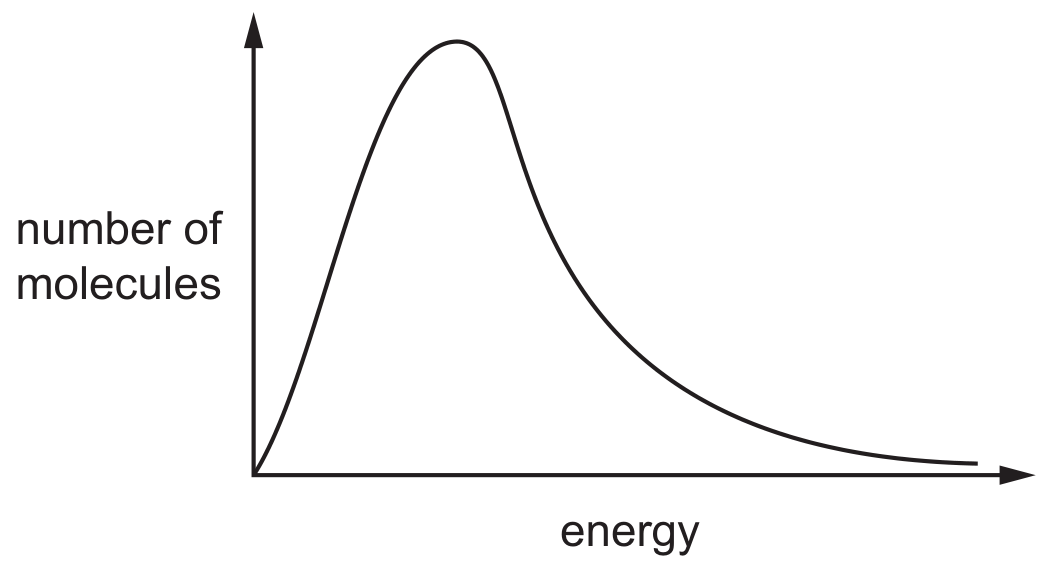
State the effect of using Al2O3\mathrm{Al}_{2} \mathrm{O}_{3} as a catalyst in the dehydration of alcohols. Use the Boltzmann distribution in Fig. 2.1 to help explain your answer.

Fig. 2.1

Fig. 2.1

[ 3 ]
[Maximum number: 1]

Hydrogen peroxide decomposes slowly at 20C20^{\circ} \mathrm{C} to form water and oxygen.

2H2O22H2O+O2 equilibrium constant =Kc2 \mathrm{H}_{2} \mathrm{O}_{2} \rightleftharpoons 2 \mathrm{H}_{2} \mathrm{O}+\mathrm{O}_{2} \quad \text { equilibrium constant }=K_{\mathrm{c}}

The reaction is faster when a catalyst is present.
Which statement is correct?

A

The catalyst alters the Boltzmann distribution so that the reactant molecules have more energy.

B

The catalyst has no effect on the value of KcK_{\mathrm{c}}.

C

The catalyst increases the value of KcK_{\mathrm{c}}.

D

The catalyst provides a different reaction mechanism with a higher activation energy.

[Maximum number: 2]

Nitrogen makes up about 79 % of the Earth's atmosphere. As a constituent element of proteins, it is present in living organisms.

Atmospheric nitrogen is used in the Haber process for the manufacture of ammonia.

(a)
(i)

What metal is most commonly used as the catalyst in a catalytic converter?

(ii)

Construct one balanced equation for the reaction in which both CO and NO are removed from the exhaust gases by a catalytic converter.

[ 2 ]
[Maximum number: 2]

Nitrogen makes up about 79 % of the Earth's atmosphere. As a constituent element of proteins, it is present in living organisms.

Atmospheric nitrogen is used in the Haber process for the manufacture of ammonia.

(a)
(i)

What metal is most commonly used as the catalyst in a catalytic converter?

(ii)

Construct one balanced equation for the reaction in which both CO and NO are removed from the exhaust gases by a catalytic converter.

[ 2 ]
[Maximum number: 3]

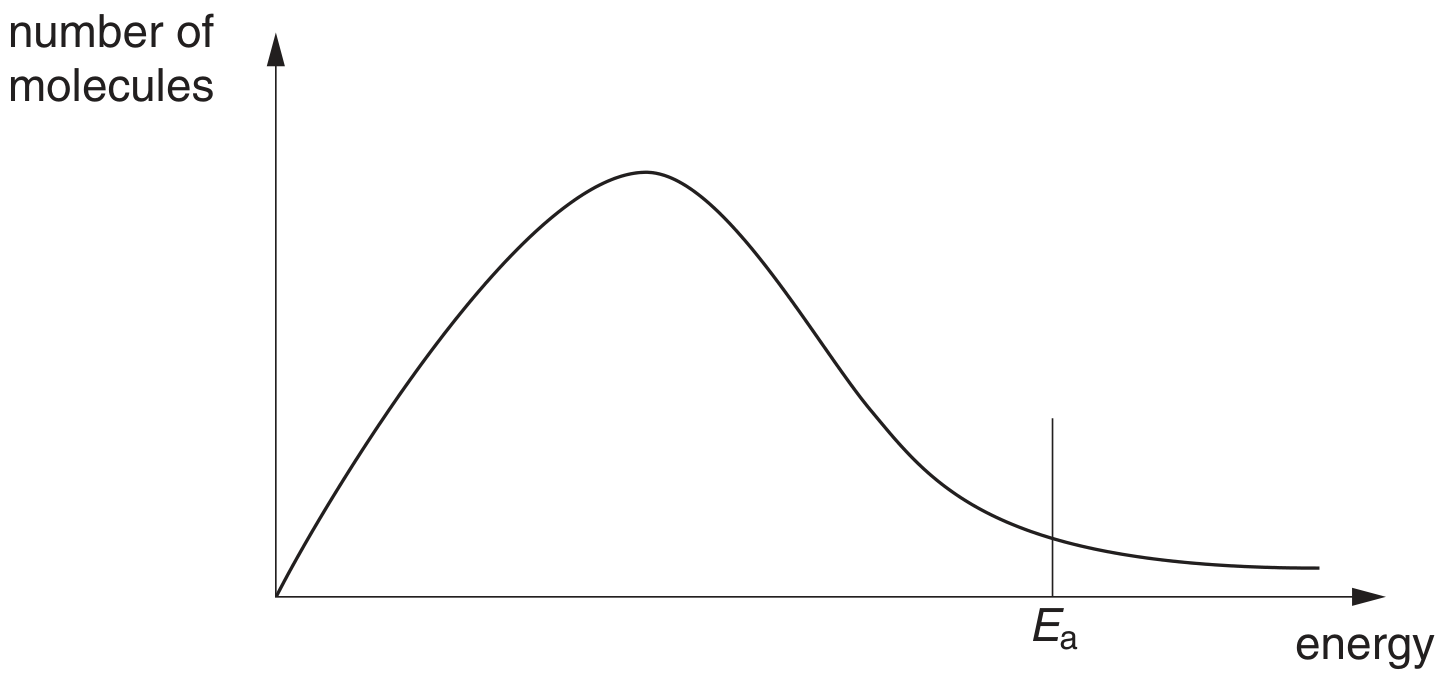
The diagram below shows, for a given temperature T, a Boltzmann distribution of the kinetic energy of the molecules of a mixture of two gases that will react together, such as nitrogen and hydrogen.

The activation energy for the reaction, EaE_{\mathrm{a}}, is marked.

Question image
(a)
(i)

On the energy axis of the graph opposite, mark the position, clearly labelled C, of the activation energy of the reaction when a catalyst is used.

(ii)

Use your answer to (ii) to explain how the use of a catalyst results in reactions occurring at a faster rate.

[ 3 ]
[Maximum number: 1]

Enzymes are biological catalysts. Many enzymes show specificity. An example of an enzyme which shows specificity is glucokinase. Glucokinase is involved in the metabolism of glucose.

What does specificity mean in this context?

A

Glucokinase is most effective as a catalyst over a narrow pH range.

B

Glucokinase is most effective as a catalyst over a narrow range of temperatures.

C

Glucokinase only operates on a narrow range of substrate molecules.

D

Glucokinase provides an alternative route for the reactions it catalyses.

0