[Maximum number: 1]
In which carbon allotrope are all electrons localised?
A
buckminsterfullerene
B
diamond
C
graphite
D
graphene
 EduNinja
In which carbon allotrope are all electrons localised?
buckminsterfullerene
diamond
graphite
graphene
At the age of 17, in a woodshed in Ohio, Charles Martin Hall discovered the commercial process for the production of aluminium metal by the electrolysis of a mixture of bauxite, , and cryolite, .
What is the main purpose of the cryolite?
is covalent, and ions interact with it to produce ions which can be discharged at the cathode.
Cryolite is a base, forming with bauxite, enabling aluminium to be discharged at the anode.
Cryolite minimises the release of ions at the graphite anodes, which are otherwise burnt away to CO.
Cryolite reduces the melting point of the bauxite.
Copper is used in electrical equipment. It has a melting point of .
Identify the lattice structure of copper.
The melting points of some solids are shown in Table 1.1.
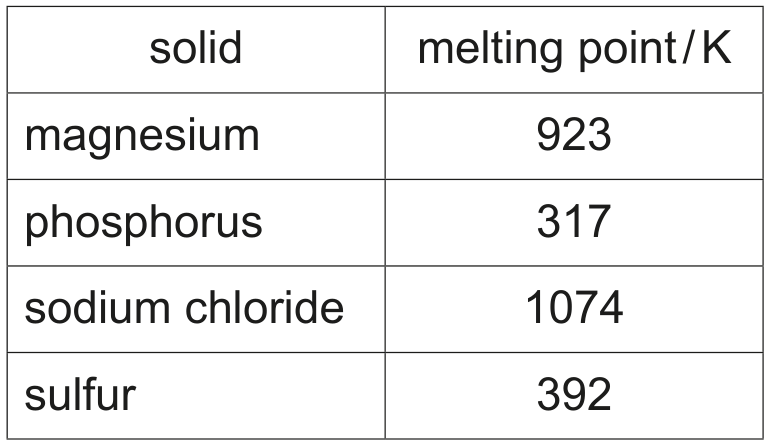
Table 1.1
State the type of bonding present in magnesium and in sodium chloride. bonding in magnesium
bonding in sodium chloride
Explain the difference in the melting points of magnesium and sodium chloride.
Explain the difference in the melting points of phosphorus and sulfur in terms of structure and bonding.
Copper has a melting point of and a high electrical conductivity.
Explain these properties of copper by referring to its structure and bonding.
Magnesium has a melting point of and high electrical conductivity.
Explain these properties of magnesium by referring to its structure and bonding.
In the Periodic Table, the p block contains elements whose outer electrons are found in the p subshell.
Silicon is found in many compounds in the Earth's crust. Silicon has only three naturally occurring isotopes, and .
Silicon reacts with nitrogen gas to form .
is a solid with a melting point of . It is insoluble in water and does not conduct electricity when molten.
Suggest the type of bonding in and structure of . Explain your answer.
The elements sodium to chlorine, in the third period, all form oxides.
Explain why the melting point of MgO is higher than that of .
Explain why the melting point of is much higher than that of .
The elements sodium to sulfur react with chlorine. The melting points of some of the chlorides formed are shown.

Explain, in terms of structure and bonding, why the melting point of is much lower than that of NaCl .
Cerium is a lanthanoid metal that shows similar chemical reactions to some elements in the third period. Most of cerium's compounds contain or ions.
Cerium shows the same structure and bonding as a typical metal.
Draw a labelled diagram to show the structure and bonding in cerium.
Cerium(IV) oxide, , is a ceramic.
Suggest two physical properties of cerium(IV) oxide.
1.
2.