Under certain conditions, chlorine undergoes a free-radical substitution reaction with ethane.
State the conditions required to initiate this reaction.
Write the overall equation for this free-radical substitution reaction.
EduNinjaUnder certain conditions, chlorine undergoes a free-radical substitution reaction with ethane.
State the conditions required to initiate this reaction.
Write the overall equation for this free-radical substitution reaction.
Combustion data can be used to calculate the empirical formula, molecular formula and relative molecular mass of many organic compounds.
T is an alcohol, CxHyO. A gaseous sample of T occupied a volume of 20 cm3 at 120∘C and 100 kPa .
The sample was completely burned in 200 cm3 of oxygen (an excess). The final volume, measured under the same conditions as the gaseous sample, was 250 cm3.
Under these conditions, all water present is vaporised. Removal of the water vapour from the gaseous mixture decreased the volume to 170 cm3.
Treating the remaining gaseous mixture with concentrated alkali, to absorb carbon dioxide, decreased the volume to 110 cm3.
The equation for the complete combustion of T can be represented as shown.

Complete the equation for the complete combustion of the alcohol, T.
Carbon dioxide, CO2, makes up about 0.040 % of the Earth's atmosphere. It is produced by animal respiration and by the combustion of fossil fuels.
In animal respiration, oxygen reacts with a carbohydrate such as glucose to give water, carbon dioxide and energy.
The typical daily food requirement of a human can be considered to be the equivalent of 1.20 kg of glucose, C6H12O6.
You should express all of your numerical answers in this question to three significant figures.
Carbon dioxide is one of a number of gases that are responsible for global warming. When fossil fuels such as octane are burned in a car engine, other atmospheric pollutants are also produced.
Give the formula of one atmospheric pollutant that may be produced in a car engine, other than CO2, and state how this pollutant damages the environment.
pollutant
damage caused
Some intercontinental jet airliners use kerosene as fuel. The formula of kerosene may be taken as C14H30.
When kerosene burns in an excess of air, carbon dioxide and water form. Balance the following equation for the complete combustion of kerosene.
The halogens chlorine and bromine react readily with hydrogen.
Describe how you could carry out this reaction using chlorine.
Describe two observations you would make if this reaction was carried out with bromine.
Some halogens also react readily with methane.
What conditions are needed to carry out this reaction when X is bromine, Br ?
Hence suggest why it is not possible to make iodomethane, CH3I, by this reaction.
The major source of sulfur for the manufacture of sulfuric acid by the Contact process is the de-sulfurisation of 'sour' natural gas. Many natural gas wells produce a mixture of volatile hydrocarbons (mainly CH4 and C2H6 ) together with up to 25 % hydrogen sulfide, H2 S.
Explain why it is important to remove the H2 S before burning the natural gas industrially.
The H2 S is removed by passing the 'sour' natural gas through a solvent containing ethanolamine. The following reaction takes place.
Which equation correctly describes the complete combustion of an alkene, CnH2n ?
CnH2n+23nO2→nCO2+2nH2O
CnH2n+23nO2→nCO2+nH2O
CnH2n+2nO2→nCO2+nH2O
CnH2n+2nO2→nCO2+2nH2O
When a small sample of hydrocarbon Q is completely combusted, it produces 3.52 g of carbon dioxide and 1.44 g of water.
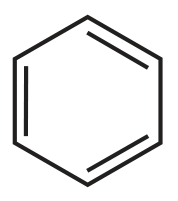
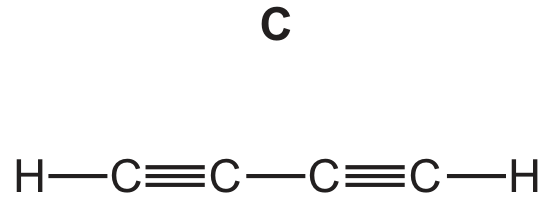
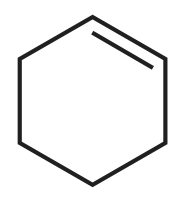
What could be the structure of hydrocarbon Q ?


Which stage in the free radical substitution of ethane by chlorine will have the lowest activation energy?
Cl2→2Cl⋅
Cl⋅+C2H6→C2H5⋅+HCl
C2H5+Cl2→C2H5Cl+Cl.
Cl⋅+C2H5⋅→C2H5Cl
Which stage in the free radical substitution of methane by chlorine will have the lowest activation energy?
CH3∙+Cl2→CH3Cl+Cl∙
Cl∙+Cl∙→Cl2
Cl∙+CH4→CH3∙+HCl
Cl2→Cl∙+Cl∙