EduNinja
[Maximum number: 1]

Fumaric acid can be converted into oxaloacetic acid by a two-step process involving the intermediate Q.

Question image

Each of these steps can be achieved in the laboratory by a single reagent.
What could be the intermediate Q and the reagent for step 2?

Q

reagent for step 2

HO2CCHBrCH2CO2H\mathrm{HO}_{2} \mathrm{CCHBrCH}_{2} \mathrm{CO}_{2} \mathrm{H}

warm acidified KMnO4\mathrm{KMnO}_{4}

HO2CCHBrCH(OH)CO2H\mathrm{HO}_{2} \mathrm{CCHBrCH}(\mathrm{OH}) \mathrm{CO}_{2} \mathrm{H}

warm NaOH(aq)

HO2CCH(OH)CH2CO2H\mathrm{HO}_{2} \mathrm{CCH}(\mathrm{OH}) \mathrm{CH}_{2} \mathrm{CO}_{2} \mathrm{H}

Fehling's solution

HO2CCH(OH)CH2CO2H\mathrm{HO}_{2} \mathrm{CCH}(\mathrm{OH}) \mathrm{CH}_{2} \mathrm{CO}_{2} \mathrm{H}

warm acidified K2Cr2O7\mathrm{K}_{2} \mathrm{Cr}_{2} \mathrm{O}_{7}

[Maximum number: 3]

Organic compounds can be distinguished using chemical tests and analytical techniques.

(a)

C2 can be synthesised using A1 as a single organic reactant.

A1

A1

C2

C2

Devise a multi-step synthetic route to form C2 from A1. Identify relevant reagents and conditions, and state the organic products of each step.

[ 3 ]
(a)

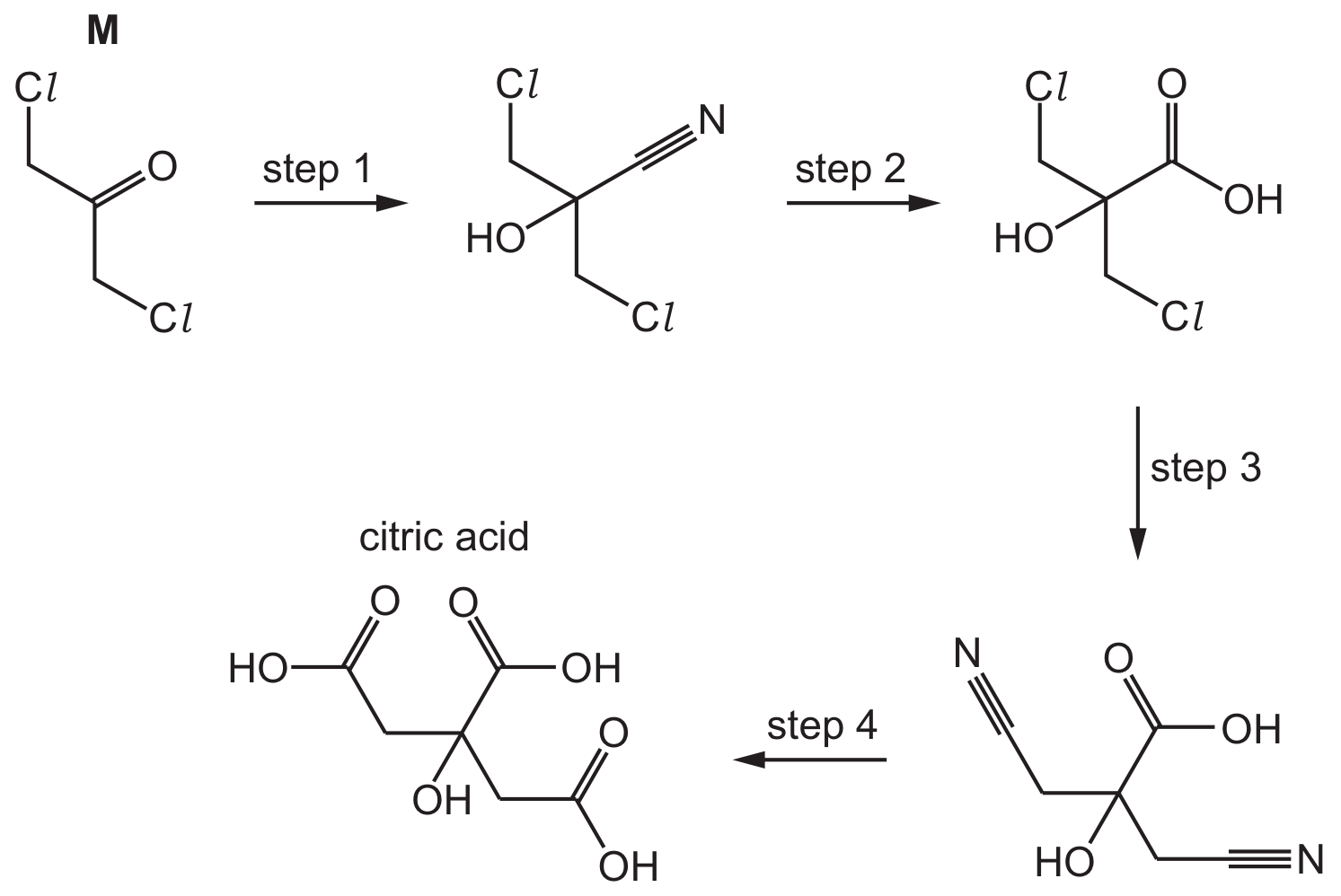
Citric acid can be made from M in a four-step reaction.

Question image

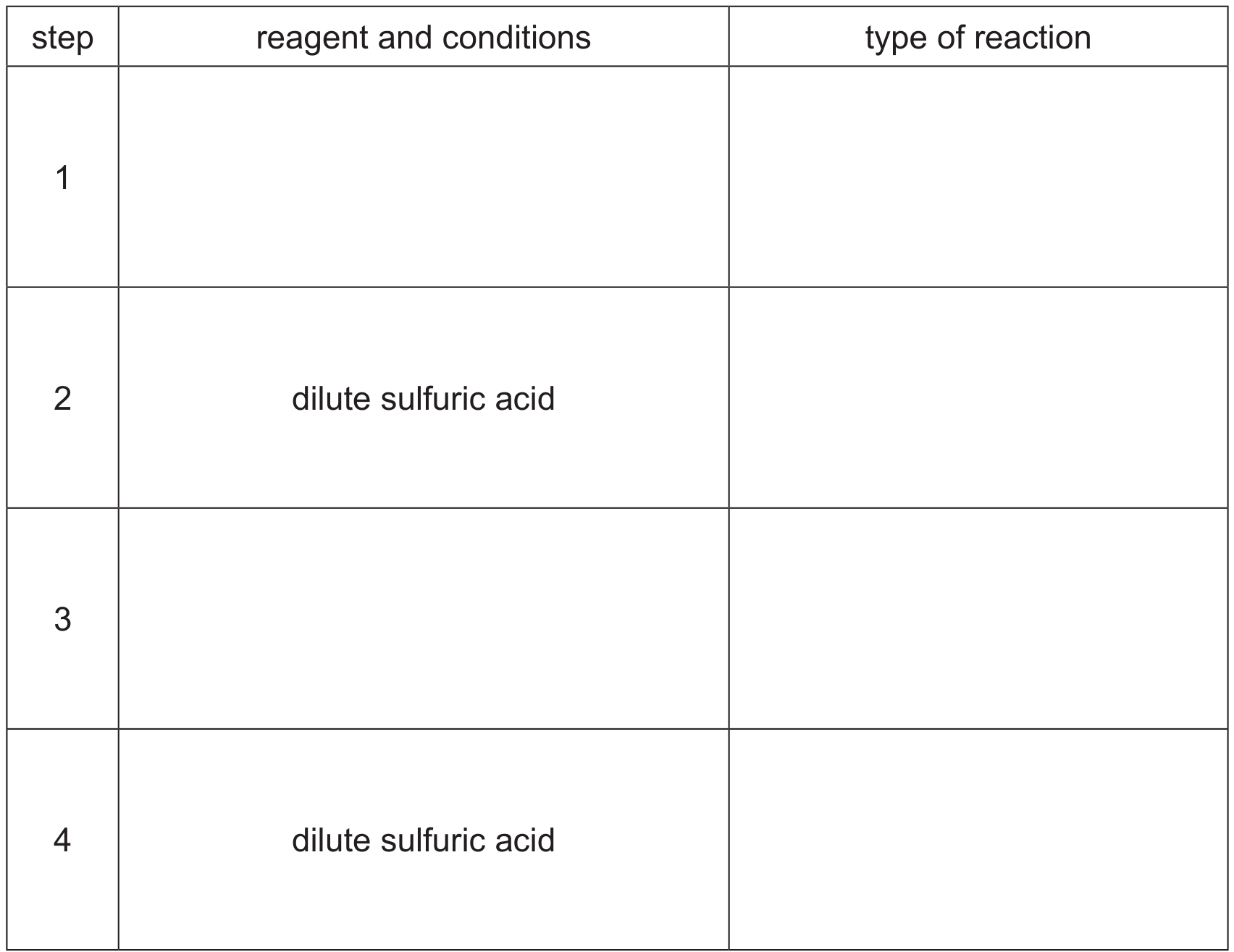
Complete the table for each step of the reaction sequence to identify:
- the reagents and conditions required
- the type of reaction.

Table
[ 5 ]
(a)

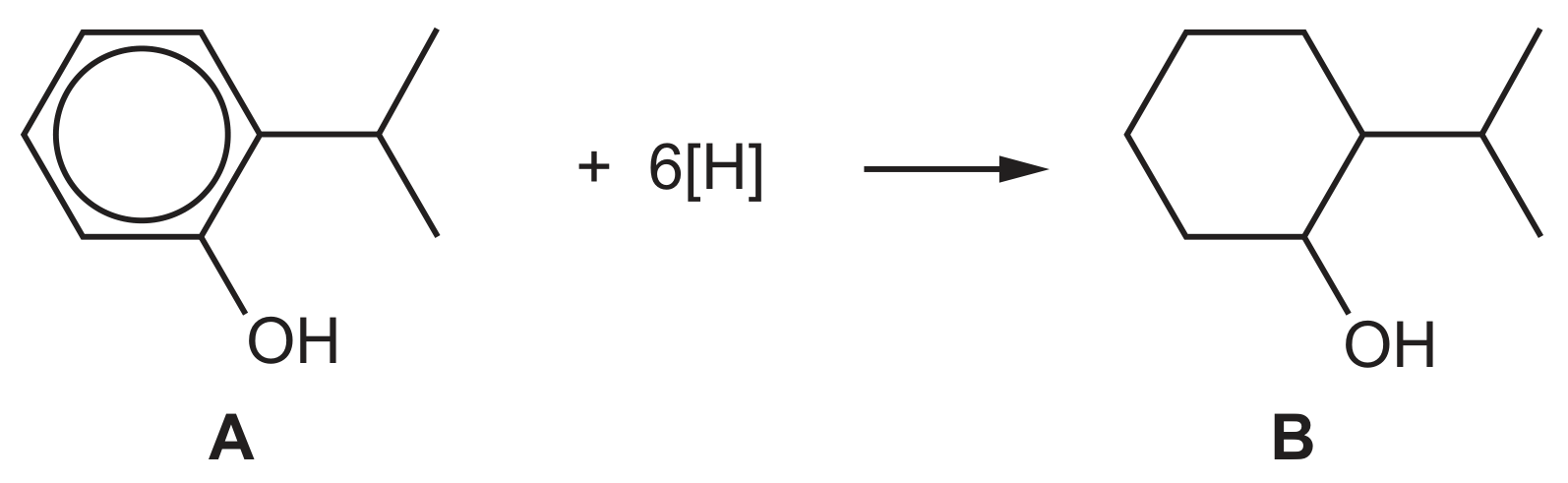
Compound B is a component of several perfumes and flavourings. It can be obtained by the hydrogenation of compound A.
During the reaction, the hydrogen atoms all add onto the same side of the benzene ring.

Question image
[ 1 ]
(i)

Suggest reagents and conditions for this reaction.

[ 1 ]
(b)

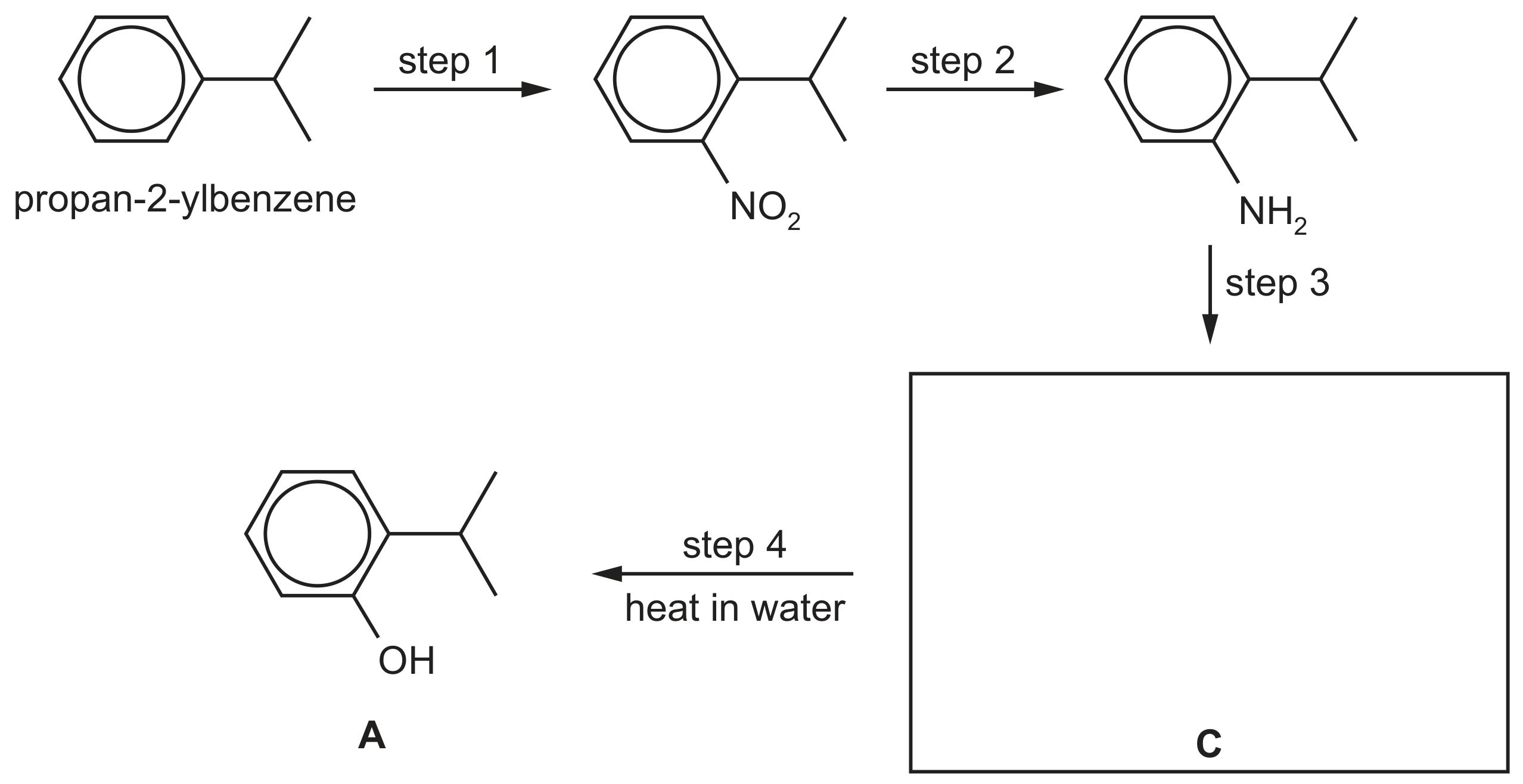
Compound A can be obtained from propan-2-ylbenzene by the following route.

Question image
[ 4 ]
(i)

Suggest reagents and conditions for the following steps.
step 1
step 2
step 3

[ 4 ]
(c)

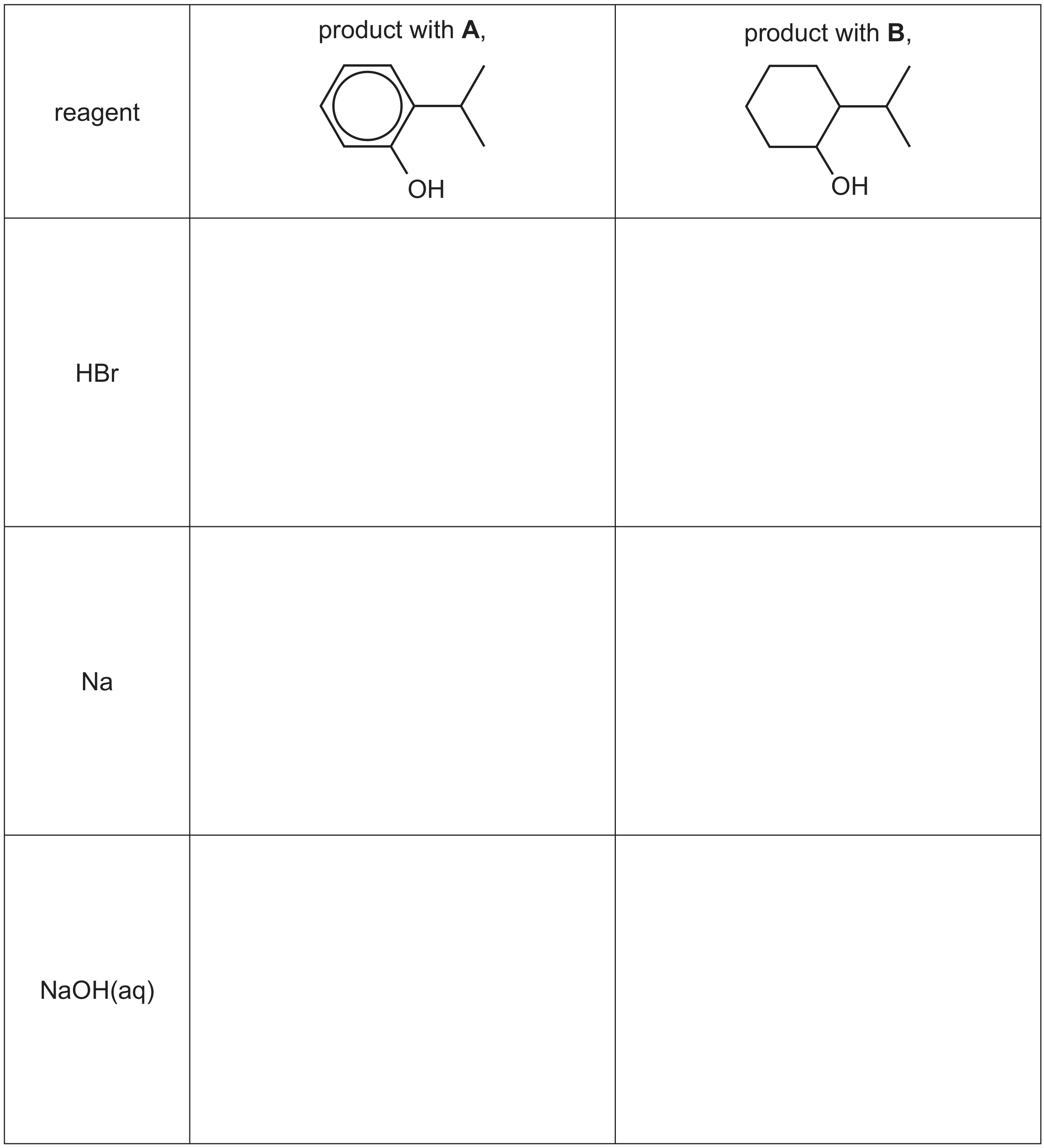
Suggest the structures of the organic products of the reactions between each of the compounds A and B and the following reagents. If no reaction occurs write 'no reaction' in the relevant box.

Table
[ 5 ]
[Maximum number: 5]

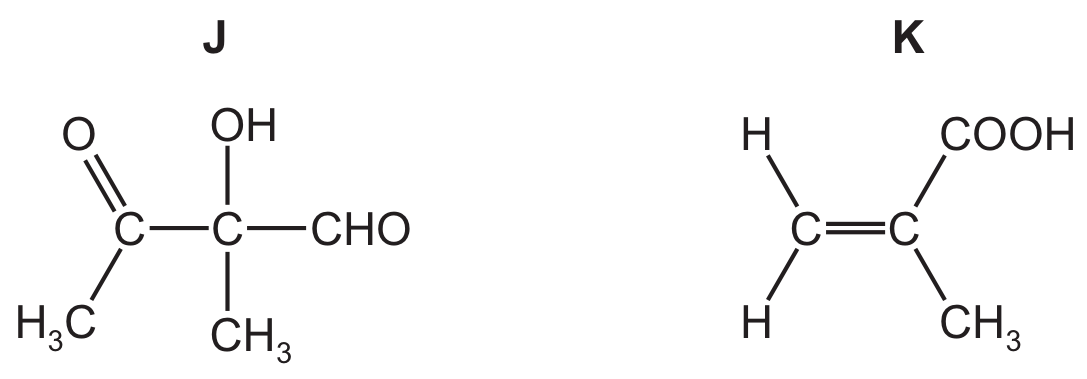
Compounds J and K are found in plant oils.

Fig. 4.1

Fig. 4.1

(a)

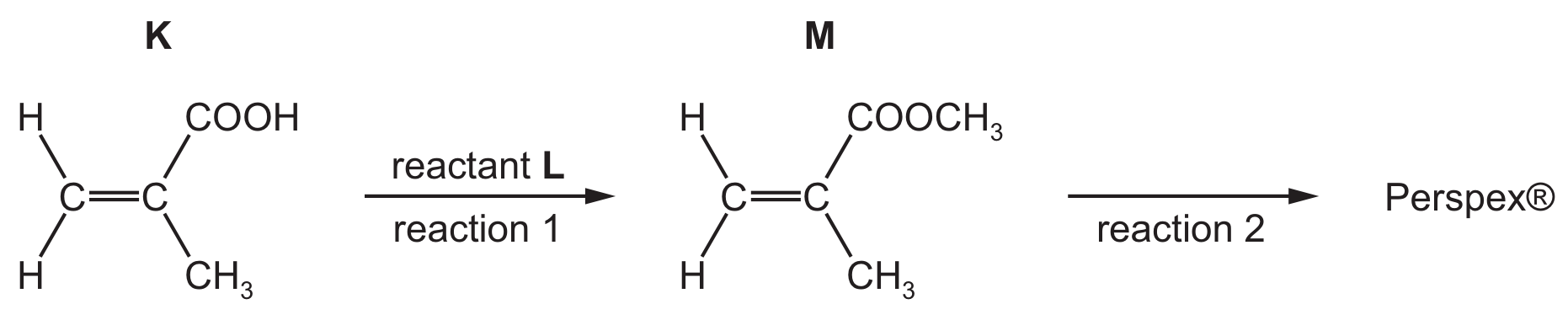
K is used to make the addition polymer Perspex®. A synthesis of Perspex® is shown in Fig. 4.2.

Fig. 4.2

Fig. 4.2

[ 5 ]
(i)

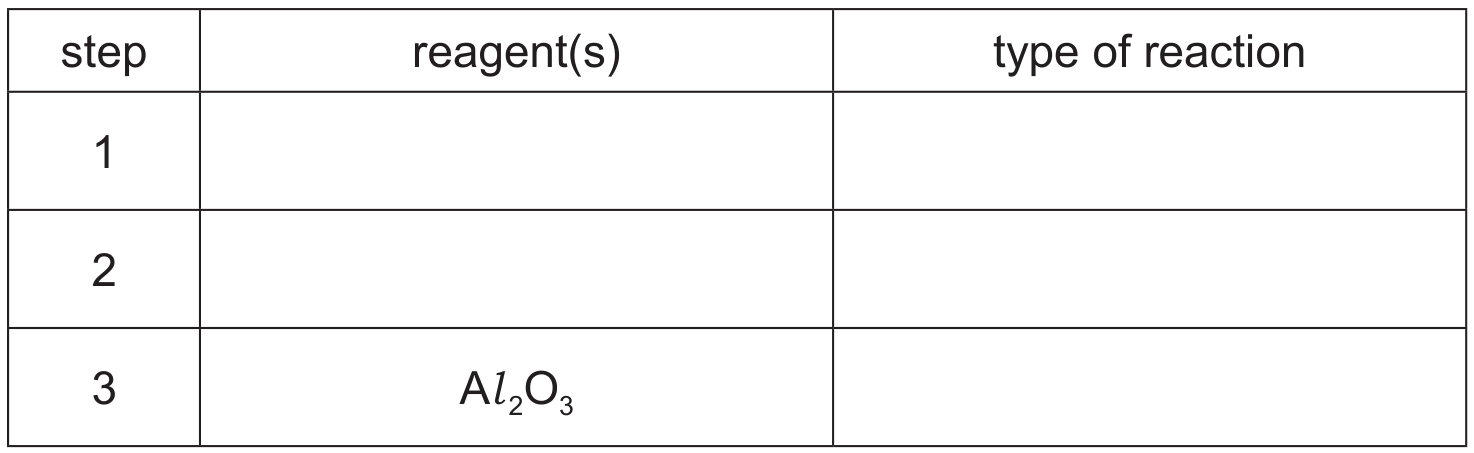
K can be made from propanone in the three-step synthesis shown in Fig. 4.3.

Fig. 4.3

Fig. 4.3

Complete Table 4.3 to identify the reagent(s) used and the type of reaction in each step.

Table 4.3

Table 4.3

[ 5 ]
[Maximum number: 5]

Astronomers using modern telescopes of various types have found many molecules in the dust clouds in space. Many of these molecules are those of organic compounds and astronomers constantly look for evidence that amino acids such as aminoethanoic acid, H2NCH2CO2H\mathrm{H}_{2} \mathrm{NCH}_{2} \mathrm{CO}_{2} \mathrm{H}, are present.

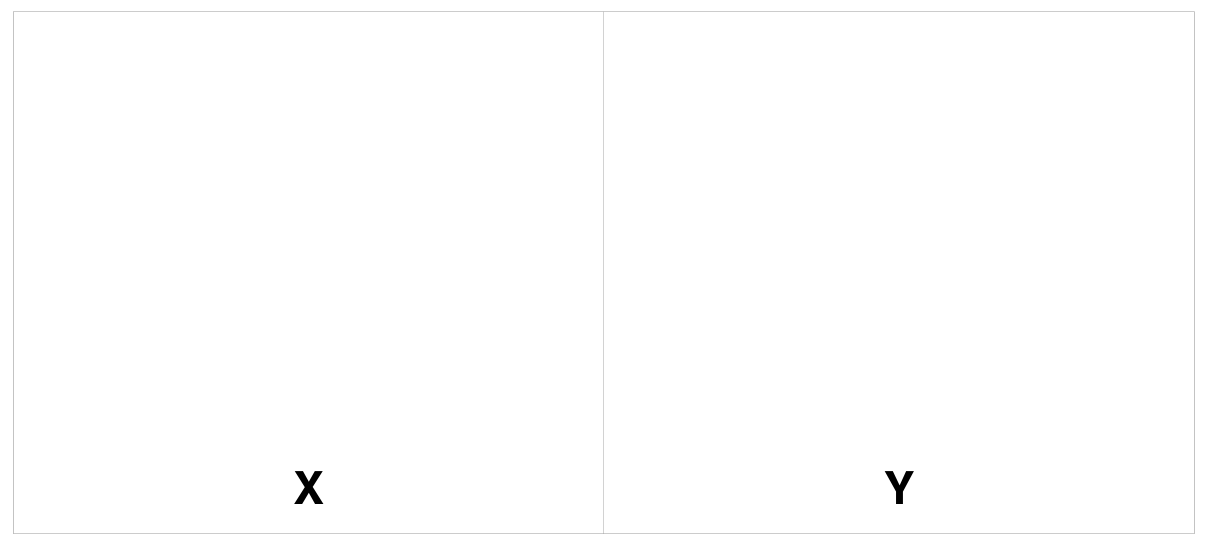
One molecule that has been found in the dust clouds is hydroxyethanal, HOCH2CHO\mathrm{HOCH}_{2} \mathrm{CHO}.

(a)
(i)

In the boxes below, draw the structural formulae of your suggested intermediates X and Y.

Table
(ii)

State the reagents for each of the three steps you have chosen.
step 1
step 2
step 3

[ 5 ]
[Maximum number: 1]

Several steps are involved in the synthesis of 2-hydroxypropanoic acid from ethanol.

Which statements concerning this synthesis are correct?

1 The chain length can be increased during a step involving reaction between HCN and an aldehyde.

2 The carboxyl group can be made by hydrolysis of a nitrile by boiling with NaOH(aq) and then acidifying.

3 The ethanol should be first oxidised by heating it under reflux with an excess of acidified potassium dichromate(VI).

A

1, 2 and 3 are correct

B

1 and 2 only are correct

C

2 and 3 only are correct

D

1 only is correct

[Maximum number: 1]

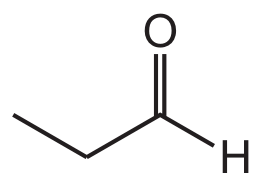
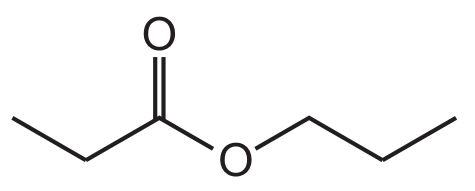
The ester C2H5CO2CH2CH2CH3\mathrm{C}_{2} \mathrm{H}_{5} \mathrm{CO}_{2} \mathrm{CH}_{2} \mathrm{CH}_{2} \mathrm{CH}_{3} can be made in a school or college laboratory by a sequence of reactions using compound X as the only organic material.

What might be the identity of compound X ?
1CH3CH2CH2OH1 \mathrm{CH}_{3} \mathrm{CH}_{2} \mathrm{CH}_{2} \mathrm{OH}2CH3CH2CHO2 \mathrm{CH}_{3} \mathrm{CH}_{2} \mathrm{CHO}3CH3COCH33 \mathrm{CH}_{3} \mathrm{COCH}_{3}

A

1, 2 and 3 are correct

B

1 and 2 only are correct

C

2 and 3 only are correct

D

1 only is correct

[Maximum number: 3]

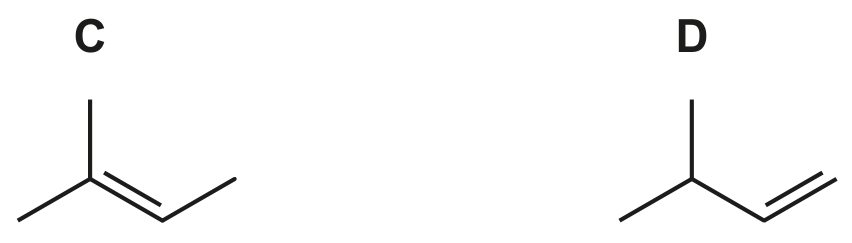
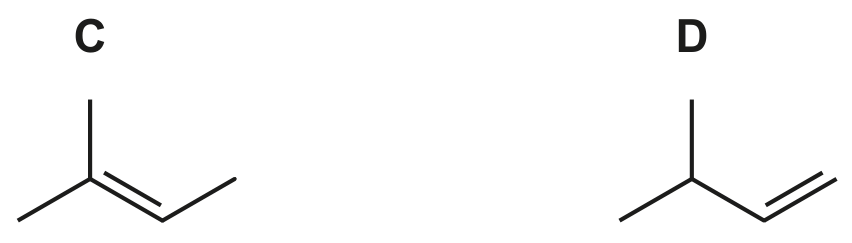
Compounds C and D are alkenes with the same molecular formula, C5H10\mathrm{C}_{5} \mathrm{H}_{10}.

Fig. 4.1

Fig. 4.1

(a)

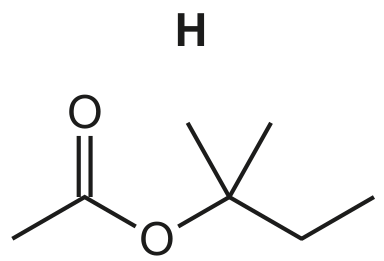
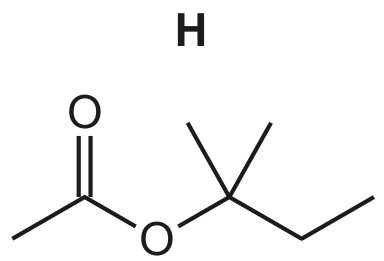
C can be used to form H.

Fig. 4.4

Fig. 4.4

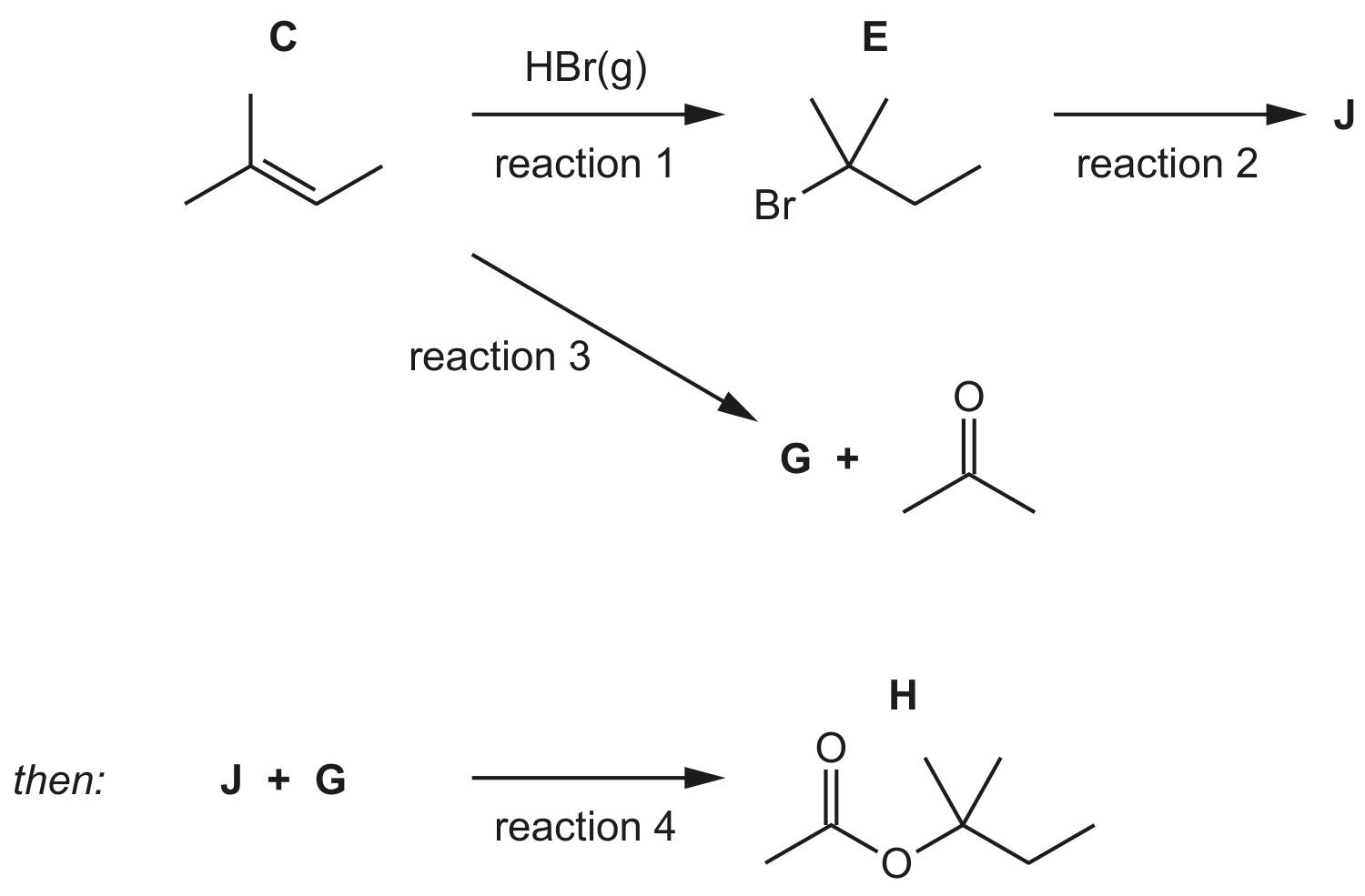
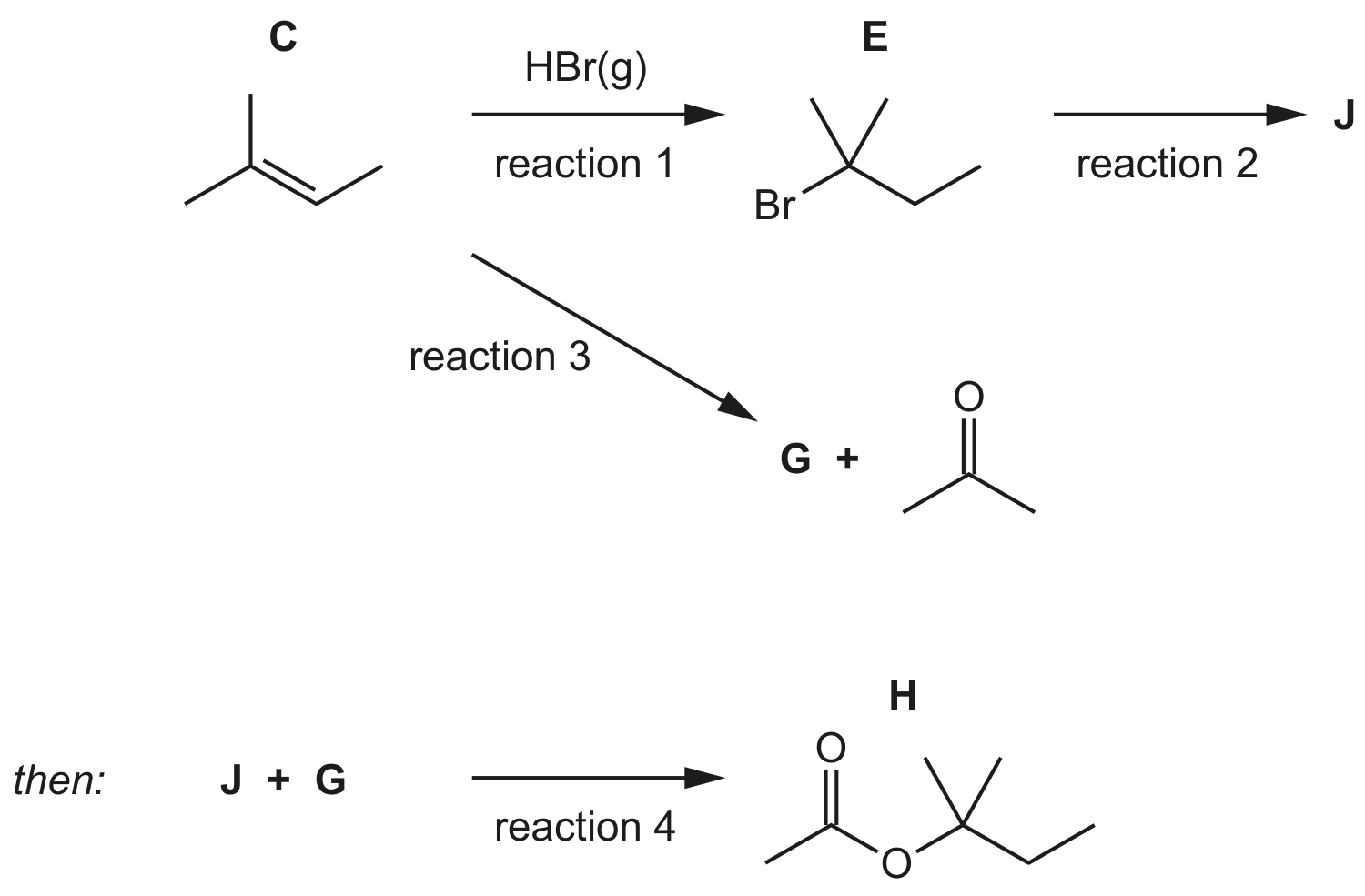
One possible synthesis of H is shown in Fig. 4.5. Different portions of C are used in reactions 1 and 3 . Some of the products are then combined to produce H.

Fig. 4.5 does not show any of the inorganic products of the reactions.

Fig. 4.5

Fig. 4.5

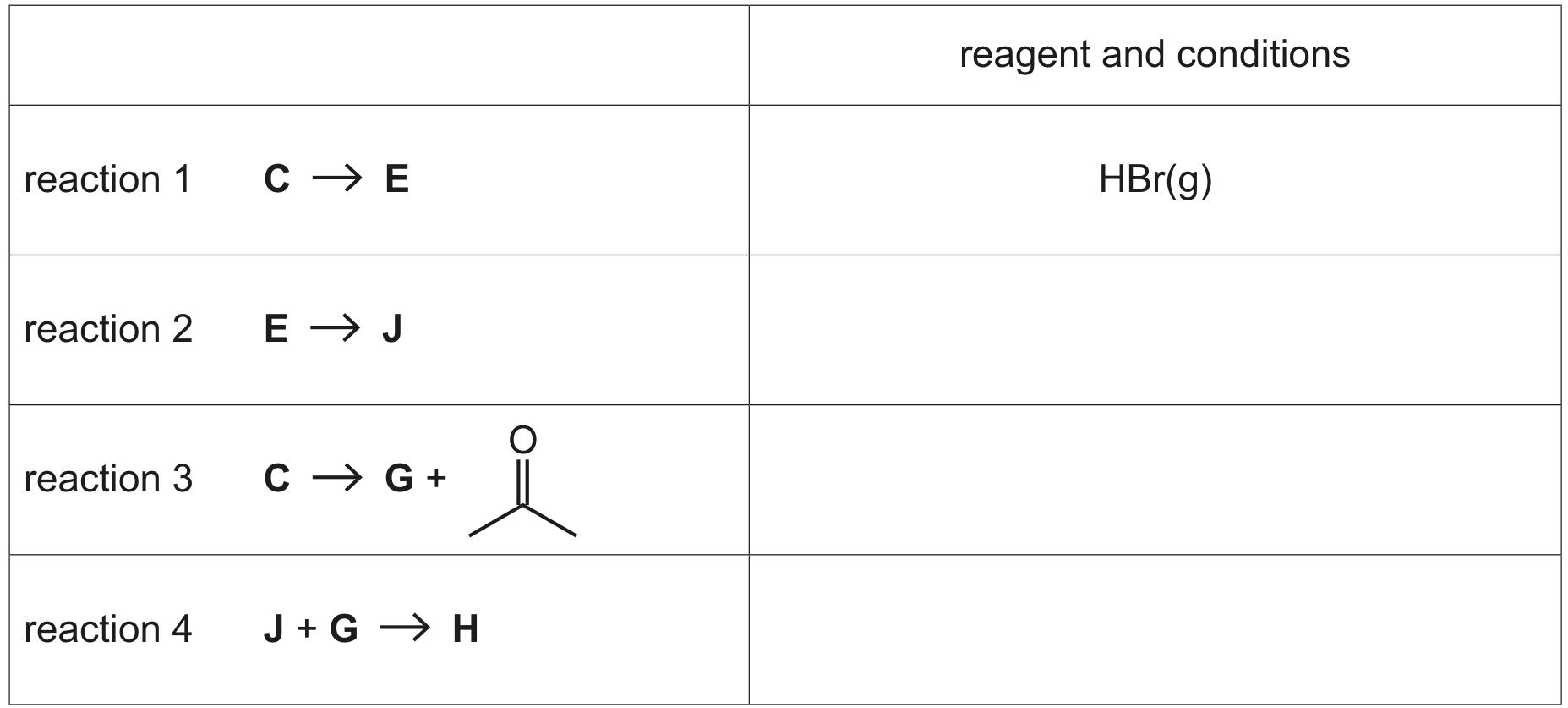
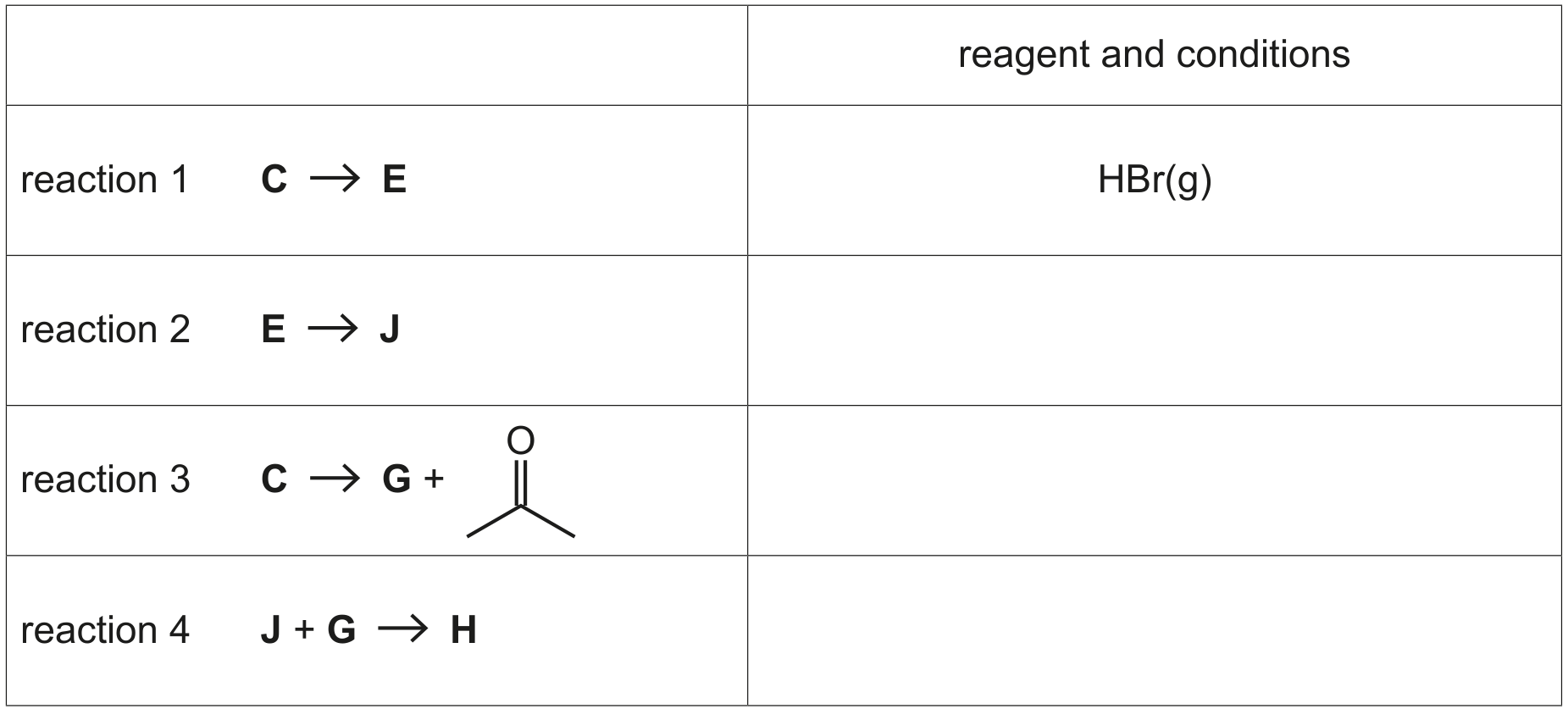
Complete Table 4.1 with the reagents and conditions required for each of the reactions shown in Fig. 4.5.

Table 4.1

Table 4.1

[ 3 ]
[Maximum number: 3]

Compounds C and D are alkenes with the same molecular formula, C5H10\mathrm{C}_{5} \mathrm{H}_{10}.

Fig. 4.1

Fig. 4.1

(a)

C can be used to form H.

Fig. 4.4

Fig. 4.4

One possible synthesis of H is shown in Fig. 4.5. Different portions of C are used in reactions 1 and 3 . Some of the products are then combined to produce H.

Fig. 4.5 does not show any of the inorganic products of the reactions.

Fig. 4.5

Fig. 4.5

Complete Table 4.1 with the reagents and conditions required for each of the reactions shown in Fig. 4.5.

Table 4.1

Table 4.1

[ 3 ]
0