(a)
The first seven ionisation energies of an element, A, in , are
[ 2 ]
(i)
State the group of the Periodic Table to which A is most likely to belong. Explain your answer.
[ 2 ]
 EduNinja
The first seven ionisation energies of an element, A, in , are
State the group of the Periodic Table to which A is most likely to belong. Explain your answer.
The elements of the third period of the Periodic Table, sodium to sulfur, all form chlorides by direct combination.
No chloride of argon has ever been produced.
Suggest a reason for this.
Copper, proton number 29, and argon, proton number 18, are elements which have different physical and chemical properties.
In the solid state, each element has the same face-centred cubic crystal structure which is shown below.
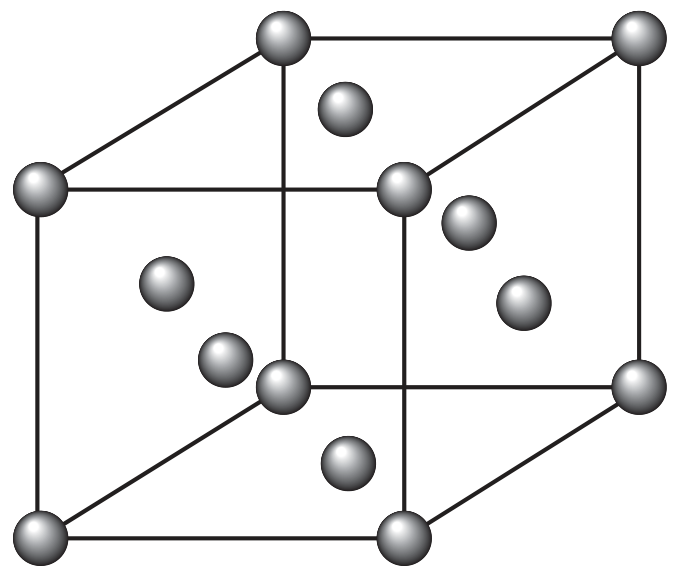
The particles present in such a crystal may be atoms, molecules, anions or cations. In the diagram above, the particles present are represented by
Suggest a reason for the lack of a reaction between argon and chlorine.
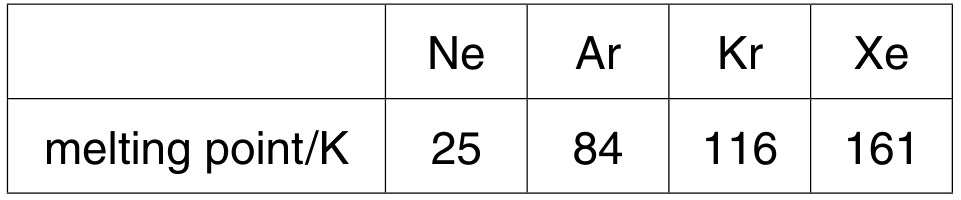
The melting points of the noble gases neon to xenon are given below.
The Periodic Table we currently use is derived directly from that proposed in 1869 by Mendeleev who had noticed patterns in the physical and chemical properties of the elements he had studied.
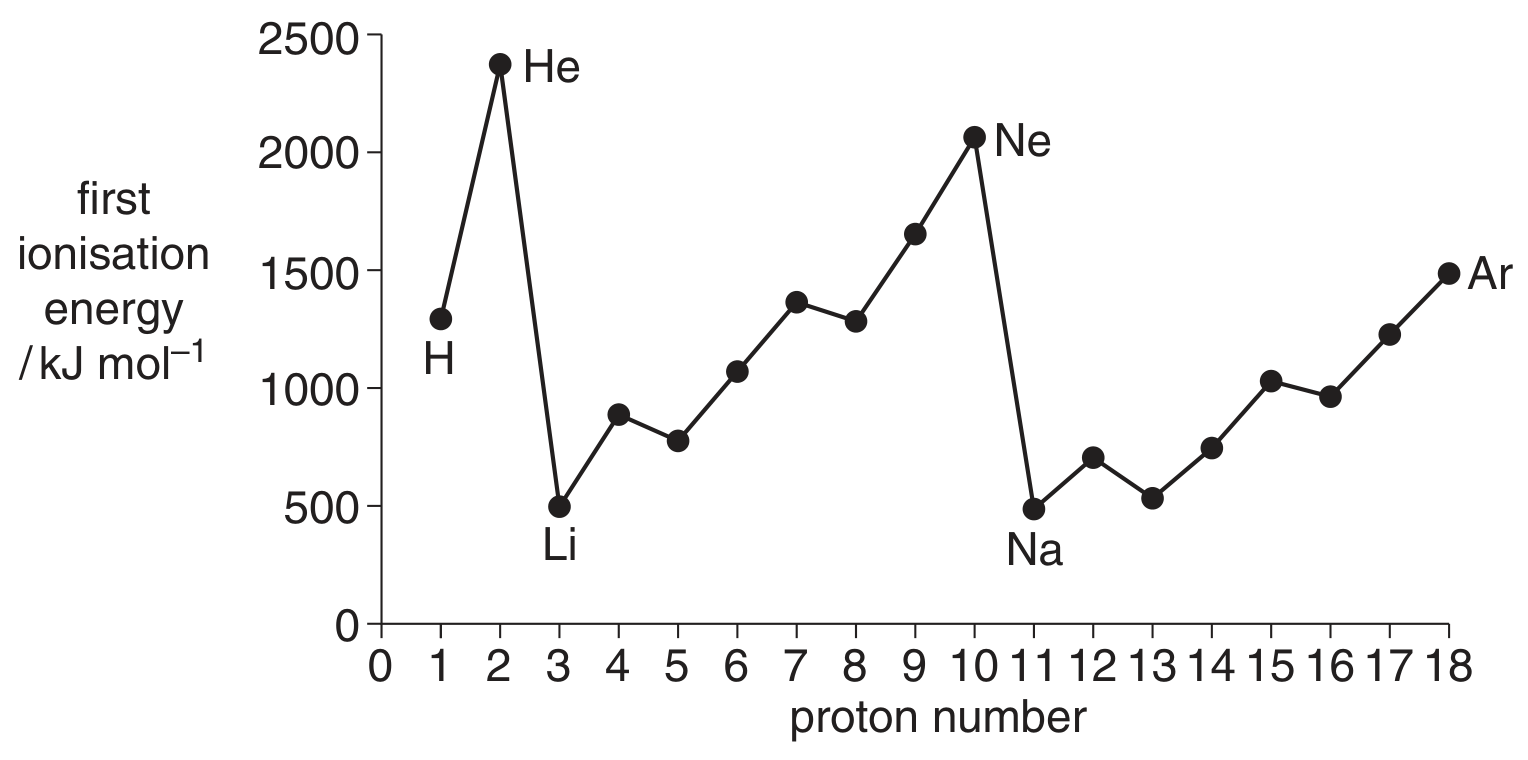
The diagram below shows the first ionisation energies of the first 18 elements of the Periodic Table.
By considering the properties of the third Period elements aluminium to chlorine, suggest the identity of the fourth Period element E.
The alkali metals are a series of six elements in Group I of the Periodic Table. The first ionisation energy of these elements shows a marked trend as the Group is descended.
When heated in chlorine, all of the alkali metals react to form the corresponding chloride.
Describe what you see when sodium is heated in chlorine and write a balanced equation for the reaction.
description
equation
An element Y reacts according to the following sequence.

What could be element Y?
Al
Ca
Mg
P
Caesium and barium are in Period 6 of the Periodic Table.
Which row is correct?
the larger
ionic radius
the higher
melting point
barium
caesium
barium
caesium
Dmitri Mendeleev published the first Periodic Table in 1869.
Mendeleev used his knowledge of chemical periodicity to propose the properties of gallium, , a Group 13 element.
Table 2 gives some chemical and physical data of elements in Group 13.
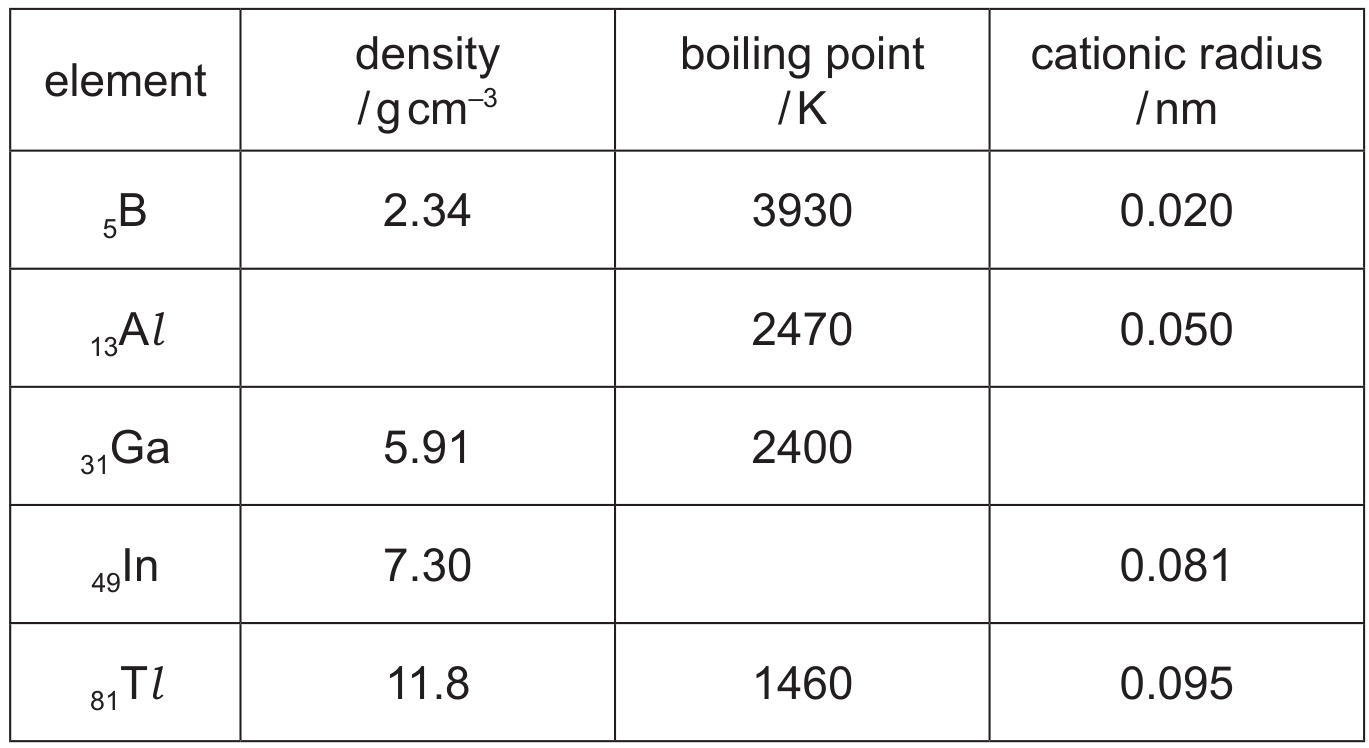
Table 2
Complete the table by predicting values for the missing data.
This question refers to the elements shown in the section of the Periodic Table below.
Li Be
H
He
Na Mg
B C N O F Ne
K Ca Sc Ti V Cr Mn Fe Co Ni Cu Zn Ga Ge As Se Br Kr
From this list of elements, identify in each case one element that has the property described. Give the symbol of the element.
an element that sinks in cold water and reacts readily with it