[Maximum number: 1]
Which row identifies a suitable starting material and reagent that can be used to produce butanenitrile?
starting material
reagent
HCN
NaCN
HCN
NaCN
 EduNinja
Which row identifies a suitable starting material and reagent that can be used to produce butanenitrile?
starting material
reagent
HCN
NaCN
HCN
NaCN
Which reagents and conditions would result in the formation of butanenitrile, ?
1-bromobutane heated under pressure with ammonia in ethanol
1-bromopropane heated with potassium cyanide in ethanol
propanal heated with hydrogen cyanide in the presence of potassium cyanide
propanone heated with hydrogen cyanide in the presence of potassium cyanide
200 mol ethanenitrile reacts with an excess of dilute sodium hydroxide. The reaction produces organic compound S and ammonia gas only.
The reaction has an 80.0% yield.
Which mass of S is produced?
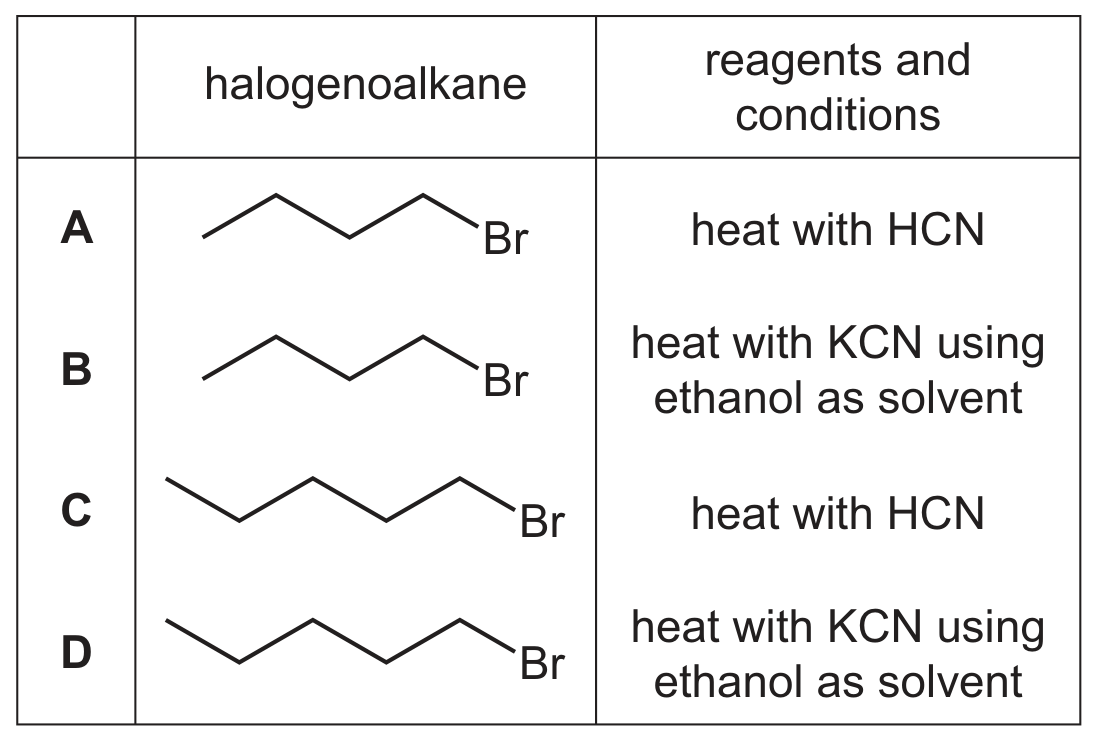
Which row gives pentanenitrile as one product?
Compound Y is treated with a single reagent under suitable conditions. 2-methylbutanoic acid is produced.
What could compound Y be?
pentan-2-one
2-methylbutan-2-ol
2-methylbutanenitrile
methylpropanenitrile
In an experiment, of an organic compound, J, in the gaseous state was sparked with an excess of oxygen. of carbon dioxide and of nitrogen were obtained among the products. All gas volumes were measured at the same temperature and pressure.
What could be the identity of J ?
1
2
3
1, 2 and 3 are correct
1 and 2 only are correct
2 and 3 only are correct
1 only is correct
Compound W contains atoms of carbon, nitrogen and hydrogen.
Compound W reacts with HCl(aq) to produce propanoic acid.
Which row is correct?
functional group
in compound W
name of
compound W
amine
ethylamine
nitrile
ethanenitrile
amine
propylamine
nitrile
propanenitrile
reacts to form alcohol Y via the reaction sequence shown.
Which row names the molecule X and the class of alcohol Y ?
name of molecule X
class of alcohol Y
2,2-dimethylbutanoic acid
primary
3,3-dimethylbutanoic acid
tertiary
dimethylpropanoic acid
primary
dimethylpropanoic acid
tertiary
reacts to form alcohol Y via the reaction sequence shown.
Which row names the molecule X and the class of alcohol Y ?
name of molecule X
class of alcohol Y
2,2-dimethylbutanoic acid
primary
3,3-dimethylbutanoic acid
tertiary
dimethylpropanoic acid
primary
dimethylpropanoic acid
tertiary
Which compounds can be used to make Y in a single-step reaction?
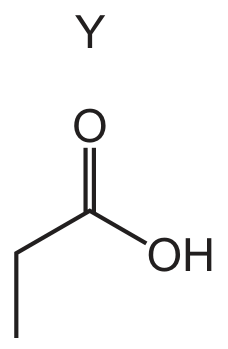
1 propanenitrile
2 ethanenitrile
3 propyl ethanoate
4 ethyl propanoate
1 and 3
1 and 4
2 and 3
2 and 4