[Maximum number: 1]
The table shows the numbers of protons, neutrons and electrons in four different particles, W, X, Y, and Z.
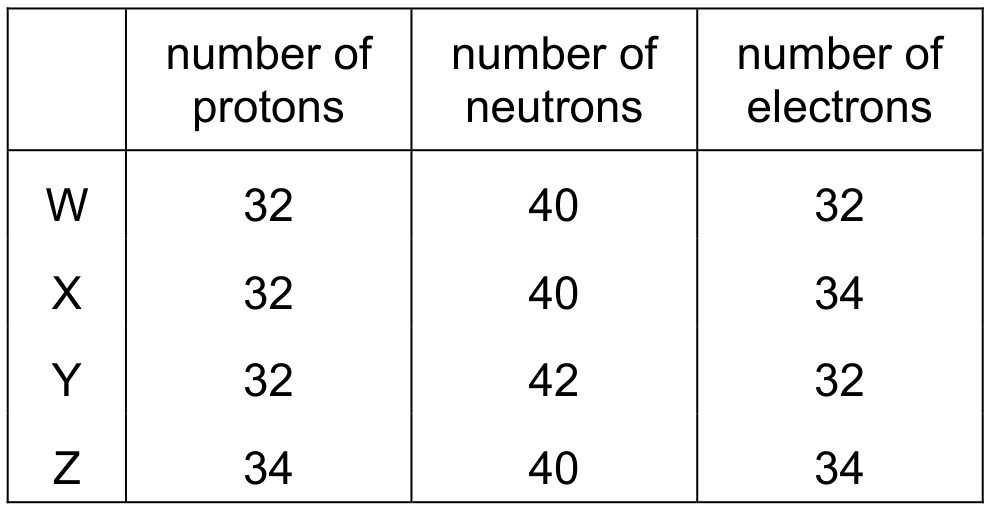
Which pair represents the atoms of two isotopes of the same element?
A
W and Y
B
W and Z
C
X and Y
D
X and Z
 EduNinja
The table shows the numbers of protons, neutrons and electrons in four different particles, W, X, Y, and Z.
Which pair represents the atoms of two isotopes of the same element?
W and Y
W and Z
X and Y
X and Z
The mass spectrum of a halogenoalkane containing one chlorine atom or bromine atom will show an additional peak at M+2.
State the isotopes of chlorine and bromine responsible for M+2 peaks.
chlorine bromine
The relative atomic mass of an element can be determined using data from its mass spectrum.
The mass spectrum of element X is shown, with the percentage abundance of each isotope labelled.
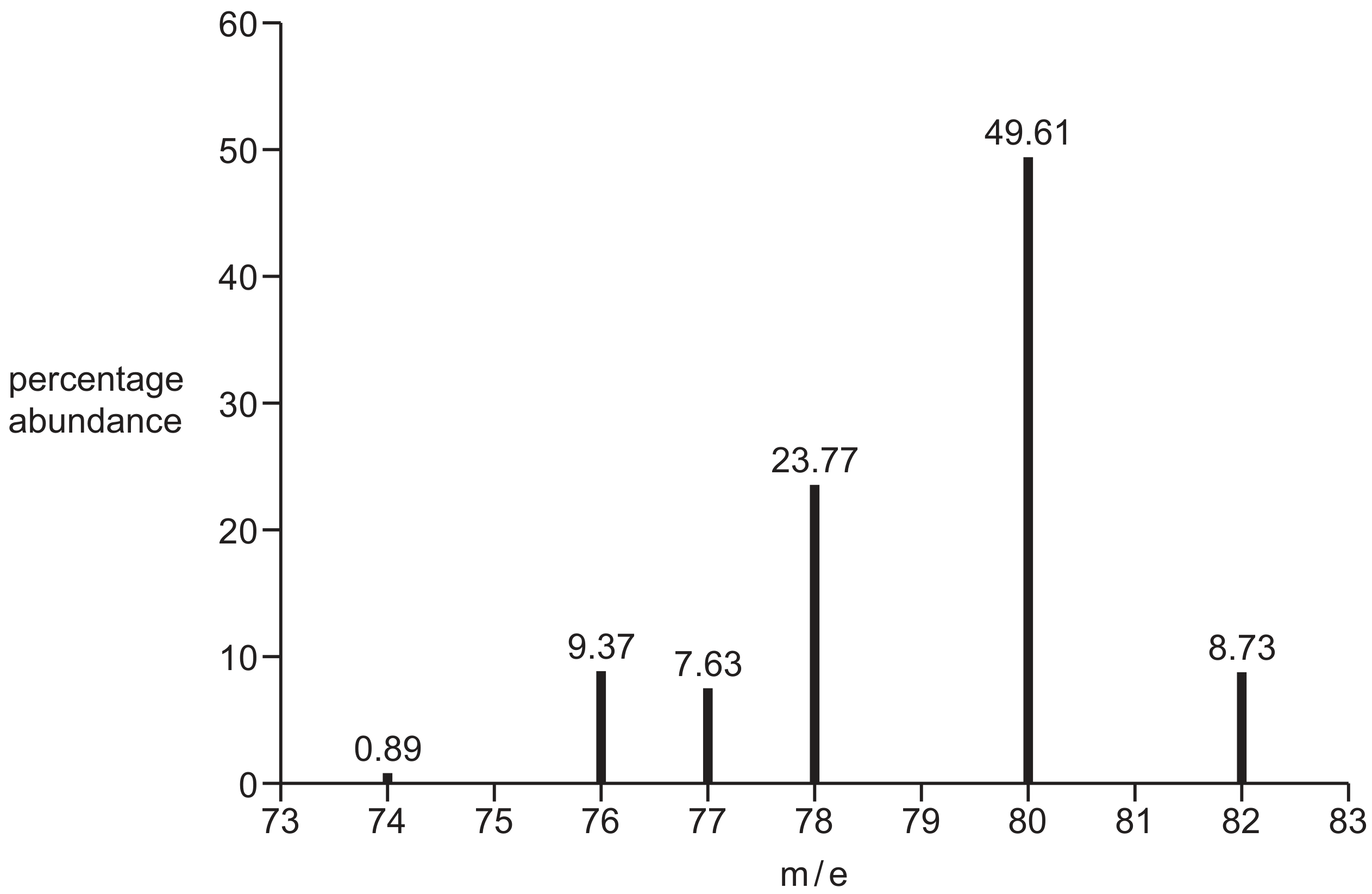
Define the terms relative atomic mass and isotope.
relative atomic mass
isotope
The model of the nuclear atom was first proposed by Ernest Rutherford. He developed this model on the basis of results obtained from an experiment using gold metal foil.
A sample of gold found in the earth consists of only one isotope.
Explain what is meant by the term isotopes.
A different sample of gold contains more than one isotope.
Suggest why this different sample of gold has the same chemical properties as the sample found in the earth.
A sample contains three different types of atom: and .
State fully, in terms of the numbers of subatomic particles, what these three atoms have in common.
State fully, in terms of the numbers of all subatomic particles, how these three atoms differ from each other.
Gallium is a metal in Group 13 of the Periodic Table.
There are two stable isotopes of gallium, and .
State, with reference to subatomic particles, how the isotopes and differ from each other.
Atoms contain the subatomic particles electrons, protons and neutrons. Protons and electrons were discovered by observations of their behaviours in electric fields.
Hydron is a general term used to represent the ions and .
State, in terms of subatomic particles in the nucleus, what is the same about each of these ions and what is different.
same
different
Calcium, magnesium and radium are Group 2 elements. Radium follows the same trends as the other members of Group 2.
is an isotope of magnesium.
Determine the number of protons and neutrons in an atom of .
number of protons
number of neutrons
A sample of magnesium contains three isotopes, and X.
The percentage abundance of the three isotopes is shown in Table 1.1.
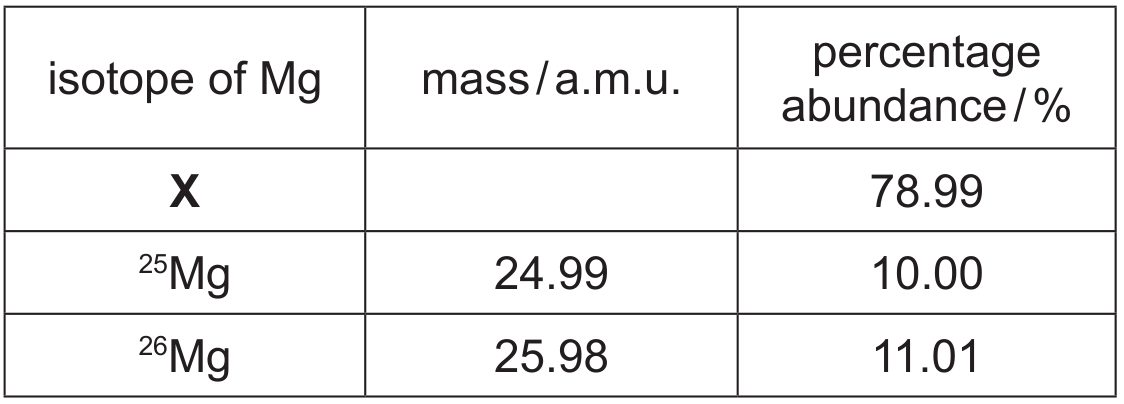
Table 1.1
State one similarity and one difference in the properties of these isotopes of magnesium. Explain your answer.
An isotope of copper has a relative isotopic mass of 65 .
Complete Table 1.2 for an atom of copper-65.

Table 1.2
Atoms with nuclei containing an odd number of protons tend to have fewer isotopes than those with an even number of protons.
Potassium also has two stable isotopes. Both isotopes have the same chemical properties.
Explain why both isotopes of potassium have the same chemical properties.