EduNinja
(a)

The major source of sulfur for the manufacture of sulfuric acid by the Contact process is the de-sulfurisation of 'sour' natural gas. Many natural gas wells produce a mixture of volatile hydrocarbons (mainly CH4\mathrm{CH}_{4} and C2H6\mathrm{C}_{2} \mathrm{H}_{6} ) together with up to 25 % hydrogen sulfide, H2 S\mathrm{H}_{2} \mathrm{~S}.

[ 8 ]
(i)

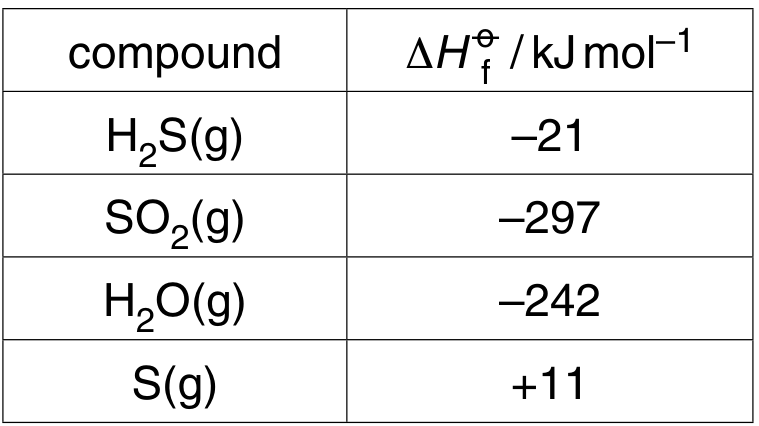
Use the following data to calculate ΔH\Delta H^{\ominus} for the reaction between H2 S\mathrm{H}_{2} \mathrm{~S} and SO2\mathrm{SO}_{2}.

Table

kJmol1\mathrm{kJ} \mathrm{mol}^{-1}

[ 8 ]
[Maximum number: 2]

Sulfides are compounds that contain sulfur but not oxygen.

(a)

The enthalpy change of combustion of CS2(I)\mathrm{CS}_{2}(\mathrm{I}) is represented by the following equation.

CS2(l)+3O2( g)ΔHcCO2( g)+2SO2( g)\mathrm{CS}_{2}(\mathrm{l})+3 \mathrm{O}_{2}(\mathrm{~g}) \xrightarrow{\Delta H_{\mathrm{c}}} \mathrm{CO}_{2}(\mathrm{~g})+2 \mathrm{SO}_{2}(\mathrm{~g})
[ 2 ]
(i)

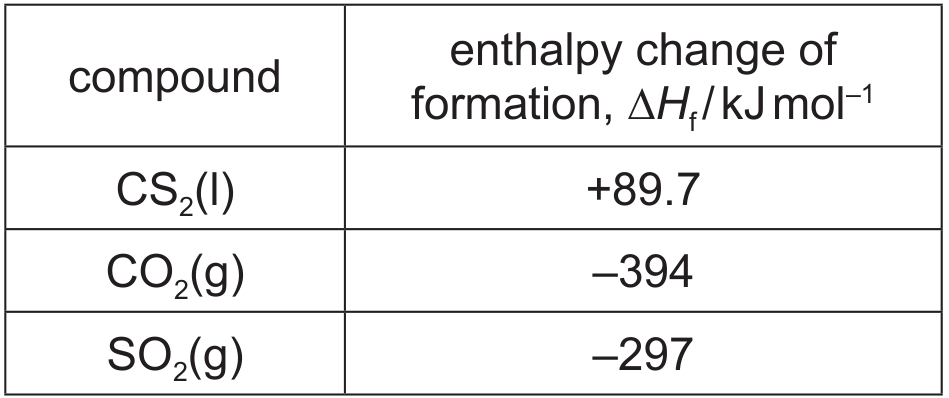
The table shows the enthalpy changes of formation of CS2(I),CO2( g)\mathrm{CS}_{2}(\mathrm{I}), \mathrm{CO}_{2}(\mathrm{~g}) and SO2( g)\mathrm{SO}_{2}(\mathrm{~g}).

Table

Use the data in the table to calculate the enthalpy change of combustion, ΔHc\Delta H_{\mathrm{c}}, of CS2(I)\mathrm{CS}_{2}(\mathrm{I}), in kJmol1\mathrm{kJ} \mathrm{mol}{ }^{-1}.

Show your working.
ΔHc\Delta H_{\mathrm{c}} of CS2(I)=\mathrm{CS}_{2}(\mathrm{I})=kJmol1\mathrm{kJ} \mathrm{mol}^{-1}

[ 2 ]
[Maximum number: 12]

Hydrazine, N2H4\mathrm{N}_{2} \mathrm{H}_{4}, can be used as a rocket fuel and is stored as a liquid. It reacts exothermically with oxygen to give only gaseous products.

The enthalpy change of a reaction such as that between hydrazine and oxygen may be calculated by using standard enthalpy changes of formation.

(a)

Hydrazine reacts with oxygen according to the following equation.

N2H4(l)+O2( g)N2( g)+2H2O( g)\mathrm{N}_{2} \mathrm{H}_{4}(\mathrm{l})+\mathrm{O}_{2}(\mathrm{~g}) \rightarrow \mathrm{N}_{2}(\mathrm{~g})+2 \mathrm{H}_{2} \mathrm{O}(\mathrm{~g})
(i)

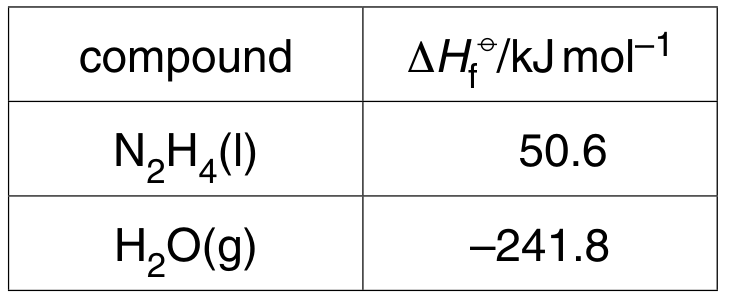
Use the data in the table to calculate the standard enthalpy change of this reaction.

Table
ΔH=\Delta H^{\ominus}=

kJmol1\mathrm{kJ} \mathrm{mol}^{-1}

[Maximum number: 1]

Group 2 metals form alkaline solutions in water.

(a)

Magnesium peroxide, MgO2\mathrm{MgO}_{2}, is made in the following reaction.

MgO( s)+H2O2(l)MgO2( s)+H2O(l)ΔH=96 kJ mol1\mathrm{MgO}(\mathrm{~s})+\mathrm{H}_{2} \mathrm{O}_{2}(\mathrm{l}) \rightarrow \mathrm{MgO}_{2}(\mathrm{~s})+\mathrm{H}_{2} \mathrm{O}(\mathrm{l}) \quad \Delta H=-96 \mathrm{~kJ} \mathrm{~mol}^{-1}
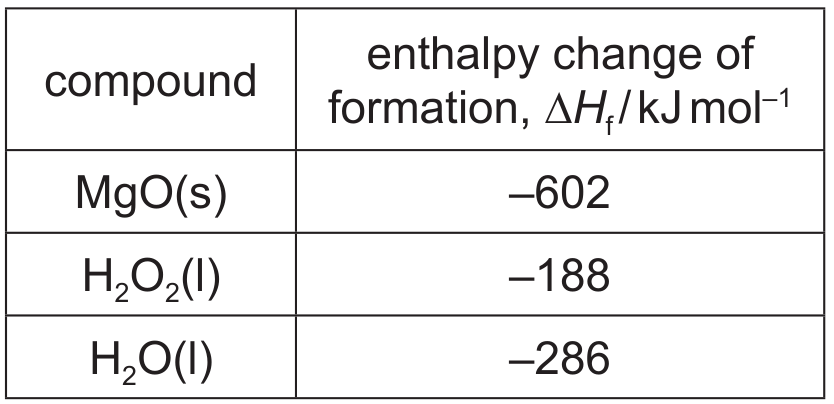
Table
[ 1 ]
(i)

Magnesium peroxide decomposes slowly to form magnesium oxide and oxygen.

MgO2( s)MgO( s)+12O2( g)\mathrm{MgO}_{2}(\mathrm{~s}) \rightarrow \mathrm{MgO}(\mathrm{~s})+\frac{1}{2} \mathrm{O}_{2}(\mathrm{~g})

Use your answer to (g)(iii) and the data in the table to calculate the enthalpy change of this reaction.

If you were unable to obtain an answer to (g)(iii), use the value ΔHf=550 kJ mol1\Delta H_{\mathrm{f}}=-550 \mathrm{~kJ} \mathrm{~mol}^{-1}. This is not the correct answer.
enthalpy change of reaction = kJmol1\mathrm{kJ} \mathrm{mol}^{-1}

[ 1 ]
[Maximum number: 1]

The enthalpy change of formation of carbon dioxide is 394 kJ mol1-394 \mathrm{~kJ} \mathrm{~mol}^{-1}.
The enthalpy change of formation of water is 286 kJ mol1-286 \mathrm{~kJ} \mathrm{~mol}^{-1}.
The enthalpy change of formation of methane is 74 kJ mol1-74 \mathrm{~kJ} \mathrm{~mol}^{-1}.
What is the enthalpy change of combustion of methane?

A

892 kJ mol1-892 \mathrm{~kJ} \mathrm{~mol}^{-1}

B

606 kJ mol1-606 \mathrm{~kJ} \mathrm{~mol}^{-1}

C

+606 kJ mol1+606 \mathrm{~kJ} \mathrm{~mol}^{-1}

D

+892 kJ mol1+892 \mathrm{~kJ} \mathrm{~mol}^{-1}

[Maximum number: 1]

A student performed an experiment to measure the enthalpy change of combustion of ethane.
He used the following values for the standard enthalpy changes of combustion of carbon and hydrogen.

ΔHc carbon =394 kJ mol1ΔHc hydrogen =286 kJ mol1\begin{aligned} & \Delta H_{\mathrm{c}}^{\ominus} \text { carbon }=-394 \mathrm{~kJ} \mathrm{~mol}^{-1} \\ & \Delta H_{\mathrm{c}}^{\ominus} \text { hydrogen }=-286 \mathrm{~kJ} \mathrm{~mol}^{-1} \end{aligned}

He calculated the enthalpy change of formation of ethane to be 140 kJ mol1-140 \mathrm{~kJ} \mathrm{~mol}^{-1}.
What was his experimental value for the standard enthalpy change of combustion of ethane?

A

2364 kJ mol1-2364 \mathrm{~kJ} \mathrm{~mol}^{-1}

B

1506 kJ mol1-1506 \mathrm{~kJ} \mathrm{~mol}^{-1}

C

1112 kJ mol1-1112 \mathrm{~kJ} \mathrm{~mol}^{-1}

D

540 kJ mol1-540 \mathrm{~kJ} \mathrm{~mol}^{-1}

[Maximum number: 1]

ΔH1\Delta H_{1}^{\ominus} is the standard enthalpy of formation of methane.
ΔH2\Delta H_{2}^{\ominus} is the standard enthalpy of combustion of carbon.
ΔH3\Delta H_{3}^{\ominus} is the standard enthalpy of combustion of hydrogen.

Which expression is equivalent to ΔHc\Delta H_{\mathrm{c}}^{\ominus} ?

A

ΔH1ΔH2+ΔH3\Delta H_{1}^{\ominus}-\Delta H_{2}^{\ominus}+\Delta H_{3}^{\ominus}

B

ΔH12ΔH3ΔH2\Delta H_{1}^{\ominus}-2 \Delta H_{3}^{\ominus}-\Delta H_{2}^{\ominus}

C

ΔH2ΔH3+ΔH1\Delta H_{2}^{\ominus}-\Delta H_{3}^{\ominus}+\Delta H_{1}^{\ominus}

D

ΔH2+2ΔH3ΔH1\Delta H_{2}^{\ominus}+2 \Delta H_{3}^{\ominus}-\Delta H_{1}^{\ominus}

[Maximum number: 1]

The following data are needed for this question.

NaHCO3( s)+HCl(aq)NaCl(aq)+H2O(l)+CO2( g)ΔH=38.97 kJ mol1Na2CO3( s)+2HCl(aq)2NaCl(aq)+H2O(l)+CO2( g)ΔH=96.59 kJ mol1\begin{array}{cl} \mathrm{NaHCO}_{3}(\mathrm{~s})+\mathrm{HCl}(\mathrm{aq}) \rightarrow \mathrm{NaCl}(\mathrm{aq})+\mathrm{H}_{2} \mathrm{O}(\mathrm{l})+\mathrm{CO}_{2}(\mathrm{~g}) & \Delta H=-38.97 \mathrm{~kJ} \mathrm{~mol}^{-1} \\ \mathrm{Na}_{2} \mathrm{CO}_{3}(\mathrm{~s})+2 \mathrm{HCl}(\mathrm{aq}) \rightarrow 2 \mathrm{NaCl}(\mathrm{aq})+\mathrm{H}_{2} \mathrm{O}(\mathrm{l})+\mathrm{CO}_{2}(\mathrm{~g}) & \Delta H=-96.59 \mathrm{~kJ} \mathrm{~mol}^{-1} \end{array}

On heating, sodium hydrogencarbonate decomposes as shown.

2NaHCO3( s)Na2CO3( s)+H2O(l)+CO2( g)2 \mathrm{NaHCO}_{3}(\mathrm{~s}) \rightarrow \mathrm{Na}_{2} \mathrm{CO}_{3}(\mathrm{~s})+\mathrm{H}_{2} \mathrm{O}(\mathrm{l})+\mathrm{CO}_{2}(\mathrm{~g})

What is the enthalpy change for this decomposition?

A

57.62 kJ mol1-57.62 \mathrm{~kJ} \mathrm{~mol}^{-1}

B

18.65 kJ mol1-18.65 \mathrm{~kJ} \mathrm{~mol}^{-1}

C

18.65 kJ mol118.65 \mathrm{~kJ} \mathrm{~mol}^{-1}

D

57.62 kJ mol157.62 \mathrm{~kJ} \mathrm{~mol}^{-1}

[Maximum number: 1]

Propanone has the molecular formula C3H6O\mathrm{C}_{3} \mathrm{H}_{6} \mathrm{O}.
The enthalpy change of combustion of hydrogen is 286 kJ mol1-286 \mathrm{~kJ} \mathrm{~mol}^{-1}.
The enthalpy change of combustion of carbon is 394 kJ mol1-394 \mathrm{~kJ} \mathrm{~mol}^{-1}.
The enthalpy change of combustion of propanone is 1786 kJ mol1-1786 \mathrm{~kJ} \mathrm{~mol}^{-1}.
Using this information, what is the enthalpy change of formation of propanone?

A

1106 kJ mol1-1106 \mathrm{~kJ} \mathrm{~mol}^{-1}

B

540 kJ mol1-540 \mathrm{~kJ} \mathrm{~mol}^{-1}

C

254 kJ mol1-254 \mathrm{~kJ} \mathrm{~mol}^{-1}

D

+1106 kJ mol1+1106 \mathrm{~kJ} \mathrm{~mol}^{-1}

[Maximum number: 1]

Calcium forms an ionic compound with carbon, called calcium carbide. The oxidation number of carbon in calcium carbide is -1 .

Calcium carbide is readily hydrolysed by water giving two products only.
What could be the formulae of calcium carbide and the two products of hydrolysis?

calcium carbide

products

Ca2C\mathrm{Ca}_{2} \mathrm{C}

CaO and C2H4\mathrm{C}_{2} \mathrm{H}_{4}

Ca2C\mathrm{Ca}_{2} \mathrm{C}

Ca(OH)2\mathrm{Ca}(\mathrm{OH})_{2} and C2H2\mathrm{C}_{2} \mathrm{H}_{2}

CaC2\mathrm{CaC}_{2}

CaO and C2H4\mathrm{C}_{2} \mathrm{H}_{4}

CaC2\mathrm{CaC}_{2}

Ca(OH)2\mathrm{Ca}(\mathrm{OH})_{2} and C2H2\mathrm{C}_{2} \mathrm{H}_{2}

0