(a)
Explain what is meant by the term electronegativity, and how it relates to the concept of bond polarity.
[ 2 ]
 EduNinja
Explain what is meant by the term electronegativity, and how it relates to the concept of bond polarity.
Sodium and silicon also react directly with chlorine to produce the chlorides shown.
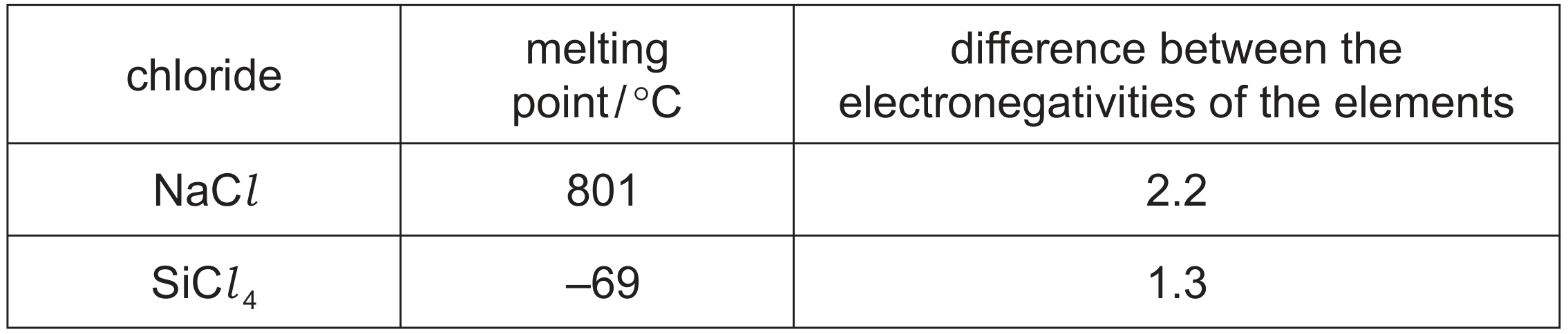
Explain the differences between the melting points of these two chlorides in terms of their structure and bonding. You should refer to the difference between the electronegativities of the elements in your answer.
NaCl structure and bonding
structure and bonding
explanation
One of the factors that determines the type of bonding present between the particles of a substance is the relative electronegativities of the bonded particles.
Explain the meaning of the term electronegativity.
The Pauling electronegativity values of elements can be used to predict the chemical properties of compounds.
Use the information in Table 1.1 to answer the following questions.

Table 1.1
Define electronegativity.
O and S are in Group 16 .
Explain the difference in the Pauling electronegativity values of O and S .
The melting points of some solids are shown in Table 1.1.
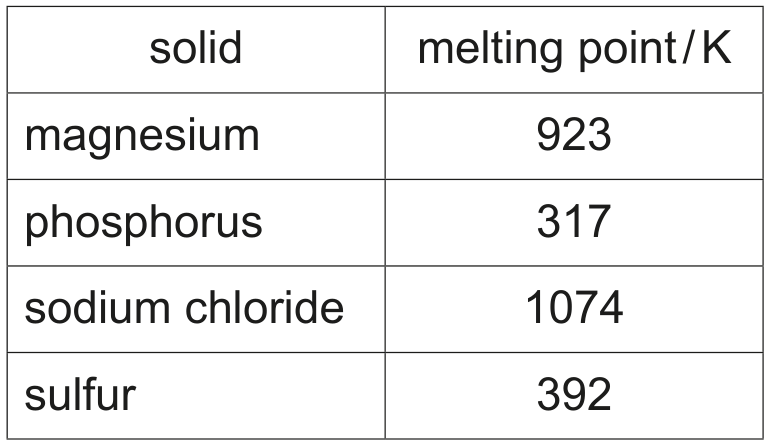
Table 1.1
Define electronegativity.
Explain why electronegativity increases across a period.
The ability of an atom in a covalent bond to attract electrons to itself is called its electronegativity.
The greater the difference between the electronegativities of the two atoms in the bond, the more polar is the bond.
Which pair will form the most polar covalent bond between the atoms?
chlorine and bromine
chlorine and iodine
fluorine and chlorine
fluorine and iodine
L and M are elements in Period 3 of the Periodic Table. Neither element is argon. Information about the Pauling electronegativity values of L and M is given.
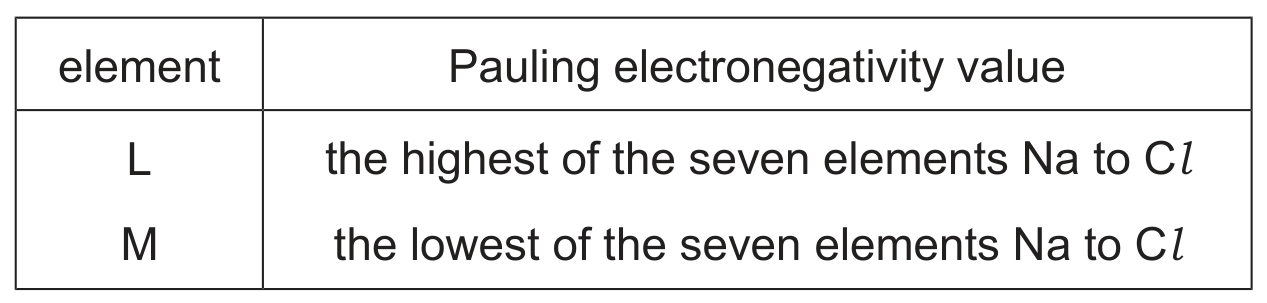
Three statements about elements L and M are given.
1 Element L contains covalent bonds.
2 Element L has a higher atomic number than element M .
3 A compound of L and M contains ionic bonds.
Which statements are correct?
1, 2 and 3
1 and 2 only
1 and 3 only
2 and 3 only
Which compound has the smallest difference in electronegativity between its two elements?
KF
KBr
LiF
LiBr
The graphs show trends in four physical properties of elements in Period 3, excluding argon. Which graph has electronegativity on the y-axis?
The graphs show trends in four physical properties of elements in Period 3, excluding argon. Which graph has electronegativity on the y-axis?