EduNinja
[Maximum number: 4]

Hydrogen iodide, HI, is a colourless gas at room temperature.

(a)

HI(g) can be formed by reacting H2( g)\mathrm{H}_{2}(\mathrm{~g}) with I2( g)\mathrm{I}_{2}(\mathrm{~g}). The reaction is reversible, and an equilibrium forms quickly at high temperatures.

H2( g)+I2( g)2HI( g)\mathrm{H}_{2}(\mathrm{~g})+\mathrm{I}_{2}(\mathrm{~g}) \rightleftharpoons 2 \mathrm{HI}(\mathrm{~g})
[ 4 ]
(i)

Construct an expression for the equilibrium constant, KpK_{\mathrm{p}}, for the reaction of H2( g)\mathrm{H}_{2}(\mathrm{~g}) and I2( g)\mathrm{I}_{2}(\mathrm{~g}) to form HI(g).

Kp=K_{\mathrm{p}}=
[ 1 ]
(ii)

The equilibrium partial pressures of the gases at 200C200^{\circ} \mathrm{C} are as follows.

pH2( g)=895 PapI2( g)=895 PapHI( g)=4800 Pa\begin{aligned} & p_{\mathrm{H}_{2}(\mathrm{~g})}=895 \mathrm{~Pa} \\ & p_{\mathrm{I}_{2}(\mathrm{~g})}=895 \mathrm{~Pa} \\ & p_{\mathrm{HI}(\mathrm{~g})}=4800 \mathrm{~Pa} \end{aligned}

Calculate KpK_{p} for this reaction.

Kp=K_{\mathrm{p}}=
[ 1 ]
(iii)

State how the value of KpK_{\mathrm{p}} would change, if at all, if the reaction were carried out at 100C100^{\circ} \mathrm{C} rather than 200C200^{\circ} \mathrm{C}.

Explain your answer.

[ 2 ]
[Maximum number: 5]

Group 2 metals form alkaline solutions in water.

(a)

Magnesium oxide reacts reversibly with chlorine according to the following equation.

2MgO( s)+2Cl2( g)2MgCl2( s)+O2( g)2 \mathrm{MgO}(\mathrm{~s})+2 \mathrm{Cl}_{2}(\mathrm{~g}) \rightleftharpoons 2 \mathrm{MgCl}_{2}(\mathrm{~s})+\mathrm{O}_{2}(\mathrm{~g})

Under certain conditions, a dynamic equilibrium is established.

[ 5 ]
(i)

State two features of a reaction that is in dynamic equilibrium.

1

2

[ 2 ]
(ii)

The equilibrium constant, KpK_{\mathrm{p}}, is given by the following expression.

Kp=pO2pCl22K_{\mathrm{p}}=\frac{p_{\mathrm{O}_{2}}}{p_{\mathrm{C} l_{2}}^{2}}

At 1.00×10⁵ Pa1.00 \times 10^{5} \mathrm{~Pa} and 500 K,70%500 \mathrm{~K}, 70 \% of the initial amount of Cl2( g)\mathrm{Cl}_{2}(\mathrm{~g}) has reacted.
Calculate KpK_{\mathrm{p}} and state its units.

Kp=K_{\mathrm{p}}=

units =

[ 3 ]
[Maximum number: 4]

In the Periodic Table, the p block contains elements whose outer electrons are found in the p subshell.

(a)

SO2\mathrm{SO}_{2} can react with ozone, O3\mathrm{O}_{3}, to form SO3\mathrm{SO}_{3} in two different reactions.

[ 4 ]
(i)

In one reaction, SO2\mathrm{SO}_{2} reacts with O3\mathrm{O}_{3} until a dynamic equilibrium is established.

SO2( g)+O3( g)SO3( g)+O2( g)\mathrm{SO}_{2}(\mathrm{~g})+\mathrm{O}_{3}(\mathrm{~g}) \rightleftharpoons \mathrm{SO}_{3}(\mathrm{~g})+\mathrm{O}_{2}(\mathrm{~g})

State and explain the effect of an increase in pressure on the composition of the equilibrium mixture.

[ 2 ]
(ii)

In the other reaction, a different equilibrium is established at 300 K as shown.

3SO2( g)+O3( g)3SO3( g)ΔH=+462.3 kJ mol13 \mathrm{SO}_{2}(\mathrm{~g})+\mathrm{O}_{3}(\mathrm{~g}) \rightleftharpoons 3 \mathrm{SO}_{3}(\mathrm{~g}) \quad \Delta H=+462.3 \mathrm{~kJ} \mathrm{~mol}^{-1}

Suggest a temperature needed to increase the yield of SO3\mathrm{SO}_{3} at equilibrium.
Explain your answer.

[ 2 ]
[Maximum number: 7]

Methylpropane, (CH3)2CHCH3\left(\mathrm{CH}_{3}\right)_{2} \mathrm{CHCH}_{3}, is an isomer of butane, CH3(CH2)2CH3\mathrm{CH}_{3}\left(\mathrm{CH}_{2}\right)_{2} \mathrm{CH}_{3}.

(a)

When a sample of butane is heated to 373 K , in the presence of a catalyst, and allowed to reach equilibrium the following reaction occurs.

CH3(CH2)2CH3( g)(CH3)2CHCH3( g)ΔH=8.0 kJ mol1\mathrm{CH}_{3}\left(\mathrm{CH}_{2}\right)_{2} \mathrm{CH}_{3}(\mathrm{~g}) \rightleftharpoons\left(\mathrm{CH}_{3}\right)_{2} \mathrm{CHCH}_{3}(\mathrm{~g}) \quad \Delta H=-8.0 \mathrm{~kJ} \mathrm{~mol}^{-1}

State and explain the effect on the composition of this equilibrium mixture when the temperature is increased to 473 K .

[ 2 ]
(b)

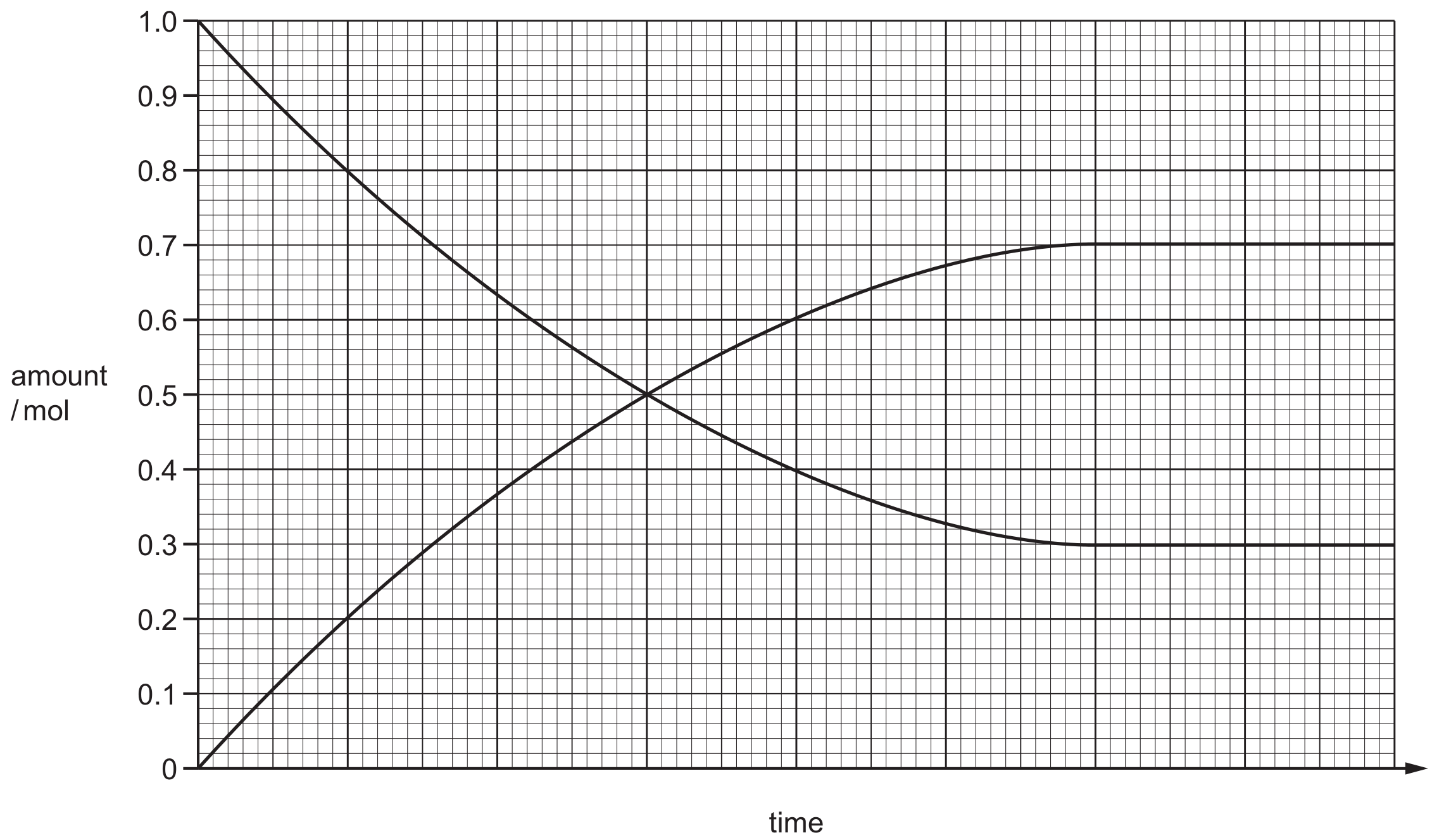
1 mole of butane gas was added to a 1dm31 \mathrm{dm}^{3} closed system, at a constant temperature and pressure. The amount of butane and methylpropane was measured at regular time intervals.

Question image
[ 5 ]
(i)

Label the graph with a t to show the time taken to reach dynamic equilibrium.

[ 1 ]
(ii)

Use the graph to find the concentration of butane and methylpropane in the mixture at equilibrium.
concentration of butane = moldm3\mathrm{mol} \mathrm{dm}^{-3}
concentration of methylpropane = moldm3\mathrm{mol} \mathrm{dm}^{-3}

[ 1 ]
(iii)

Write an expression for KcK_{\mathrm{c}} for this reaction.

[ 1 ]
(iv)

Calculate a value for KcK_{\mathrm{c}} and state its units.

Kc=K_{\mathrm{c}}=

units =

[ 2 ]
[Maximum number: 11]

The elements sodium to chlorine, in the third period, all form oxides.

(a)

SO3\mathrm{SO}_{3} is produced by the reaction between SO2\mathrm{SO}_{2} and O2\mathrm{O}_{2} in the Contact process. A dynamic equilibrium is established.

2SO2( g)+O2( g)2SO3( g)ΔH=196 kJ mol12 \mathrm{SO}_{2}(\mathrm{~g})+\mathrm{O}_{2}(\mathrm{~g}) \rightleftharpoons 2 \mathrm{SO}_{3}(\mathrm{~g}) \quad \Delta H=-196 \mathrm{~kJ} \mathrm{~mol}^{-1}
[ 5 ]
(i)

Explain why increasing the total pressure, at constant temperature, increases the rate of production of SO3\mathrm{SO}_{3} and increases the yield of SO3\mathrm{SO}_{3}.
rate
yield

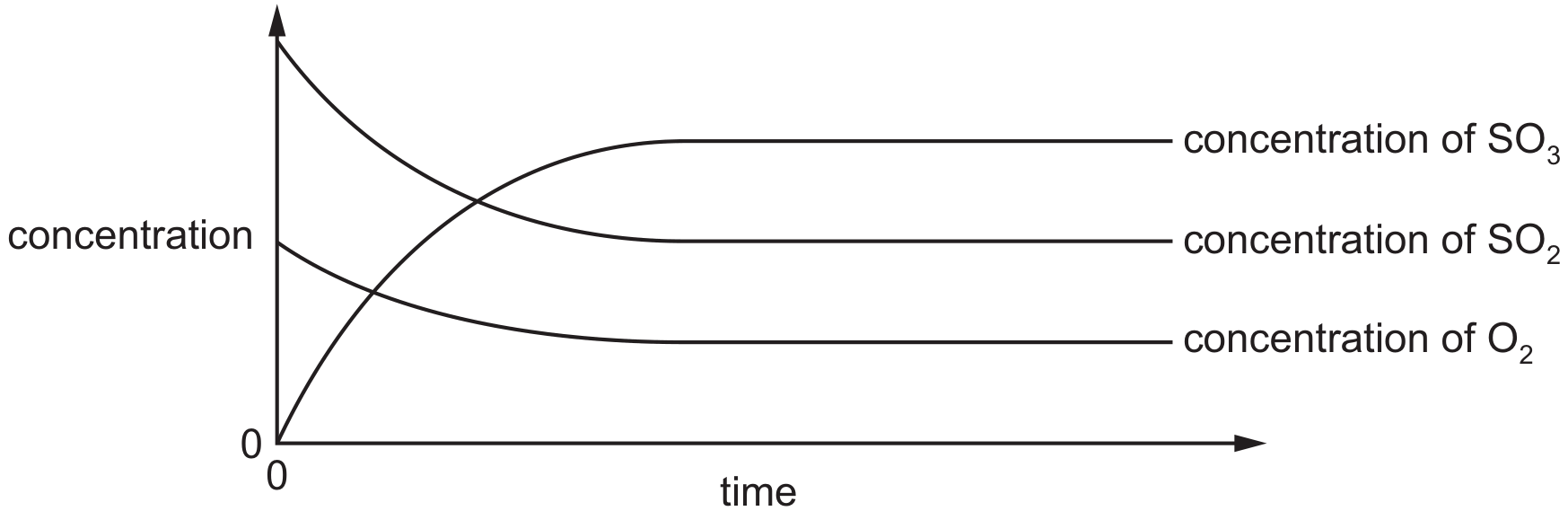
The graph shows how the concentrations of all three species in the system change with time for a typical reaction mixture. The gradients of all three lines decrease with time and then level off in this dynamic equilibrium.

Question image
[ 4 ]
(ii)

Explain why all three lines become horizontal.

[ 1 ]
(b)

2.00 moles of SO2( g)\mathrm{SO}_{2}(\mathrm{~g}) and 2.00 moles of O2( g)\mathrm{O}_{2}(\mathrm{~g}) are sealed in a container with a suitable catalyst, at constant temperature and pressure. The resulting equilibrium mixture contains 1.98 moles of SO3( g)\mathrm{SO}_{3}(\mathrm{~g}).
The total volume of the equilibrium mixture is 40.0dm340.0 \mathrm{dm}^{3}.

2SO2( g)+O2( g)2SO3( g)2 \mathrm{SO}_{2}(\mathrm{~g})+\mathrm{O}_{2}(\mathrm{~g}) \rightleftharpoons 2 \mathrm{SO}_{3}(\mathrm{~g})
[ 6 ]
(i)

Write the expression for the equilibrium constant, KcK_{\mathrm{c}}, for the reaction between SO2( g)\mathrm{SO}_{2}(\mathrm{~g}) and O2( g)\mathrm{O}_{2}(\mathrm{~g}) to produce SO3( g)\mathrm{SO}_{3}(\mathrm{~g}).

Kc=K_{c}=
[ 1 ]
(ii)

Calculate the amount, in moles, of SO2( g)\mathrm{SO}_{2}(\mathrm{~g}) and O2( g)\mathrm{O}_{2}(\mathrm{~g}) in the equilibrium mixture.

SO2( g)=..molO2( g)=..mol\begin{array}{r} \mathrm{SO}_{2}(\mathrm{~g})=\ldots \ldots \ldots \ldots \ldots \ldots \ldots \ldots \ldots \ldots . . \mathrm{mol} \\ \mathrm{O}_{2}(\mathrm{~g})=\ldots \ldots \ldots \ldots \ldots \ldots \ldots \ldots \ldots \ldots . . \mathrm{mol} \end{array}
[ 2 ]
(iii)

Use your answers to (d)(i) and (d)(ii) to calculate the value of KcK_{\mathrm{c}} for this equilibrium mixture. Give the units of KcK_{\mathrm{c}}.

Kc= units =\begin{array}{r} K_{\mathrm{c}}= \\ \text { units }= \end{array}
[ 3 ]
[Maximum number: 3]

Sulfuric acid is manufactured by the Contact process.
One stage in this process is the conversion of sulfur dioxide into sulfur trioxide in the presence of a heterogeneous catalyst of vanadium(V) oxide, V2O5\mathrm{V}_{2} \mathrm{O}_{5}.

Question image
(a)
(i)

State and explain the effect of increasing temperature on the yield of SO3\mathrm{SO}_{3}.

[ 3 ]
[Maximum number: 10]

Ammonia, NH3\mathrm{NH}_{3}, is manufactured from nitrogen and hydrogen by the Haber process.

N2( g)+3H2( g)2NH3( g)ΔH=92 kJ mol1\mathrm{N}_{2}(\mathrm{~g})+3 \mathrm{H}_{2}(\mathrm{~g}) \rightleftharpoons 2 \mathrm{NH}_{3}(\mathrm{~g}) \quad \Delta H=-92 \mathrm{~kJ} \mathrm{~mol}^{-1}
(a)

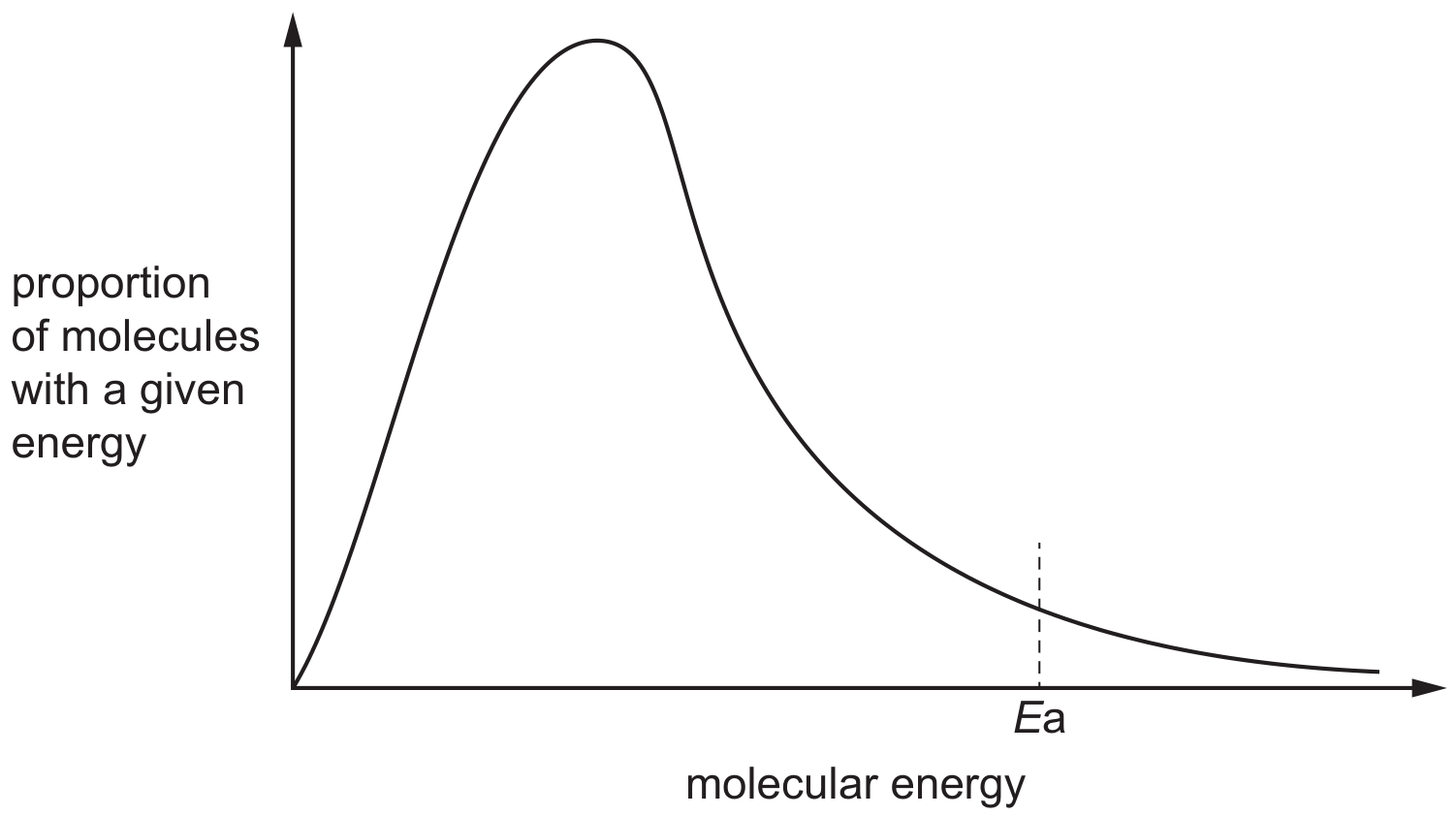
The Haber process is usually carried out at a temperature of approximately 400C400^{\circ} \mathrm{C} in the presence of a catalyst. Changing the temperature affects both the rate of production of ammonia and the yield of ammonia.

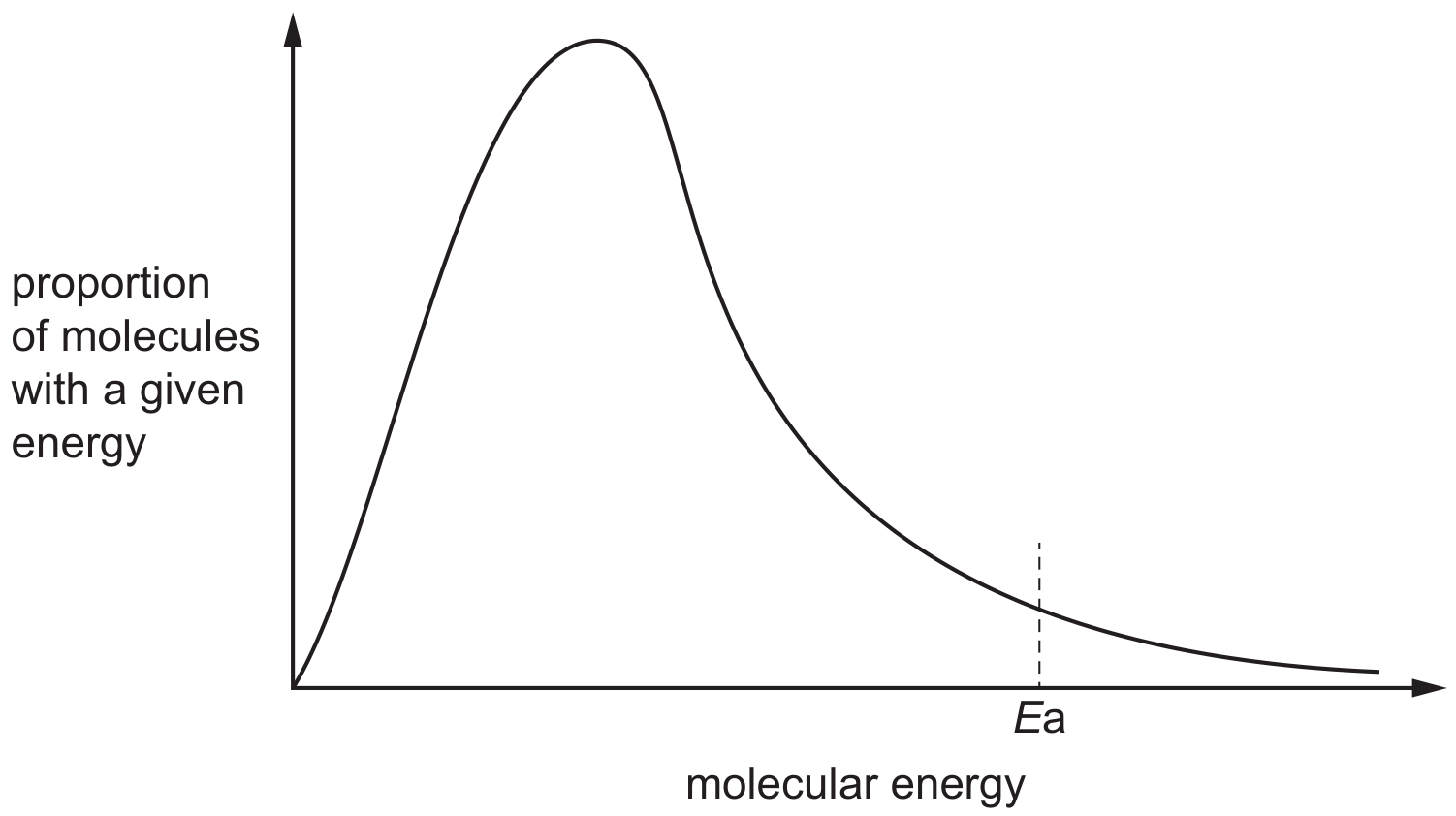
The Boltzmann distribution for a mixture of nitrogen and hydrogen at 400C400^{\circ} \mathrm{C} is shown. Ea represents the activation energy for the reaction.

Question image
[ 3 ]
(i)

State and explain the effect of increasing temperature on the yield of ammonia. Use Le Chatelier's principle to explain your answer.

[ 3 ]
(b)

At a pressure of 2.00×10⁷ Pa,1.00 mol2.00 \times 10^{7} \mathrm{~Pa}, 1.00 \mathrm{~mol} of nitrogen, N2( g)\mathrm{N}_{2}(\mathrm{~g}), was mixed with 3.00 mol of hydrogen, H2( g)\mathrm{H}_{2}(\mathrm{~g}). The final equilibrium mixture formed contained 0.300 mol of ammonia, NH3( g)\mathrm{NH}_{3}(\mathrm{~g}).

[ 2 ]
(i)

Calculate the amounts, in mol, of N2( g)\mathrm{N}_{2}(\mathrm{~g}) and H2( g)\mathrm{H}_{2}(\mathrm{~g}) in the equilibrium mixture.

N2( g)=. mol H2( g)=.. mol \begin{aligned} & \mathrm{N}_{2}(\mathrm{~g})=\ldots \ldots \ldots \ldots \ldots \ldots \ldots \ldots \ldots \ldots . \text { mol } \\ & \mathrm{H}_{2}(\mathrm{~g})=\ldots \ldots \ldots \ldots \ldots \ldots \ldots \ldots \ldots . . \text { mol } \end{aligned}
[ 2 ]
(ii)

Calculate the partial pressure of ammonia, pNH3\mathrm{pNH}_{3}, in the equilibrium mixture.

Give your answer to three significant figures.

pNH3=p \mathrm{NH}_{3}=

Pa

(c)

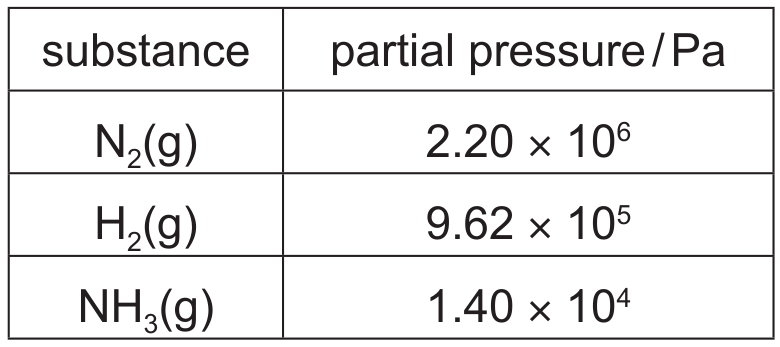
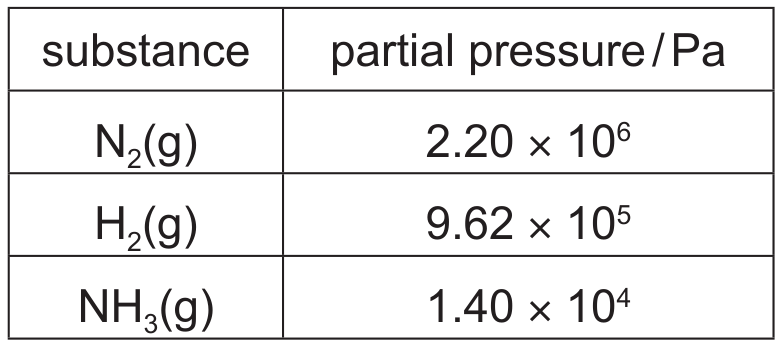
In another equilibrium mixture the partial pressures are as shown.

Table
[ 5 ]
(i)

Write the expression for the equilibrium constant, KpK_{\mathrm{p}}, for the production of ammonia from nitrogen and hydrogen.

Kp=K_{p}=
[ 1 ]
(ii)

Calculate the value of KpK_{\mathrm{p}} for this reaction.

State the units.

Kp=K_{p}=

units =

[ 2 ]
(iii)

This reaction is repeated with the same starting amounts of nitrogen and hydrogen. The same temperature is used but the container has a smaller volume.

State the effects, if any, of this change on the yield of ammonia and on the value of KpK_{\mathrm{p}}. effect on yield of ammonia
effect on value of KpK_{p}

[ 2 ]
[Maximum number: 10]

Ammonia, NH3\mathrm{NH}_{3}, is manufactured from nitrogen and hydrogen by the Haber process.

N2( g)+3H2( g)2NH3( g)ΔH=92 kJ mol1\mathrm{N}_{2}(\mathrm{~g})+3 \mathrm{H}_{2}(\mathrm{~g}) \rightleftharpoons 2 \mathrm{NH}_{3}(\mathrm{~g}) \quad \Delta H=-92 \mathrm{~kJ} \mathrm{~mol}^{-1}
(a)

The Haber process is usually carried out at a temperature of approximately 400C400^{\circ} \mathrm{C} in the presence of a catalyst. Changing the temperature affects both the rate of production of ammonia and the yield of ammonia.

The Boltzmann distribution for a mixture of nitrogen and hydrogen at 400C400^{\circ} \mathrm{C} is shown. Ea represents the activation energy for the reaction.

Question image
[ 3 ]
(i)

State and explain the effect of increasing temperature on the yield of ammonia. Use Le Chatelier's principle to explain your answer.

[ 3 ]
(b)

At a pressure of 2.00×10⁷ Pa,1.00 mol2.00 \times 10^{7} \mathrm{~Pa}, 1.00 \mathrm{~mol} of nitrogen, N2( g)\mathrm{N}_{2}(\mathrm{~g}), was mixed with 3.00 mol of hydrogen, H2( g)\mathrm{H}_{2}(\mathrm{~g}). The final equilibrium mixture formed contained 0.300 mol of ammonia, NH3( g)\mathrm{NH}_{3}(\mathrm{~g}).

[ 2 ]
(i)

Calculate the amounts, in mol, of N2( g)\mathrm{N}_{2}(\mathrm{~g}) and H2( g)\mathrm{H}_{2}(\mathrm{~g}) in the equilibrium mixture.

N2( g)=. mol H2( g)=.. mol \begin{aligned} & \mathrm{N}_{2}(\mathrm{~g})=\ldots \ldots \ldots \ldots \ldots \ldots \ldots \ldots \ldots \ldots . \text { mol } \\ & \mathrm{H}_{2}(\mathrm{~g})=\ldots \ldots \ldots \ldots \ldots \ldots \ldots \ldots \ldots . . \text { mol } \end{aligned}
[ 2 ]
(ii)

Calculate the partial pressure of ammonia, pNH3\mathrm{pNH}_{3}, in the equilibrium mixture.

Give your answer to three significant figures.

pNH3=p \mathrm{NH}_{3}=

Pa

(c)

In another equilibrium mixture the partial pressures are as shown.

Table
[ 5 ]
(i)

Write the expression for the equilibrium constant, KpK_{\mathrm{p}}, for the production of ammonia from nitrogen and hydrogen.

Kp=K_{p}=
[ 1 ]
(ii)

Calculate the value of KpK_{p} for this reaction.

State the units.

Kp=K_{p}=

units =

[ 2 ]
(iii)

This reaction is repeated with the same starting amounts of nitrogen and hydrogen. The same temperature is used but the container has a smaller volume.

State the effects, if any, of this change on the yield of ammonia and on the value of KpK_{\mathrm{p}}. effect on yield of ammonia
effect on value of KpK_{p}

[ 2 ]
(a)

When concentrated hydrochloric acid is added to a solution containing [Co(H2O)6]2+\left[\mathrm{Co}\left(\mathrm{H}_{2} \mathrm{O}\right)_{6}\right]^{2+}, a blue solution of [CoCl4]2\left[\mathrm{CoCl}_{4}\right]^{2-} is formed and the following equilibrium is established.

[Co(H2O)6]2++4Cl[CoCl4]2+6H2O\left[\mathrm{Co}\left(\mathrm{H}_{2} \mathrm{O}\right)_{6}\right]^{2+}+4 \mathrm{Cl}^{-} \rightleftharpoons\left[\mathrm{CoCl}_{4}\right]^{2-}+6 \mathrm{H}_{2} \mathrm{O}

Use Le Chatelier's principle to suggest the expected observations when silver nitrate solution is added dropwise to the blue solution of [CoCl4]2\left[\mathrm{CoCl}_{4}\right]^{2-}. Explain your answer.

[ 2 ]
(a)

At room temperature N2O3\mathrm{N}_{2} \mathrm{O}_{3} dissociates.

N2O3( g)NO( g)+NO2( g)\mathrm{N}_{2} \mathrm{O}_{3}(\mathrm{~g}) \rightleftharpoons \mathrm{NO}(\mathrm{~g})+\mathrm{NO}_{2}(\mathrm{~g})
[ 3 ]
(i)

Write the expression for KpK_{\mathrm{p}} for this equilibrium. Include the units in your answer.

Kp=K_{p}=
units =

A 1.00dm31.00 \mathrm{dm}^{3} flask at 25C25^{\circ} \mathrm{C} is filled with pure N2O3( g)\mathrm{N}_{2} \mathrm{O}_{3}(\mathrm{~g}) at an initial pressure of 0.60 atm . At equilibrium, the partial pressure of NO2( g)\mathrm{NO}_{2}(\mathrm{~g}) is 0.48 atm .

[ 1 ]
(ii)

Calculate the partial pressures of NO(g) and N2O3( g)\mathrm{N}_{2} \mathrm{O}_{3}(\mathrm{~g}) at equilibrium. Hence calculate the value of KpK_{p} at 25C25^{\circ} \mathrm{C}.

p(NO( g))=..p( N2O3( g))=\begin{aligned} & p(\mathrm{NO}(\mathrm{~g}))=. . \\ & p\left(\mathrm{~N}_{2} \mathrm{O}_{3}(\mathrm{~g})\right)= \end{aligned}
Kp=K_{\mathrm{p}}=
[ 2 ]
0