EduNinja
(a)

Iodine is made by reacting bromine with sodium iodide.

[ 2 ]
(i)

Construct an ionic equation for the reaction of bromine with sodium iodide.

[ 1 ]
(ii)

State the role of bromine in the reaction. Explain your answer.

[ 1 ]
(b)

Concentrated sulfuric acid is added to separate samples containing equal amounts of NaCl , NaBr and NaI . All three samples initially react to produce the hydrogen halide.

[ 4 ]
(i)

Write an equation to describe the acid-base reaction that occurs when concentrated sulfuric acid reacts with NaBr .

[ 1 ]
(ii)

Deduce which sodium halide, NaCl, NaBr or NaI , produces the largest percentage yield of hydrogen halide when concentrated sulfuric acid is added. Explain your answer by considering the relative reactivity of the halide ions as reducing agents.
identity of sodium halide
explanation
[ 3 ]
(a)

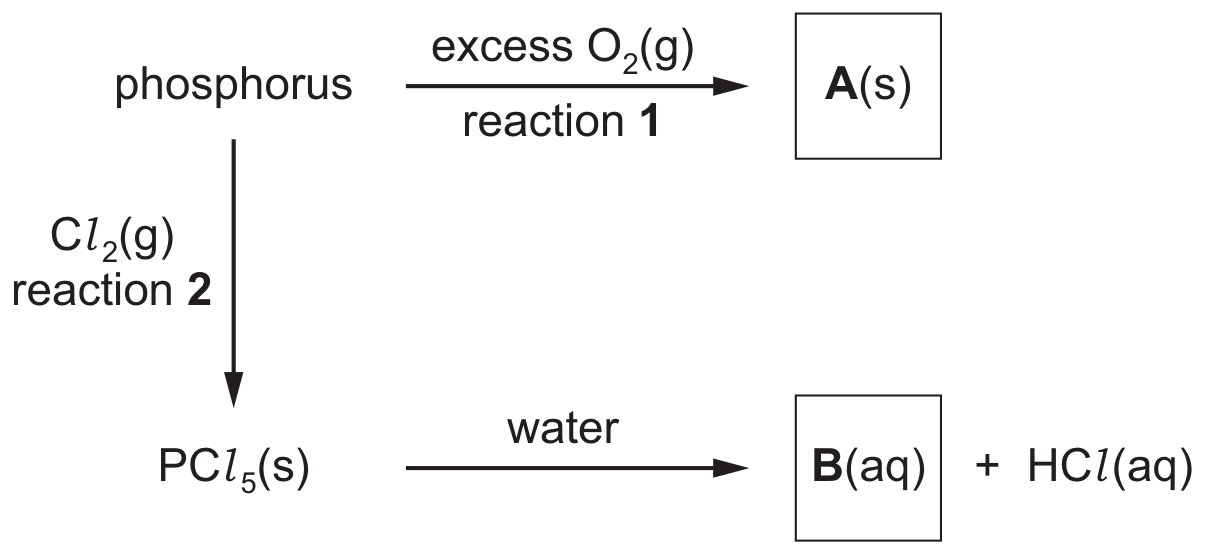
Phosphorus is a non-metal in the third period. It reacts vigorously with excess oxygen but slowly with chlorine.

Some reactions of phosphorus are shown.

Question image
[ 3 ]
(i)

Give two observations you could make in reaction 2 .
1.
2.

[ 2 ]
(ii)

Name compound B.

[ 1 ]
(a)

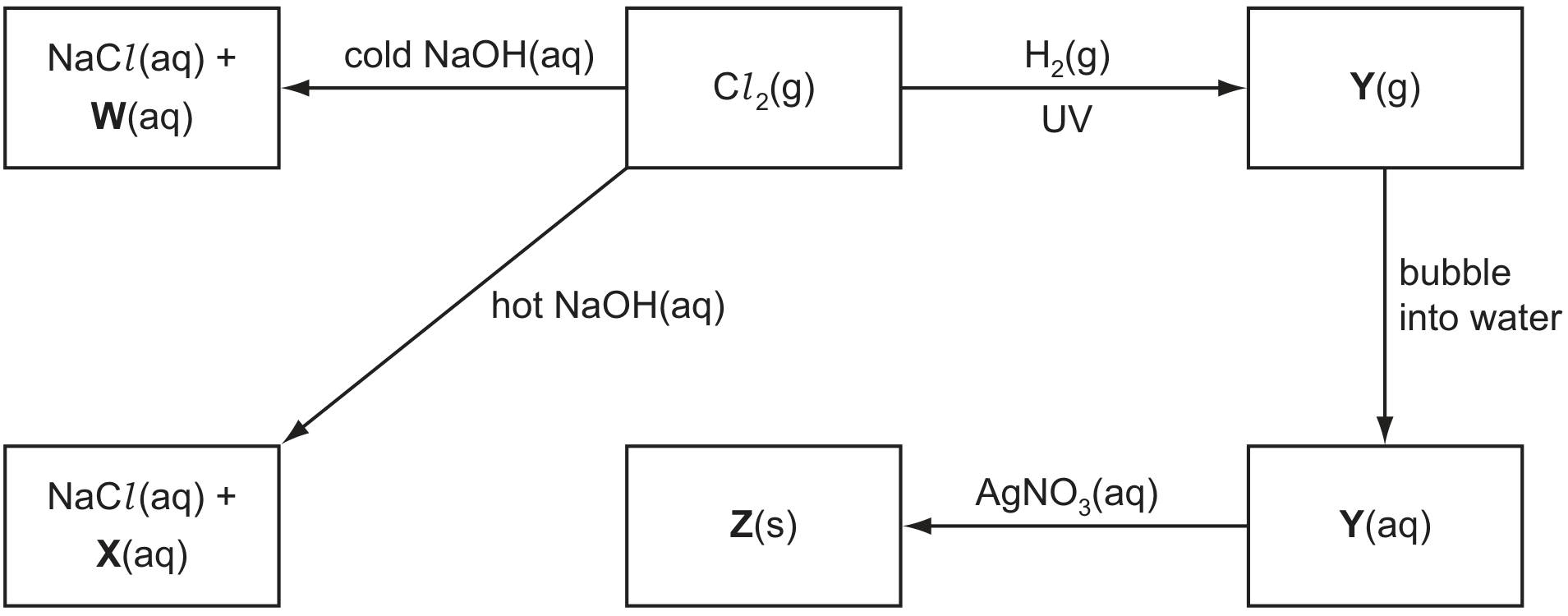
Some reactions involving chlorine and its compounds are shown in the reaction scheme below.

Question image
[ 1 ]
(i)

Write an ionic equation for the reaction of Y with AgNO3(aq)\mathrm{AgNO}_{3}(\mathrm{aq}). Include state symbols.

[ 1 ]
[Maximum number: 3]

A Group 2 metal combines with bromine to form a crystalline solid, MBr2\mathrm{MBr}_{2}.
Excess aqueous AgNO3\mathrm{AgNO}_{3} is added to a solution of MBr2\mathrm{MBr}_{2} and a precipitate forms. The mixture is filtered. The precipitate is dried and the mass of the precipitate is recorded.

(a)

A sample of MBr2\mathrm{MBr}_{2} is dissolved in water. Chlorine gas is then bubbled into the solution.

[ 1 ]
(i)

Describe the observations for this reaction.

[ 1 ]
(b)

Compound Y is a pure insoluble solid which contains halide ions.

A single reagent is added directly to compound Y to determine the halide ion present.
Identify the reagent added. State the observation which would confirm that Y contains bromide ions.
reagent
observation

[ 2 ]
[Maximum number: 3]

Radium, Ra, is an element found in Group 2 of the Periodic Table. It is a crystalline solid at room temperature and conducts electricity.

Radium chloride, RaCl2\mathrm{RaCl}_{2}, has a melting point of 900C900^{\circ} \mathrm{C} and is soluble in water.

(a)

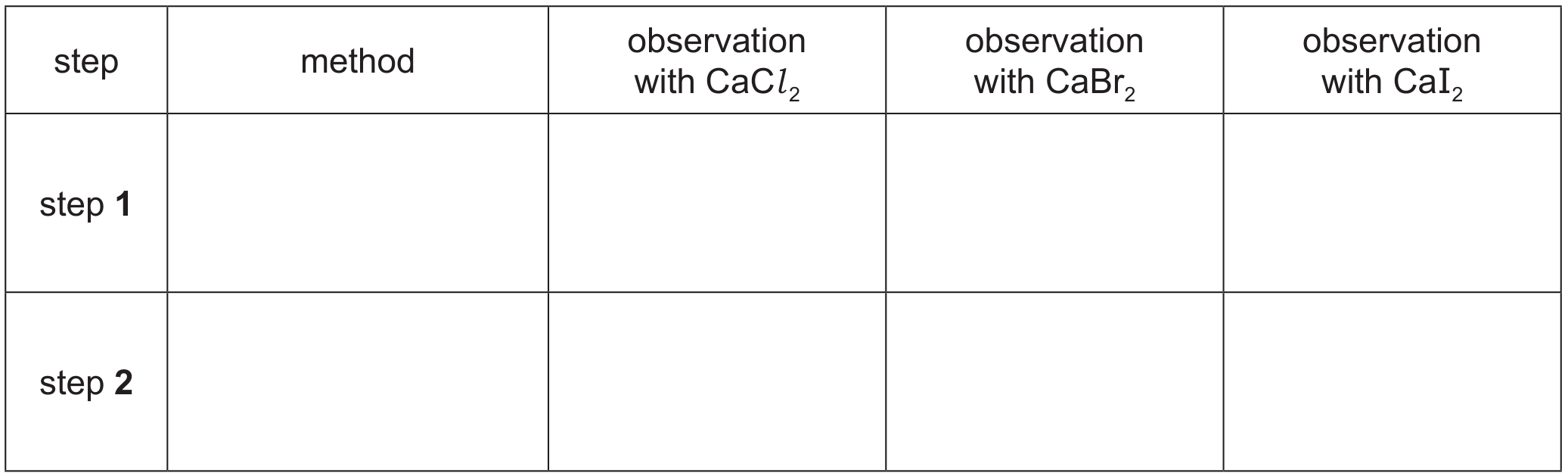
A sample of aqueous calcium halide, CaX2(aq)\mathrm{CaX}_{2}(\mathrm{aq}), contains either chloride, bromide or iodide ions.

Complete Table 2.1 to describe a two-step process that could be used to identify the halide ion present.

Table 2.1

Table 2.1

[ 3 ]
[Maximum number: 1]

Chile saltpetre, NaNO3\mathrm{NaNO}_{3}, contains sodium iodide as an impurity.
Aqueous silver nitrate is added to an aqueous solution of Chile saltpetre. Concentrated aqueous ammonia is then added.

Which observations are made?

with acidified silver nitrate

with concentrated aqueous ammonia

no precipitate

no further reaction

no precipitate

precipitate forms

precipitate forms

precipitate dissolves

precipitate forms

precipitate remains

[Maximum number: 2]

Magnesium shows reactions typical of a Group 2 metal.

(a)

1 cm31 \mathrm{~cm}^{3} of MgCl2(aq)\mathrm{MgCl}_{2}(\mathrm{aq}) is placed in a test-tube. A few drops of AgNO3(aq)\mathrm{AgNO}_{3}(\mathrm{aq}) are added, followed by 1 cm31 \mathrm{~cm}^{3} of dilute NH3(aq)\mathrm{NH}_{3}(\mathrm{aq}).

State in full what is observed in this experiment.

[ 2 ]
[Maximum number: 3]

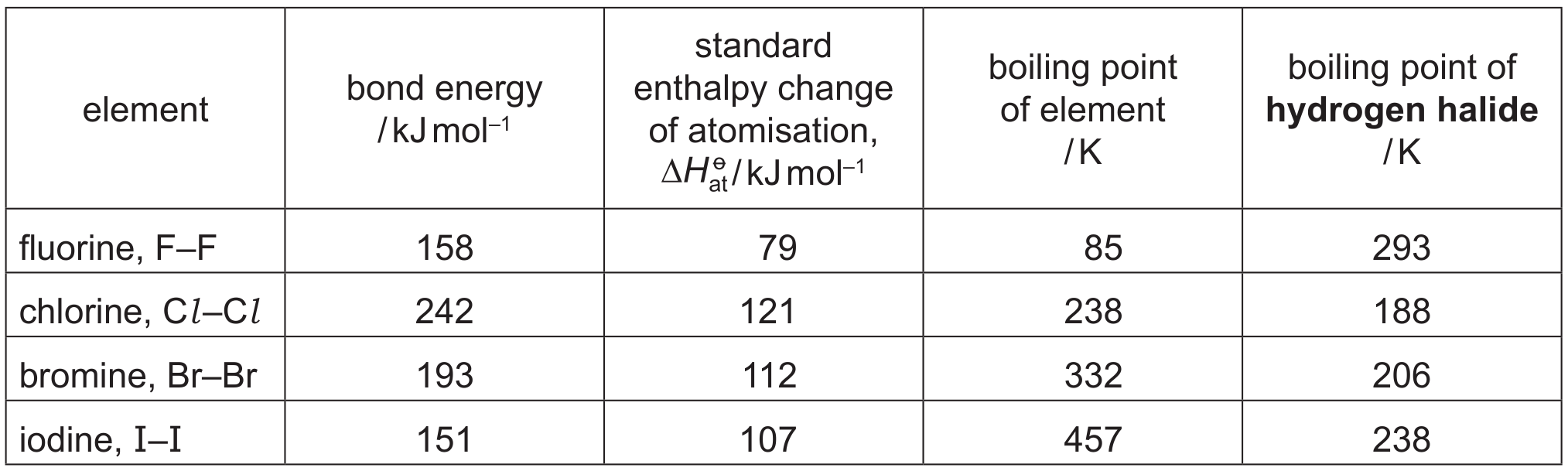
The elements in Group 17, the halogens, and their compounds, show many similarities and trends in their properties. Some data are given for the elements fluorine to iodine.

Table
(a)

In an experiment, two of the halogens are represented as P2\mathbf{P}_{2} and Q2\mathbf{Q}_{2}.
P2\mathbf{P}_{2} combines with hydrogen on heating to form HP, which can be easily broken down into its elements. A solution of HP in water reacts with aqueous silver ions to form a yellow precipitate that is insoluble in dilute aqueous ammonia.
Q2\mathbf{Q}_{2} combines explosively with hydrogen in sunlight to form HQ , which is stable to heat. A solution of HQ in water reacts with aqueous silver ions to form a white precipitate that is soluble in dilute aqueous ammonia.

[ 3 ]
(i)

Identify the halogens P2\mathbf{P}_{2} and Q2\mathbf{Q}_{2}.

P2=..Q2=\mathbf{P}_{2}=\ldots \ldots \ldots \ldots \ldots \ldots \ldots \ldots \ldots \ldots \ldots \ldots \ldots \ldots \ldots \ldots \ldots \ldots \ldots \ldots . . \mathbf{Q}_{2}=
[ 1 ]
(ii)

Write ionic equations, including state symbols, for
1. the formation of the white precipitate on addition of aqueous silver ions to aqueous HQ,
2. the subsequent dissolving of this precipitate in dilute aqueous ammonia.

[ 2 ]
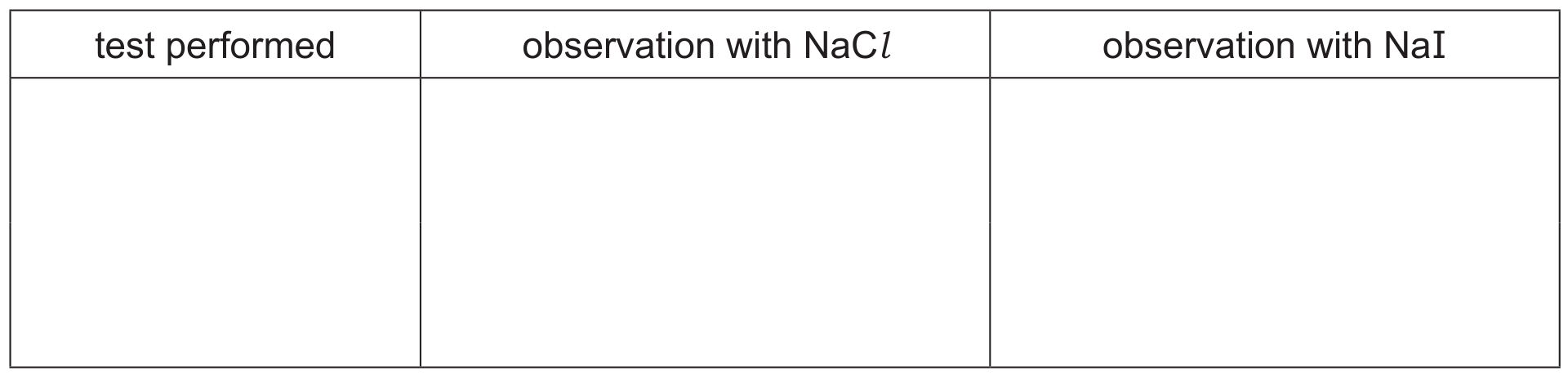
(a)

Complete the table to show how both AgNO3(aq)\mathrm{AgNO}_{3}(\mathrm{aq}) and NH3(aq)\mathrm{NH}_{3}(\mathrm{aq}) could be used to distinguish between solutions of NaCl(aq) and NaI(aq).

Table

Important information for this question
- In this question (pr) means 'a solution in propanone'.
- Sodium iodide is soluble in propanone giving Na+(pr)\mathrm{Na}^{+}(\mathrm{pr}) and I(pr)\mathrm{I}^{-}(\mathrm{pr}).
- Sodium chloride is insoluble in propanone.
The reaction between 2-chlorobutane and sodium iodide in propanone is shown.

CH3CH2CHClCH3(pr)+Na+(pr)+I(pr)CH3CH2CHICH3(pr)+NaCl( s)\mathrm{CH}_{3} \mathrm{CH}_{2} \mathrm{CHClCH}_{3}(\mathrm{pr})+\mathrm{Na}^{+}(\mathrm{pr})+\mathrm{I}^{-}(\mathrm{pr}) \rightarrow \mathrm{CH}_{3} \mathrm{CH}_{2} \mathrm{CHICH}_{3}(\mathrm{pr})+\mathrm{NaCl}(\mathrm{~s})

The rate of this reaction can be investigated by measuring the electrical conductivity of the reaction mixture. The electrical conductivity changes as the reaction progresses due to the precipitation of the NaCl produced.

[ 2 ]
[Maximum number: 1]

Chlorine, Cl2\mathrm{Cl}_{2}, is a reactive yellow-green gas. It is a strong oxidising agent.

(a)

The halide ions, X\mathrm{X}^{-}(where X=C l, Br, I ), show clear trends in their physical and chemical properties.

[ 1 ]
(i)

Explain why different sulfur-containing products are produced when each of these halide ions reacts with concentrated H2SO4\mathrm{H}_{2} \mathrm{SO}_{4}.

[ 1 ]
0