[Maximum number: 1]
Hydrogen iodide, HI, is a colourless gas at room temperature.
(a)
In the laboratory, HI(aq) can be formed in a two-step process.
step
step
[ 1 ]
(i)
Name the type of reaction in step 2 .
[ 1 ]
 EduNinja
Hydrogen iodide, HI, is a colourless gas at room temperature.
In the laboratory, HI(aq) can be formed in a two-step process.
step
step
Name the type of reaction in step 2 .
Elements and compounds which have small molecules usually exist as gases or liquids.
HCN reacts with ethanal, .
What type of reaction is this?
Halogenoalkanes can undergo homolytic fission in the upper atmosphere.
Explain the term homolytic fission.
Suggest the most likely organic radical that would be formed by the homolytic fission of bromochloromethane, . Explain your answer.
The major source of sulfur for the manufacture of sulfuric acid by the Contact process is the de-sulfurisation of 'sour' natural gas. Many natural gas wells produce a mixture of volatile hydrocarbons (mainly and ) together with up to 25 % hydrogen sulfide, .
What type of reaction is occurring here?
The recovered is converted to sulfur by the following two reactions.
I Part of the is burned in air.
II The gas stream resulting from reaction I is then blended with the remaining and fed into an iron oxide catalyst bed, where sulfur and water are produced according to the following equation.
Carbon and silicon are elements in Group 14.
0.144 g of was placed in a container of hydrogen gas at and .
The container was heated to make the and hydrogen gas react.
The reaction occurred as shown in the equation.
After the reaction, the container was allowed to cool to . The pressure decreased to . All of the had reacted.
Name the type of reaction that occurred.
The molecular formula represents the compounds propene and cyclopropane.
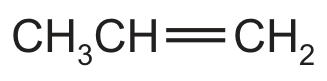
propene
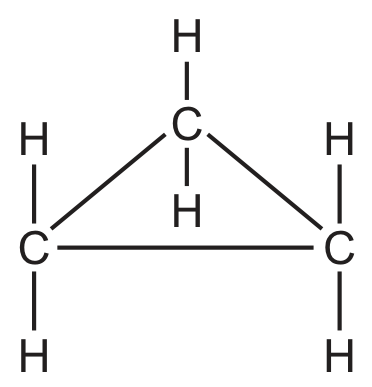
cyclopropane
Under suitable conditions, propene and cyclopropane each react with chlorine.
With propene, 1,2-dichloropropane, is formed.
State fully what type of reaction this is.
Sodium cyanate, NaNCO, is used in the production of isocyanic acid.
Sodium cyanate is prepared commercially by reacting urea, , with sodium carbonate. Other products in this reaction are carbon dioxide, ammonia and steam.
Write an equation for the production of NaNCO by this method.
Chlorine, , is a reactive yellow-green gas. It is a strong oxidising agent.
Dichloromethane, , is widely used as an organic solvent.
can be prepared by reacting and at room temperature.
The reaction proceeds via several steps, as shown.
Give the name of the mechanism of this reaction.
Name the type of reaction shown in the final step.
Menthol and menthone, the main constituents of oil of peppermint, can be made synthetically from thymol by the following route.
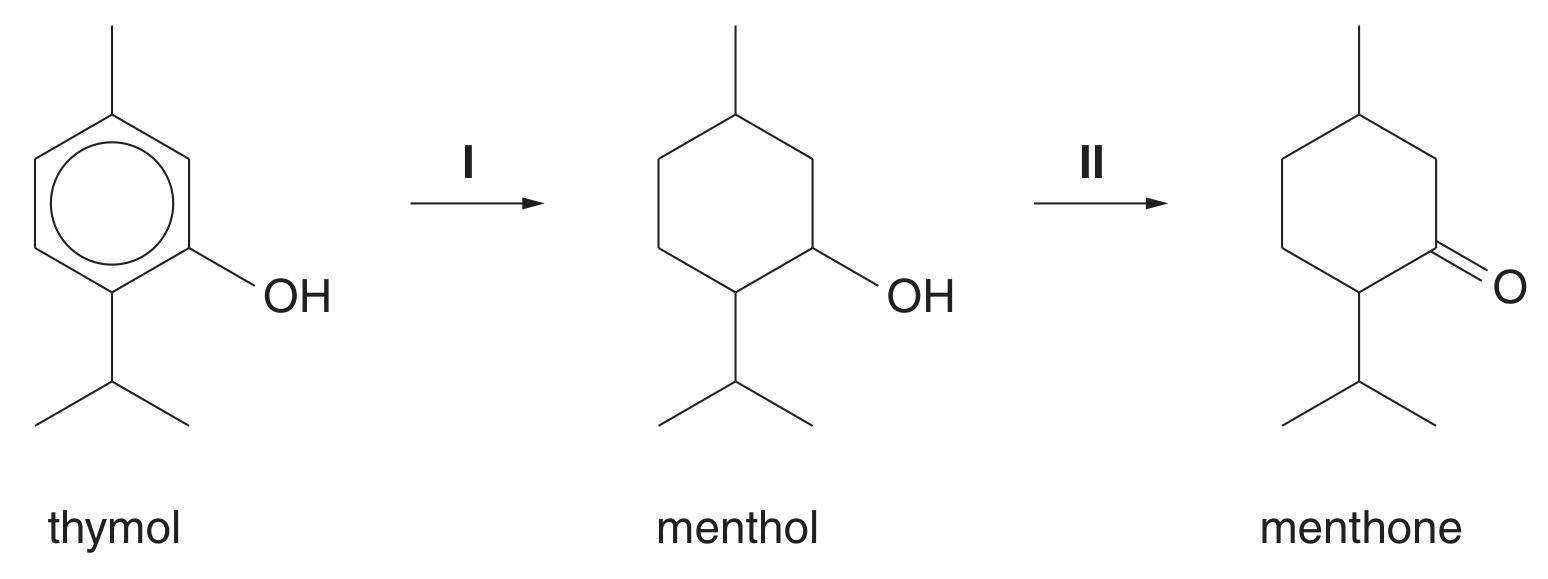
State the type of reaction of
- reaction I,
- reaction II.
Sucrose, , reacts with water to form glucose and fructose in reaction A.
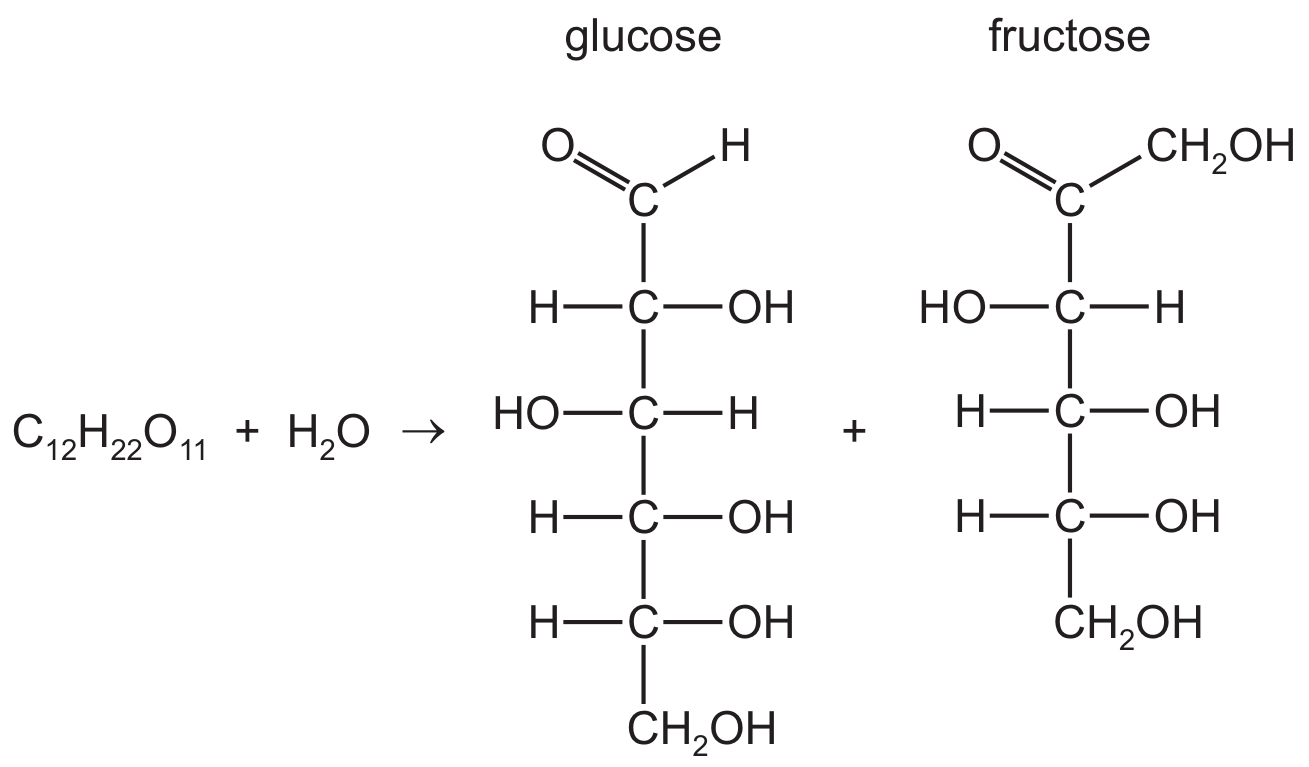
reaction \(\mathbf{A
Suggest a name for this type of reaction.