EduNinja
(a)

The reaction between propane and chlorine produces a mixture of many compounds, four of which are structural isomers with the molecular formula C3H6Cl2\mathrm{C}_{3} \mathrm{H}_{6} \mathrm{Cl}_{2}.
Draw the structural or skeletal formulae of these isomers, and indicate any chiral atoms with an asterisk (*).

[ 3 ]
[Maximum number: 3]

Methylpropane, (CH3)2CHCH3\left(\mathrm{CH}_{3}\right)_{2} \mathrm{CHCH}_{3}, is an isomer of butane, CH3(CH2)2CH3\mathrm{CH}_{3}\left(\mathrm{CH}_{2}\right)_{2} \mathrm{CH}_{3}.

(a)
(i)

Explain why methylpropane and butane are a pair of isomers.

[ 2 ]
(ii)

Identify the type of isomerism shown by methylpropane and butane.

[ 1 ]
[Maximum number: 2]

Combustion data can be used to calculate the empirical formula, molecular formula and relative molecular mass of many organic compounds.

(a)

T is an alcohol, CxHyO\mathrm{C}_{x} \mathrm{H}_{y} \mathrm{O}. A gaseous sample of T occupied a volume of 20 cm320 \mathrm{~cm}^{3} at 120C120^{\circ} \mathrm{C} and 100 kPa .

The sample was completely burned in 200 cm3200 \mathrm{~cm}^{3} of oxygen (an excess). The final volume, measured under the same conditions as the gaseous sample, was 250 cm3250 \mathrm{~cm}^{3}.

Under these conditions, all water present is vaporised. Removal of the water vapour from the gaseous mixture decreased the volume to 170 cm3170 \mathrm{~cm}^{3}.

Treating the remaining gaseous mixture with concentrated alkali, to absorb carbon dioxide, decreased the volume to 110 cm3110 \mathrm{~cm}^{3}.

The equation for the complete combustion of T can be represented as shown.

CxHyO+zO2xCO2+y2H2O\mathrm{C}_{x} \mathrm{H}_{y} \mathrm{O}+z \mathrm{O}_{2} \rightarrow x \mathrm{CO}_{2}+\frac{y}{2} \mathrm{H}_{2} \mathrm{O}
[ 2 ]
(i)

Give the skeletal formulae for two possible structures of T.

Name each alcohol.

Question image
[ 2 ]
[Maximum number: 2]

Compound A is an organic compound which contains carbon, hydrogen and oxygen.
When 0.240 g of the vapour of A is slowly passed over a large quantity of heated copper(II) oxide, CuO , the organic compound A is completely oxidised to carbon dioxide and water. Copper is the only other product of the reaction.

The products are collected and it is found that 0.352 g of CO2\mathrm{CO}_{2} and 0.144 g of H2O\mathrm{H}_{2} \mathrm{O} are formed.

(a)

Compound A is a liquid which does not react with 2,4-dinitrophenylhydrazine reagent or with aqueous bromine.

Suggest two structural formulae for A.

Question image
[ 2 ]
[Maximum number: 1]

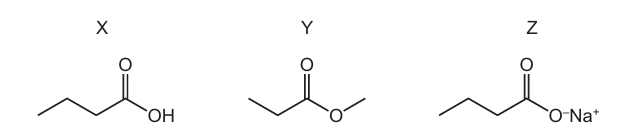
The structures represent three compounds, each with four carbon atoms per molecule.

Question image

Which row is correct?

lowest

boiling point

\longrightarrow

highest

boiling point

X

Y

Z

Y

X

Z

Z

X

Y

Z

Y

X

[Maximum number: 3]

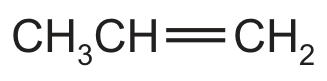
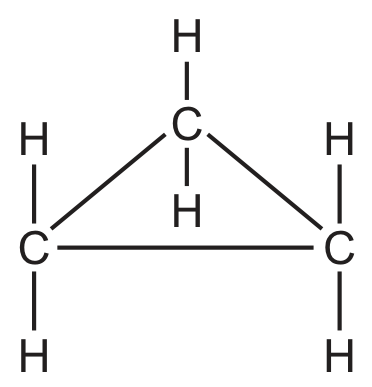
The molecular formula C3H6\mathrm{C}_{3} \mathrm{H}_{6} represents the compounds propene and cyclopropane.

propene

propene

cyclopropane

cyclopropane

(a)

Under suitable conditions, propene and cyclopropane each react with chlorine.

[ 3 ]
(i)

When cyclopropane reacts with chlorine, three different compounds with the molecular formula C3H4Cl2\mathrm{C}_{3} \mathrm{H}_{4} \mathrm{C} l_{2} can be formed.

Draw displayed structures of each of these three compounds.

[ 3 ]
(a)

When heated with HCl(aq), organic isocyanates, RNCO , are hydrolysed to the amine salt, RNH3Cl\mathrm{RNH}_{3} \mathrm{Cl}, and CO2\mathrm{CO}_{2}.

RNCO+H2O+HClRNH3Cl+CO2\mathrm{RNCO}+\mathrm{H}_{2} \mathrm{O}+\mathrm{HCl} \rightarrow \mathrm{RNH}_{3} \mathrm{Cl}+\mathrm{CO}_{2}

A1.00 g sample of an organic isocyanate, RNCO, was treated in this way, and the CO2\mathrm{CO}_{2} produced was absorbed in an excess of aqueous Ba(OH)2\mathrm{Ba}(\mathrm{OH})_{2} according to the equation shown. The solid BaCO3\mathrm{BaCO}_{3} precipitated weighed 1.66 g .

Ba(OH)2(aq)+CO2( g)BaCO3( s)+H2O(l)\mathrm{Ba}(\mathrm{OH})_{2}(\mathrm{aq})+\mathrm{CO}_{2}(\mathrm{~g}) \rightarrow \mathrm{BaCO}_{3}(\mathrm{~s})+\mathrm{H}_{2} \mathrm{O}(\mathrm{l})
[ 1 ]
(i)

Suggest a possible structure of the amine RNH2\mathrm{RNH}_{2}, which forms the amine salt, RNH3Cl\mathrm{RNH}_{3} \mathrm{Cl}. □

[ 1 ]
(a)
(i)

There are two isomers of CH3CH2CHClCH3\mathrm{CH}_{3} \mathrm{CH}_{2} \mathrm{CHClCH}_{3} that have fewer peaks in their carbon-13 NMR spectra than CH3CH2CHClCH3\mathrm{CH}_{3} \mathrm{CH}_{2} \mathrm{CHClCH}_{3}.

Draw the structures of the isomers and state the number of peaks for each isomer.
isomer 1
isomer 2
number of peaks = number of peaks =

[ 3 ]
[Maximum number: 8]

One reason for the wide variety of organic compounds is isomerism, either structural isomerism or stereoisomerism.

(a)
(i)

Explain the meaning of the term structural isomerism.

[ 2 ]
(ii)

Explain the meaning of the term stereoisomerism.

[ 2 ]
(b)

Pent-1-ene, CH2=CH(CH2)2CH3\mathrm{CH}_{2}=\mathrm{CH}\left(\mathrm{CH}_{2}\right)_{2} \mathrm{CH}_{3}, does not show stereoisomerism.

[ 4 ]
(i)

Give two reasons why pent-1-ene does not show stereoisomerism. reason 1
reason 2

[ 2 ]
(ii)

A different structural isomer of pent-1-ene shows geometrical isomerism.

Draw the structure of one of the two geometrical isomers with the formula C5H10\mathrm{C}_{5} \mathrm{H}_{10}.
Give the full name of this isomer.

Question image
[ 2 ]
[Maximum number: 5]

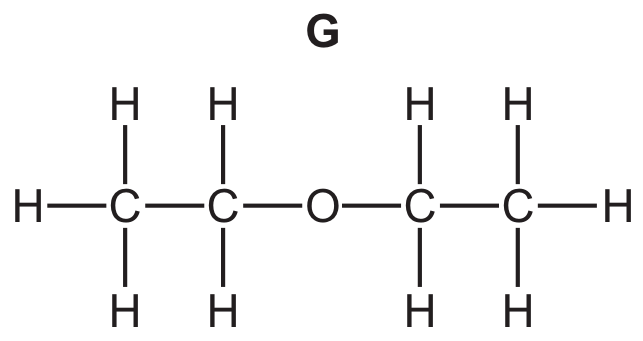
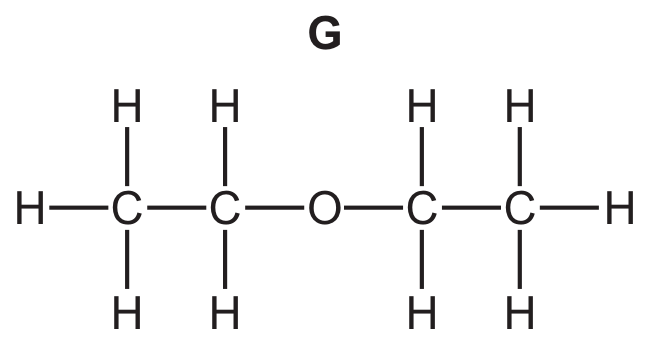
G belongs to a group of compounds called ethers.

Fig. 3.1

Fig. 3.1

(a)

The functional group in G is an oxygen atom bonded to two carbon atoms.

Fig. 3.3

Fig. 3.3

G, H and J are structural isomers with molecular formula C4H10O\mathrm{C}_{4} \mathrm{H}_{10} \mathrm{O}. H and J are straight chain molecules.

Table 3.3 shows the boiling points and reactions of G, H and J when heated under reflux with excess acidified K2Cr2O7\mathrm{K}_{2} \mathrm{Cr}_{2} \mathrm{O}_{7}.

Table 3.3

Table 3.3

[ 5 ]
(i)

Identify the type of structural isomerism shown between G and H using the information in Table 3.3.

[ 1 ]
(ii)

Identify the type of structural isomerism shown between H and J using the information in Table 3.3.

[ 1 ]
(iii)

Draw a possible structure for H and for J. State the systematic name for each structure.

Table

```
J
name
```

[ 3 ]
0