(a)
The elements of Group 17 are called halogens.
Complete Table 1.1.
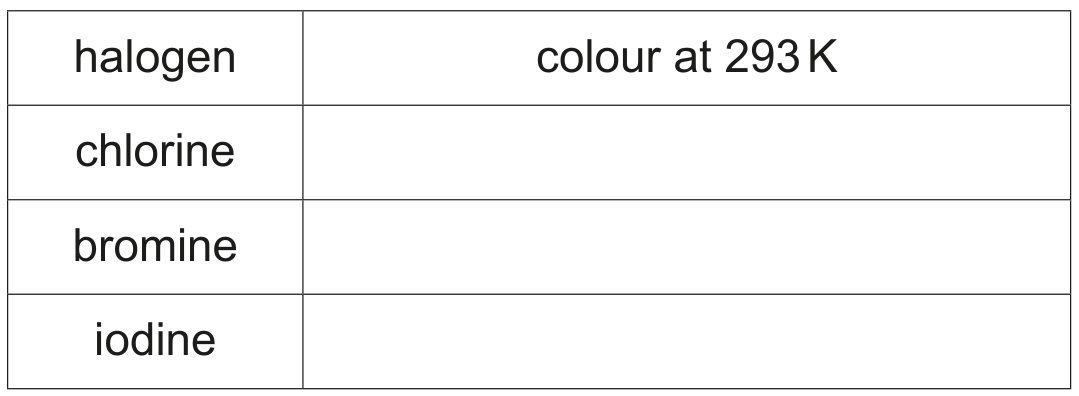
Table 1.1
[ 1 ]
(b)
State the trend in volatility of the halogens chlorine, bromine and iodine. Explain your answer.
[ 3 ]
 EduNinja
The elements of Group 17 are called halogens.
Complete Table 1.1.
Table 1.1
State the trend in volatility of the halogens chlorine, bromine and iodine. Explain your answer.
The elements in Group 17 are known as the halogens.
Between the molecules of Group 17 elements van der Waals' forces exist.
State the trend in the relative strength of van der Waals' forces down Group 17.
State the physical state of each of the halogens under room conditions.
chlorine
bromine
iodine
The halogens chlorine, bromine and iodine are all volatile elements.
State and explain the trend in volatility down Group 17.
Which statement describes the halogens chlorine, bromine and iodine?
Their bond energies decrease with increasing proton number.
Their first ionisation energies increase with increasing proton number.
They are all coloured gases at room temperature.
They are all good reducing agents.
Copper, proton number 29, and argon, proton number 18, are elements which have different physical and chemical properties.
In the solid state, each element has the same face-centred cubic crystal structure which is shown below.
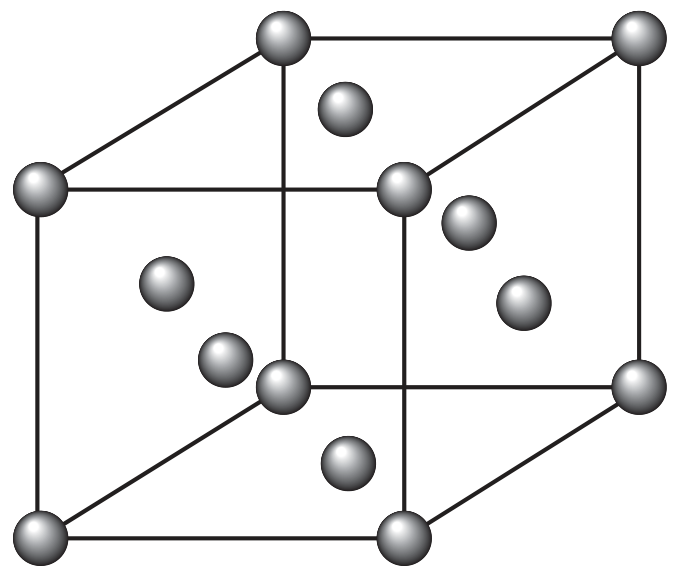
The particles present in such a crystal may be atoms, molecules, anions or cations. In the diagram above, the particles present are represented by
Explain why there is an increase in melting point from neon to xenon.
Magnesium shows reactions typical of a Group 2 metal.
When of is added to of in a test-tube, the solution remains orange.
Explain this observation.
Tennessine, Ts, is an unstable man-made element. It is found below astatine, At, in Group 17. The chemical properties of Ts and its compounds have only been predicted.
Some scientists predict that Ts has properties typical of metals like copper.
Complete Table 2.2 with:
- the predicted melting point of tennessine
- the lattice structure of solid chlorine, bromine and tennessine.
Assume that Ts has properties typical of metals like copper.
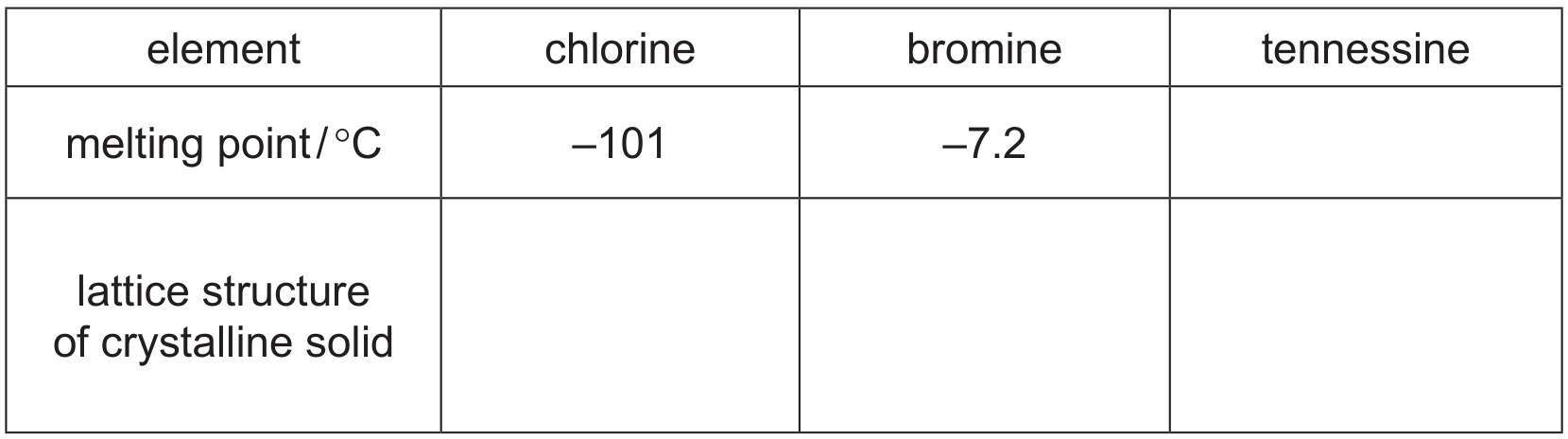
Table 2.2
Group 17 elements are commonly referred to as the halogens.
State and explain the trend in volatility of chlorine, bromine and iodine down the group.
Hydrogen gas reacts with the different halogens under different conditions.
Which problem can result if too much is applied to crops by farmers?
Not all the is used by plants and the excess makes the soil alkaline.
Rain washes some of the into rivers where it forms a precipitate.
Some of the dissolves in groundwater which may eventually be used for drinking.
Ammonia is produced; this lowers the pH of the soil.
Which statement explains why iodine is less volatile than chlorine?
Chlorine is more electronegative than iodine and so has more repulsion between its molecules.
The greater number of electrons in iodine leads to larger temporary dipole-induced dipole forces.
The I-I bond energy is smaller than the Cl-Cl bond energy.
The iodine molecules have stronger permanent dipole-permanent dipole forces.