EduNinja
[Maximum number: 1]

Manganese and nitrogen can show a range of different oxidation states.
Calculate the sum of the oxidation states of Mn and N in each row of the table.

In which row is this sum the smallest?

manganese-containing species

nitrogen-containing species

MnCl4\mathrm{MnCl}_{4}

N2\mathrm{N}_{2}

MnCO3\mathrm{MnCO}_{3}

NO2\mathrm{NO}_{2}{ }^{-}

K2MnO4\mathrm{K}_{2} \mathrm{MnO}_{4}

NH4+\mathrm{NH}_{4}{ }^{+}

Mn(OH)3\mathrm{Mn}(\mathrm{OH})_{3}

NH2OH\mathrm{NH}_{2} \mathrm{OH}

[Maximum number: 1]

What is the average oxidation number of sulfur in each compound?

Ca(HSO3)2\mathrm{Ca}\left(\mathrm{HSO}_{3}\right)_{2}

Na2 S2O3\mathrm{Na}_{2} \mathrm{~S}_{2} \mathrm{O}_{3}

4

2

4

4

6

2

6

4

(a)
(i)

A sample of Al reacts with an excess of Cl2\mathrm{Cl}_{2}.

State the oxidation number of Al in the product of the reaction.
oxidation number of Al

[ 1 ]
(b)

The oxide of silicon reacts with calcium oxide in an addition reaction to produce calcium silicate, CaSiO3\mathrm{CaSiO}_{3}. The oxidation number of calcium in CaSiO3\mathrm{CaSiO}_{3} is +II .

[ 1 ]
(i)

Deduce the oxidation number of silicon in calcium silicate.
oxidation number of silicon

[ 1 ]
[Maximum number: 2]

Copper is used in electrical equipment. It has a melting point of 1085C1085^{\circ} \mathrm{C}.

(a)

When KI(aq) is added to CuSO4(aq)\mathrm{CuSO}_{4}(\mathrm{aq}) the blue-coloured solution turns brown and a white precipitate of CuI(s) is seen.

The reaction between copper ions and iodide forms only two products.

[ 2 ]
(i)

Complete the equation for this reaction.

..Cu2++..I..CuI+....\ldots \ldots \ldots . . \mathrm{Cu}^{2+}+\ldots \ldots \ldots . . \mathrm{I}^{-} \rightarrow \ldots \ldots \ldots . . \mathrm{CuI}+\ldots \ldots \ldots \ldots \ldots \ldots \ldots \ldots \ldots \ldots . . . .
[ 1 ]
(ii)

Identify the oxidising agent in this reaction. Explain your answer in terms of electron transfer.

[ 1 ]
(a)

When magnesium is heated in air, magnesium oxide, MgO , is the major product. Smaller amounts of magnesium nitride, Mg3 N2\mathrm{Mg}_{3} \mathrm{~N}_{2}, are also made.

[ 2 ]
(i)

Calculate the oxidation number for magnesium and for the nitrogen species in Mg3 N2\mathrm{Mg}_{3} \mathrm{~N}_{2} to complete Table 1.1.

Table 1.1

Table 1.1

[ 1 ]
(ii)

Identify the type of reaction which takes place between magnesium and nitrogen. Explain your answer.

[ 1 ]
[Maximum number: 3]

Hydrogen iodide, HI, is a colourless gas at room temperature.

(a)

HI reacts with oxygen to form iodine and water.

[ 3 ]
(i)

Construct an equation for the reaction of HI with oxygen.

[ 1 ]
(ii)

Explain, with reference to oxidation numbers, why this reaction is a redox reaction.

[ 2 ]
[Maximum number: 3]

The elements in Group 17 are known as the halogens.

(a)

Sodium chlorate(I), NaClO, oxidises dilute hydrochloric acid to form three products. The products which contain chlorine have chlorine species with oxidation number -1 or 0.

No other species changes its oxidation number during the reaction.
Use this information to complete the ionic equation.

..ClOO+.HCl...+...+...\ldots \ldots . . \mathrm{ClO} \mathrm{O}^{-}+\ldots \ldots . \mathrm{HCl} \rightarrow \ldots \ldots \ldots . . .+\ldots \ldots \ldots . . .+\ldots \ldots . \ldots . .
[ 3 ]
[Maximum number: 1]

Group 2 metals form alkaline solutions in water.

(a)

Magnesium peroxide, MgO2\mathrm{MgO}_{2}, is made in the following reaction.

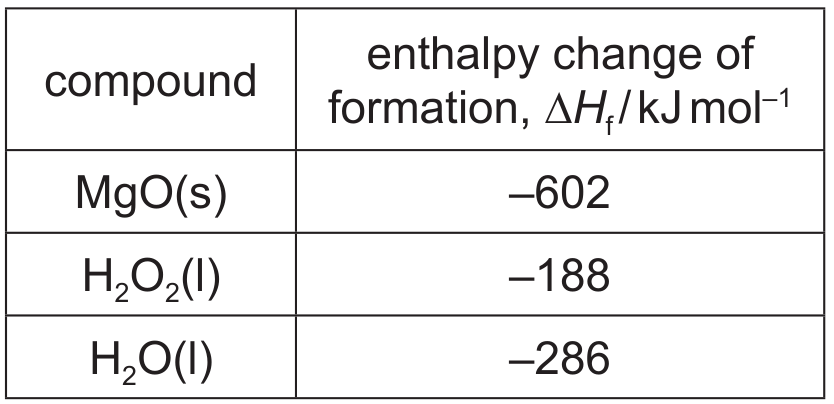
MgO( s)+H2O2(l)MgO2( s)+H2O(l)ΔH=96 kJ mol1\mathrm{MgO}(\mathrm{~s})+\mathrm{H}_{2} \mathrm{O}_{2}(\mathrm{l}) \rightarrow \mathrm{MgO}_{2}(\mathrm{~s})+\mathrm{H}_{2} \mathrm{O}(\mathrm{l}) \quad \Delta H=-96 \mathrm{~kJ} \mathrm{~mol}^{-1}
Table
[ 1 ]
(i)

The peroxide ion is O22\mathrm{O}_{2}{ }^{2-}.

Deduce the average oxidation number of oxygen in the peroxide ion.

[ 1 ]
(a)

Chlorine can be prepared using the following reaction.

MnO2( s)+4HCl(aq)MnCl2(aq)+2H2O(l)+Cl2( g)\mathrm{MnO}_{2}(\mathrm{~s})+4 \mathrm{HCl}(\mathrm{aq}) \rightarrow \mathrm{MnCl}_{2}(\mathrm{aq})+2 \mathrm{H}_{2} \mathrm{O}(\mathrm{l})+\mathrm{Cl}_{2}(\mathrm{~g})
[ 2 ]
(i)

Explain why MnO2( s)\mathrm{MnO}_{2}(\mathrm{~s}) is described as an oxidising agent in this reaction.

Refer to oxidation numbers in your answer.

[ 1 ]
(ii)

State what you would observe during this reaction.

[ 1 ]
[Maximum number: 1]

Nitrogen, N2\mathrm{N}_{2}, is the most abundant gas in the Earth's atmosphere and is very unreactive.

(a)

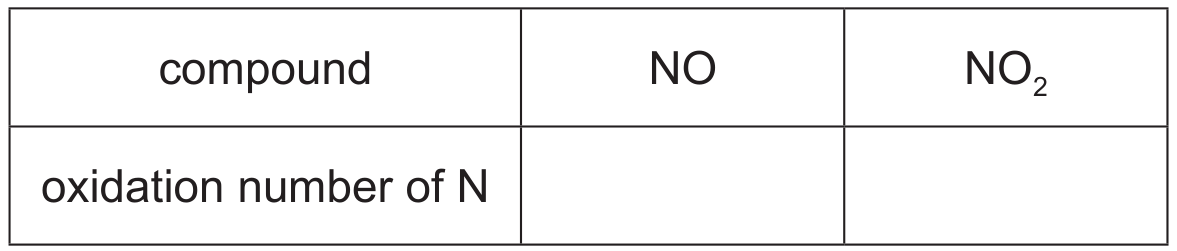
Three oxides of nitrogen, NO,NO2\mathrm{NO}, \mathrm{NO}_{2} and N2O\mathrm{N}_{2} \mathrm{O}, can be formed under different conditions.

[ 1 ]
(i)

Complete the table to give the oxidation numbers of nitrogen in NO and NO2\mathrm{NO}_{2}.

Table
[ 1 ]
0