EduNinja
[Maximum number: 1]

Which statement about enthalpy changes is correct?

A

Enthalpy changes of atomisation are always negative.

B

Enthalpy changes of combustion are always positive.

C

Enthalpy changes of formation are always positive.

D

Enthalpy changes of neutralisation are always negative.
[Maximum number: 1]

Enthalpy changes, ΔH\Delta H, can be positive or negative.
Which row is correct?

ΔH\Delta H positive

ΔH\Delta H negative

atomisation

bond breaking

bond breaking

neutralisation

bond making

combustion

combustion

bond making

[Maximum number: 4]

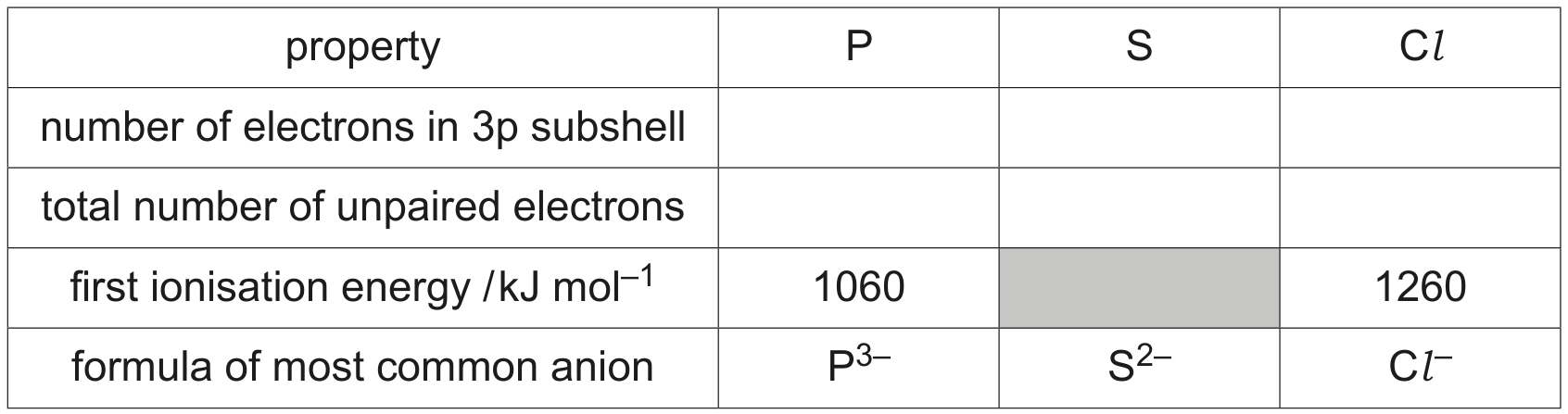
The elements phosphorus, sulfur and chlorine are in Period 3 of the Periodic Table.

Table 1.1 shows some properties of the elements P to Cl .
The first ionisation energy of S is not shown.

Table 1.1

Table 1.1

(a)

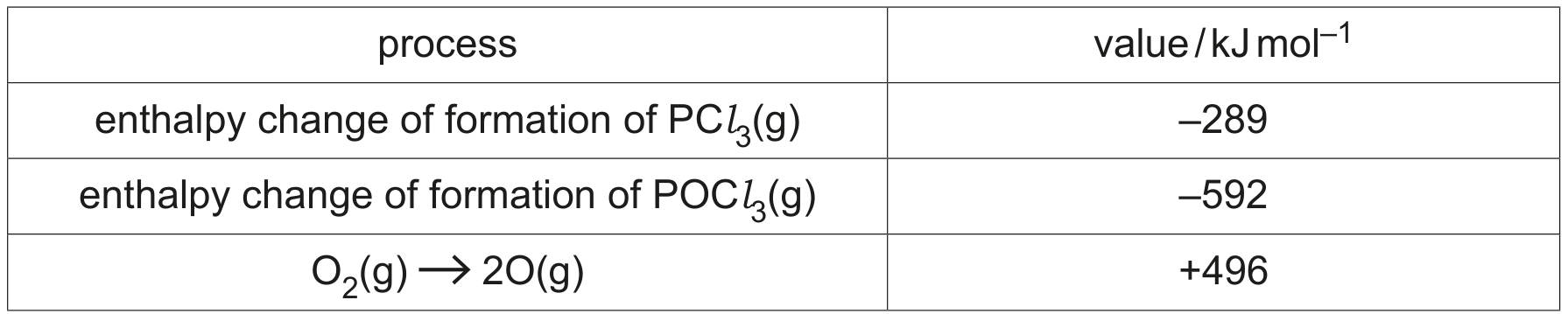
POCl3( g)\mathrm{POCl}_{3}(\mathrm{~g}) forms when PCl3( g)\mathrm{PCl}_{3}(\mathrm{~g}) reacts with O2( g)\mathrm{O}_{2}(\mathrm{~g}).

2PCl3( g)+O2( g)2POCl3( g)2 \mathrm{PCl}_{3}(\mathrm{~g})+\mathrm{O}_{2}(\mathrm{~g}) \rightarrow 2 \mathrm{POCl}_{3}(\mathrm{~g})

Table 1.3 gives some relevant data.

Table 1.3

Table 1.3

[ 4 ]
(i)

Define enthalpy change of formation, ΔHf\Delta H_{\mathrm{f}}.

[ 2 ]
(ii)

Calculate the bond energy of P=O in POCl3\mathrm{POCl}_{3} using the data in Table 1.3.

Show your working. kJmol1\mathrm{kJ} \mathrm{mol}{ }^{-1}

[ 2 ]
(a)

When magnesium is heated in air, magnesium oxide, MgO , is the major product. Smaller amounts of magnesium nitride, Mg3 N2\mathrm{Mg}_{3} \mathrm{~N}_{2}, are also made.

[ 5 ]
(i)

Define enthalpy change of formation.

[ 2 ]
(ii)

When 3.645 g of Mg(s) burns in excess N2( g)\mathrm{N}_{2}(\mathrm{~g}) to form Mg3 N2( s),23.05 kJ\mathrm{Mg}_{3} \mathrm{~N}_{2}(\mathrm{~s}), 23.05 \mathrm{~kJ} of energy is released.

Calculate the enthalpy change of formation, ΔHf\Delta H_{\mathrm{f}}, of Mg3 N2\mathrm{Mg}_{3} \mathrm{~N}_{2}. Show your working.

ΔHf(Mg3 N2)=\Delta H_{\mathrm{f}}\left(\mathrm{Mg}_{3} \mathrm{~N}_{2}\right)=
[ 3 ]
[Maximum number: 3]

Calcium, magnesium and radium are Group 2 elements. Radium follows the same trends as the other members of Group 2.

(a)

Magnesium, Mg , burns in oxygen, O2\mathrm{O}_{2}.

The activation energy, EaE_{\mathrm{a}}, for this reaction is +148 kJ mol1+148 \mathrm{~kJ} \mathrm{~mol}^{-1}.

[ 3 ]
(i)

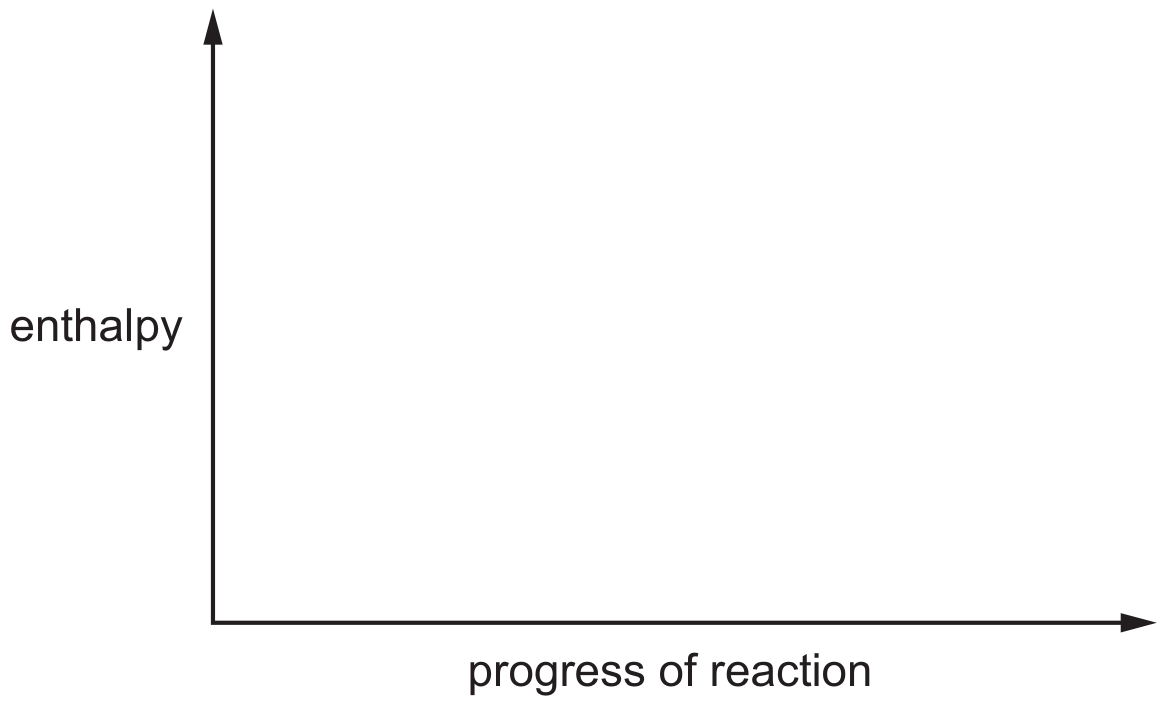
On Fig. 1.1:
- sketch a reaction pathway diagram for the reaction that occurs when Mg burns in O2\mathrm{O}_{2}
- label the diagram to show the enthalpy change, ΔH\Delta H, and the activation energy, EaE_{\mathrm{a}}, for the reaction.

Fig. 1.1

Fig. 1.1

[ 3 ]
[Maximum number: 2]

Hydrogen iodide, HI, is a colourless gas at room temperature.

(a)

The standard enthalpy change of formation, ΔHf\Delta H_{\mathrm{f}}^{\ominus}, of HI(g) is +26.5 kJ mol1+26.5 \mathrm{~kJ} \mathrm{~mol}^{-1}.

Define the term standard enthalpy change of formation.

[ 2 ]
[Maximum number: 2]

The rate of chemical reactions is affected by changes in temperature and pressure.

(a)

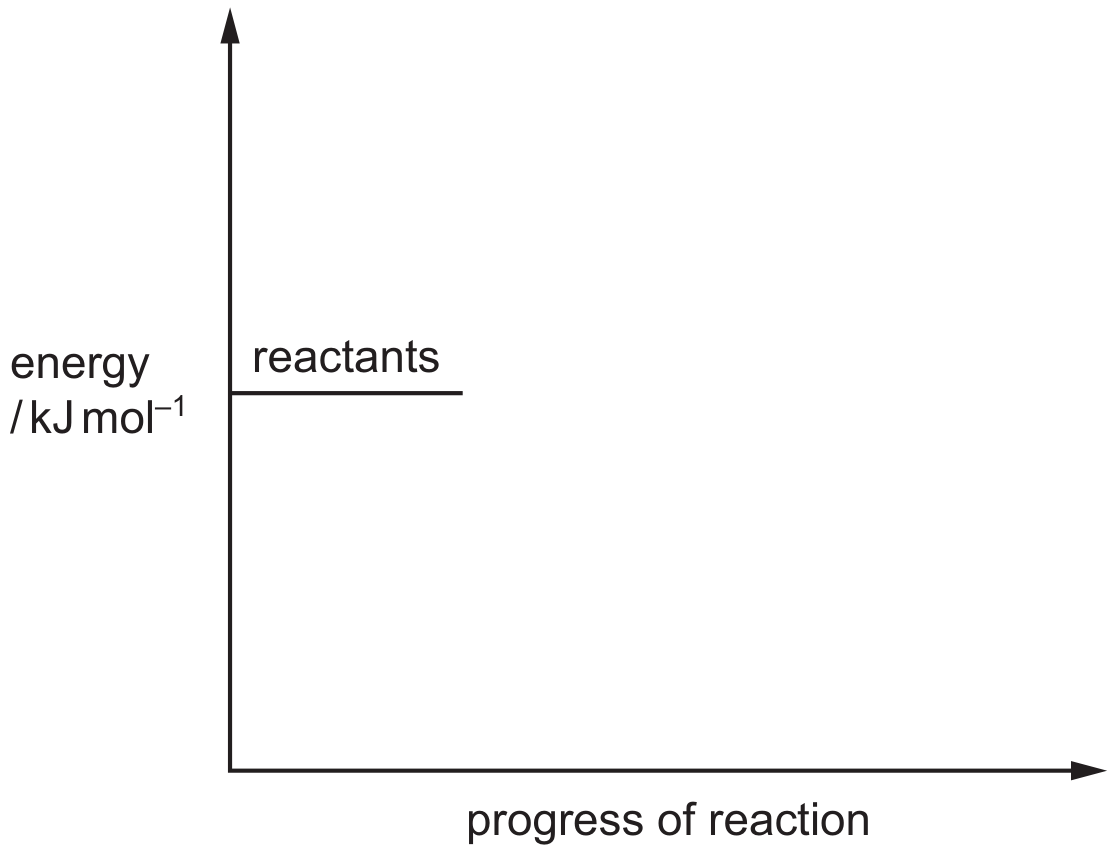
Krypton reacts with fluorine in the presence of ultraviolet light to make krypton difluoride, KrF2( g)\mathrm{KrF}_{2}(\mathrm{~g}).

Kr( g)+F2( g)KrF2( g)\mathrm{Kr}(\mathrm{~g})+\mathrm{F}_{2}(\mathrm{~g}) \rightarrow \mathrm{KrF}_{2}(\mathrm{~g})

activation energy for the reaction, Ea=+385 kJ mol1E_{\mathrm{a}}=+385 \mathrm{~kJ} \mathrm{~mol}^{-1}
enthalpy change of formation of KrF2,ΔHf=+60.2 kJ mol1\mathrm{KrF}_{2}, \Delta H_{\mathrm{f}}=+60.2 \mathrm{~kJ} \mathrm{~mol}^{-1}

[ 2 ]
(i)

Use this information to complete the reaction profile diagram for the formation of KrF2\mathrm{KrF}_{2}. Label EaE_{\mathrm{a}} and ΔHf\Delta H_{\mathrm{f}} on the diagram.

Assume the reaction proceeds in one step.

Question image
[ 2 ]
[Maximum number: 2]

Group 2 metals form alkaline solutions in water.

(a)

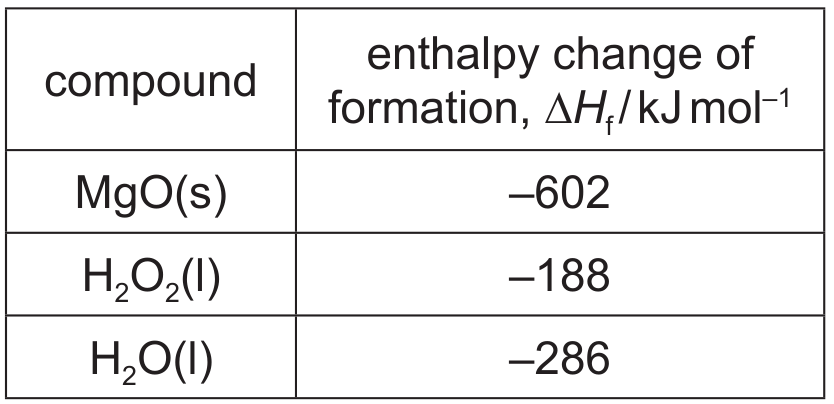
Magnesium peroxide, MgO2\mathrm{MgO}_{2}, is made in the following reaction.

MgO( s)+H2O2(l)MgO2( s)+H2O(l)ΔH=96 kJ mol1\mathrm{MgO}(\mathrm{~s})+\mathrm{H}_{2} \mathrm{O}_{2}(\mathrm{l}) \rightarrow \mathrm{MgO}_{2}(\mathrm{~s})+\mathrm{H}_{2} \mathrm{O}(\mathrm{l}) \quad \Delta H=-96 \mathrm{~kJ} \mathrm{~mol}^{-1}
Table
[ 2 ]
(i)

Define the term enthalpy change of formation.

[ 2 ]
[Maximum number: 2]

Nitrogen, N2\mathrm{N}_{2}, is the most abundant gas in the Earth's atmosphere and is very unreactive.

(a)

Three oxides of nitrogen, NO,NO2\mathrm{NO}, \mathrm{NO}_{2} and N2O\mathrm{N}_{2} \mathrm{O}, can be formed under different conditions.

[ 2 ]
(i)

Molecules of N2O\mathrm{N}_{2} \mathrm{O} can be formed by the reaction between N2\mathrm{N}_{2} and O2\mathrm{O}_{2}. The bond between

the N and O atoms ( NO\mathrm{N} \rightarrow \mathrm{O} ) is a co-ordinate (dative covalent) bond.

2 N2( g)+O2( g)2 N NO( g)2 \mathrm{~N}_{2}(\mathrm{~g})+\mathrm{O}_{2}(\mathrm{~g}) \rightarrow 2 \mathrm{~N} \equiv \mathrm{~N} \rightarrow \mathrm{O}(\mathrm{~g})

The enthalpy change of reaction for this reaction is +82 kJ mol1+82 \mathrm{~kJ} \mathrm{~mol}^{-1}.

Calculate the bond enthalpy, in kJmol1\mathrm{kJ} \mathrm{mol}^{-1}, of the NO\mathrm{N} \rightarrow \mathrm{O} bond.

Use relevant data from the Data Booklet to answer this question. kJmol1\mathrm{kJ} \mathrm{mol}^{-1}

[ 2 ]
[Maximum number: 5]

Sulfuric acid is manufactured by the Contact process.
One stage in this process is the conversion of sulfur dioxide into sulfur trioxide in the presence of a heterogeneous catalyst of vanadium(V) oxide, V2O5\mathrm{V}_{2} \mathrm{O}_{5}.

Question image
(a)

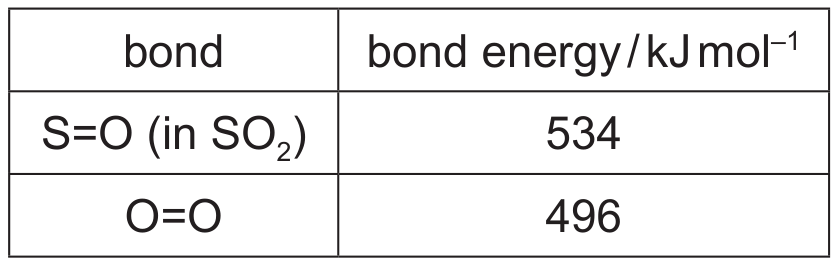
Some bond energies are given.

Table

Use the data, and the enthalpy change for the conversion of sulfur dioxide into sulfur trioxide, to calculate a value for the S=O bond energy in SO3\mathrm{SO}_{3}.
S=O bond energy in SO3=\mathrm{SO}_{3}=kJmol1\mathrm{kJ} \mathrm{mol}^{-1}

The Contact process is usually carried out at a temperature of about 400C400^{\circ} \mathrm{C} and a pressure just above atmospheric pressure. Using a higher or lower temperature and pressure would affect both the rate of production of sulfur trioxide and the yield of sulfur trioxide.

[ 2 ]
(b)

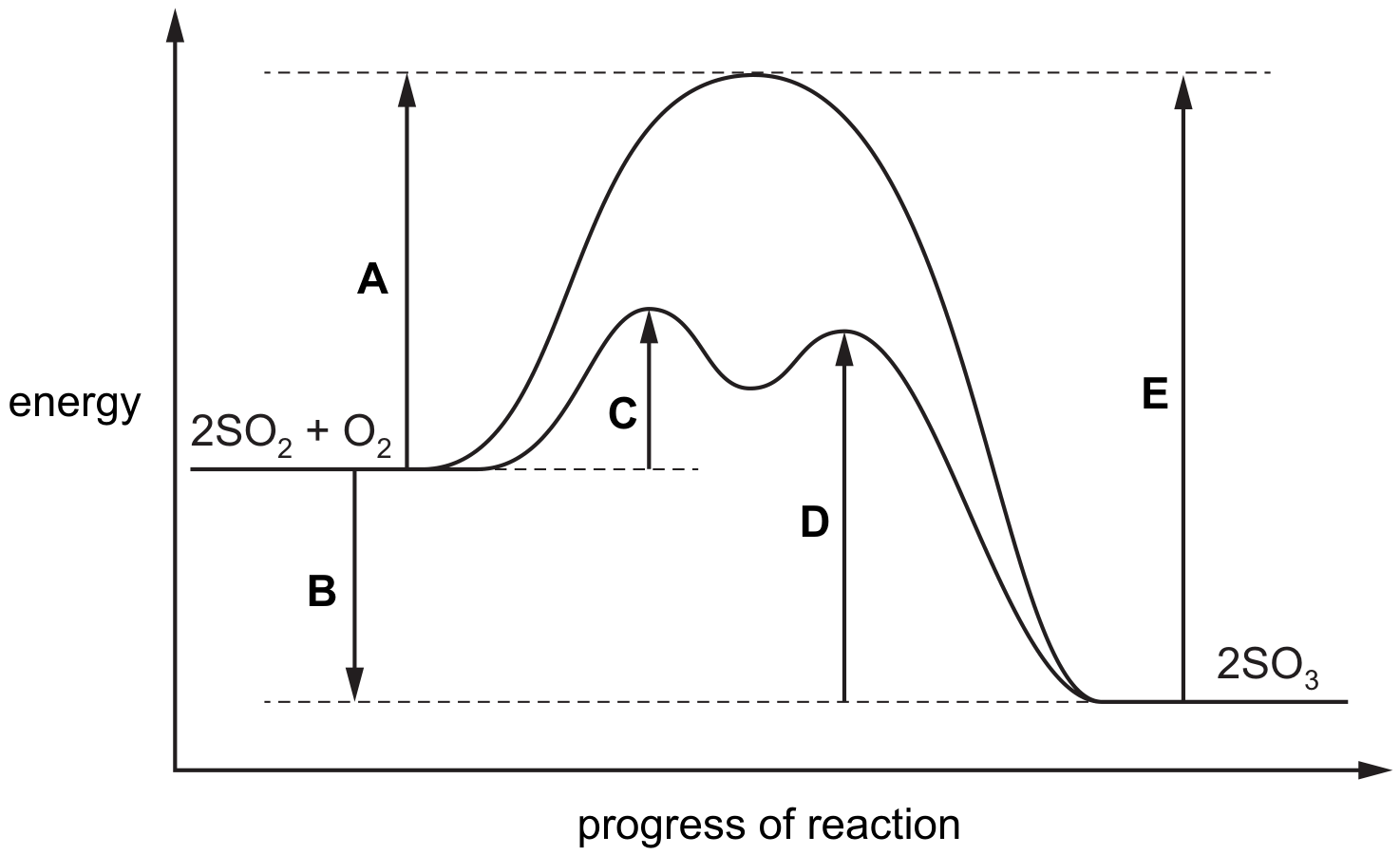
A reaction pathway diagram for both the catalysed and uncatalysed reactions between SO2\mathrm{SO}_{2} and O2\mathrm{O}_{2} is shown.

Question image

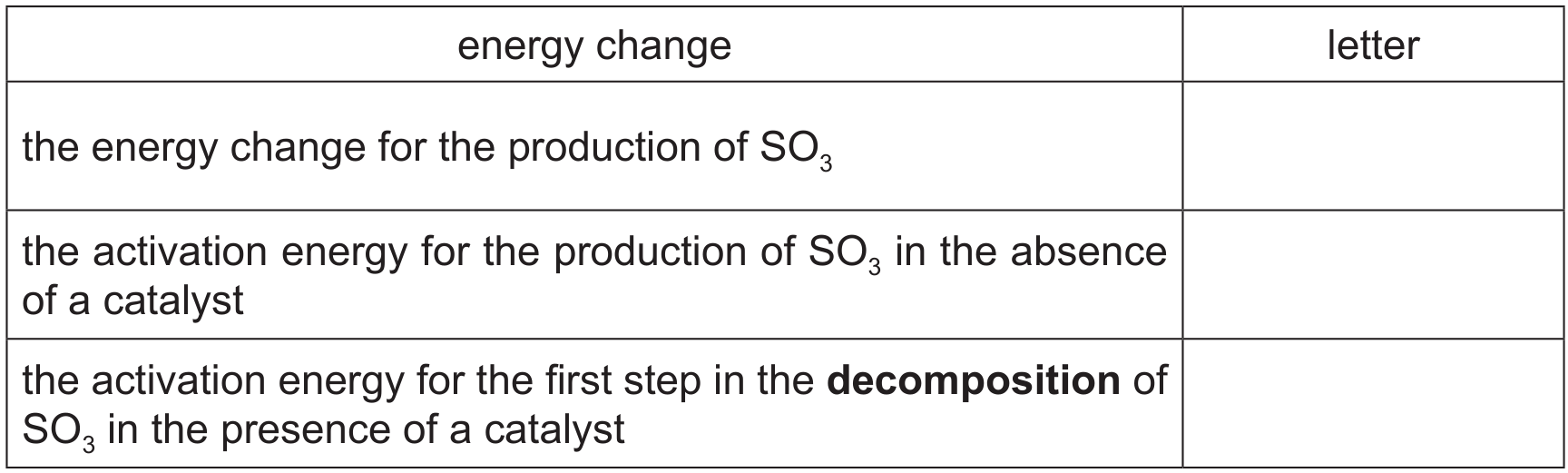
The letters A-E represent energy changes.
Complete the table by stating which letter, A-E, represents the energy change described.

Table

The equation for this stage of the Contact Process is shown.

2SO2( g)+O2( g)2SO3( g)ΔH=196 kJ mol12 \mathrm{SO}_{2}(\mathrm{~g})+\mathrm{O}_{2}(\mathrm{~g}) \rightleftharpoons 2 \mathrm{SO}_{3}(\mathrm{~g}) \quad \Delta H=-196 \mathrm{~kJ} \mathrm{~mol}^{-1}
[ 3 ]
0