EduNinja
(a)
(i)

State what determines the maximum oxidation number of the Period 3 elements in their oxides.

[ 1 ]
(b)

Separate samples of aluminium oxide, Al2O3\mathrm{Al}_{2} \mathrm{O}_{3}, and phosphorus(V) oxide, P4O10\mathrm{P}_{4} \mathrm{O}_{10}, react with an excess of NaOH(aq) at room temperature.

[ 3 ]
(i)

Give the state of Al2O3\mathrm{Al}_{2} \mathrm{O}_{3} and P4O10\mathrm{P}_{4} \mathrm{O}_{10} at room temperature.

Al2O3P4O10\begin{aligned} & \mathrm{Al}_{2} \mathrm{O}_{3} \\ & \mathrm{P}_{4} \mathrm{O}_{10} \end{aligned}
[ 1 ]
(ii)

Write an equation for the reaction of each oxide with an excess of NaOH(aq) at room temperature.

Al2O3+P4O10+\begin{aligned} & \mathrm{Al}_{2} \mathrm{O}_{3}+ \\ & \mathrm{P}_{4} \mathrm{O}_{10}+ \end{aligned}
[ 2 ]
[Maximum number: 1]

The elements silicon, phosphorus and sulfur are in Period 3 of the Periodic Table.

(a)

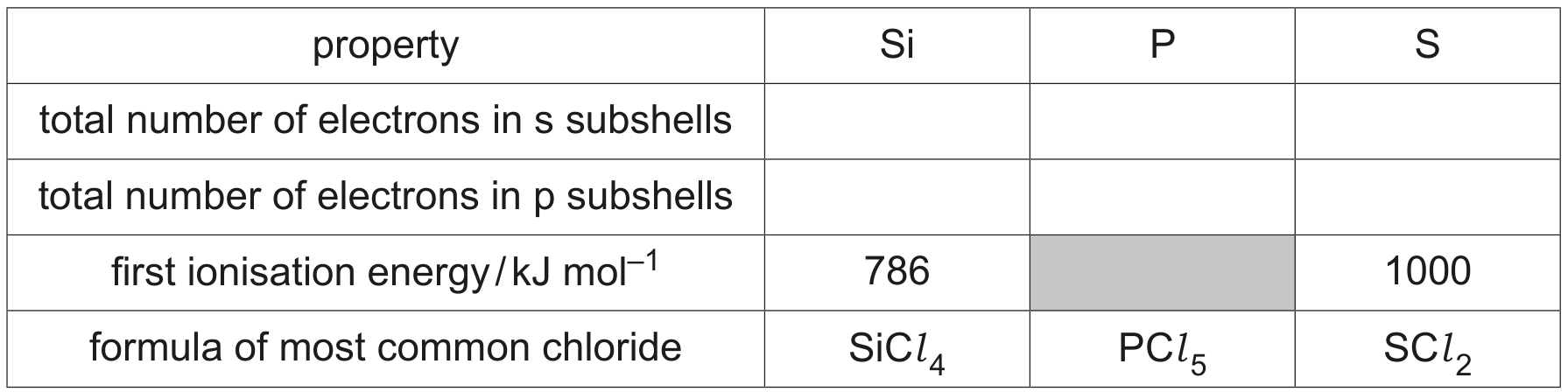
Table 1.1 shows some properties of the elements Si to S .

The first ionisation energy of P is not shown.

Table 1.1

Table 1.1

[ 1 ]
(i)

SiCl4\quad \mathrm{SiCl}_{4} and PCl5\mathrm{PCl}_{5} each react with water, forming misty fumes.

Identify the chemical responsible for the misty fumes.

[ 1 ]
[Maximum number: 3]

The Pauling electronegativity values of elements can be used to predict the chemical properties of compounds.

Use the information in Table 1.1 to answer the following questions.

Table 1.1

Table 1.1

(a)

CO2\mathrm{CO}_{2} and SO2\mathrm{SO}_{2} are acidic gases.

[ 3 ]
(i)

Write an equation for the reaction of SO2\mathrm{SO}_{2} with H2O\mathrm{H}_{2} \mathrm{O}.

[ 1 ]
(ii)

Write an equation for the reaction of SO2\mathrm{SO}_{2} with NaOH .

[ 1 ]
(iii)

Construct an equation for the reaction of CO2\mathrm{CO}_{2} with Mg(OH)2\mathrm{Mg}(\mathrm{OH})_{2}.

[ 1 ]
[Maximum number: 3]

Gallium is an element in Group 13.
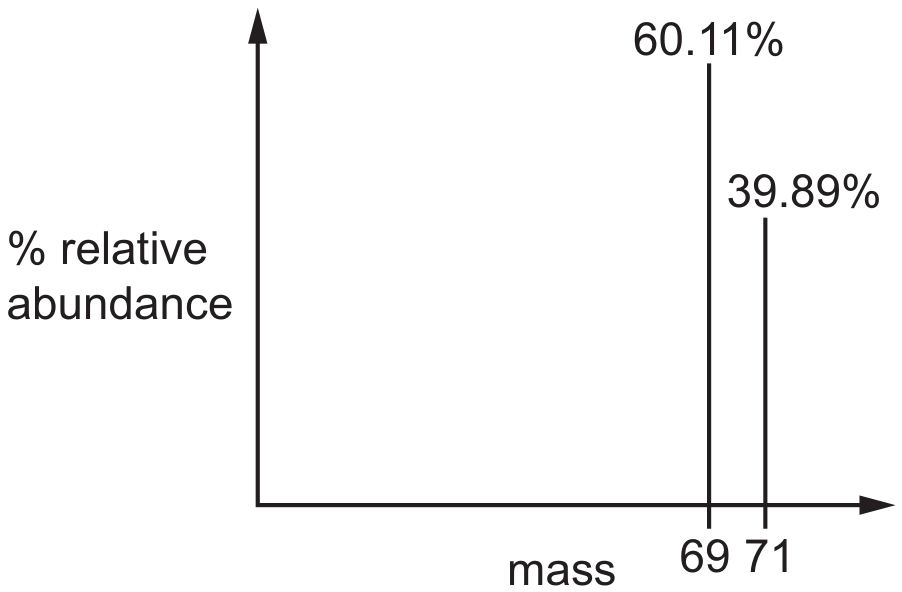
A sample of gallium is analysed using a mass spectrometer. The mass spectrum produced is shown.

Question image
(a)

Gallium oxide, Ga2O3\mathrm{Ga}_{2} \mathrm{O}_{3}, and aluminium oxide react in the same way with HCl(aq) and with NaOH(aq).

[ 3 ]
(i)

Suggest the equation for the reaction between Ga2O3\mathrm{Ga}_{2} \mathrm{O}_{3} and HCl(aq).

[ 1 ]
(ii)

Suggest an equation for the reaction between gallium oxide and NaOH(aq).

[ 2 ]
[Maximum number: 3]

Gallium is a metal in Group 13 of the Periodic Table.

(a)

Gallium metal reacts rapidly when exposed to air. A white solid layer is formed on its surface.

[ 3 ]
(i)

Suggest an equation to describe the reaction occurring when gallium metal is exposed to air.

[ 2 ]
(ii)

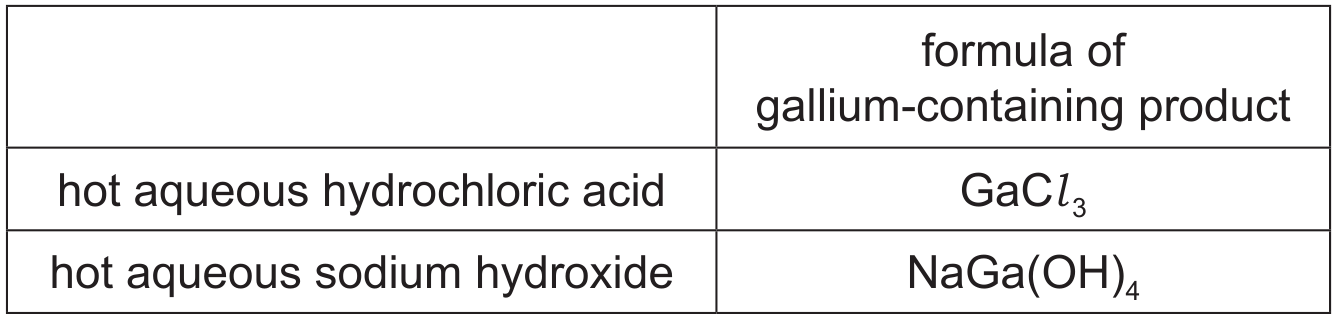
The table gives the formula of each gallium-containing product formed when gallium oxide reacts separately with hot aqueous hydrochloric acid and hot aqueous sodium hydroxide.

Table

Give the name of the type of behaviour shown by gallium oxide in these reactions.

[ 1 ]
[Maximum number: 2]

Group 2 metals form alkaline solutions in water.

(a)

Unlike the other oxides of Group 2 metals, beryllium oxide is amphoteric.

[ 2 ]
(i)

Give the meaning of the term amphoteric.

[ 1 ]
(ii)

Beryllium oxide and aluminium oxide have similar chemical properties.

The Be(OH)42\mathrm{Be}(\mathrm{OH})_{4}{ }^{2-} anion is a product of the reaction between beryllium oxide and excess concentrated OH(aq)\mathrm{OH}^{-}(\mathrm{aq}).

Construct an equation for this reaction.

[ 1 ]
[Maximum number: 4]

Sodium and magnesium are the first two elements in the third period.

(a)

Sodium and magnesium both react with cold water to produce the same type of product in solution. With sodium the solution is clear but with magnesium it appears cloudy.

[ 1 ]
(i)

Write an equation for the reaction of magnesium with cold water.

[ 1 ]
(b)

Group 2 elements, including magnesium, react with oxygen and with dilute acids. There are trends in both the physical and chemical properties of the elements and their compounds down the group. Reactivity generally increases from Mg to Ba .

[ 3 ]
(i)

Give two observations for the reaction of magnesium with oxygen. Write an equation for this reaction. Include state symbols.
equation

[ 3 ]
(a)

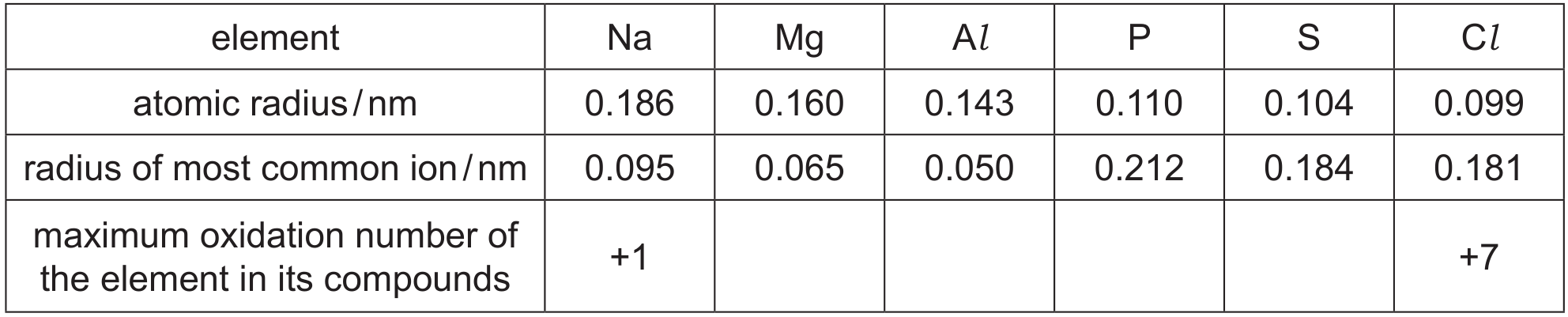
The table shows information about some of the elements in the third period.

Table
[ 1 ]
(i)

Complete the table to show the maximum oxidation number of each element in its compounds.

[ 1 ]
(a)

The acid/base behaviour of the oxides in the third period varies across the period.

[ 6 ]
(i)

Describe this behaviour and explain it with reference to the structure and bonding of sodium oxide, Na2O\mathrm{Na}_{2} \mathrm{O}, aluminium oxide, Al2O3\mathrm{Al}_{2} \mathrm{O}_{3}, and sulfur trioxide, SO3\mathrm{SO}_{3}.

[ 2 ]
(ii)

Write equations for reactions of these three oxides with hydrochloric acid and/or sodium hydroxide as appropriate.

[ 4 ]
(a)

The elements in Period 3 of the Periodic Table show different behaviours in their reactions with oxygen.

[ 6 ]
(i)

Describe what you would see when separate samples of magnesium and sulfur are reacted with oxygen.

Write an equation for each reaction.
magnesium
sulfur

[ 4 ]
(ii)

Write equations for the reactions of aluminium oxide, Al2O3\mathrm{Al}_{2} \mathrm{O}_{3}, with sodium hydroxide,
hydrochloric acid.

[ 2 ]
0